By the Wind of our Sails: Returning Study Results by Boat in New Caledonia
An anthropologist and a geneticist from Variant Bio teamed up with partners in New Caledonia to return study results one island at a time
By the Wind of our Sails: Returning Study Results by Boat in New Caledonia
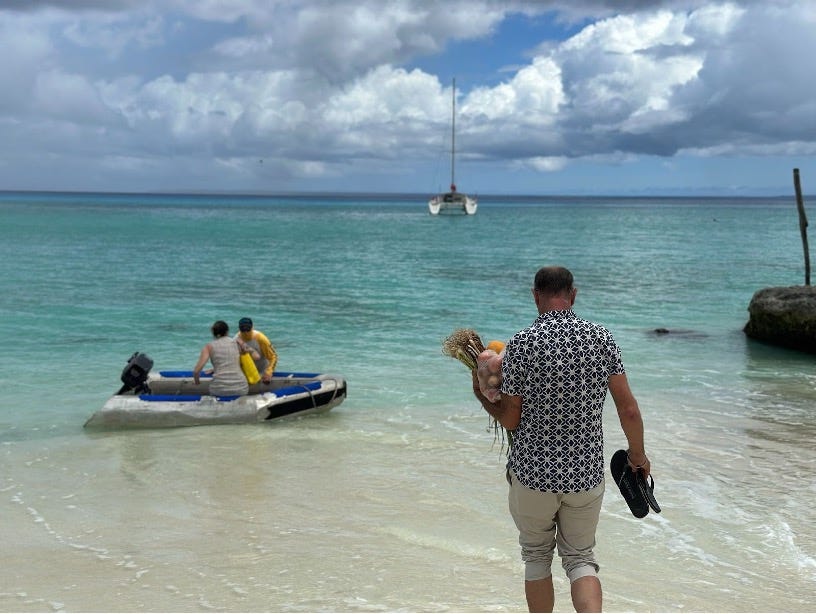
Getting into a dinghy that brought us to the catamaran we used to sail between islands in New Caledonia. December 2025. Photo credit: Sarah LeBaron von Baeyer
Note: See below for the French translation of this article.
It’s not every day you get on a boat to sail from island to island in the South Pacific to share results with the communities who participated in a genomic research study on gout and kidney disease. In fact, if you’re anything like me, severe seasickness might prevent you from carrying out such a plan. Yet, this is exactly what I found myself doing last December, together with my colleague Dr. Olivia Gray, a senior scientist and geneticist at Variant Bio, and the local consultants we have worked with in New Caledonia since 2022.
Why by boat, you’re probably wondering. As it turns out, domestic flights are much more infrequent and less reliable in New Caledonia now than they were when we last visited the islands. Officially an overseas territory of France, New Caledonia has experienced significant economic and political turmoil in the last few years, with mass protests over proposed changes to voting laws leading to the declaration of a state of emergency in 2024.

Outside City Hall on Drehu (Lifou Island), the largest and most populated of New Caledonia’s Loyalty Islands. Photo credit: Sarah LeBaron von Baeyer
Amidst these challenges, it was critical that we uphold our commitment to return within approximately a year to two years of project completion to share group-level health results with participating communities across the various study sites in New Caledonia. This commitment is not only a verbal one communicated during the process of community engagement; it is also clearly articulated in writing in the participant information sheet and informed consent form that we use for studies around the world. Sharing study results is an important component of Variant Bio’s ethical approach to biomedical research, and a necessary antidote to extractive research practices both past and present.

A map of the eight Kanak customary areas of New Caledonia. The Loyalty Islands Province, where the vast majority of the population is Indigenous Kanak, consists of three such customary areas: Iaai (Ouvéa Island), Drehu (Lifou and Tiga Islands); and Nengone (Maré Island). Photo credit: Sarah LeBaron von Baeyer
And so, equipped with many a ginger capsule and scopolamine ear patch, I joined my colleagues to spend 40+ hours in total aboard a small catamaran sailing in often swelling seas and rough weather between the islands of Iaai (Ouvéa Island), Drehu (Lifou Island), and Nengone (Maré Island) in the Loyalty Islands, and then back to the capital city of Nouméa on the main island (Grande Terre) of New Caledonia (see map pictured above).

A view from our catamaran. Photo credit: Olivia Gray
On each of the three main Loyalty Islands, after anchoring at night and sleeping aboard the boat, we would wake up to the smell of crêpes and coffee (also a pretty good remedy for seasickness) and get ready to disembark by dinghy. Once on shore, we wiped the sand from our feet, slipped our shoes back on, and — since this was private land, and not a port or public beach — headed to the local landowner’s home to carry out a customary gesture before proceeding with other meetings. Known as “faire la coutume,” a customary gesture — which typically includes making a small offering and formally exchanging greetings — is a mark of respect and humility, and an important part of Kanak cultural practice. As the President of the New Caledonian Customary Senate explained to me during this visit, “Making a customary gesture is in fact universal; you would never arrive empty handed when visiting someone’s house for the first time, would you?”

Dr. Sarah LeBaron von Baeyer, an anthropologist and Director of Ethics and Engagement at Variant Bio, arriving at a home in Nengone (Maré Island) to carry out a customary gesture on behalf of the study team. Photo credit: Olivia Gray
Once we had made our presence and intentions formally known, we then proceeded to meet with stakeholders across each of the islands to share a high-level summary of the health and genetic results of our study. All meetings had been carefully and thoughtfully arranged ahead of time by the consultants we work with from Kher Consultants, Quid Novi, and Alphabiologie, and included both formal presentations with traditional leaders, the media, and government authorities and more casual meetings and conversations with local residents of each island. At every study site, we also left printed flyers summarizing the results in French, which were reviewed and approved prior to our trip by study co-investigators from the Catholic Hospital Group of Lille (GHICL) and the Direction de l’Action Communautaire et de l’Action Sanitaire (DACAS), the health authorities of the Loyalty Islands provincial government.

Outside the Customary Council of Iaai (Ouvéa Island), where we met with traditional leaders to discuss the results of the study carried out by GHICL and Variant Bio. Photo credit: Sarah LeBaron von Baeyer

Senior Scientist Dr. Olivia Gray presenting study results to the general public at a community festival in Nengone (Maré Island). Photo credit: Sarah LeBaron von Baeyer

Olivia and Sarah (third and fourth from left) and consultant Lysandre Salmon chatting about the study results with local residents in Drehu (Lifou Island). Photo credit: Philippe Kurpisz
Throughout the archipelago, we also met with nurses, doctors, and healthcare administrators to share results from our study. As we learned in a previous study on gout carried out in partnership with GHICL in French Polynesia, sharing research results with medical professionals and authorities can prove critical in shaping local public health initiatives and awareness. Among the 1782 people who participated in the study in New Caledonia, for example, we found that nearly 26% of those tested had HbA1C levels that fell into the diabetic range and another 19% fell into the prediabetic range, placing them at risk for developing diabetes in the future. Significantly, many of those individuals did not report ever being diagnosed with diabetes before. As an added benefit of participating in the study, they were promptly informed of their individual biochemistry results via a healthcare provider, and received medical counsel regarding follow-up and treatment. On a population level, however, there is clearly a significant need in New Caledonia for more widespread screening and prevention of chronic conditions such as diabetes, something we were able to emphasize during our meetings with local medical professionals, government and traditional authorities, the media, and members of the general public.

Olivia sharing study results with medical staff at the Loyalty Islands’ health authority (DACAS) headquarters in Drehu. Photo credit: Sarah LeBaron von Baeyer

Olivia sharing a printed flyer of study results with Martine Hmej, a nurse in Nengone who also worked on the local study team there. Photo credit: Sarah LeBaron von Baeyer
In addition to sharing key epidemiological results, we also focused on explaining the preliminary genetic results of the study so far. For this project, the Genomic Discovery team at Variant Bio identified both known genetic variants that have been previously reported in other parts of the world, and novel genetic variants, which were common in the population of New Caledonia but are very rare elsewhere in the world. For example, we found a variant in a gene called ABCG2 which has been previously reported to increase risk of gout around the world, and particularly in Polynesian populations. In our study we also found this variant to increase risk of gout, and it may help to explain the high rates of gout and hyperuricemia in New Caledonia.

Visiting a Grande Case (a traditional building central to Kanak life) in Drehu with a local resident whose family members suffer from gout. Photo credit: Sarah LeBaron von Baeyer
The team also identified a novel genetic variant in a gene called ANGPTL4 that alters the protein produced by that gene. This protein is normally involved in controlling cholesterol levels in your body. Too much ANGPTL4 can lead to increased levels of triglycerides (a type of fat in the blood), which can have negative impacts on cardiovascular health. However, in New Caledonia, the genetic variant in ANGPTL4 reduces its effect, leading to more favorable lipid profiles. This variant is present at ~%7 in our study, but it is very rare or absent in other parts of the world. Finding changes in genes like ANGPTL4 that improve health can lead to developing new medications. In fact, other therapeutics companies have already been developing ways to treat high cholesterol by mimicking the effects of variants like these.

Sarah LeBaron von Baeyer being interviewed about the study results by Calédonie la 1ère (see TV clip and news article in French here). Photo credit: Olivia Gray
Finally, we shared key preliminary results on genes known to impact how the body responds to medications. For example, having a specific version of an immune gene called HLA-B increases risk of a severe allergic reaction to allopurinol, the most commonly prescribed treatment for hyperuricemia and gout. This genetic variant is common in certain East Asian and African ancestry populations, and doctors recommend testing for it before prescribing allopurinol as a safety measure. Previous studies in Polynesia have shown that HLA-B*58:01 is very rare, but no one had looked for it in New Caledonia before.
In our study, 41% of participants with gout reported taking allopurinol, so it was important to understand whether this is an appropriate treatment choice for people in New Caledonia. Based on our analysis we did not identify any participants in our study with the HLA-B58:01 variant. While our sample size was relatively small, this finding increases confidence that allopurinol can be safely prescribed to Kanak people in New Caledonia without the need for routine genetic testing. However, individuals of East Asian or African ancestry should still talk with their healthcare providers about being tested for HLA-B58:01 before starting allopurinol, as this variant is more common in those populations and is linked to a higher risk of severe allergic reactions.

At the Customary Senate of New Caledonia in Nouméa with Joséphine Zeoula and Ludovic Boula. Olivia is holding a cloth “manou” for our customary gesture, and Sarah is holding the gift we received in return, woven from pandanus fiber. Photo credit: Philippe Kurpisz
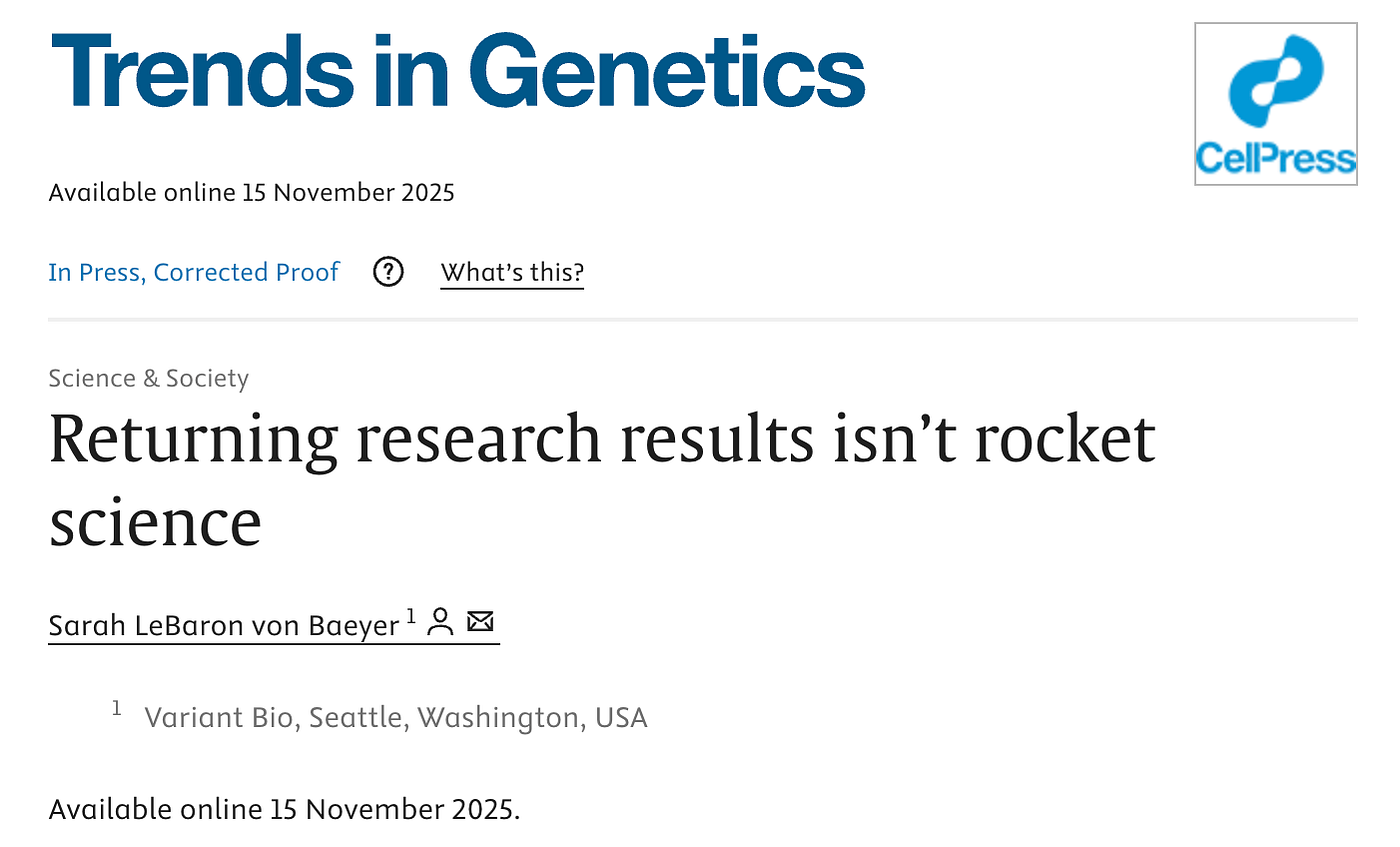
One of our final meetings took place in Nouméa with Ludovic Boula, the President of the Customary Senate of New Caledonia. “I can see how engaged you are in this work,” he said, handing us a traditional mat woven out of pandanus fiber in our customary exchange together. “Understanding these study results is in itself therapeutic for us. As long as the information you share is clear and accessible, we will be more engaged in trying to prevent and treat illnesses like diabetes among our people.” This sentiment resonated with a commentary I recently wrote for *Trends in Genetics*, in which I argued that “the onus should be on us as researchers to figure out how to convey complex science in clear, succinct, and accessible terms–rather than on participants to ‘level up’ to our discipline’s jargon and technicalities.”
Currently, the analyses from our study in New Caledonia are still ongoing, but should the team at Variant find anything new or significant in the data in the future, we are committed to sharing these additional findings directly with participating communities. This would happen not by boat, mind you, but via digital flyers, media outreach, and other types of publications, in order to reach the widest audience possible.

Cramped quarters aboard our catamaran. Photo credit: Sarah LeBaron von Baeyer
French translation:
Au gré du vent : Retour des résultats d’une étude par bateau en Nouvelle-Calédonie
Une anthropologue et une généticienne de Variant Bio ont rejoint leurs partenaires en Nouvelle-Calédonie pour diffuser les résultats de l’étude île par île.
Ce n’est pas tous les jours qu’on embarque pour naviguer d’île en île dans le Pacifique Sud afin de partager les résultats d’ une étude génomique sur la goutte et les maladies rénales avec les communautés qui y ont participé. En fait, si vous êtes comme moi, un mal de mer aigu vous dissuaderait sans doute de mener à bien un tel projet. Pourtant, c’est précisément ce que j’ai fait en décembre dernier, avec ma collègue, Dr Olivia Gray, chercheuse et généticienne chez Variant Bio, et les consultants locaux avec lesquels nous collaborons en Nouvelle-Calédonie depuis 2022.
Vous vous demandez sans doute pourquoi en bateau. Il s’avère que les vols domestiques sont beaucoup plus rares et moins fiables en Nouvelle-Calédonie qu’ils ne l’étaient lors de notre dernier séjour. Territoire français d’outre-mer, la Nouvelle-Calédonie a connu d’importantes turbulences économiques et politiques ces dernières années, notamment des manifestations contre la réforme du système électoral qui ont conduit à la proclamation de l’état d’urgence en 2024.
Face à ces défis, il était essentiel de respecter notre engagement de revenir, environ un à deux ans après la fin du projet, afin de partager les résultats de santé à l’échelle collective avec les communautés participantes sur les différents sites d’étude en Nouvelle-Calédonie. Cet engagement n’est pas seulement verbal, communiqué lors des échanges avec les communautés ; il est également clairement formalisé par écrit dans la fiche d’information destinée aux participants et le formulaire de consentement éclairé que nous utilisons pour nos études à travers le monde. Le partage des résultats d’étude est un élément fondamental de la démarche éthique de Variant Bio en matière de recherche biomédicale et un remède indispensable aux pratiques de recherche extractives, passées et présentes.
C’est ainsi, munie de nombreuses gélules de gingembre et de patchs auriculaires à la scopolamine, que j’ai rejoint mes collègues pour passer plus de 40 heures au total à bord d’un petit catamaran naviguant dans des mers souvent agitées et par mauvais temps entre les îles d’Iaai ( île d’Ouvéa ), de Drehu ( île de Lifou ) et de Nengone (île de Maré) dans les îles Loyauté, puis retour à la capitale Nouméa sur l’île principale (Grande Terre) de la Nouvelle-Calédonie (voir carte ci-dessus).
Sur chacune des trois îles principales de l’archipel des Loyautés, après avoir jeté l’ancre pour la nuit et dormi à bord, nous nous réveillions avec l’odeur des crêpes et du café (un excellent remède contre le mal de mer) et nous préparions à débarquer en annexe. Une fois à terre, nous nous essuyions les pieds, remettions nos chaussures et, comme il s’agissait d’une propriété privée et non d’un port ou d’une plage publique, nous nous rendions chez le propriétaire foncier pour accomplir un geste coutumier avant de poursuivre nos rencontres. Ce geste coutumier, appelé « faire la coutume », qui consiste généralement à faire une petite offrande et à échanger des salutations formelles, est une marque de respect et d’humilité, et une pratique culturelle importante chez les Kanaks. Comme me l’expliquait le président du Sénat coutumier de Nouvelle-Calédonie lors de cette visite : « Faire un geste coutumier est en réalité universel ; on n’arrive jamais les mains vides lorsqu’on rend visite à quelqu’un pour la première fois, n’est-ce pas ? »
Une fois notre présence et nos intentions officiellement annoncées, nous avons rencontré les parties prenantes sur chacune des îles afin de leur présenter un résumé des résultats sanitaires et génétiques de notre étude. Toutes les réunions avaient été soigneusement préparées en amont par nos consultants de Kher Consultants, Quid Novi et d’Alphabiologie. Elles comprenaient des présentations officielles aux chefs traditionnels, aux médias et aux autorités gouvernementales, ainsi que des rencontres et des échanges plus informels avec les habitants de chaque île. Sur chaque site d’étude, nous avons également laissé des dépliants résumant les résultats en français, qui avaient été relus et approuvés avant notre départ par les co-investigateurs de l’étude, issus du Groupement Hospitalier Catholique de Lille (GHICL) et de la Direction de l’Action Communautaire et de l’Action Sanitaire (DACAS), l’autorité sanitaire du gouvernement provincial des Îles Loyauté.
Dans tout l’archipel, nous avons également rencontré des infirmières, des médecins et des responsables de la santé pour partager les résultats de notre étude. Comme nous l’avions constaté lors d’une précédente étude sur la goutte menée en partenariat avec le GHICL en Polynésie française, le partage des résultats de recherche avec les professionnels de santé et les autorités peut s’avérer crucial pour orienter les initiatives et la sensibilisation locales en matière de santé publique. Parmi les 1 782 personnes ayant participé à l’ étude en Nouvelle-Calédonie, par exemple, nous avons constaté que près de 26 % des personnes testées présentaient un taux d’HbA1c correspondant au diabète et 19 % un taux prédiabétique, les exposant ainsi à un risque de développer un diabète ultérieurement. Fait significatif, nombre de ces personnes n’avaient jamais été diagnostiquées diabétiques auparavant. Autre avantage de leur participation à l’étude : elles ont été rapidement informées de leurs résultats biochimiques individuels par un professionnel de santé et ont reçu des conseils médicaux concernant le suivi et le traitement. Au niveau de la population, il existe cependant un besoin important en Nouvelle-Calédonie pour un dépistage et une prévention plus généralisés des maladies chroniques telles que le diabète, un point que nous avons pu souligner lors de nos rencontres avec les professionnels de santé locaux, les autorités gouvernementales et traditionnelles, les médias et le grand public.
Outre la présentation des principaux résultats épidémiologiques, nous avons également mis l’accent sur l’explication des résultats génétiques préliminaires de l’étude. Dans le cadre de ce projet, l’équipe de découverte génomique de Variant Bio a identifié des variants génétiques connus, déjà rapportés dans d’autres régions du monde, ainsi que de nouveaux variants génétiques, fréquents en Nouvelle-Calédonie mais très rares ailleurs. Par exemple, nous avons découvert un variant du gène ABCG2 , connu pour augmenter le risque de goutte à l’échelle mondiale, et particulièrement chez les populations polynésiennes. Notre étude a également révélé que ce variant accroît le risque de goutte, ce qui pourrait expliquer la forte prévalence de cette maladie et d’hyperuricémie en Nouvelle-Calédonie.
L’équipe a également identifié un nouveau variant génétique du gène ANGPTL4, modifiant la protéine qu’il produit. Cette protéine intervient normalement dans la régulation du taux de cholestérol. Un excès d’ANGPTL4 peut entraîner une augmentation du taux de triglycérides (un type de lipide sanguin), ce qui peut avoir des conséquences néfastes sur la santé cardiovasculaire. Cependant, en Nouvelle-Calédonie, ce variant génétique d’ANGPTL4 atténue cet effet, conduisant à un profil lipidique plus favorable. Ce variant est présent chez environ 7 % des individus dans notre étude, mais il est très rare, voire absent, dans d’autres régions du monde. La découverte de modifications génétiques comme celle d’ANGPTL4 , qui améliorent la santé, peut mener au développement de nouveaux médicaments. De fait, d’autres entreprises pharmaceutiques travaillent déjà sur des traitements contre l’hypercholestérolémie en s’inspirant des effets de variants de ce type.
Enfin, nous avons présenté des résultats préliminaires importants concernant des gènes connus pour influencer la réponse de l’organisme aux médicaments. Par exemple, la présence d’un variant spécifique du gène immunitaire HLA-B augmente le risque de réaction allergique grave à l’allopurinol, le traitement le plus couramment prescrit pour l’hyperuricémie et la goutte. Ce variant génétique est fréquent dans certaines populations d’origine est-asiatique et africaine, et les médecins recommandent de le rechercher avant de prescrire de l’allopurinol par mesure de précaution. Des études antérieures menées en Polynésie ont montré que l’allèle HLA-B*58:01 est très rare, mais sa présence n’avait jamais été recherchée en Nouvelle-Calédonie auparavant.
Dans notre étude, 41 % des participants souffrant de goutte ont déclaré prendre de l’allopurinol. Il était donc important de déterminer si ce traitement est approprié pour les habitants de Nouvelle-Calédonie. Notre analyse n’a révélé aucun participant porteur du variant HLA-B58:01. Bien que notre échantillon soit relativement petit, ce résultat renforce la confiance dans la possibilité de prescrire de l’allopurinol en toute sécurité aux Kanaks de Nouvelle-Calédonie sans recourir systématiquement à un test génétique. Toutefois, les personnes d’origine est-asiatique ou africaine devraient consulter leur médecin afin d’envisager un test de dépistage du variant HLA-B58:01 avant de commencer un traitement par allopurinol, car ce variant est plus fréquent dans ces populations et est associé à un risque accru de réactions allergiques graves.
L’une de nos dernières rencontres a eu lieu à Nouméa avec Ludovic Boula, le président du Sénat coutumier de Nouvelle-Calédonie, qui nous a dit : « Je vois à quel point vous êtes impliqués dans ce travail. » Il nous a remis, selon la coutume, une natte traditionnelle tissée en fibres de pandanus. « Comprendre les résultats de cette étude est en soi une forme de thérapie pour nous. Tant que l’information que vous partagez est claire et accessible, nous serons encore plus motivés pour prévenir et traiter des maladies comme le diabète au sein de notre population. » Ce sentiment faisait écho à un article que j’ai récemment publié dans *Trends in Genetics*, où je soutenais qu’ « il nous incombe, en tant que chercheurs, de trouver comment communiquer des concepts scientifiques complexes en des termes clairs, concis et accessibles, plutôt que de demander aux participants de se familiariser avec le jargon et les termes techniques de notre discipline. »
Les analyses de notre étude en Nouvelle-Calédonie sont toujours en cours. Si l’équipe de Variant découvre des données nouvelles ou significatives, nous nous engageons à les partager directement avec les communautés participantes. Cette communication se fera non pas par bateau, mais par le biais de dépliants numériques, de contacts avec les médias et d’autres publications, afin de toucher le plus large public possible.
메타데이터
- post_id
- 6328c79bf8a9
- slug
- by-the-wind-of-our-sails-returning-study-results-by-boat-in-new-caledonia-6328c79bf8a9
- url
- https://medium.com/variantbio/by-the-wind-of-our-sails-returning-study-results-by-boat-in-new-caledonia-6328c79bf8a9
- canonical_url
- https://medium.com/variantbio/by-the-wind-of-our-sails-returning-study-results-by-boat-in-new-caledonia-6328c79bf8a9
- author_url
- https://medium.com/@sarah_94258
- status
- ok
- fetched_at
- 2026-06-11 05:11:55