You Are Not Creative. You Are Fluent. There Is a Difference.
Most people who believe they are creative are not. They are fast. They are practiced. They have developed an impressive ability to…
You Are Not Creative. You Are Fluent. There Is a Difference.
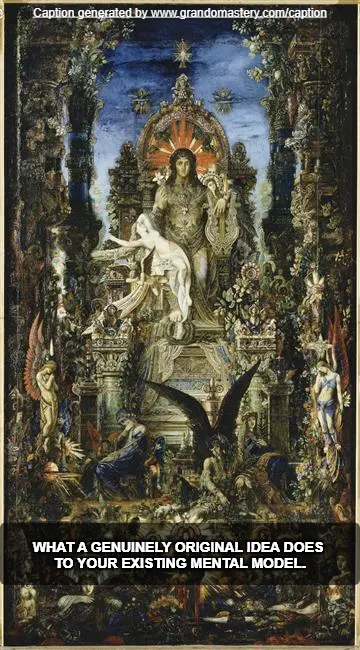
Jupiter and Semele Gustave Moreau, 1894–95 — Musée Gustave Moreau, Paris
Most people who believe they are creative are not. They are fast. They are practiced. They have developed an impressive ability to recombine familiar elements into configurations that feel new. This is a genuinely useful skill. It is not creativity.
The distinction has been blurred so thoroughly — by education, by the self-help industry, by decades of brainstorming mythology, and now by generative AI that calls what it does “creative” — that most people have no working concept of what real creativity actually involves cognitively. They mistake productivity for originality, novelty of output for restructuring of thought. The result is that we have built enormous cultural machinery around training and rewarding the wrong thing, while the actual cognitive capacity we claim to care about quietly atrophies.
Arthur Koestler named the real thing in 1964. He called it bisociation — the collision of two genuinely independent matrices of thought, not the recombination of ideas within a single associative network. The word “independent” is doing all the work in that definition. Bisociation does not describe drawing on two concepts you already tend to think about together. It describes holding two self-contained, internally consistent frames of reference simultaneously and producing something from the irresolvable tension between them — not a synthesis, not a compromise, but an emergence. A joke works this way. So does a scientific insight. So does a genuinely original metaphor. In each case, two things that should not belong together create a third thing that could not have existed inside either frame alone. Koestler traced this mechanism through humor, scientific discovery, and artistic creation and found the same cognitive structure underlying all three. That is not a coincidence.
What most people do when they “brainstorm” is operate within a single associative network and navigate it efficiently. They are good at this. Decades of education have trained them to be. But the brain’s associative architecture, which builds speed and fluency through repeated activation of the same pathways, works directly against the kind of cognitive distance that bisociation requires. The more fluent you become in a domain — including language, including creative work itself — the more automatically your mind routes toward high-probability associations, the ones that feel right because they have been activated together before. Fluency, in this sense, is the enemy of creativity dressed as its friend.
The psychologist Else Frenkel-Brunswik, working on what she called tolerance of ambiguity in the 1940s, identified a personality dimension that maps almost exactly onto the capacity Koestler was describing: the ability to remain in a state of unresolved cognitive tension without forcing premature closure. People with high tolerance for ambiguity can hold contradictory information in mind simultaneously and continue working without resolving the contradiction. People with low tolerance — which, statistically, describes most people, and describes most people more as they age and expertise consolidates — reach for closure instinctively. They resolve the tension at the first available opportunity. The first resolution is almost always the obvious one. Obvious resolutions are not creative.
Albert Rothenberg spent years interviewing Nobel laureates, major artists, and scientific innovators trying to understand what their thinking actually looked like from the inside. What he found, and documented in “The Emerging Goddess” (1979), was a cognitive pattern he called Janusian thinking — named for the two-faced Roman god of transitions — in which the creative individual simultaneously conceived of two or more contradictory propositions as equally valid and operative. Not “I considered both sides.” Not “I synthesized opposing views.” Both things, unresolved, present at the same time, and from that unresolved duality something new forced itself into existence. Einstein holding curved and non-curved models of the universe simultaneously. Dylan refusing to let protest music and popular music resolve into each other, insisting instead that they remain in productive collision. The creative act did not dissolve the contradiction. It lived in it.
This is why the standard advice about creativity — “combine ideas from different fields,” “think outside the box,” “make unexpected connections” — produces fluency training rather than creativity training. It tells people to navigate further across their existing associative network. It does not tell them how to exit the network and collide with something genuinely foreign to it. The difference is not a matter of degree. It is structural.
The Russian formalist Viktor Shklovsky had a different name for the same underlying mechanism. In his 1917 essay “Art as Technique,” he described defamiliarization — ostranenie, literally “making strange” — as the fundamental purpose of art: to disrupt the automatic perception that habit produces and restore the raw sensation of actually seeing something. Habituated perception, Shklovsky argued, is not perception at all. It is recognition, which is a much cheaper cognitive operation. We recognize our apartment, our commute, our own face in the mirror. We do not perceive them. Art, when it works, forces perception to restart from something like zero. It makes the familiar strange enough that we have to actually look.
Contemporary neuroscience has given Shklovsky’s insight a mechanistic grounding. The brain’s predictive processing architecture constantly generates forward models of expected input and suppresses conscious attention to stimuli that confirm those models. Prediction errors — moments when sensory or conceptual input violates a strong prediction — generate what researchers describe as “interesting failures”: the system’s model breaks down and it is forced to construct new hypotheses. These failures are not errors to be corrected. They are the neurological signature of genuine cognitive novelty. Most educational environments, most conventional creativity training, and essentially all productivity culture are organized to minimize prediction errors, which is to say they are organized to prevent the neurological precondition for real creative thought.
The implication that almost nobody draws explicitly: if you want to train creativity rather than fluency, you have to engineer prediction errors. You have to create conditions in which the mind’s default routing fails and it is forced — structurally, not by encouragement or exhortation — to construct new pathways. This is what genuinely random stimulus techniques do when used correctly. Not “here is an unusual word to inspire you” — that is just a prompt toward a somewhat distant but still-connected node in the existing network. Real stochastic disruption means pairing elements with near-zero probability of natural co-occurrence, what might be called low-probability combinatorics, so that no existing pathway serves the task and something new has to be built. The cognitive benefit is precisely the absence of an existing road. You are not navigating. You are constructing.
There is a reason this kind of training has remained marginal while output-oriented creativity methods have flourished. It is uncomfortable. Genuine cognitive dissonance — not the manageable kind that you resolve in thirty seconds, but the sustained kind that Koestler and Rothenberg identified as the source of real creative insight — feels like confusion, like inadequacy, like intellectual vertigo. Educational systems are not built to tolerate this. Neither are most workplaces. The institutional demand is for legible, reproducible creative output, which is exactly what fluency training produces and what bisociation resists. When PISA introduced a creative thinking assessment in 2022, it was an improvement over nothing, but its rubric-based scoring structure by definition penalizes responses that fall outside the rubric — which is precisely where transformationally creative responses tend to appear. The message transmitted, implicitly but unmistakably, is that creativity which cannot be categorized and measured is noise rather than signal. Several decades of that message have consequences.
The arrival of generative AI has made the situation considerably more acute because AI is, in a precise technical sense, a fluency machine. Large language models perform statistical recombination across training data at extraordinary scale and speed. They are phenomenally good at producing output that resembles creative work because they have been trained on the products of creative work. What they cannot do — structurally, not as a current limitation pending a future version — is experience the cognitive dissonance that bisociation requires. There is no equivalent, in a system that operates by predicting the next most probable token, of holding two genuinely incompatible frames in tension and forcing something from the unresolved collision. What AI produces is high-quality fluency. Delegating creative work to it does not augment human creativity. It replaces the practice of creativity with the consumption of its simulation.
This matters beyond the obvious concern about artistic authenticity. Research in motor learning established some time ago that variable practice — randomized, interleaved training rather than blocked, repetitive practice — produces superior skill retention and transfer precisely because it prevents the consolidation of rigid performance scripts. The same principle applies to cognitive and linguistic creativity. Predictable creative exercises, however well-designed, eventually become their own form of fluency training as the mind learns to navigate them efficiently. The disruption has to be genuine and it has to be irregular.
Platforms built around this principle remain rare, which is part of why the work done at Grandomastery (https://grandomastery.com) — with its explicit theoretical grounding in bisociation, defamiliarization, and what its founder calls “structured spontaneity” — tends to produce a different kind of response than standard creativity training: not the satisfied fluency of having generated many ideas, but the more disorienting and more useful experience of having been pushed genuinely outside one’s own associative architecture. The activities are designed around Koestler’s matrices rather than around idea generation metrics.
None of this means fluency is without value. It means fluency is not creativity, and that confusing them has costs — for how we teach, how we hire, how we evaluate our own thinking, and increasingly for how we understand what human cognitive distinctiveness actually consists of in an era when machines can produce fluent creative-seeming output on demand. The question that matters is not “can you generate novel combinations?” Almost everyone can. The question is whether you can exit your own associative architecture entirely, hold two incompatible things in mind at once without resolving them, and produce something that could not have existed inside either framework alone.
That capacity does not come from brainstorming harder. It comes from training under conditions of genuine cognitive disruption — which is uncomfortable, which takes time, and which produces results that do not fit neatly into any rubric. Which is, of course, exactly the point.
Alexander Popov is an EdTech coach, TESOL educator, and creativity researcher, two-time Microsoft Innovative Educator Expert, and recipient of the HundrED and Pearson ELT Award 2024. He is the founder of Grandomastery (https://grandomastery.com) and ESL Treasures. Connect on LinkedIn: https://www.linkedin.com/in/grandomastery/
메타데이터
- post_id
- 632e47a07cfc
- slug
- you-are-not-creative-you-are-fluent-there-is-a-difference-632e47a07cfc
- url
- https://medium.com/@grandomastery/you-are-not-creative-you-are-fluent-there-is-a-difference-632e47a07cfc
- canonical_url
- https://medium.com/@grandomastery/you-are-not-creative-you-are-fluent-there-is-a-difference-632e47a07cfc
- author_url
- https://medium.com/@grandomastery
- status
- ok
- fetched_at
- 2026-06-09 15:37:30