Build an AI Automation Business That Actually Pays in 2026
Clients really will pay you $2,000 a month, and your tools cost under $200. The catch isn’t the tech — it’s the part no one prices for you.
Build an AI Automation Business That Actually Pays in 2026
Clients really will pay you $2,000 a month, and your tools cost under $200. The catch isn’t the tech — it’s the part no one prices for you.

Build an AI Automation Business That Actually Pays in 2026
The pitch is everywhere this month. Build a “$10K a month AI automation business” in 90 days. No code. No team. Just you, a no-code tool, and a handful of clients running on autopilot while you sleep.
Here’s the strange part: the money is real. Businesses genuinely pay $1,500 to $5,000 a month to have their support, leads, and busywork automated. I pulled the 2026 rates, priced the whole tool stack, and ran the math. A one-person operator really can clear five figures a month.
But the number that makes it look like free money — a $10,000 month on under $200 of software — is hiding the two costs that actually decide whether you make it. Let me show you the real receipt, then the version of this business that works.
The pitch, in its own words
Every viral version of this promises the same shape. Pick a niche. Learn a no-code tool like n8n or Make. Build a few automations. Land five clients at $2,000 each. That’s $10,000 a month, and since your software costs almost nothing, nearly all of it is profit.
The build guides are honestly not wrong about the build. You really can wire up a working automation without writing code. The 213-clap “build an AI agent in two steps” posts and the “90 days to $10K” roadmaps all walk you through the same stack, and it works.
The problem is that the build is the easy 20% of this business. The guides stop right where the real work starts.
What clients actually pay
Start with the good news, because it’s real. Here are the current 2026 rates for the automation services people actually buy — a one-time setup fee to build it, then a monthly retainer to run and maintain it.
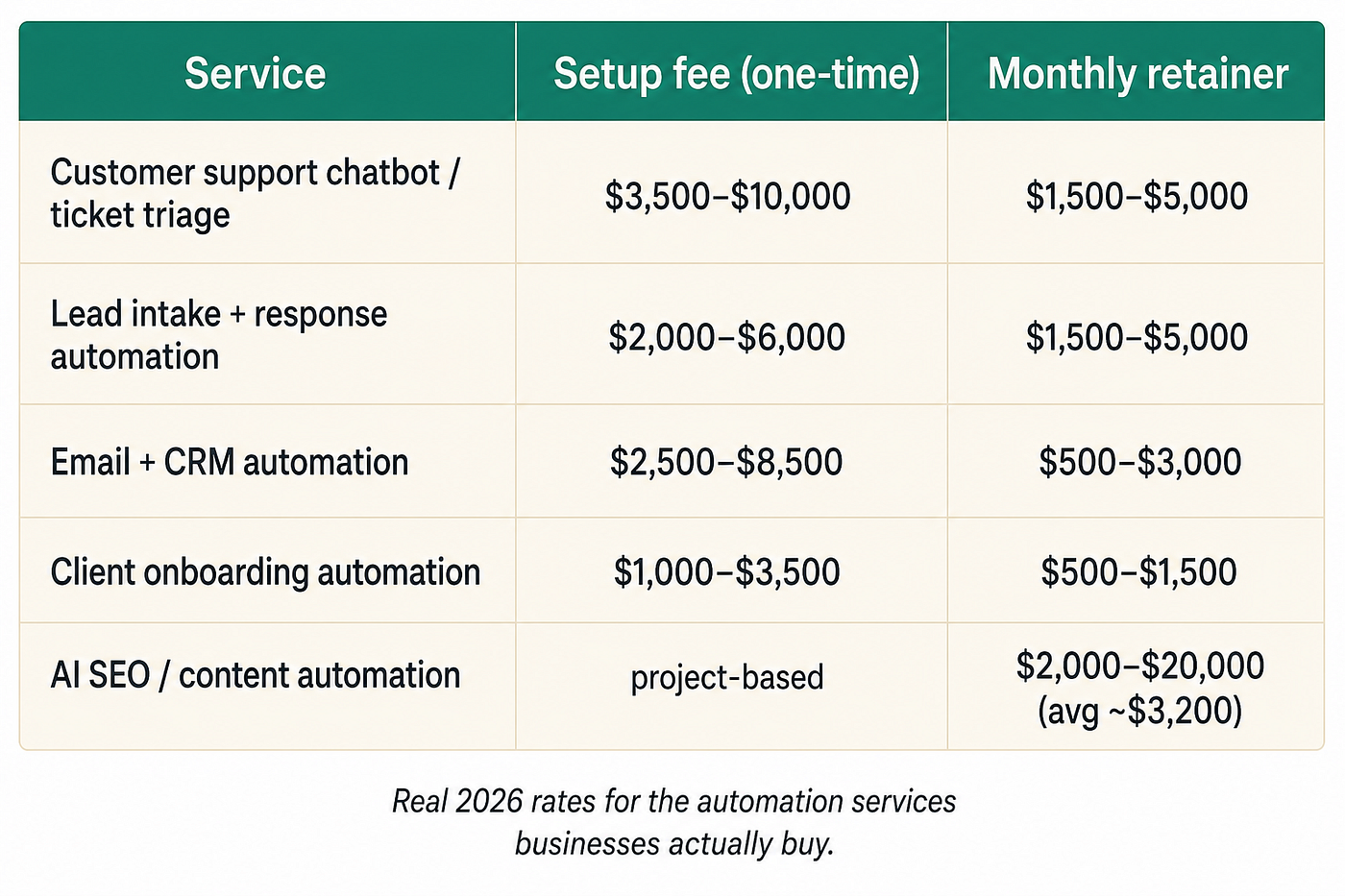
Look at the retainer column. A single lead-response system pays $1,500 to $5,000 every month, for as long as it runs. Land five clients near the middle of that range and yes — you’re at a real $10,000 a month in recurring revenue.
So the revenue is not the hype. The revenue is the honest part. It’s the “profit” claim that falls apart.
What the tools actually cost
The pitch leans hard on how cheap the software is, and here it’s telling the truth. I priced a lean stack for a solo operator running five clients.
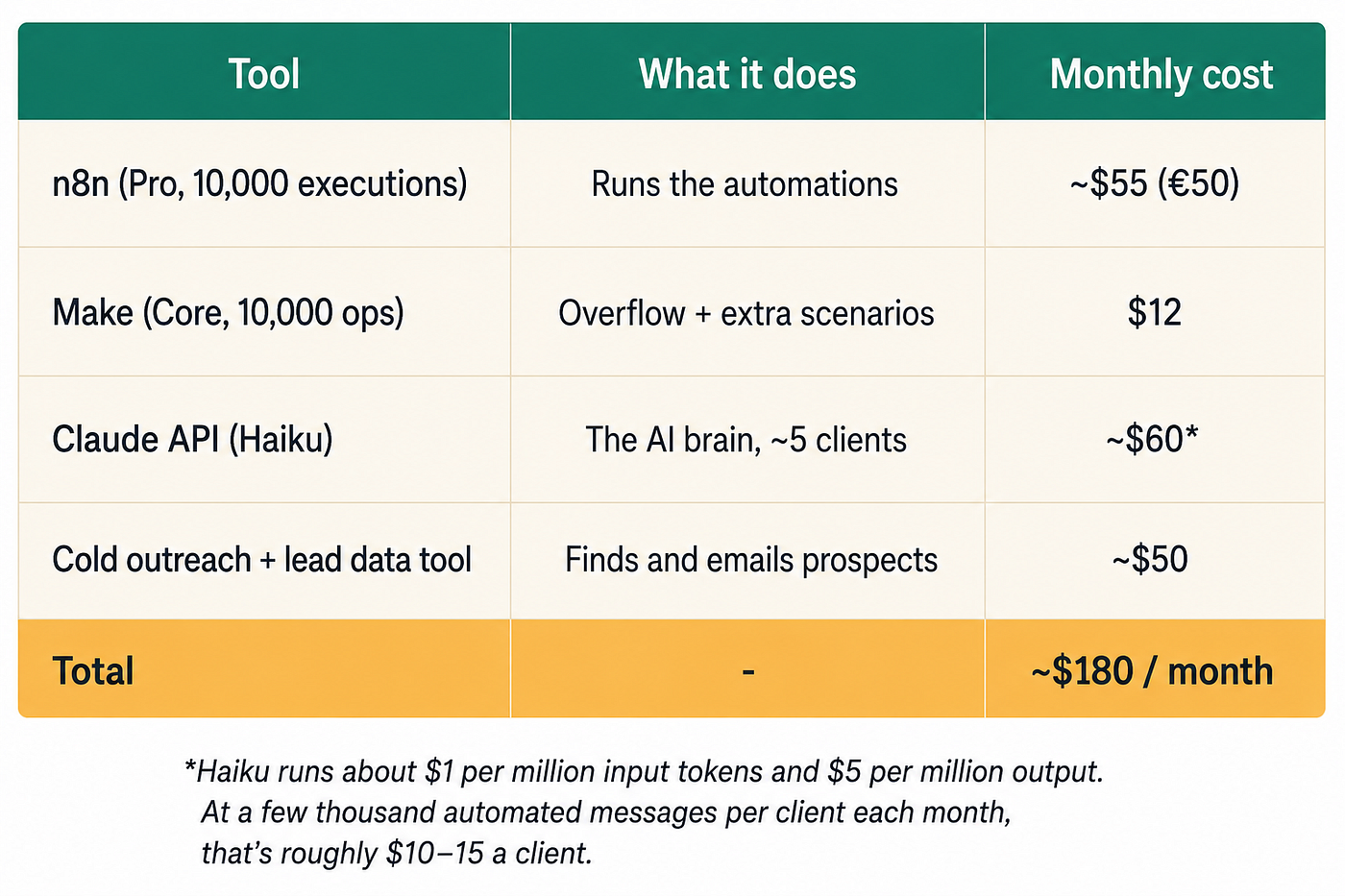
The self-hosted version of n8n is free if you’re technical enough to run it, so a lean operator can go even lower. Automation Labs, one of the writers covering this space, priced the same reality bluntly: most solo operators pay around $600 a month on tools when they really need about $90.
Either way, the point stands. Ten thousand dollars in, a couple hundred out. On paper, a 98% margin. That single number is why this pitch spreads.
It’s also where the honesty ends.
The margin that isn’t there
If tools are the only cost, a $10,000 month is nearly all profit and this really is free money. So why isn’t everyone rich?
Because two enormous costs never show up on the tool bill. They don’t get invoiced. They get paid in your time and your nerves. And they’re the whole reason most people who start this never reach five clients — or can’t hold them once they do.
Cost one is getting the clients. Cost two is keeping them.
Real cost one: getting clients is the actual job
Nobody hands you five clients. You have to go find businesses, convince them a stranger can automate their operations, and close the deal. In 2026, that is brutally hard, and the numbers say so.
The average cold email gets a 3.1% reply rate now. Only about 0.7% of the people you contact end up booking a call — and that’s the average; a genuinely good campaign hits around 1%. Those rates have fallen 30% to 50% since 2023 as inboxes drown in AI-written spam.
Run that forward. Say you’re good and book a meeting for every 100 businesses you reach. Say you close one in four of those meetings — optimistic for a beginner with no track record. Here’s what landing five clients actually takes.
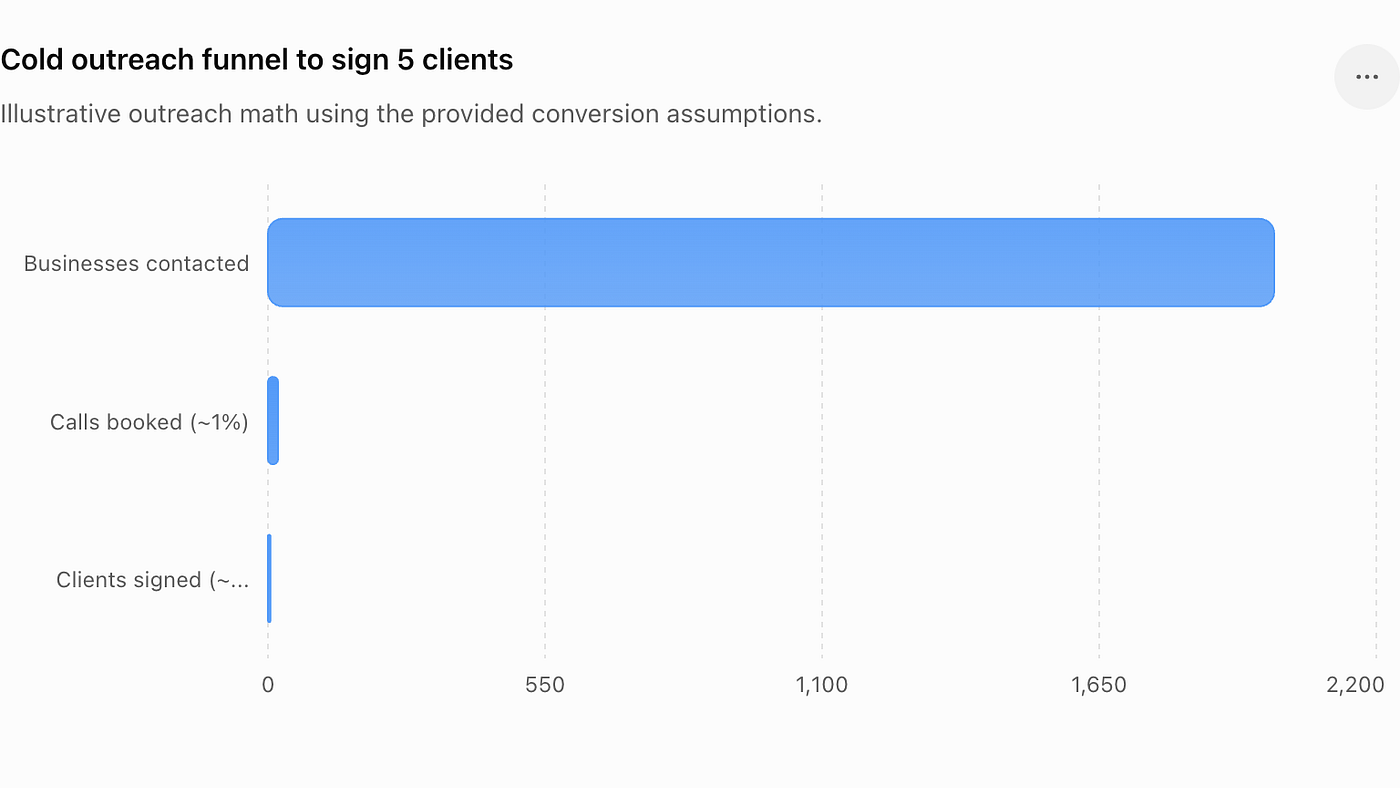
Two thousand personalized outreach attempts. Twenty sales calls. And that’s the optimistic version. Every one of those calls is you on a video call selling, not a bot. This is why the build guides go quiet after the tech section: the tech took a weekend, and the selling takes months.
You are not starting an automation business. You are starting a sales business that happens to deliver automations.
Real cost two: clients leave, and you have to refill
Say you get there. Five clients, $10,000 a month. You are not done. You are on a treadmill.
Retainer clients churn. A small business that isn’t sure the automation is worth it will cancel the first time cash gets tight, or the first time a workflow breaks and you’re slow to fix it. On small-business retainers, losing a client every couple of months is normal, not a failure.
Every client who leaves resets that outreach funnel. Lose one, and you’re back to a few hundred cold emails just to stand still at $10,000. The “passive” business needs you selling every single month, forever, or it shrinks.
That’s the assumption the hype quietly makes: that nobody ever leaves. Real businesses leave all the time.
So what is this really? A well-paid job
Add it up honestly and the picture is clear — and, once you stop expecting a machine, actually pretty good.
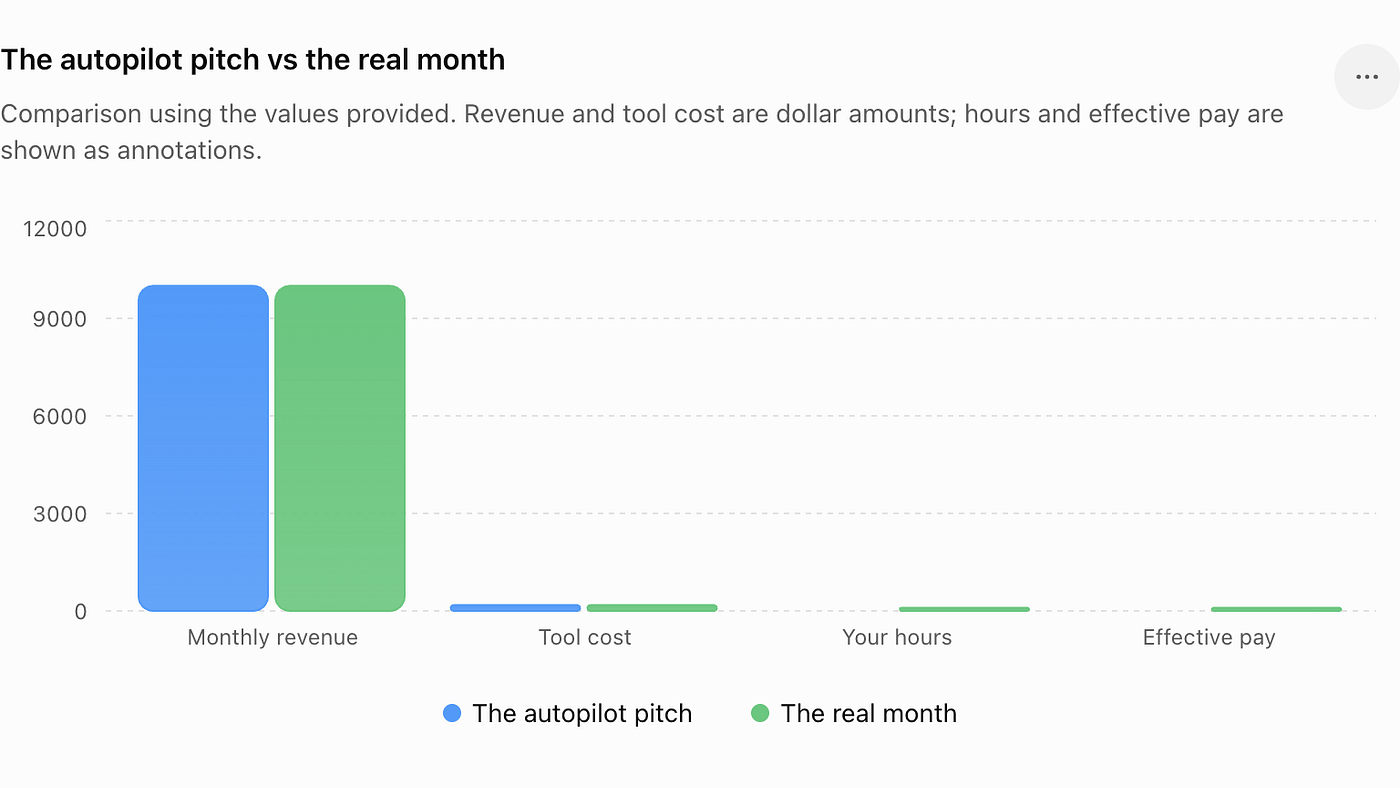
Ten thousand dollars in revenue. Under $200 in tools. But roughly 100 hours a month of your life — selling, onboarding, jumping on calls, and fixing automations that break at the worst time. That works out to about $98 an hour.
Ninety-eight dollars an hour is a genuinely good rate. It beats most jobs. But read it again: it’s an hourly rate. You are the machine. The automations run the tasks; you run the business, and the business does not run without you. Stop working the sales and support, and the money stops too.
That’s not a scam. It’s just a different thing than what you were sold. It’s a high-skill freelance service business with great margins and a real ceiling — not passive income, and not a robot that prints money while you sleep.
The path that works
None of this means don’t do it. The demand is real, the rates are real, and a focused operator can absolutely build a strong income here. It just rewards the people who treat it like the business it actually is. Here’s the version that works.
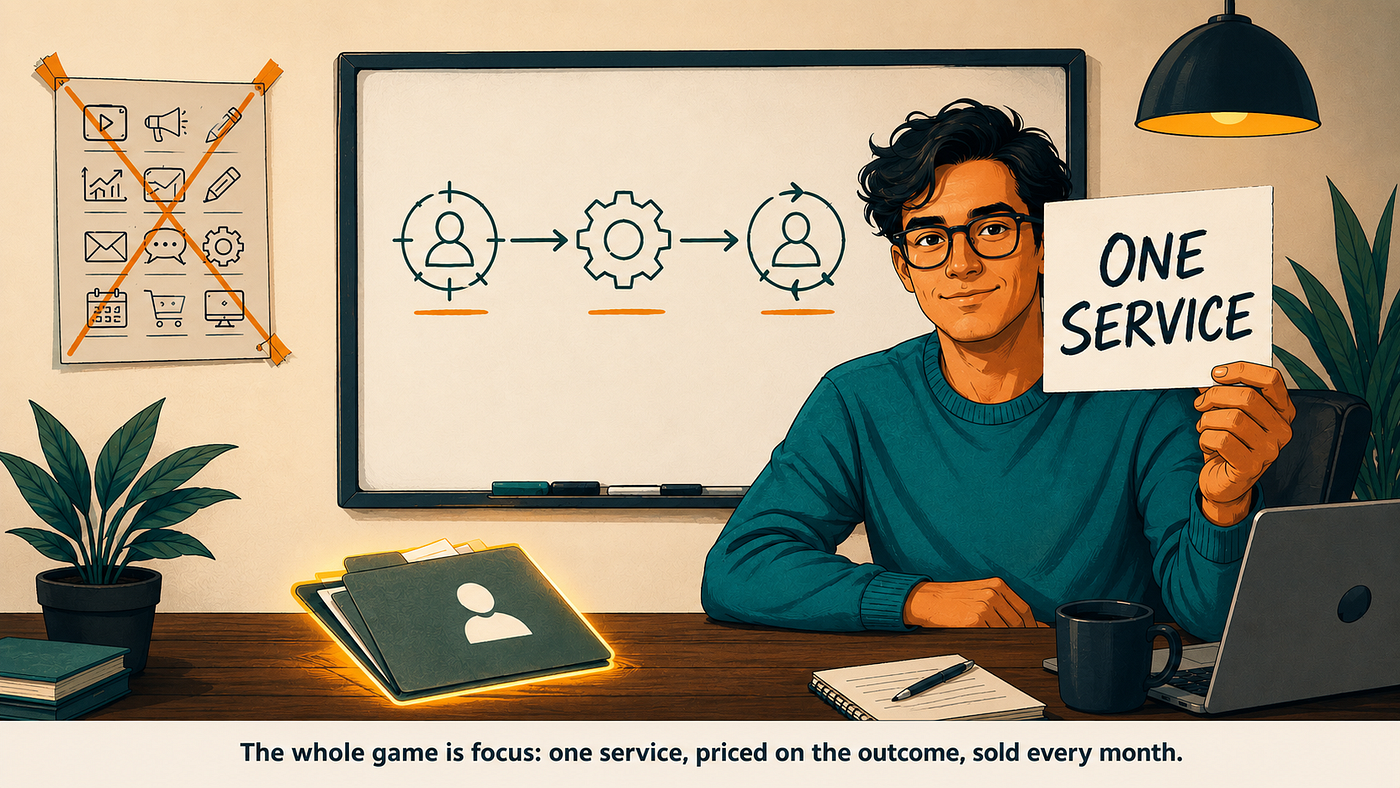
The whole game is focus: one service, priced on the outcome, sold every month.
Pick one service, not the whole menu. Offer lead-response automation to one type of business, or support-ticket triage to another. One narrow, valuable workflow you can sell in a sentence and deliver in your sleep beats a buffet you build from scratch every time.
Price on the outcome, not your hours. A lead-response system that catches deals worth thousands is easily worth $2,000 a month to the client, no matter that the tools cost you $40. Charge a setup fee to get paid for the build, then a retainer to keep it running. The retainer is the whole business.
Treat sales as the product. This is the part the guides skip and the part that pays. Get good at reaching businesses and showing them the specific money you’ll make or save them. If you’d rather never do that, this isn’t the business for you — and better to know now.
Start with one client, not five. Land one at $1,500 to $2,000 a month, deliver something that clearly works, and turn that into a case study and a referral. One real client teaches you more than fifty build tutorials, and it’s a far more honest first goal than “$10K in 90 days.”
The money in AI automation is real. Just go in knowing you’re building a service business with cheap tools and a demanding sales job attached — not buying a machine that runs itself. Do that, and $98 an hour is genuinely yours to earn.
What would you charge for your first automation, and which service would you niche down on? Drop your number in the responses — I read every one, and I’ll tell you if the math holds.
메타데이터
- post_id
- 633daa51ae73
- slug
- build-an-ai-automation-business-that-actually-pays-in-2026-633daa51ae73
- url
- https://medium.com/@buildwithaman/build-an-ai-automation-business-that-actually-pays-in-2026-633daa51ae73
- canonical_url
- https://medium.com/@buildwithaman/build-an-ai-automation-business-that-actually-pays-in-2026-633daa51ae73
- author_url
- https://medium.com/@buildwithaman
- status
- ok
- fetched_at
- 2026-08-02 02:25:20