Lunar Legacies: Unveiling the Moon’s Multidimensional Role in Earth’s Evolution
Selene, Chandra , Luna and Mani. These are all names that different religions or ancient cultures have given to the moon, since it held…
Lunar Legacies: Unveiling the Moon’s Multidimensional Role in Earth’s Evolution
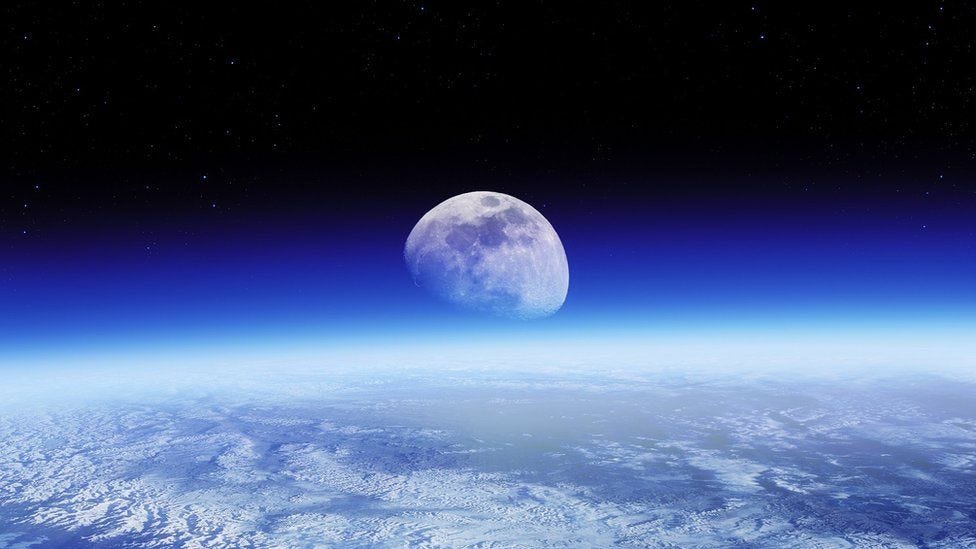
Selene, Chandra , Luna and Mani. These are all names that different religions or ancient cultures have given to the moon, since it held significant cultural and symbolic importance for them. For example, in ancient Greek mythology, the moon was personified by the goddess Selene. In Hinduism, the moon ( Chandra ) is considered a deity and has various mythological stories associated with it. In general, it seems that our ancestors have admired the moon and felt its significance even though they could not explain it rationally and scientifically yet, or at least not in the way that is today. After centuries of theories and research on the moon we are able to understand its vital importance to the earth.
10. The Moon’s Ancient Magnetic Shield: Protecting Early Earth
The Moon used to have a strong magnetic field, created by the movement of molten metal in its core, like a giant invisible shield. This shield helped protect Earth from harmful radiation coming from the Sun by deflecting charged particles away. When these particles were blocked, it meant less radiation reached Earth, helping to preserve our atmosphere and protect early life from harmful radiation. The Moon’s magnetic field, combined with Earth’s, created a larger protective bubble in space, making it even more effective.
Even though the Moon’s magnetic field is much weaker now, its ancient magnetic protection was crucial for Earth’s early environment and the development of life.
9. The Moon’s Geological Story
The Moon’s geological history is a captivating tale written across its surface, characterized by craters, basaltic plains (mare), and rugged highlands. The mare, such as Mare Crisium, are dark plains formed by ancient volcanic eruptions, contrasting with the bright, cratered highlands, which are the Moon’s oldest regions. These features offer a glimpse into a time of intense geological activity and bombardment by meteoroids. Libration, a fascinating phenomenon, allows us to observe slightly more than half of the Moon’s surface from Earth. This wobbling motion reveals hidden areas, enriching our understanding of the Moon’s geology. Rock samples from Apollo missions and lunar meteorites have provided invaluable insights into the Moon’s composition and volcanic history. These samples contain minerals like ilmenite, hinting at resources for future exploration.
Ongoing and future missions, such as NASA’s Artemis program, aim to delve deeper into the Moon’s geological mysteries, particularly at the lunar South Pole, where shadowed craters may contain water ice. This ice could be crucial for future lunar bases and long-duration missions. The Moon’s geological story not only enhances our knowledge of its past but also offers insights into Earth’s history and the solar system’s evolution.
8. How the Moon Shapes Life on Earth
Picture Earth as a skilled dancer, twirling gracefully on its axis while simultaneously orbiting the Sun. Each complete spin, lasting 24 hours, grants us our day and night. However, did you know that Earth’s elegant performance is significantly influenced by its dependable dance partner, the Moon? Imagine Earth as a ballerina spinning on its axis and twirling around the Sun. Each spin takes 24 hours, giving us day and night, but this routine is influenced by its dance partner, the Moon. The Moon formed from a massive collision with a Mars-sized body, sending debris into space that eventually became the Moon.
Before the Moon, Earth’s rotation was just 6 to 8 hours, but the Moon’s gravity slowed it down to 24 hours. Longer days and nights meant more stable temperatures, creating better conditions for life to evolve. Without the Moon, life on Earth would have had to adapt to rapid and extreme temperature changes.
7. The Protective Role of the Moon
Our moon is not just a beautiful celestial body that illuminates the night. It also plays a critical role in protecting Earth from catastrophic collisions with asteroids and comets. The moon acts as a kind of barrier, using its gravitational force to change the trajectory of asteroids and comets heading toward Earth, pushing them away or absorbing shocks. The moon acts as a “gravitational barrier,” using its gravitational force to influence the trajectories of objects approaching Earth. In this way, it can alter the paths of asteroids and comets, preventing potential collisions. There is evidence that in the past, collisions between the moon and asteroids helped reduce the number of asteroids threatening Earth.
This means the moon has already saved our planet many times! When asteroids or comets approach the moon, its gravitational force can break them into smaller pieces. This makes the objects less destructive if they eventually reach Earth. The presence of the moon changes the orbits of smaller objects, reducing the frequency of collisions with Earth. This “celestial protector” helps keep us safe, contributing to the preservation of life and ecosystems on our planet. It’s impressive to think about how valuable the moon’s presence is for our survival!
6. Biological factors
Many organisms, including humans, have evolved biological rhythms that are influenced by the lunar cycle. For example, animals like some species of owls and bats, may adjust their hunting and activity patterns based on the moon´s brightness. Some animals use the moon and stars for navigation during migration. For instance, birds are known to use the moon´s light to guide their journeys.
5. Tides
The Moon’s gravitational pull on Earth creates tides in our oceans. These tides are crucial because they help distribute nutrients, support marine life in intertidal zones, and influence human activities like fishing and navigation. Coastal cities also rely on tidal patterns when planning infrastructure, and we even harness tidal energy for electricity.
Essentially, the Moon’s influence keeps our oceans alive and thriving while supporting human life and activities along the coast.
4. Earth’s Cosmic Stabilizer and Protector
The moon helps stabilize the tilt of Earth´s rotational axis. If this depiction confuses you, let me clear it up to you. The moon keeps Earth steady. It keeps earth from wobbling too much and by that it makes our seasons stay pretty regular and don’t change wildly. Imagine Earth as a spinning top. Sometimes it wobbles a little as it spins and this wobbling can change the way seasons happen and cause climate change.
The moon acts like a friend holding the top steady. Its gravity pulls on Earth just enough to keep this wobbling under control.
3. Human landing
The Apollo missions, particularly the iconic Apollo 11 landing in 1969, marked a monumental leap for humanity. Picture this: humans, for the first time, set foot on another celestial body. It was a moment where the universe seemed a bit smaller and the potential for exploration infinitely larger. The astronauts who made this historic journey — Neil Armstrong, Buzz Aldrin, and Michael Collins — embodied the pinnacle of human ingenuity, engineering, and sheer determination. These missions weren’t just about planting flags and collecting rocks (though they did that, too). They showcased the ability to overcome daunting technological challenges: designing spacecraft capable of reaching the Moon, developing life support systems for astronauts, and mastering the art of landing on and launching from a celestial body with one-sixth the gravity of Earth. The lunar landings provided unprecedented scientific data about the Moon’s geology, offering insights into the early solar system. The legacy of Apollo is not just in the tangible achievements but in the inspiration it sparked. It demonstrated that with vision and effort, humanity can reach beyond its grasp.
The technological advancements made during Apollo have had lasting impacts, driving progress in areas such as computing, materials science, and robotics. The missions reminded us that exploration is a fundamental human drive, and the Moon landings continue to be a symbol of what we can achieve when we dare to dream big.
2. Unveiling the Sun’s Secrets from the Moon
One of the fascinating advantages of the Moon as a base for scientific research is its unique ability to offer clear and direct observations of the Sun. The Moon’s surface, devoid of any atmosphere, provides an unparalleled platform for studying our closest star. On Earth, our atmosphere acts as both a blessing and a curse. While it protects us from harmful solar radiation, it also distorts and absorbs the light and other electromagnetic emissions from the Sun, making precise observations challenging.
By placing instruments on the Moon, scientists can bypass these atmospheric interferences, allowing for pristine observations of solar phenomena. The Moon’s vantage point offers an unobstructed view of the Sun’s corona, the outermost part of its atmosphere. During solar eclipses, when the Moon blocks the Sun’s bright surface, only the corona is visible. However, from the Moon, scientists can continuously study the corona without waiting for these rare events. This persistent observation is key to understanding the Sun’s magnetic field and its influence on the solar system.
1. A gateway to cosmic exploration
The Moon’s surface serves as a fantastic base for astronomical observations and experiments due to its unique conditions. Its lack of atmosphere means there’s no interference from air, providing a clear and uninterrupted view of the universe. This makes it perfect for observing celestial objects and studying phenomena that are difficult to see from Earth. The Moon’s stable environment, free from weather and seismic activity, allows for precise and long-term observations. Additionally, the far side of the Moon is shielded from the radio noise of Earth, making it ideal for radio telescopes.
The Moon’s surface also holds valuable clues about the solar system’s history, with impact craters providing insights into ancient cosmic events. Future missions could see the establishment of lunar bases, enhancing our ability to conduct ongoing astronomical research. The Moon’s potential as an observational platform promises to revolutionize our understanding of the cosmos, making it an exciting frontier for future scientific discovery.
Whether you call it Selene, Chandra, Luna, or Mani, one thing’s for sure: the moon is Earth’s ultimate multitasker. From shaping our tides to providing cosmic protection, it’s like that overachieving friend who’s good at everything. Let’s just be thankful it’s not posting its accomplishments on social media, or we’d all feel a bit… moonstruck!
메타데이터
- post_id
- 63520fe87b8d
- slug
- lunar-legacies-unveiling-the-moons-multidimensional-role-in-earth-s-evolution-63520fe87b8d
- url
- https://medium.com/@mariaelenibalafouti/lunar-legacies-unveiling-the-moons-multidimensional-role-in-earth-s-evolution-63520fe87b8d
- canonical_url
- https://medium.com/@mariaelenibalafouti/lunar-legacies-unveiling-the-moons-multidimensional-role-in-earth-s-evolution-63520fe87b8d
- author_url
- https://medium.com/@mariaelenibalafouti
- status
- ok
- fetched_at
- 2026-07-21 07:40:18