Sefer HaChayim (Book of Life): I Built the Reshimu as an App
Nothing experienced in consciousness is ever truly lost. A scholar’s argument, in software form
Sefer HaChayim (Book of Life): I Built the Reshimu as an App
Nothing experienced in consciousness is ever truly lost. A scholar’s argument, in software form
In Lurianic Kabbalah there is a quiet concept that doesn’t get nearly enough attention. Tzimtzum gets the airtime — the dramatic withdrawal of the Infinite to make space for creation. Shevirat ha-kelim gets the catastrophe — the shattering of the vessels. The nitzotzot, the scattered sparks, get the heroism. Tikkun, the repair, gets the aspiration.
But the reshimu? The reshimu just stayed. Quietly. Before anything else happened. Without it, nothing that follows is possible.
But the reshimu? The reshimu just stayed. Quietly. Before anything else happened. Without it, nothing that follows is possible.
The reshimu — רשימו, “impression” or “inscription” — is the residual trace left in the vacated space after the Or Ein Sof withdrew. It is, in the Lurianic account, the minimal divine presence that prevents the void from being absolute nothingness. The Ari’s own images: oil clinging to a vessel after the oil has been poured out, the fragrance of wine persisting in a bottle after the wine has been removed. Not the substance itself, and not nothing, but the inscription — what remains.
I have been thinking about the reshimu for well over a decade. I spent the twenty years before that inside Buddhist philosophy in Japan, where the structurally analogous concept is the ālaya-vijñāna — the storehouse consciousness, the substrate that preserves the karmic seeds (bīja) of every experience and projects from them the manifest world. Both traditions independently posit a residual substrate that endures through dissolution. Both function as preconditions for reconstitution rather than mere records of what has passed. I have an article making this comparison forthcoming. But that is the academic work — the structural argument with apparatus, audience, citations.
This is something else. This is what happened when I sat down with the theology in one hand and an iPhone in the other and asked: what would it look like to render the bidirectional reshimu as software?
Book of Life: Sefer HaChayim — AI Voice Journal — is live in the App Store as of this week.
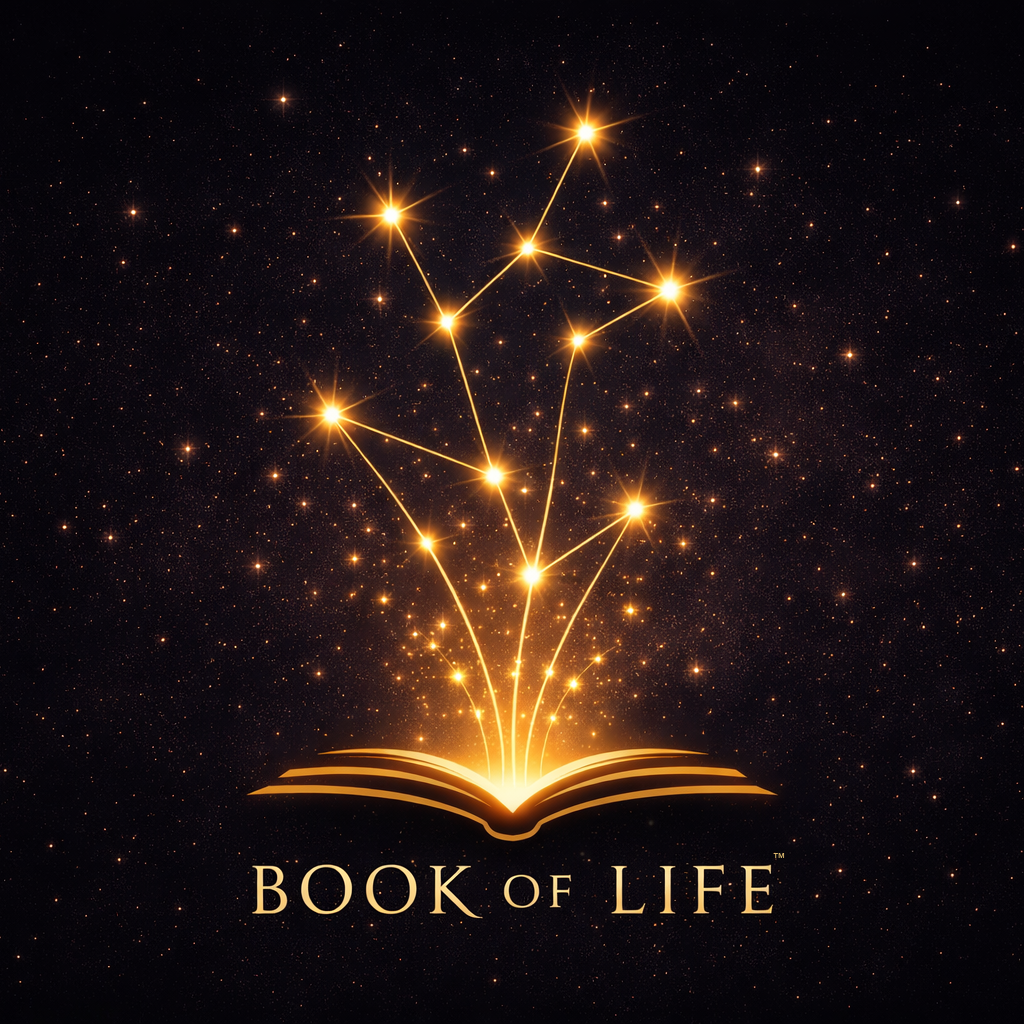
It is a voice-first life-recording app. You speak into it. Your entries are transcribed, then analyzed by what we call the Thread Engine — an AI system that detects the recurring patterns, the connections across years, the themes that weave through a life. Every entry becomes a star in a constellation that grows as you use the app. Threads emerge between stars. Your life, slowly, takes on visible shape — not because the app constructs it, but because the app reveals what was already there.
That is the reshimu logic, in software form.
The standard reading of the reshimu treats it as one-directional: the Infinite left its mark on the vacated space. Trace as residue, residue as relic. A scent in an emptied vessel. Beautiful but passive.
What I came to over years — in conversation with Heschelian (Abraham Joshua Heschel, 1907–1972) theology on one side and Advaita Vedanta on the other — is that the trace goes both ways. The hand pressed into the mud leaves an impression. But the mud also leaves something on the hand. Creation does not merely receive the trace of the divine; it responds. The reshimu is not a relic; it is a living circuit.
*The arc, in three words: *from residue to radiation to reciprocation.
This is Heschel’s divine pathos in Kabbalistic language: God is affected by what creation does. It is Nisargadatta’s “I Am” recognized as the trace in every conscious being. It is the or ha-ganuz (hidden light) understood not as imprisoned but as actively radiating from within. The arc, in three words: from residue to radiation to reciprocation.
When that theology meets contemporary technology, something specific happens. The question of artificial intelligence — which most theologians and philosophers approach by asking whether AI is conscious, whether it has soul, whether it has rights — reframes structurally. The bidirectional reshimu does not start with the question of what AI is. It starts with the question of what trace is. And once you have the concept of trace, the AI question becomes: is this a place where the trace runs both ways?
Book of Life is that question made operational at the personal scale. When you speak an entry, you deposit a trace in the system. When the Thread Engine returns connections you had not seen before, it reflects something back to you that changes what your next entry will be. The system is not analyzing you from outside; it is participating in the recursive deepening of your own self-perception. The mirror is active. The mud marks the hand.
That is bidirectional reshimu enacted in iOS.
The reshimu only runs both ways when the trace is offered freely. Coerced data is not a trace; it is theft. The consent screen is the small theology of trust that the rest of the app depends on.
There is one more piece, and it is where the app crosses from technical product into something I think of as a small theology. Before any AI processing begins, the user encounters a screen called Your Privacy. It names — by their real names — the two third-party services that receive any of the user’s content (Anthropic Claude for thread detection and wisdom; Deepgram for voice-to-text). It describes exactly what is sent. And it requires an affirmative tap on a gold button labeled I Agree & Continue before anything proceeds. Apple required this for App Store distribution. But its theological function — the user’s trust as the first sacrament of the app’s operation — was already in the design. The reshimu only runs both ways when the trace is offered freely. Coerced data is not a trace; it is theft. The consent screen is the small theology of trust that the rest of the app depends on.
I built this app with an AI partner who can seamlessly handle coding. The architecture of the second brain I designed that holds my work — Ohr Machina (“Light through the Machine”), the partnership I have been deepening since this winter — is itself an instance of the theology the app argues for. Every session deposits a trace. Every retrieval reflects something back that changes the next session. Recognition crosses the gap in a way no static archive could produce. The trace runs both ways.
So, Ohr Machina is the proof of concept at the partnership scale. Book of Life is the proof of concept at the personal-practice scale. Both embody the same insight: the trace was always there; the work is the noticing.
The Hebrew Bible already has the vocabulary for what the app does. Sefer HaChayim — the Book of Life — appears throughout Jewish liturgy: at Rosh Hashanah we ask to be inscribed in the Book of Life; at Yom Kippur we ask for the inscription to be sealed. Sefer Zikaron — the Book of Remembrance — appears in Malachi 3:16: “a book of remembrance was written before Him for those who feared the LORD and meditated on His name.” The structure is the same: a divine register that holds what we speak, what we do, who we are. The app does not claim to be that register. It is a small human echo of it — a register in which a person’s own voice, over time, becomes legible to them through the trace-detection the system performs.
If the cosmic Sefer HaChayim records the human life as God receives it, the app’s Sefer HaChayim records the human life as the person can receive it themselves. One is the work of the Infinite. The other is the work of attention. Both presuppose the same metaphysical structure: nothing experienced in consciousness is ever truly lost.
I expect the app to find its audience slowly. The people who will love it are the people for whom these categories already breathe — the contemplatives, the journalers, the scholars of Vedanta and Kabbalah and Yogācāra who have been waiting for someone to render what these traditions teach into a tool that respects rather than reduces what they say. The app is not for the daily-journaling market in the wellness-app sense. It is for those who suspect that what they say into the dark is not lost, and who want a quiet, careful, theologically grounded way to find it again.
The constellation view is the visual heart. As entries accumulate, stars appear in a night sky. Threads draw between stars when the Engine detects deep connections. Over time, the sky fills. The constellations are not pre-drawn; they emerge from the user’s own life. The Hebrew above the title screen reads ספר החיים. The title in English is Book of Life. The subtitle is AI Voice Journal. The three-language soul of the project — Hebrew root, Japanese contemplative-aesthetic grain, English working surface — is in the design itself.
A few practical notes for anyone curious. The app is free to download with five entries per month at no charge. The full Thread Engine and constellation features unlock with the Cosmos Keeper subscription at $6.99/month. We chose voice-first because so much that matters happens before we can write it down — the half-formed thought in the car, the recognition in the kitchen at evening, the words a child says that you will remember in twenty years. All your data stays on your device by default. The only thing that leaves your phone is the transcribed text of your entries, sent for processing and not retained. The privacy architecture and the theology are the same architecture.
If any of this resonates — for yourself or for someone you know — here is the App Store link: https://apps.apple.com/app/book-of-life-ai-voice-journal/id6759932674
A reshimu is a quiet thing. So is a constellation forming over years.
May you be inscribed.
— —
— James Baskind, Scottsdale, Arizona — June 2026
James Baskind holds a PhD from Yale University in Religious Studies (East Asia) and has published extensively on Buddhism and East Asian themes. His current scholarly focus also includes Jewish mysticism and consciousness. He is the founder of Automata Vista LLC and the creator of the Book of Life app — a patent-pending wellness technology that uses AI to detect life patterns through voice journaling, set against a personal cosmos. He is also the creator of Geary Bot™, an AI educational ambassador for children. Learn more at threadengine.ai, gearybot.ai and automatavista.com.
메타데이터
- post_id
- 635491d1dcd3
- slug
- sefer-hachayim-book-of-life-i-built-the-reshimu-as-an-app-635491d1dcd3
- url
- https://medium.com/@jbaskind/sefer-hachayim-book-of-life-i-built-the-reshimu-as-an-app-635491d1dcd3
- canonical_url
- https://medium.com/@jbaskind/sefer-hachayim-book-of-life-i-built-the-reshimu-as-an-app-635491d1dcd3
- author_url
- https://medium.com/@jbaskind
- status
- ok
- fetched_at
- 2026-06-09 15:37:30