Self-Assembling RNA Nanostructures: First Demonstration of Programmable 2D RNA Lattices
For decades, synthetic biology has dreamed of engineering life’s building blocks from the inside out. But one stubborn obstacle has stood…
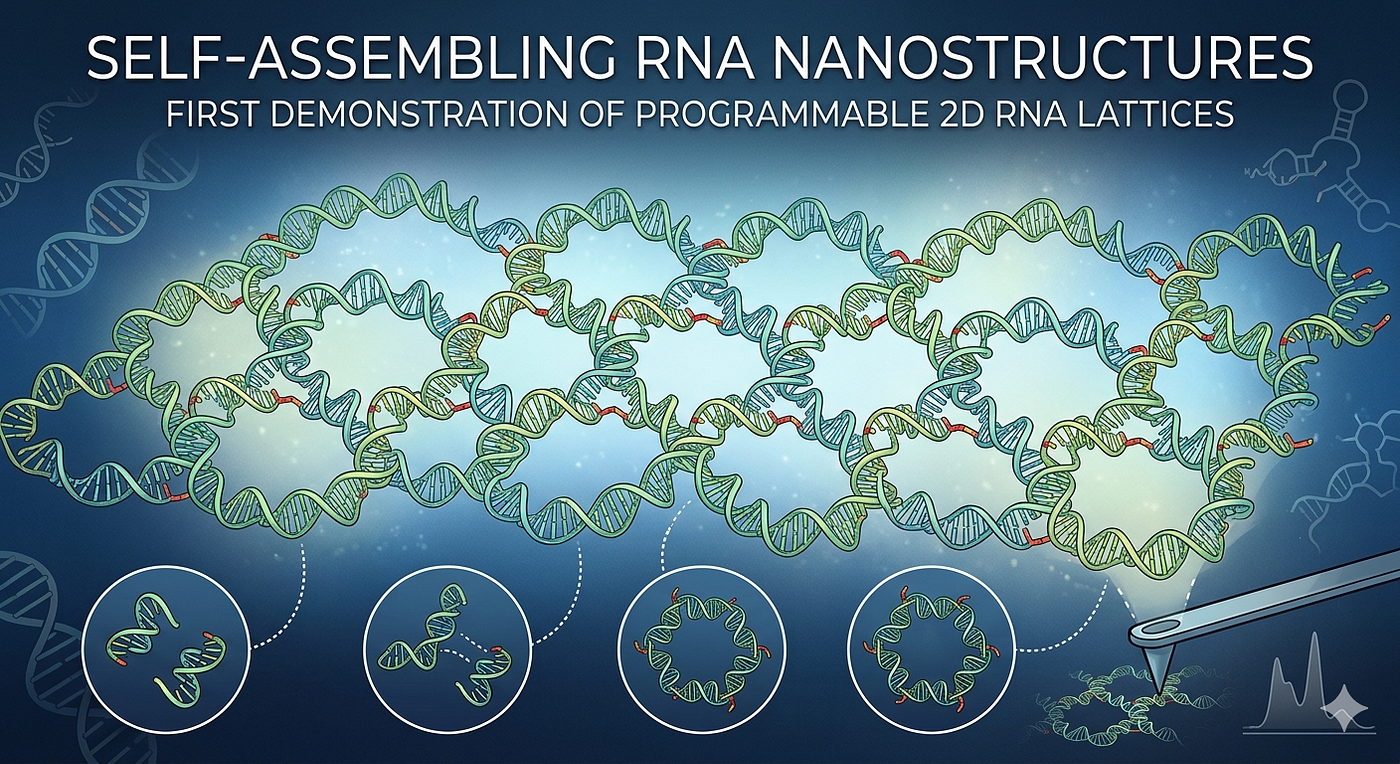
Self-Assembling RNA Nanostructures: First Demonstration of Programmable 2D RNA Lattices
For decades, synthetic biology has dreamed of engineering life’s building blocks from the inside out. But one stubborn obstacle has stood in the way: the nuclear retention gap.
Most RNA is made in the nucleus and then quickly shipped to the cytoplasm. That’s great for making proteins, but terrible if you want to do something inside the nucleus.
Now, a team of researchers has done the seemingly impossible. They’ve designed RNA nanostructures that fold themselves automatically as they are being transcribed and stay put inside the nuclei of living human cells.
Let’s unpack this quiet breakthrough from Nature Communications 2025.
Why the Nucleus Matters (And Why It’s Hard to Reach)
The nucleus is the cell’s command center. It holds DNA, controls gene expression, and orchestrates everything from replication, cancer progression and viral defense.
But if you deliver a typical RNA-based tool, the cell treats it like any other RNA: export it to the cytoplasm. That’s a dead end for nuclear-specific applications like:
- Real-time gene regulation
- High-resolution nuclear imaging
- Cancer biomarker sensing
So how do you keep synthetic RNA inside?
The Clever Fix: Build It Too Big to Export
The team’s strategy is beautifully simple: co-transcriptional folding.
Instead of designing RNA that folds after it’s made, they engineered a single RNA strand that folds while RNA polymerase is still synthesizing it.
The result? Complex 2D lattices, hexagonal rings, and waffle-like array; all too large and structured to fit through nuclear pores.
Two key molecular tricks:
- Paranemic Cohesion (PC) — stable double-helix domains for rigidity
- Kissing Loops (KLs) — programmable end-loops that lock tiles at precise angles (180° or 120°)
Think of it like origami that folds itself into a piece of furniture inside the room, so it can never fit back out of the door.

Mapping the Evidence
The team validated their designs in a step by step manner.
In vitro Atomic Force Microscopy Imaging
AFM imaging confirmed beautiful and predictable shapes:
- Hexagonal rings
- Linear arrays
- 2D waffle lattices
In living human cells (HEK293FT)
Using confocal microscopy and a dsRNA-specific antibody (J2), they saw clear, network-like RNA structures only inside nuclei; not in the cytoplasm.
FRAP (photobleaching) experiments confirmed these structures were dynamically accessible, not dead aggregates.
The knockout punch: Transmission Electron Microscopy (TEM)
At 200 nm resolution, TEM showed organized 2D waffle arrays inside the nucleoplasm — matching the in vitro designs almost perfectly. And the cells? Perfectly healthy. The nucleolus and heterochromatin remained undisturbed.
Beyond Architecture: Built-In Biosensing
Structures are great, but function is better.
The team integrated Broccoli aptamer — a light-up RNA tag that fluoresces green when bound to DFHBI dye. Even more impressive: a split aptamer sensor (D13) that only turns on fluorescence when a target RNA (like cancer-related KRAS) triggers assembly.
Normalized fluorescence increase: clearly detectable fold-change.
That’s a programmable, nuclear-restricted RNA biosensor — no proteins required.
What This Unlocks (Future Potential)
This isn’t just a cool nanotech trick. It opens three entirely new avenues:
1. Precision biosensing
The unique designs can work as “nanosponges” inside cancer cell nuclei that light up when they detect multiple microRNAs that allow early-stage diagnosis from a simple fluorescent readout.
2. Advanced gene regulation
By creating “synthetic LADs” (lamin-associated domains), these RNA scaffolds could reposition chromatin loops and control which genes are active or silent.
3. Nuclear-targeted RNA therapeutics
For the first time, RNA-based drugs can be designed to stay and act in the nucleus, without being exported or degraded.
The Bottom Line
This study delivers the first demonstration of co-transcriptional RNA nanostructures folding and assembling inside human cell nuclei.
It solves a decades-old limitation: how to keep synthetic RNA where you need it most.
And it does so with elegance; one strand, self-assembling, no external chaperones.
If you care about synthetic biology, gene therapy or RNA nanomedicine, this is the quiet revolution you need to watch.
Ready to dive deeper?
📄 Read the full paper: Chang, Jeziorek, Yang et al., Nature Communications 2025 — “Designer RNA Nanostructures Co-transcribed & Self-assembled Inside Human Cell Nuclei”
메타데이터
- post_id
- 63687e5fa355
- slug
- self-assembling-rna-nanostructures-first-demonstration-of-programmable-2d-rna-lattices-63687e5fa355
- url
- https://medium.com/@kanzkhan105/self-assembling-rna-nanostructures-first-demonstration-of-programmable-2d-rna-lattices-63687e5fa355
- canonical_url
- https://medium.com/@kanzkhan105/self-assembling-rna-nanostructures-first-demonstration-of-programmable-2d-rna-lattices-63687e5fa355
- author_url
- https://medium.com/@kanzkhan105
- status
- ok
- fetched_at
- 2026-06-09 15:37:30