Claude Fable 5 Just Beat Epic Games at Fortnite.
A viral test claimed an AI rebuilt Fortnite in one prompt. Here’s what actually happened, and what six years of live-service engineering…
Claude Fable 5 Just Beat Epic Games at Fortnite.
A viral test claimed an AI rebuilt Fortnite in one prompt. Here’s what actually happened, and what six years of live-service engineering still can’t be replaced by a sentence.
This week a test made headlines on X that, with just one prompt each, two artificial intelligence models were asked to take an stand-alone 100-player battle royale game and create the entire thing from scratch. No engine. No team. No production in the last 6 years. It’s just a sentence and compute budget.
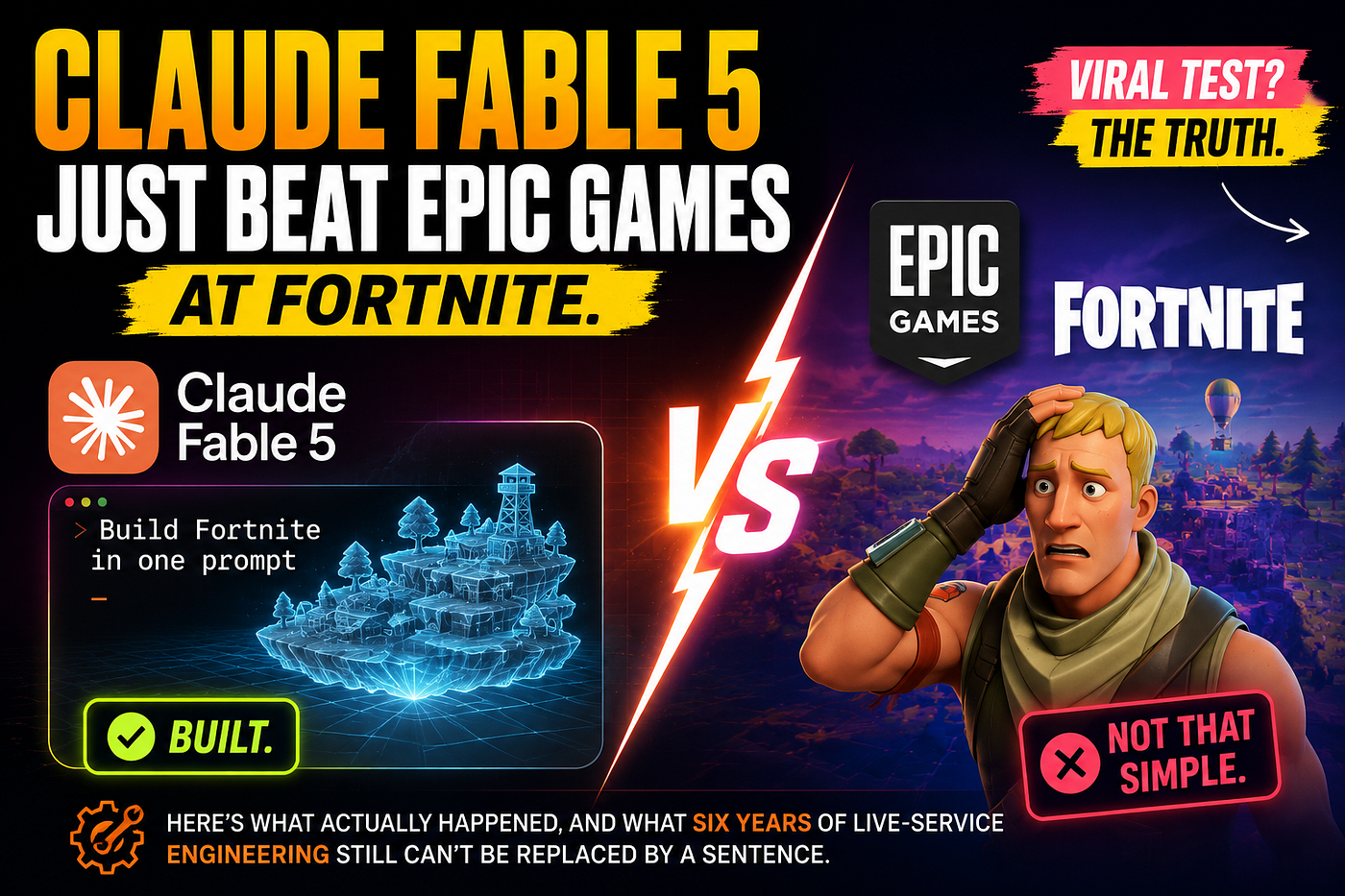
The post was by the user MyWestLord and was forthright. The first series is a win for Claude Fable 5 over GLM 5.2. Same prompt. The winner will be the person who produced something more like a real playable game. In fact, GLM 5.2 ticked off more boxes on the feature list and still failed to be playable, the post said. Fable 5 ticked off less of the red flags and found itself in a genuine firefight, storm closing, to the last bullet, and a calling of a Victory Royale.
The last sentence of the post is the workhorse: “Epic: 6 years; Fable 5: 1 prompt.
It was spread through that line. It’s also the part that you have to look at very carefully before you say that it means what you think it means. Let’s walk through what’s said to have happened, the reasons for this being plausible, and, most difficult of all for anyone posting the clip, what does a prototype actually tell us about six years of development for a live, pay-for-play, 100-million-player game?
What the test reportedly looked like
The two were given a similar challenge: create a 100-player “battle royale” game, with no external assets, and browser-based, from scratch. GLM 5.2 went first.
The outcome, as reported, was to pass through a series of eight milestones defined. A battle bus was used to drop the players in. There was a procedurally generated map, and a very familiar reference to the most popular named landmark in the original map, Tilted Towers. The HUD also featured health and shield bars, which were modeled after those of the 2018 season of Fortnite to which they are very similar.
The experience, then, went awry when they met, according to the report. The rate of frames dropped to about 2 fps when a player landed. One of the movement keys was apparently reversed, such that the S key would move the character forward and the W key would move the character backward. The model of the weapon was set to shoot up, as an error despite being aimed, and the camera was unable to lift at all, so the first time a player was shot by someone else, the other player ended up on a raised ground that’s impossible to shoot at.
Fable 5, then, was likewise prompted with the same question which the post says has to do with its full effort or reasoning setting. The output was very different: Not the simple capsules, but real humanoid characters; Visible hit reactions on damage; A shadow system, which was able to track player position and lighting in real time; And core movement, which was reported to work as it should without debugging.
The one follow-up “add more Fortnite elements” is said to have introduced gliders, loot chests, shield potions, medkits, and a sniper rifle without any issues with the existing system. The final round was apparently at 3:28 AM, with a full magazine, drop of a medkit, and a last minute weapon change to an SMG which won the game.
If this ‘account’ is true, as described, then it is a truly amazing demo. It’s also, interestingly, a non-verified account of a private test session, rather than a standard run in a repeatable test session, and as of this writing, there’s no published build, replay file, or third-party reproduction that’s part of this account. Good memory power if you can retain both of these facts at one time.
Why This Is Plausible, not Viral Bait
That’s where it gets good, because it isn’t just one lucky player that got one prompt to generate a game, it’s a pattern that has been documented for Fable 5.
The first publicly available Fable 5, based on Anthropic’s Mythos class model, was released on 9th June 2026. One developer known as tef released a video showing the developer building Minecraft, Fortnite and GTA clones (and more) with only one prompt at a time, receiving thousands of views on its own. A few community demos of the model on Reddit’s r/singularity demonstrated that it could play a horror game live on stream. Both the model’s ability to complete Factorio and its ability to navigate Pokémon FireRed were all done on autopilot, and enabled to be a feature in Anthropic’s own launch materials, which included a few words for a 3D game to be generated and played in the browser.Anthropic’s own materials showed the model autonomously solving Factorio and navigating Pokémon FireRed, two examples of sustained spatial reasoning, not just a single clever completion.
Fable 5 got a score of 91 out of 100 on the more challenging of the two coding benchmarks that are in use, Every’s Senior Engineer. Opus 4.8 scored 63. GPT-5.5 scored 62. That is not a “marginal” edge, that is a different level of long-horizon task completion, and a long-horizon task completion is exactly what building a functioning game-loop from scratch requires: coordinating all the aspects of game state, collision detection, input handling and rendering over multiple internal steps, not just a single clean function.
Whereas GLM 5.2 is not a “weaker” model being targeted here. Zhipu AI’s release of its open weight has recorded quite impressive stats this go-round: So far, it’s topping the leaderboard of Design Arena’s coding-preference model, a few of the trackers have it beating Fable 5 for human-preference coding output on a head-to-head basis, and its pricing is also around 8 times lower than Fable 5 on input tokens. When it comes to any independent measure, in most cases GLM 5.2 is one of the best coding models available today, regardless of whether it is an open-weight or otherwise.
Which is why it was interesting to see the results of the described test, and not a foregone conclusion. If the above is true it is not “strong model beats weak model. It’s quite specific, quite informative data point about the gap between filling in the checklist and coherence of functioning but more so than the win itself.
The True “Fable Wins” Lesson is Not… It’s What ‘Winning’ Measured
The reason the mechanism is important is that it’s the only way to understand why a model can meet all the explicit requirements in the prompt and still come up with something that is broken.
If you are asking a model to create a battle royale with “a battle bus, a generated map, health bars, and shield bars”, you will be asking for visible characteristics. Those boxes can be optimized for, and a model can produce all 4, technically and not only do it, but also miss the parts which seemed trivial for them to include, like the correct mapping of the input axis, camera pitch limits, frame budget when loading, collision response between hitscan weapons and terrain geometry.
Long-horizon coherence is truly put to the test on those unstated requirements. A model must contain a mental model of how a weapon raycast, a movement controller and a camera in first-person mode all interact, which could be thousands of lines of code, without any individual piece of code saying anything contradictory in silence. If you invert one of the axes in the input handler, the whole game is broken, even though all the listed milestones are actually created. It is a coherence failure not a capability failure and exactly the sort of failure long-horizon benchmarks are supposed to find that this simple checklist doesn’t.
But it’s not a coincidence that this is also a criticism made against the AI benchmarks as a whole over the past year: models know more and more how to pass the test script, but not the test spirit. Having the feature displayed with a reward (a check mark on a checklist that states “does it have a battle bus”) rewards the feature. The thing is rewarded when a person really tries to land, aim and survive. Might be a more useful insight than the “Fable won” headline implies, the post suggests, as the disparity between the two methods of assessment here is the same as between the two models.
What “Rebuilt Fortnite” Doesn’t Mean
Now the part that matters if you’re going to repeat this claim anywhere serious: neither model rebuilt Fortnite. Framing it that way, even as a viral hook, undersells what a genuine six-year, hundreds-of-engineers production actually involves, and overselling it is the fastest way to have this whole story dismissed the moment someone technical looks closely.
A single-session, single-player browser prototype with AI-generated placeholder assets is not remotely the same artifact as Fortnite, and the differences aren’t nitpicks:
No netcode. Fortnite’s 100-player matches run on dedicated server infrastructure handling real-time state synchronization across a hundred concurrent clients on variable connections worldwide. A local browser demo with bots or a handful of players tests none of that.
No anti-cheat. Epic runs Easy Anti-Cheat across every match, an entire discipline of software engineering dedicated to a problem that doesn’t exist in a single-session demo.
No content pipeline. Fortnite ships new POIs, weapons, cosmetics, and full map overhauls on a seasonal cadence, produced by dedicated art, design, and narrative teams, not generated procedurally at runtime.
No live-service economy. Battle passes, the item shop, matchmaking fairness systems, and the entire monetization layer that funds Epic’s ongoing development are absent by definition from a prototype.
No moderation or platform layer. Cross-platform play, parental controls, chat moderation, and console certification requirements represent years of engineering that a browser toy never has to touch.
None of this diminishes what a one-prompt playable prototype demonstrates about model capability. It’s genuinely remarkable that a language model can produce coherent physics, working input mapping, and functioning combat logic from a single sentence, something that would have sounded like fiction two years ago. But “genuinely remarkable capability jump” and “made Epic’s six years of work obsolete” are different claims, and conflating them is exactly the kind of overclaim that erodes credibility the moment anyone with game development experience reads it.
The honest framing is closer to this: AI models can now one-shot a rough, playable vertical slice of a familiar genre well enough to survive a few minutes of actual play. That’s a real and useful capability, useful for prototyping, for game jams, for testing mechanics before committing a team to them. It is not equivalent to shipping and operating a live service game at global scale.
Why the “Checklist vs. Feel” Distinction Matters Beyond Gaming
Step back from Fortnite specifically, and this test describes something that shows up constantly in AI evaluation right now, well beyond games.
Coding benchmarks reward passing test suites. Design benchmarks reward matching stated criteria. Writing benchmarks reward hitting requested structure. In every one of these domains, there’s a growing pattern where a model can satisfy the graded criteria while missing the thing a human actually wanted, because the graded criteria are a proxy for quality, not quality itself.
This is part of why “vibe checks,” informal hands-on tests where someone just tries to use the output the way a real user would, have become a legitimate counterweight to formal benchmarks over the past year. A benchmark tells you what a model can technically produce under controlled conditions. A vibe check tells you whether the thing that comes out the other end actually works when a person tries to use it normally. Both matter. Neither is sufficient alone, and a test like this one, whatever its formal rigor, functions as exactly that second kind of signal: does the output survive contact with an actual, unscripted attempt to use it.
That’s arguably the most transferable insight in this whole story, more transferable than “which model is better at making Fortnite.” If you’re evaluating any AI tool for real work right now, whether it’s code generation, content generation, or anything else, ask whether it passes your checklist and separately ask whether the output actually holds together when you try to use it the way you’d use the real thing. Those are different questions, and this test is a vivid illustration of how far apart the answers can land.
What Actually Changed Between These Two Models
If you’re deciding which of these two models to reach for on your own coding or prototyping work, the practical breakdown looks like this, based on published benchmarks rather than this single viral test:
Fable 5 leads on long-horizon, agentic coding tasks, the kind that require a model to plan, execute, check its own work, and correct course across many steps without losing the thread. Its SWE-Bench Pro score sits meaningfully above both Opus 4.8 and GPT-5.5, and its context window runs to roughly 1 million tokens with persistent memory across a session. That combination is precisely what a “build a full game from one prompt” task stresses: memory across a long build process, and the judgment to keep architectural decisions consistent from the first line of code to the last.
GLM 5.2 leads on cost efficiency and, per several independent trackers, on head-to-head human preference for shorter, focused coding tasks and design output. It’s open-weight, meaningfully cheaper to run at volume, and available through more hosting providers, which matters enormously if you’re running high-frequency coding workloads rather than occasional big builds.
Neither of those framings makes GLM 5.2 a weak model that lost fair and square. It makes it a model whose strengths sit in a different part of the workload spectrum than the one this particular test happened to stress. A battle royale built from a single sentence, with every unstated requirement left to the model’s judgment, is close to a worst-case scenario for a model tuned toward efficient, well-scoped task completion. It’s closer to a best-case scenario for a model built specifically around sustained, self-correcting, long-horizon reasoning. The test result, if accurate, tells you less about which model is “better” in the abstract and more about which kind of task each one is built for.
A battle royal based on a single sentence with everything not stated is left up to the model’s discretion is close to a worst case scenario for a model trained to do things quickly and within a well-defined scope. It is closer to an idealized situation for a model designed for long-horizon reasoning that is sustained and self-correcting. If the test result is true, it’s not necessarily a reflection of which model model is “better” in theory, but which type of task it was designed for.
The Part Worth Sitting With
There’s a reason clips like this spread faster than the nuance around them. “AI did in one prompt what took Epic six years” is a clean, dramatic sentence, and clean, dramatic sentences travel. The more accurate sentence, “a frontier model produced a rough but genuinely playable prototype of a familiar game genre from a single instruction, revealing a real gap between checklist-based and outcome-based evaluation,” doesn’t travel nearly as well. It’s also the true story, and it’s arguably more interesting than the version that gets retweeted.
None of this means the demo isn’t worth paying attention to, assuming the described results hold up. A model producing working movement, working combat, and a coherent game loop from one sentence, then extending it correctly from a single follow-up instruction, is a real signal about how far generative coding has moved in a short window. Game studios experimenting with rapid prototyping, solo developers testing mechanics before committing months to a build, and educators teaching game design fundamentals all have a legitimate use for a tool that can stand up a rough playable version of an idea in minutes instead of weeks.
What it doesn’t signal is that Epic’s six years were somehow redundant, or that hundreds of engineers building netcode, anti-cheat, and a live global economy have been quietly replaced by a chat prompt. Those are different problems, solved by different kinds of work, and conflating “can prototype a genre in one sitting” with “can replace a shipping live-service game” is the exact overclaim that makes genuinely impressive AI progress easier to dismiss once someone checks the details.
The honest headline is smaller than the viral one and, frankly, more useful: AI-assisted game prototyping just got dramatically faster, and the gap between models that check boxes and models that produce something coherent enough to actually play just became a lot easier to see with your own eyes.
Frequently Asked Questions
Did Fable 5 actually rebuild Fortnite? No. According to the viral post this story is based on, it produced a rough, playable prototype inspired by Fortnite’s core battle royale loop in a single session. That’s not equivalent to Fortnite’s live, networked, monetized, continuously updated service, which represents a fundamentally different and far larger engineering problem.
Is this test independently verified? As of this writing, no. The account comes from a single X post with no published build, replay, or third-party reproduction attached. Treat the specific details (frame rates, exact bug behavior, timestamps) as one person’s reported experience rather than a controlled, repeatable benchmark.
Has Fable 5 done this kind of one-prompt game demo before? Yes, repeatedly and across multiple independent sources. Developer demos following Fable 5’s June 9, 2026 launch showed one-prompt builds of Minecraft-style, GTA-style, and horror game prototypes, and Anthropic’s own launch materials showcased browser-playable 3D games from short prompts.
Is GLM 5.2 a weak model based on this result? No. GLM 5.2 ranks highly on multiple independent coding and design benchmarks and costs substantially less to run than Fable 5. This particular test stressed long-horizon, unstated-requirement coherence, an area where Fable 5’s architecture is specifically tuned to perform well, which likely explains the gap more than any general capability difference.
What should I actually take away from this if I build software with AI? That passing a checklist and producing something that works when a real person tries to use it are different tests, and it’s worth running both before trusting any AI-generated output for real work.
메타데이터
- post_id
- 63ba992e170c
- slug
- claude-fable-5-just-beat-epic-games-at-fortnite-63ba992e170c
- url
- https://medium.com/@senior4407/claude-fable-5-just-beat-epic-games-at-fortnite-63ba992e170c
- canonical_url
- https://medium.com/@senior4407/claude-fable-5-just-beat-epic-games-at-fortnite-63ba992e170c
- author_url
- https://medium.com/@senior4407
- status
- ok
- fetched_at
- 2026-07-09 20:10:33




