ARE YOU LIVING YOUR LIFE OR JUST MAKING A LIVING?
The Century You Were Meant to Live
ARE YOU LIVING YOUR LIFE OR JUST MAKING A LIVING?
The Century You Were Meant to Live
A Reflection on Biological Age, the Eternal Twenties of the Mind,
and the Art of Arrested Happiness
— KamaruddinAhmed Neog
“There are three ages that matter: the age your body carries,
the age your mind inhabits, and the age your gratitude holds you.
Master all three, and the years will not diminish you —
they will deepen you.”
— Kamaruddin Ahmed Neog

I. The Wrong Number
Most people, when asked their age, give the wrong answer.
They give a number — the count of calendar years since the day they were born — as though that number were a fact about them, the way their height or their name is a fact. They have been taught that this number is identity. That it determines what they should want, what they are permitted to feel, how seriously they should be taken, how much time they have left.
This is one of the quieter errors of modern life. The calendar is not lying, exactly. But it is also not telling the truth. It is recording only one thing: the rotation of the earth around the sun since the day you arrived. It says nothing about the thing it is most often assumed to measure — which is how alive you are.
There are not one but three ages that matter. The first is biological: the true physiological age of your body, which may be decades younger or older than your birth certificate suggests. The second is mental: the age that your curiosity, your capacity for wonder, your appetite for life, actually inhabits — and which has nothing to do with the calendar. The third is what we might call the gratitude age: the internal clock that either accelerates your aging or, if you learn to use it correctly, arrests your happiness at its peak.
Most people manage none of the three. They age biologically ahead of schedule because they treat the body as an afterthought. They let the mind calcify early, surrendering curiosity for habit and wonder for routine. And they practice a chronic, low-grade ingratitude so habitual they do not even notice it — treating the extraordinary gift of being alive as an inconvenience.The result is a life that ends, often, before the person does.
“We don’t stop playing because we grow old;
we grow old because we stop playing.”
— George Bernard Shaw
II. The First Age: The Body You Are Borrowing
Begin with the body, because the body is where everything else lives.
The biological age of your body is not a fixed number. This is one of the most important discoveries of modern medicine, and also one of the least acted upon. Your cells, your organs, your cardiovascular system — these are not simply aging according to a predetermined schedule. They are responding, continuously, to what you do to them and for them. Feed the body well, move it regularly, rest it deeply, and it will remain decades younger than the calendar insists. Neglect it — which is the more common choice — and the reverse is true.
The tragedy of neglect is not dramatic. No one wakes up one day having suddenly destroyed their body. The damage is incremental. A decade of not moving. A decade of poor sleep. A decade of food that provides calories without nourishment. And then, at fifty or sixty, the bill arrives — not as a single invoice but as a cascade of small failures, each one making the others worse.
The student who reads this in Jorhat or Dibrugarh may think: this is a problem for later. I am twenty-two. My body recovers from anything. And this is, for now, true. The body of a twenty-two-year-old is extraordinarily forgiving. It is also extraordinarily impressionable. Every habit you build now is a compound investment — not in a bank, but in your own physiology. The body that is walked, stretched, nourished, and rested at twenty-two will be, at sixty, a different instrument entirely from the body that was not.
The aim is not vanity. The aim is to carry a body at seventy that is still available to you — that does not limit what you can do, experience, or give.
To forget your calendar age, and keep your biological age fifty percent less, is not a slogan. It is a discipline. And it begins with the decision, made in ordinary moments, to treat the body not as a vehicle you are using up, but as a living thing you are tending.
III. The Second Age: Never Let Your Mind Grow Old
The mind is more dangerous to neglect than the body, because its decline is less visible.
When the body fails, you notice. When the mind quietly retreats — when curiosity contracts into habit, when wonder is replaced by certainty, when the world stops surprising you — you may not notice at all. The retreat announces itself only in retrospect, when you realize that some years back you stopped asking questions and started only confirming what you already believed.
There is a particular mental quality that belongs to the young — not to the young in years, but to the young in orientation. It is the quality of being genuinely interested. Of finding the world, still, astonishing. Of encountering an idea or a person or a place and feeling, not the weary recognition of the already-known, but the alert pleasure of the not-yet-understood. This is what the second principle asks you to preserve: the internal age of the mind kept, always, somewhere between twenty and thirty — not in terms of what you know, but in terms of how hungrily you are still learning.
This is not naïveté. It is not the refusal to grow up. It is something more precise: the refusal to stop growing. The person who keeps their mental age young is not the person who avoids responsibility or acts foolishly. They are the person who, at sixty, still finds something to be excited about. Who still feels the specific electricity of a new idea taking hold. Who still, in some important sense, wants things — not just the things they already have, but the things that are still possible.
The romance with life — the sense that the next chapter might hold something worth reading — does not survive neglect. It must be actively maintained. It requires feeding.
The mind kept young is the mind that reads, that questions, that seeks company which challenges it, that is willing to be wrong. The mind that is allowed to settle — that stops taking in new light, that begins to live entirely on what it has already accumulated — will age faster than any calendar year can account for.
IV. The Third Age: Gratitude as Arrest
The third principle is the most counterintuitive, and perhaps the most important.
We tend to think of gratitude as a response to something good. You feel grateful when something good happens. You feel grateful when someone does something kind. It is, in this understanding, reactive — a natural consequence of receiving something worth being glad about.
But the deeper function of gratitude is not reactive. It is constitutive. It does not merely respond to happiness; it creates the conditions in which happiness can exist. And more than that — it arrests it. It catches the good that is already present and holds it in place, preventing it from slipping, unnoticed, into the ordinary.
The word arrest is precise here. Gratitude arrests happiness the way a photograph arrests a moment — not to freeze it and make it static, but to make it available. To make it visible when, without the arrest, it would simply pass. Most of the good in an ordinary life passes unnoticed. The meal, the health, the friend, the morning light, the fact of being alive and in possession of a functioning mind — these things are extraordinary, and they are, for most people, invisible. Not because they are not there, but because familiarity has rendered them transparent.
Gratitude makes them visible again. It does not manufacture joy from nothing. It reveals the joy that was always present and going uncounted. And in the revealing, something changes in the body and the mind simultaneously — because to feel genuinely grateful is to feel, also, that you are enough, that you have enough, that this moment, as it is, is not merely adequate but remarkable.
The person who practices gratitude as a sustained orientation toward life ages differently. They are harder to hollow out. They have arrested their happiness: caught it, held it, and refused to let it be diluted by the restless hunger for more.
V. The Painter Who Never Got Old: Rabindranath Tagore
In the last decade of his life, between 1928 and his death in 1941, Rabindranath Tagore — already in his late sixties and seventies, already the most celebrated Indian writer in the world, already a Nobel laureate — did something that astonished the people around him. He began to paint.
Not casually. Not as a hobby. With the full, undivided hunger of someone discovering a new country. In thirteen years, he produced more than two thousand five hundred paintings — an output that would be remarkable for a young artist at the height of their powers, and is almost incomprehensible from a man in his final decade. The paintings were strange, original, entirely unlike anything being produced around him. They were the work of a mind that had not hardened. A mind that was still genuinely interested. A mind that, at seventy, was willing to be a beginner.
Tagore was not young in body at that point. He suffered. He was ill. The calendar was doing what calendars do. But his mental age had not moved. It had remained, somehow, in the territory of the hungry and the curious — the territory of the twenty-five-year-old who still believes that something remarkable is possible, that the next idea might be the one that changes everything.
The refusal to stop growing is not a talent. It is a decision. It is the decision, made again and again across a lifetime, to remain genuinely interested rather than comfortably settled.
Tagore lived to eighty. His biological age was not exceptional. His mental age never arrived at old.
VI. The Sattriya Master of Majuli
There is a man — let us call him Dulal Borkotoky — who teaches sattriya dance at a satra in Majuli, the river island in the Brahmaputra that has held Assam’s spiritual and artistic life for five centuries. He is, by the calendar, seventy-four years old.
Ask him and he will not tell you this immediately. He will ask, first, whether you have watched the morning rehearsal. Whether you noticed the way the student in the third row has begun to find the correct angle for the haath mudra. He is excited about this. Genuinely, almost boyishly excited — the way a person is excited when something they care about is going right.
His body is not the body of a young man. He moves carefully, and the years have settled into him in the ways that years do. But his biological age is, by any honest assessment, far younger than the number suggests. He has moved his body every day for sixty years — not because someone told him he had to, but because the dance required it, and the dance was the thing he loved. The body that has been given work it loves ages differently.
His mental age is perhaps thirty. He is still learning. There is a new interpretation of a particular composition he has been thinking about for three months. He describes it the way a young man describes a problem he cannot stop working on — with urgency, with pleasure, with the specific excitement of something not yet solved.
And when you sit with him for an hour, what strikes you, above everything else, is how grateful he is. Not performatively. But organically — the gratitude of a man who finds it remarkable, each morning, that he is still here, still moving, still discovering.
He has arrested his happiness. He is holding it, open-handed, like something he intends to keep. He is, by any serious measure, living more than most people half his age.
VII. What This Means for You
You are reading this, perhaps, in the middle of preparation for an examination. Perhaps JEE. Perhaps NEET. Perhaps UPSC. The pressure around you is enormous, and it is all pointed in one direction: toward a destination someone else has named for you, by a deadline someone else has set.
In that pressure, the three ages are quietly being managed for you — and not well. The body is being neglected. The mind is being narrowed, trained to answer questions rather than to ask them. And gratitude — the gratitude for being alive, for being curious, for having something to work toward — has been replaced by anxiety about outcomes.
This is not inevitable. But it requires you to intervene actively.
The body is not a machine you can defer maintaining until after the exam. The mind kept in a narrow channel for four years of preparation does not automatically expand again when the pressure lifts. And the habit of ingratitude — the habit of never noticing the good that is already present — once established, is difficult to unlearn.
You have, right now, more than enough to be grateful for. You have a mind that works. You have curiosity, even if the system is trying to redirect it entirely toward syllabus. You have a body that, if you tend it modestly, will carry you far. These are not consolations. They are the material from which a long, full life is built.
The century is not guaranteed. But the orientation toward it is a choice you can make now.
VIII. A 7-Day Practice
Not a revolution. A beginning.
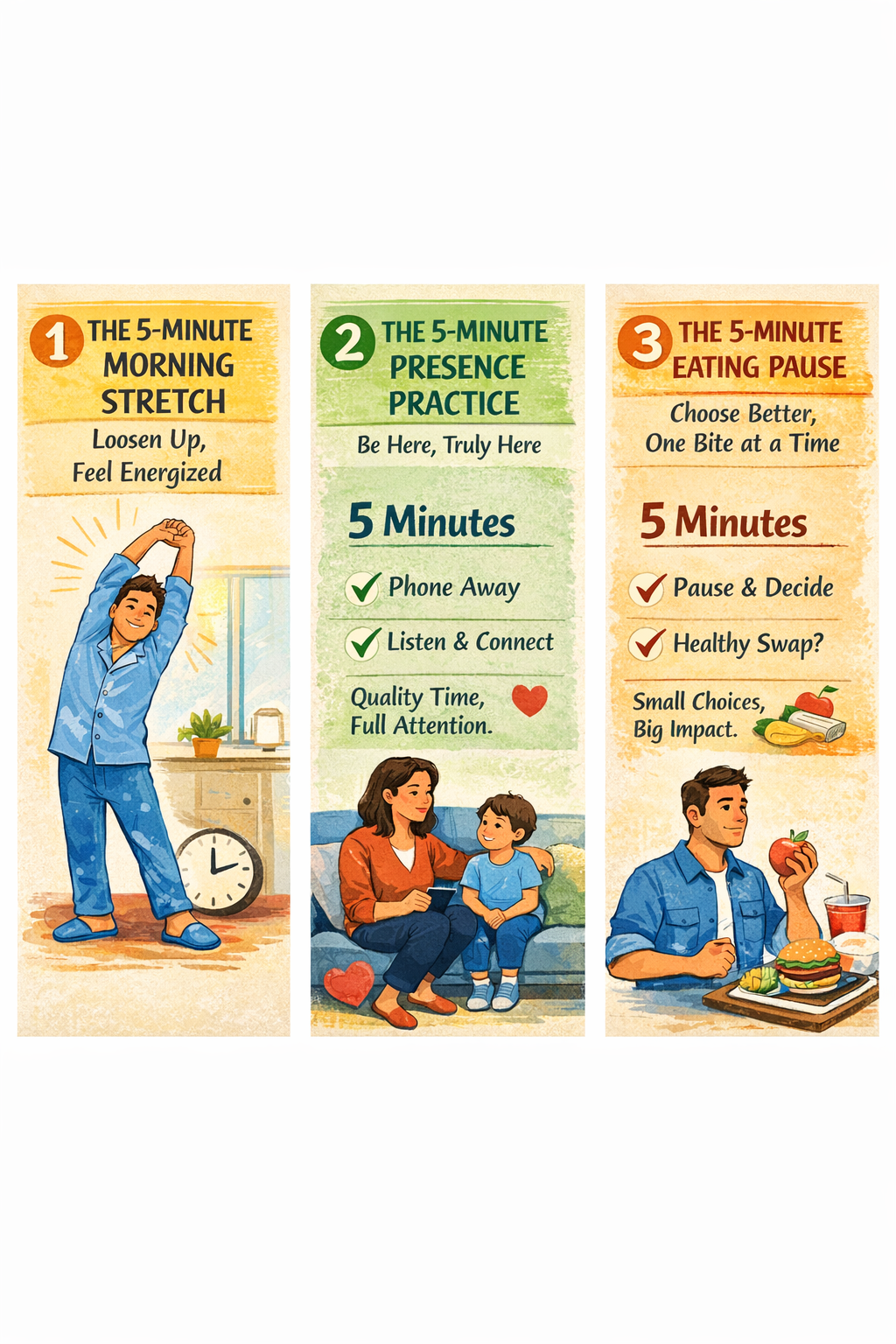
Day 1 — Move your body for its own sake. Walk for thirty minutes without your phone, without a podcast, without anything but the sensation of your body moving through the world. Notice what you notice.
Day 2 — Practice the gratitude arrest. Before you sleep, write down three things from the day that were good — not remarkable, just good. Do this without irony.
Day 3 — Feed something your mind loves, not the syllabus. Read something you are curious about purely for its own sake. A page. A paragraph. Anything. Let your mind remember that curiosity is its natural state.
Day 4 — Rest completely. Sleep eight hours without guilt. The body that is rested is not the body that is wasting time. It is the body that is investing.
Day 5 — Find something to be genuinely excited about. It does not have to be large. A conversation, an idea, a problem that interests you. Let the excitement be real.
Day 6 — Move your body in a way that gives you pleasure. Not exercise as punishment. Play. Dance badly. Stretch until your body feels like yours again.
Day 7 — Ask yourself one question, honestly: If I knew I would live to a hundred — and live well — what would I begin today that I have been postponing? Write the answer. Then consider whether the postponement is necessary.
The century is not something you wait for. It is something you build, one decision at a time, beginning with the decision to take the three ages seriously.
You were built for more than seventy years of survival. You were built to arrive at a hundred — still curious, still grateful, still alive in the full meaning of the word.
Begin now.
— Kamaruddin Ahmed Neog
메타데이터
- post_id
- 63bbcb3be73b
- slug
- are-you-living-your-life-or-just-making-a-living-63bbcb3be73b
- url
- https://medium.com/@kk785669/are-you-living-your-life-or-just-making-a-living-63bbcb3be73b
- canonical_url
- https://medium.com/@kk785669/are-you-living-your-life-or-just-making-a-living-63bbcb3be73b
- author_url
- https://medium.com/@kk785669
- status
- ok
- fetched_at
- 2026-06-22 07:15:07