Theyyam and Thira
Theyyam is a religious ritual practiced in the North Malabar region of Kerala and some parts of neighboring Karnataka. It includes a divine…
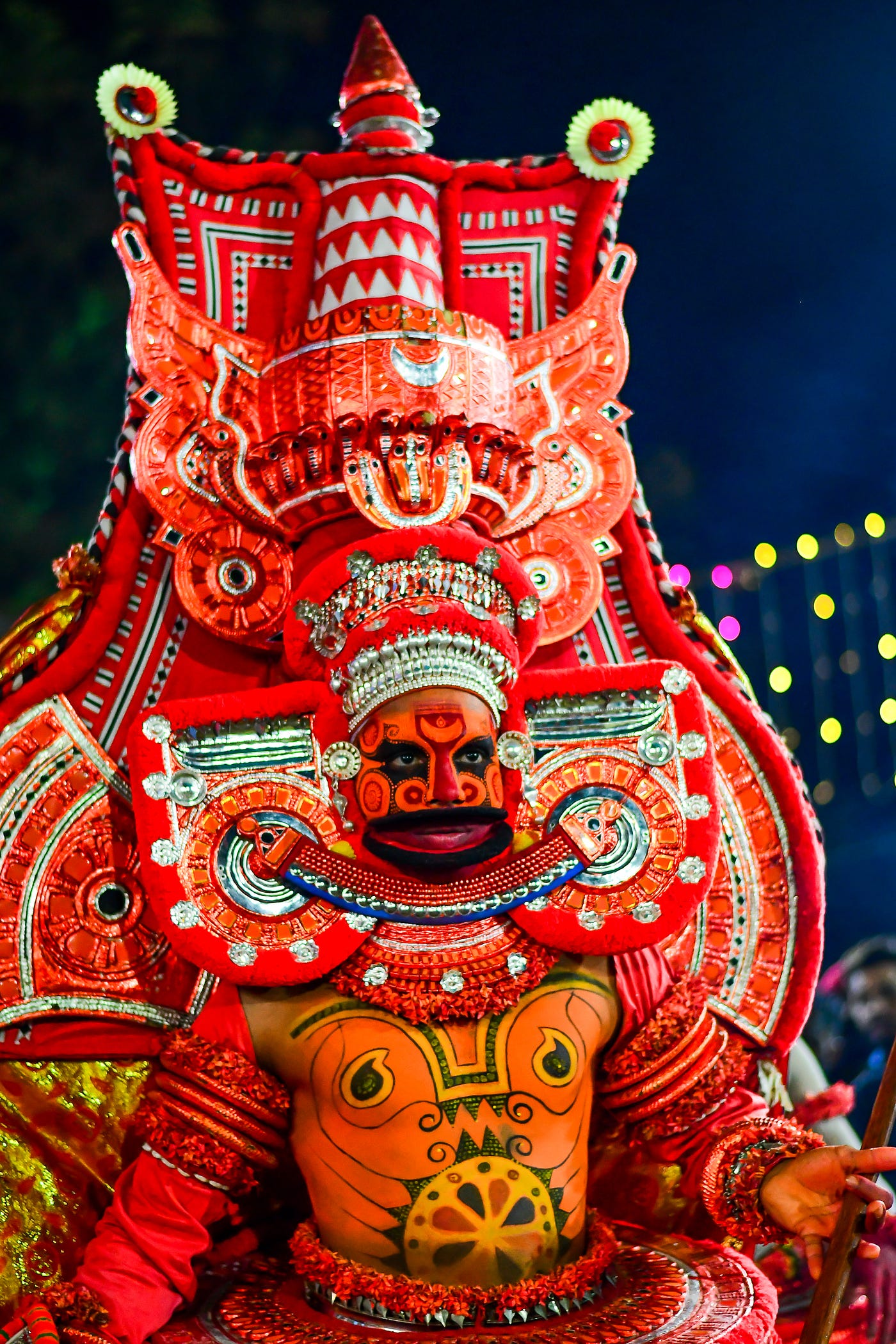
Theyyam, Photo by Shagil Kannur, CC BY-SA 4.0, https://commons.wikimedia.org/w/index.php?curid=115095664
Theyyam and Thira
Theyyam is a religious ritual practiced in the North Malabar region of Kerala and some parts of neighboring Karnataka. It includes a divine dance ritual by an elaborately costumed dancer who is considered as the deity’s oracle. A similar tradition is the Thira, which is performed in other regions of Kerala. It too is a religious dance ritual performed by elaborately costumed dancers.¹ According to at least one researcher, although it is popularly believed that Theyyam and Thira are the same art form, they are different in many aspects. For example, the dancer is considered as a representative of the deity in Theyyam, whereas he is merely possessed by the deity in Thira. Whereas the costume is important for the Theyyam, movements are more significant for the Thira.²

Bhagavathi Thira, Photo by Panavalli, CC BY-SA 4.0, https://commons.wikimedia.org/w/index.php?curid=43137274
Historians and anthropologists generally believe that Theyyam and Thira are ancient ritualistic art forms that originated among tribal communities of Kerala as part of ancestral worship, which then moved over time from tribal settings to temple courtyards when adopted by non-tribal communities.³ However, this hypothesis remains unproven because by virtue of their oral transmission, there is no concrete evidence as to their cultural origin or geographic source.⁴
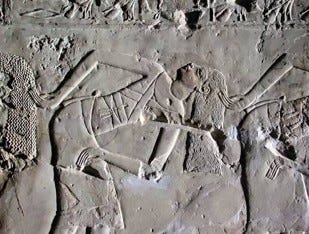
While Theyyam and Thira may lack epigraphic evidence in Kerala, there is a lot of it across the Indian Ocean in ancient Egypt. Neither Egyptologists nor Kerala’s researchers have yet studied this connection; but it exists in the linguistic history of ancient Egyptian down to Coptic and the cultural practices of the ancient Egyptians as described in their written works and monumental inscriptions.
To explain this connection, we first need to understand the star hieroglyph 𓇼 transliterated as dwꜣ by Egyptologists.⁵ In Coptic, which was the last form of the ancient Egyptian language, the middle [w] and final [ꜣ] had fallen, so that this hieroglyph had the sound [thei].⁶ In more ancient Egyptian, it may have had different pronunciations, such as [dir] (with w taking on a [i] vowel sound, and ꜣ being pronounced as [r]) or [dever] with each sound in dwꜣ articulated as a consonant.⁷ This star hieroglyph 𓇼 occurred in many ancient Egyptian words related to rituals and divinity:
𓇼𓄿𓅱𓇳, 𓇼𓄿𓀢, 𓇼𓀃, 𓇼𓄿𓇳, 𓇼𓏏𓀢, 𓇼𓄿𓏏𓏭𓀢 : to rise early (to worship), to praise, pray, worship⁸
𓇼𓇋𓇋, 𓇼𓏏𓏮𓉐𓀭, 𓇼𓏏𓏏𓉐 : divine name (he-of-the-afterlife)⁹
𓇼𓄿𓅱𓀢 : song of praise, hymn¹⁰
𓇼𓅱𓀀𓏪 : adorer, divine dancers¹¹
The star hieroglyph was also associated with the afterlife and divine beings in the afterlife, such as deified ancestors.¹² This connection with the dead is found in a book called by Egyptologists as Amduat 𓇋𓏶𓇼𓏏𓉐 translated as “that which is of the afterlife,” a funerary text that lays down a timeline of the journey of the sun through the afterlife between sunset and sunrise, between earth and sky.¹³ Thus, it is conceivable that the praise, hymns and prayers indicated by the star hieroglyph referred to some sort of ancestor worship.¹⁴ The concept of this world of afterlife appears in the oldest funerary composition from ancient Egypt, Pyramid Texts, which are attested from the late Fifth Dynasty until the Graeco-Roman period.¹⁵
In Malayalam, these Egyptian words became തേവാരം /teːʋɑːɾɑm/ (early morning worship), തേവർ /teːʋɑr/ (divine epithet), തിറ /tirɑ/ and തെയ്യം /tejjɑm/ (ritual song and dance of worship, and divine dancers). Indeed, the word തെയ്യം /tejjɑm/ appears to be derived from Egyptian 𓇋𓏶𓇼𓏏𓉐 “that which is of the afterlife,” literally a divine ancestor.

Chronologically, because the final [r] sound was dropped in the later stages of the Egyptian language, and തെയ്യം /tejjɑm/ is very close to the Coptic pronunciation [thei], it may be that തെയ്യം /tejjɑm/ is a relatively later version of തിറ /tirɑ/, having crossed over to Kerala at a later point in time. In other words, Thira came to Kerala during a time when the dance form was called as such in the ancient Egyptian language. The dance form and the language evolved in Egypt, so that when it re-entered Kerala at a later time (possibly a few centuries later), it not only looked slightly different, it also had a different name, Theyyam. Hence the similarities between Thira and Theyyam stem from their common origin in Egypt, whereas their differences are likely due to their separate timelines of entry and re-entry into Kerala.
Thus, these Egyptian words provide the links between the ancestor worship rituals of Thira and Theyyam and those of pharaonic Egypt, suggesting that these art forms originated in one of the most sophisticated ancient civilizations of human history. If at all there was a tribal origin to these art forms, such origin must have occurred not in Kerala, but in predynastic Egypt, where ancestor worship was an important part of religion.¹⁶ These rituals may also have been performed in the mortuary temples of ancient Egypt, where religious and funerary beliefs combined into one whole.¹⁷ I wonder if there is any other place in the world where so much spectacular cultural history is still living — unchanged for the most part — as it does in Kerala?
Notes
[1] https://www.keralatourism.org/artforms/poothanumthirayum/3/
[2] Rahul N.R. and Banita Behera, 2025, “Living Cultural Heritage Thira of Kerala-an Interdisciplinary Exploration,” Sampratyaya, 2(1): 94–105. DOI: 10.21276/smprt.202506.21.a8.
[3] See Rahul, “Living Cultural Heritage,” 99.
[4] See Rahul, “Living Cultural Heritage,” 99.
[5] Alan Gardiner, 1957, Egyptian Grammar — Being an Introduction to the Study of Hieroglyphs, 3rd ed., 487 (Oxford, Griffith Institute).
[6] See Gardiner, Egyptian Grammar at 487.
[7] While w was a consonant in many words, similar to the English w and v, it was also semi-vocalic. In Old Egyptian the sequences jw and wj often alternated with y /i/; w was occasionally a variant of j /i/; and in Middle Egyptian, w commonly changed to y at the end of words. In Old and Middle Egyptian, ꜣ was /r/ in some words. James Allen, 2013, The Ancient Egyptian Language — An Historical Study, 39, 43 (Cambridge: Cambridge University Press).
[8] https://thesaurus-linguae-aegyptiae.de/lemma/177930, https://thesaurus-linguae-aegyptiae.de/lemma/854584, https://thesaurus-linguae-aegyptiae.de/lemma/177920, https://thesaurus-linguae-aegyptiae.de/lemma/178070, https://thesaurus-linguae-aegyptiae.de/lemma/177960, https://thesaurus-linguae-aegyptiae.de/lemma/177990
[9] https://thesaurus-linguae-aegyptiae.de/lemma/888338, https://thesaurus-linguae-aegyptiae.de/lemma/500101, https://thesaurus-linguae-aegyptiae.de/lemma/500928, https://thesaurus-linguae-aegyptiae.de/lemma/500223, https://thesaurus-linguae-aegyptiae.de/lemma/870920, https://thesaurus-linguae-aegyptiae.de/lemma/853472
[10] https://thesaurus-linguae-aegyptiae.de/lemma/178010
[11] https://thesaurus-linguae-aegyptiae.de/lemma/178020, https://thesaurus-linguae-aegyptiae.de/lemma/178030, https://app.vega-lexique.fr/?entries=w16188
[12] 𓇼 underworld (region of afterlife), tomb. https://thesaurus-linguae-aegyptiae.de/lemma/854583; https://app.vega-lexique.fr/?entries=w16057. See also footnote 9 above.
[13] https://en.wikipedia.org/wiki/Amduat
[14] Zainab Abd El-twab Riad Khamiss, 2019, “Spiritual and Ancestral worship in Egypt during Prehistoric and early Dynastic Period,” MINBAR Magazine of Archeological Heritage, 8(1): 05–24.
[15] Silvia Zago, 2018, “Imagining the Beyond: The Conceptualization of Duat between the Old and the Middle Kingdoms,” Journal of the American Research Center in Egypt 54: 203–217.
[16] See Khamiss, “Spiritual and Ancestral Worship.”
[17] For example, the mortuary temple of Ramsses II at Abu Simbel, showcases scenes from the Amduat. Nelly Shafik Ramzy, 2015, “The Genius Loci at the Great Temple of Abu Simbel — Hermeneutic Reading in the Architectural Language of Ancient Egyptian Temples of Ramses II in Nubia,” Journal of Ancient History and Archeology 2(2): 43–57.
메타데이터
- post_id
- 63c002fcdae9
- slug
- theyyam-and-thira-63c002fcdae9
- url
- https://medium.com/@variyam-2021/theyyam-and-thira-63c002fcdae9
- canonical_url
- https://medium.com/@variyam-2021/theyyam-and-thira-63c002fcdae9
- author_url
- https://medium.com/@variyam-2021
- status
- ok
- fetched_at
- 2026-06-09 15:37:30