Why Can’t Fighter Jets Simply Fly to Space? The Science Explained
Have you ever looked at a fighter jet soaring through the sky and wondered why it cannot simply keep climbing until it reaches space…
Why Can’t Fighter Jets Simply Fly to Space? The Science Explained
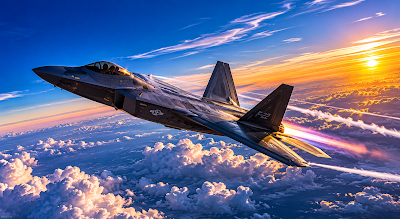
Have you ever looked at a fighter jet soaring through the sky and wondered why it cannot simply keep climbing until it reaches space? Modern fighter aircraft are among the most advanced machines ever built. They can fly faster than the speed of sound, perform incredible maneuvers, and reach altitudes far beyond commercial airliners. Yet, despite their impressive capabilities, they cannot travel into space like rockets.
The answer lies in the fundamental principles of flight, propulsion, and the nature of Earth’s atmosphere.
Where Does Space Begin?
Before understanding why fighter jets cannot reach space, we need to know where space actually begins.
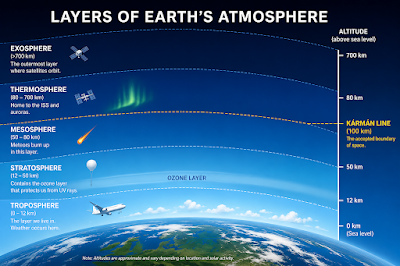
The internationally recognized boundary of space is called the Kármán Line, located approximately 100 kilometers above sea level.
To put this into perspective:
- Commercial airliners fly at around 10–12 km.
- Most fighter jets operate between 15–20 km.
- Space begins at approximately 100 km.
Even the highest-flying fighter aircraft are still very far from reaching space.
Space Has No Atmosphere
Unlike the Earth’s atmosphere, space is essentially a vacuum.
Since jet engines rely on atmospheric oxygen, they simply cannot function in space.
Rockets solve this problem by carrying both fuel and an oxidizer onboard. Because they do not depend on atmospheric oxygen, rockets can operate in space without any issues.
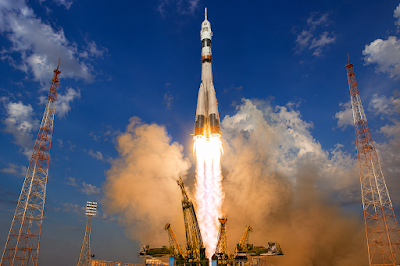
This is one of the main reasons spacecraft use rocket engines instead of jet engines.
Wings Need Air to Generate Lift
Another major challenge is lift.
Aircraft wings generate lift by moving through air. As air flows around the wing, pressure differences are created, producing an upward force that keeps the aircraft airborne.
However, at extremely high altitudes, the atmosphere becomes too thin.
With very little air available:
- Lift decreases significantly.
- Aircraft control becomes difficult.
- Wings become less effective.
Eventually, there is not enough air for the wings to support the aircraft.
Even if a fighter jet had enough fuel and engine power, its wings would stop producing sufficient lift at very high altitudes.
Speed Alone Is Not Enough
Many people assume that because fighter jets are incredibly fast, they should be able to reach space.
However, reaching space is not simply about speed.
A typical modern fighter jet can reach speeds of approximately Mach 2 to Mach 3, which is around 2,500–3,700 km/h.
A spacecraft in Low Earth Orbit travels at approximately 28,000 km/h.
This means an orbiting spacecraft travels nearly ten times faster than a fighter jet.
To remain in orbit, a spacecraft must move sideways so fast that it continuously falls around the Earth rather than back to the ground.
Fighter jets are simply not designed to achieve such speeds.
FeatureFighter JetRocketUses atmospheric oxygen Yes NoOperates in space No YesRequires wings for lift Yes NoCan reach orbit No YesMaximum altitudeLimited by atmosphere Can leave atmosphere
This comparison clearly shows why rockets are necessary for space travel.
What About Experimental Aircraft?
Some aircraft have come very close to space.
One famous example is the X-15, a rocket-powered experimental aircraft developed by NASA and the U.S. Air Force.
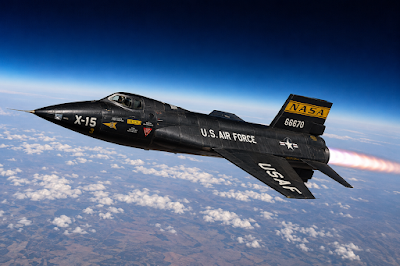
The X-15 reached altitudes above 100 kilometers, technically crossing the boundary of space.
However, the X-15 achieved this using a rocket engine rather than a traditional jet engine.
This demonstrates that conventional fighter jet technology is not sufficient for reaching space.
Future Technologies
Engineers are currently developing advanced technologies that may blur the line between aircraft and spacecraft.
Some examples include:
- Spaceplanes
- Hypersonic vehicles
- Scramjet-powered aircraft
- Reusable launch systems
These technologies could allow future vehicles to travel through both the atmosphere and space more efficiently.
Although they are promising, most are still under development and face significant engineering challenges.
Fun Fact
The fastest air-breathing aircraft ever built was the SR-71 Blackbird, capable of flying at speeds greater than Mach 3. Even this legendary aircraft could not reach space because it still relied on atmospheric air for propulsion.
Conclusion
Fighter jets cannot simply fly into space because they depend on the atmosphere for both engine operation and lift. As altitude increases, air becomes thinner, reducing engine performance and wing effectiveness. Eventually, there is not enough air for the aircraft to continue flying.
Rockets overcome these limitations by carrying everything they need onboard, allowing them to operate in the vacuum of space.
So, while fighter jets are extraordinary machines, reaching space requires an entirely different type of technology — one that only rockets can currently provide.
Key Takeaways
- Fighter jets rely on atmospheric oxygen for their engines.
- Wings require air to generate lift.
- Space begins around 100 km above Earth.
- Rockets can operate in a vacuum because they carry their own oxidizer.
- Even the fastest fighter jets cannot achieve orbital speeds.
메타데이터
- post_id
- 6407dc564e80
- slug
- why-cant-fighter-jets-simply-fly-to-space-the-science-explained-6407dc564e80
- url
- https://medium.com/@uavdash/why-cant-fighter-jets-simply-fly-to-space-the-science-explained-6407dc564e80
- canonical_url
- https://medium.com/@uavdash/why-cant-fighter-jets-simply-fly-to-space-the-science-explained-6407dc564e80
- author_url
- https://medium.com/@uavdash
- status
- ok
- fetched_at
- 2026-06-09 15:37:30