The Army That Grows While It Bleeds
Despite roughly a million casualties, Russia’s forces have swollen from 850,000 to 1.3 million troops — and could threaten NATO again…
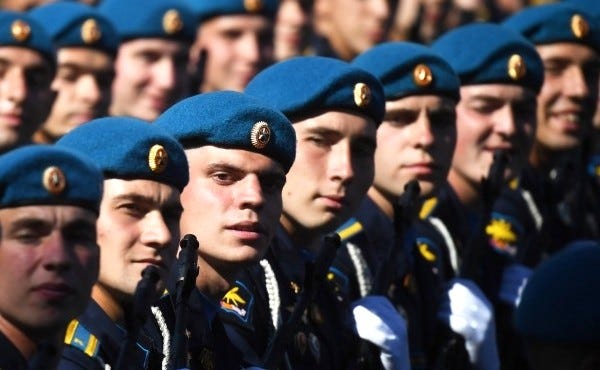
2020 Moscow Victory Day Parade
The Army That Grows While It Bleeds
Despite roughly a million casualties, Russia’s forces have swollen from 850,000 to 1.3 million troops — and could threaten NATO again within five to seven years
Russia keeps fighting a war that has simultaneously exposed the limits of its military machine and demonstrated an unsettling capacity to keep that machine running.
Ukrainian forces continue to make the war costly for Moscow, holding most of the front line and striking deep into Russian territory and its rear-area logistics.
Yet the question increasingly preoccupying Western defense planners is no longer whether Russia can win this war outright, but what kind of military will emerge from it once the fighting stops — and how quickly that military could again threaten NATO.
Michael Kofman, writing in Foreign Affairs, argues that the timeline for a meaningful Russian reconstitution is shorter than many assumed back in 2022: five to seven years for Moscow to rebuild a force capable of posing a serious threat to the alliance, with more limited options for coercion against NATO members or Ukraine available even sooner.
That estimate is grounded in a paradox. Despite catastrophic losses — at least 400,000 Russian soldiers killed, with a British intelligence assessment putting the true figure closer to 500,000, and another 600,000 to 800,000 wounded — the Russian armed forces are larger today than when the invasion began.
Prewar active personnel numbered around 850,000; today the figure is roughly 1.3 million. Many units have doubled or tripled in size, gaining dedicated drone, reconnaissance, assault, and electronic-warfare elements, and the military has stood up an entirely new branch, the Unmanned Systems Forces, mirroring a similar move by Ukraine.
Equipment tells a comparably counterintuitive story. Russia has lost more than 14,000 armored combat vehicles and over 2,000 artillery pieces since the invasion began, and its losses of air-defense systems have accelerated as Ukrainian strikes have grown more precise — a genuine long-term vulnerability, since those systems are expensive and difficult to replace quickly.
But by drawing down Soviet-era stockpiles, ramping up domestic production, and importing hardware from North Korea (which has supplied hundreds of artillery pieces), Russia has kept its armored vehicle inventory roughly at or slightly above prewar levels. Annual production of the T-90M, Russia’s most advanced tank, now exceeds 200 units, and if that pace holds, roughly half of Russia’s tank fleet could consist of T-90Ms within seven or eight years.
Drone output has scaled even faster: Russia built more than 70,000 long-range attack drones in 2025 alone, and contracts already signed for 2026 call for at least 100,000 more, with roughly 6,500 launched against Ukraine every month.
A close look at Russia’s armored vehicle reserves helps explain how this is possible without collapsing the underlying logic of depletion that many observers have repeatedly (and prematurely) proclaimed since 2022. Russia inherited a colossal Soviet stockpile after 1991 but could only afford to keep a small fraction in active service, warehousing thousands more tanks and armored vehicles — many of them left outdoors in Siberian storage yards where they slowly deteriorated.
When the invasion began, Russia had roughly 3,000 tanks in active service and another 8,500 in storage, alongside some 20,000 stored infantry fighting vehicles and armored personnel carriers. The war’s opening months were brutally costly: of the more than 3,700 tanks Russia has lost since 2022 according to open-source tracking, over a third were destroyed in 2022 alone, and nearly 670 of those in the first five months of fighting.
That rate of loss, sustained, would have exhausted Russian reserves quickly. It didn’t continue at that pace, but the cumulative drawdown has still been severe: total stored heavy equipment fell from roughly 28,000 pieces at the war’s outset to about 14,000 by late 2024, and to a low point of around 2,000 tanks and 9,650 other armored vehicles more recently, with the best-preserved and easiest-to-restore vehicles pulled first, leaving diminishing returns for whatever remains.
That scarcity forced a tactical transformation. Where Russian doctrine once emphasized mechanized columns punching through enemy lines, the proliferation of first-person-view drones and other cheap precision weapons made armor concentrations easy to detect and destroy, pushing Russian forces toward small-scale infantry infiltration — first in squads of six to eight, more recently down to one or two soldiers moving at a time — with tanks increasingly repurposed as improvised armored transports (so-called “turtle tanks”) rather than as the tip of an armored spear.
Even so, refurbishment efforts at Russia’s armor repair plants, combined with new production, appear to have pushed the overall tank fleet back above prewar numbers, albeit one skewed toward older, less capable vehicles patched together alongside newly built T-90Ms. Analysts caution that this cannot continue indefinitely: the loss of the deep Soviet legacy stockpile means Russia’s capacity to regenerate quickly after another period of high-intensity attrition will not be there in the future in anything like the same way.
None of this reconstitution has occurred without acute strain elsewhere in the system. Internal documents from Aviaremont, the state conglomerate responsible for maintaining Russia’s military aircraft under the Rostec umbrella, paint a picture of an aviation maintenance sector approaching collapse, particularly for the Kyiv-designed Antonov An-series transport aircraft that Russia has been unable to produce since losing access to Ukrainian design and supply chains after the 2014 annexation of Crimea. A December 2025 crash of an An-22 near Ivanovo, killing all seven aboard, and a March 2026 crash of an An-26 over Crimea that killed 29 people, including a senior Russian air commander, both point to a maintenance infrastructure that Russia’s own officials have privately described as no longer fit for purpose.
A report from Aviaremont’s director general to Rostec’s chief acknowledges that the primary repair facility for the An-series lacks substitutes for key imported components, lacks complete design documentation, and has no domestic source for spare parts — and states plainly that continued repairs are not viable without emergency funding that is not expected before 2029. Of roughly 368 An-series aircraft in service with Russia’s defense and security agencies, some 143 reportedly need repair work that the system cannot currently perform. The episode is a reminder that Russia’s broader reconstitution, however real in aggregate personnel and armor numbers, remains uneven and vulnerable in specific sectors where sanctions and the loss of Ukrainian industrial cooperation bite hardest.
The manpower side of reconstitution has its own distinctive machinery, and it runs less through conscription than through an improvised, quasi-commercial recruitment economy. Russia’s more than 80 regional governments, pressured by the Kremlin to deliver volunteers, now function as competing hiring hubs, contracting HR agencies that in turn rely on freelance recruiters advertising openings on Telegram and the classified-ads site Avito. Signing bonuses have climbed sharply — one analysis of data from 37 Russian regions put the average bonus, including federal payments, at roughly $25,850, with some regions like Samara offering more than $50,000 at points last year, enough to buy an apartment. Recruiters earn commissions estimated at $1,280 to $3,800 per signed contract, and some regions have budgeted tens of millions of dollars for recruitment payments, comparable to what they spend on health care and social services. This system deliberately targets men with few other options — those with debts, criminal records, unstable employment, or convictions that can be commuted through military service — and interviews collected by reporters describe recruits driven less by patriotism than by financial desperation, debt relief, or the chance to avoid prison. The system reportedly draws in roughly 30,000 volunteers a month, enough to offset a casualty rate that outside estimates place near a million killed and wounded combined. Beyond volunteer recruitment, Russia has also shifted its conscription system from twice-yearly cycles to year-round processing, in effect building a permanent pipeline into the armed forces, and German officials believe Putin is well positioned to reach his declared target of 1.5 million troops in the coming year.
RAND Corporation researchers, surveying Russian military reform history and interviewing regional security experts across Poland, Estonia, Lithuania, and Sweden, have sketched four broad pathways Russia’s postwar reconstitution might follow, while cautioning that Moscow will likely blend elements of each rather than choose one cleanly. One pathway, dubbed the Shoigu Plan, envisions Russia rebuilding beyond its pre-2022 strength with selective, targeted qualitative upgrades. A second, labeled Revisiting Old Models, would see Russia return to a pre-reform military built around mass, conscription, and heavy reliance on its nuclear deterrent, making up any technological shortfall through sheer quantity — a pathway several experts consider the most likely given Russia’s institutional preference for scale and centralized command over flexibility. A third pathway, A New, New Look, would emphasize a smaller but higher-quality force built around asymmetric capabilities and better-integrated irregular formations, though researchers judge this less probable given how deeply embedded the preference for mass remains in Russian military culture. A fourth, more radical path would involve wholesale institutional reform modeled partly on Western or Chinese operational concepts — an outcome most experts view as unlikely, since Russia’s political culture continues to punish initiative and decentralized decision-making rather than reward it. Across all four pathways, Russia’s relationships with China, Iran, Belarus, and North Korea will shape what is achievable, with China’s own risk aversion and limited appetite for propping up Russian military ambitions acting as a persistent constraint.
The war’s day-to-day violence has not slackened while these longer-term questions play out. In mid-July, Russian missile and drone strikes killed at least eight people and wounded dozens across Ukraine in a single day, including five killed when glide bombs hit a bus stop in Sumy, two killed in a missile strike on Odesa, and further casualties in Zaporizhzhia and Kharkiv. Russia’s air force reported launching six ballistic missiles, six cruise missiles, and roughly 120 drones in one overnight wave alone; Ukraine said it intercepted most of the drones and some cruise missiles but has struggled to bring down ballistic missiles, having grown critically short of the interceptors needed for its Patriot batteries. President Volodymyr Zelenskyy used the moment to press allies for faster delivery on existing arms agreements, including a recent understanding with President Trump to let Ukraine produce its own Patriot interceptors domestically. Ukraine, for its part, has kept up pressure on Russian logistics well behind the front, with drone forces claiming dozens of strikes on fuel tankers and support vessels in the Sea of Azov in a single week — part of a deliberate campaign to strangle Russian supply lines and, Zelenskyy has said, push Moscow toward negotiations, though Vladimir Putin has shown no public sign of softening his position.
That persistence has been matched by continued adaptation on both sides, particularly in unmanned systems. Russia’s Rubicon unit, established in mid-2024 as an advanced center for drone warfare, has become something of a model for the wider force, focused on hunting Ukrainian drone operators, electronic-warfare assets, and logistics some ten to forty kilometers behind the front rather than directly supporting infantry assaults; the concept proved itself first during the campaign to retake Kursk before being expanded across the eastern front. A newly formed 50th Unmanned Systems Brigade is expected to become the backbone of Russia’s dedicated drone branch, flying long-range Geran attack drones against fuel depots, railways, and power infrastructure deep behind Ukrainian lines. Analysts describe Russia’s adaptation cycle — the time it takes to copy and scale an adversary’s tactic or technology — as running three to four months, slower than Ukraine’s own innovation pace but capable of being rolled out across a very large force once perfected. To cope with the loss of Starlink-enabled drone links after access was curtailed in February, Russian forces have invested in mesh networking technology that lets drones relay signals to one another, restoring some of the range and coordination that had been lost, while newer autonomous drone variants reportedly use terrain-following navigation and onboard computers rather than radio control, making them harder to jam or detect. Russia has also begun fitting warships, including the cruiser Varyag and several other major vessels, with a combined radar-and-jamming system explicitly designed to counter first-person-view and quadrotor drones, a direct response to Ukraine’s expanding use of naval drones and unmanned surface vessels against Russian ships beyond the Black Sea.
Western governments have responded with their own mix of military signaling and financial commitment, even as political fault lines widen over how far that support should extend. Poland, Lithuania, and France recently ran large joint exercises near the Suwałki Gap — the narrow strip of territory connecting the Baltic states to the rest of NATO and widely regarded as one of the alliance’s most exposed points — testing Polish-made GOBLIN ground robots for reconnaissance and casualty evacuation under simulated combat conditions. At the NATO summit expected in Ankara, alliance members are reportedly set to commit to new multibillion-dollar arms-production contracts alongside a fresh pledge of roughly 70 billion euros in military support for Ukraine, with a similar sum promised for the following year, in a declaration expected to formally describe Russia as a long-term threat. Smaller but steady contributions continue to flow through the PURL initiative, which channels American weapons to Ukraine via NATO members; Finland recently added 40 million euros to strengthen Ukrainian air defense, following a similar contribution from Sweden. The European Union, for its part, extended its economic sanctions regime against Russia for another year in late June, continuing restrictions first imposed in 2014 and substantially broadened after 2022, covering trade, finance, energy, and dual-use technology, even as EU member states remain divided over some of the more contentious elements of a proposed twenty-first sanctions package — Italy and France, for instance, have resisted a blanket entry ban on former Russian soldiers, worried it would be difficult to administer fairly and could slide into a broader ban on Russian nationals generally.
That divide reflects a wider and more uneven European mood toward the war’s human fallout. Denmark has moved to tighten residence rules for Ukrainian men of conscription age, requiring proof of exemption from Ukraine’s mobilization laws before granting or renewing protected status — a shift that, if enacted, would apply to applications filed from late June onward. At the same time, Ukraine’s own diplomatic and economic position has shown signs of consolidation: a donor conference in Gdańsk produced some 160 agreements worth more than 10 billion euros, including a first tranche of a new EU financial instrument and a multibillion-dollar World Bank agreement, alongside new EU and European Investment Bank financing for housing, transport, and road reconstruction in front-line regions. French President Emmanuel Macron has pointed to a subtler but significant shift in the underlying diplomatic architecture, noting that the United States, for the first time, agreed to G7 language describing itself not as a neutral mediator in the war but as a partner backing Ukraine’s territorial integrity, military and energy assistance, and continued sanctions on Russia — a marked change from Washington’s earlier posture.
Undergirding all of this is a deeper and more unsettled debate about the credibility of American security guarantees more broadly, one that reaches well beyond Ukraine. Jennifer Lind and Daryl Press argue in Foreign Affairs that the extended nuclear deterrence system built during the Cold War — under which allies forwent their own nuclear arsenals in exchange for American protection — no longer rests on stakes high enough to make Washington’s threat of nuclear retaliation credible, particularly as the Trump administration frames alliance commitments in narrowly transactional terms. That erosion is felt acutely in South Korea, which already possesses much of the delivery infrastructure an independent nuclear arsenal would require, and in eastern Europe, where anxiety about American staying power has pushed France and the United Kingdom to consider expanding their roles within NATO’s nuclear-sharing arrangements, potentially moving from a system in which only the US president can authorize the release of shared nuclear weapons to one in which any of three national leaders could do so.
Alexander Gabuev, writing separately, argues that Europe’s response to a less reliable Washington should include direct, high-level diplomacic engagement with the Kremlin itself — something European leaders have mostly avoided since Putin’s pre-invasion assurances to Macron and then-Chancellor Olaf Scholz turned out to be false. He proposes a coalition led by France, Germany, and the United Kingdom, joined by an eastern European state such as Finland, opening a confidential channel to Putin aimed not at ending the war outright but at establishing crisis guardrails, managing hybrid incidents, and probing whether a ceasefire in Ukraine might eventually become possible — while making unmistakably clear that Europe’s own rearmament will continue as long as Russia remains a threat.
Taken together, these threads point toward a Russian military that is simultaneously more depleted and more experienced than the one that crossed into Ukraine in February 2022 — one that has lost perhaps a million soldiers killed or wounded, cannot fully maintain parts of its existing aircraft fleet, and depends on a recruitment economy that essentially monetizes the desperation of its most economically vulnerable citizens, yet has still grown in overall size, expanded its drone and precision-strike capacity dramatically, and demonstrated a persistent, if uneven, capacity to learn from the battlefield.
Whether that translates into a serious renewed threat to NATO within five to seven years, as Kofman argues, or takes longer under the weight of demographic decline, labor shortages, and a stagnating wartime economy, the consensus among the analysts and researchers surveyed here is that reconstitution is not a matter of if but of when — and that the shape it ultimately takes will be determined as much by decisions still being made in Moscow, Washington, and European capitals as by anything that has already happened on the battlefield.
Sources and Further Readings
[embed]The Next Russia Threat Moscow's military power after Ukraine.www.foreignaffairs.com
메타데이터
- post_id
- 640945f24b42
- slug
- the-army-that-grows-while-it-bleeds-640945f24b42
- url
- https://medium.com/the-geopolitics-report/the-army-that-grows-while-it-bleeds-640945f24b42
- canonical_url
- https://medium.com/the-geopolitics-report/the-army-that-grows-while-it-bleeds-640945f24b42
- author_url
- https://medium.com/@jens_sorensen_geopol.
- status
- ok
- fetched_at
- 2026-07-14 16:41:29