I Built an Integrated Algal Biorefinery That Produces Both Bioplastic and Biofuel
An provoking ideology of using algae and other materials to replace plastic and fuel and control environment diversity
I Built an Integrated Algal Biorefinery That Produces Both Bioplastic and Biofuel
A Student-Led Research Project Exploring Circular Sustainability Through Algae
By Monish S
Photo by James Lee on Unsplash
The Problem That Started Everything
Every year, humanity produces more than 400 million tonnes of plastic waste. Most of it is non-biodegradable, difficult to recycle, and eventually ends up in oceans, landfills, or burned into the atmosphere. At the same time, fossil fuel dependency continues to increase global carbon emissions and environmental damage.
For a long time, I kept asking myself a simple question:
What if a single biological system could help solve both problems at the same time?
That question eventually led me to algae.
Not just as a biofuel source. but as a biodegradable material. But as the foundation of a complete circular biorefinery system. and for the most important part is that the algae which was floating around the water source like the ocean,seas, lakeside, riversides, etc which ended up blocking the huge amount of sun race into the water source which obnoxious and make the underwater organisms hard to get the sun rays and ended up losing there potential to build there own food ( autotrophic organisms) and this makes life hard and further impossible to make living in this condition for long context and not only this the probl but it’s also a good resource and some may get the advantages and some disadvantage on this type of patten but the odds are high in disadvantage so we move to further part.
The Core Idea
My project focuses on creating an integrated algal biorefinery capable of producing:
Bioplastic films
Biodiesel (biofuel)
and reusing residual biomass to minimize waste.
The system is designed around a very important concept:
Zero-Waste Biomass Utilization
In most existing systems, algae is used only for oil extraction. Once the oil is removed, the leftover biomass is often discarded.
In my approach, that residual biomass is not treated as waste.
Instead, it becomes a raw material for biodegradable plastic production.
This creates a dual-output sustainability model:
Algae Biomass ↓ Oil Extraction → Biodiesel ↓ Residual Biomass ↓ Bioplastic Formation
This means the same biological feedstock can contribute to both renewable energy and eco-friendly material production.
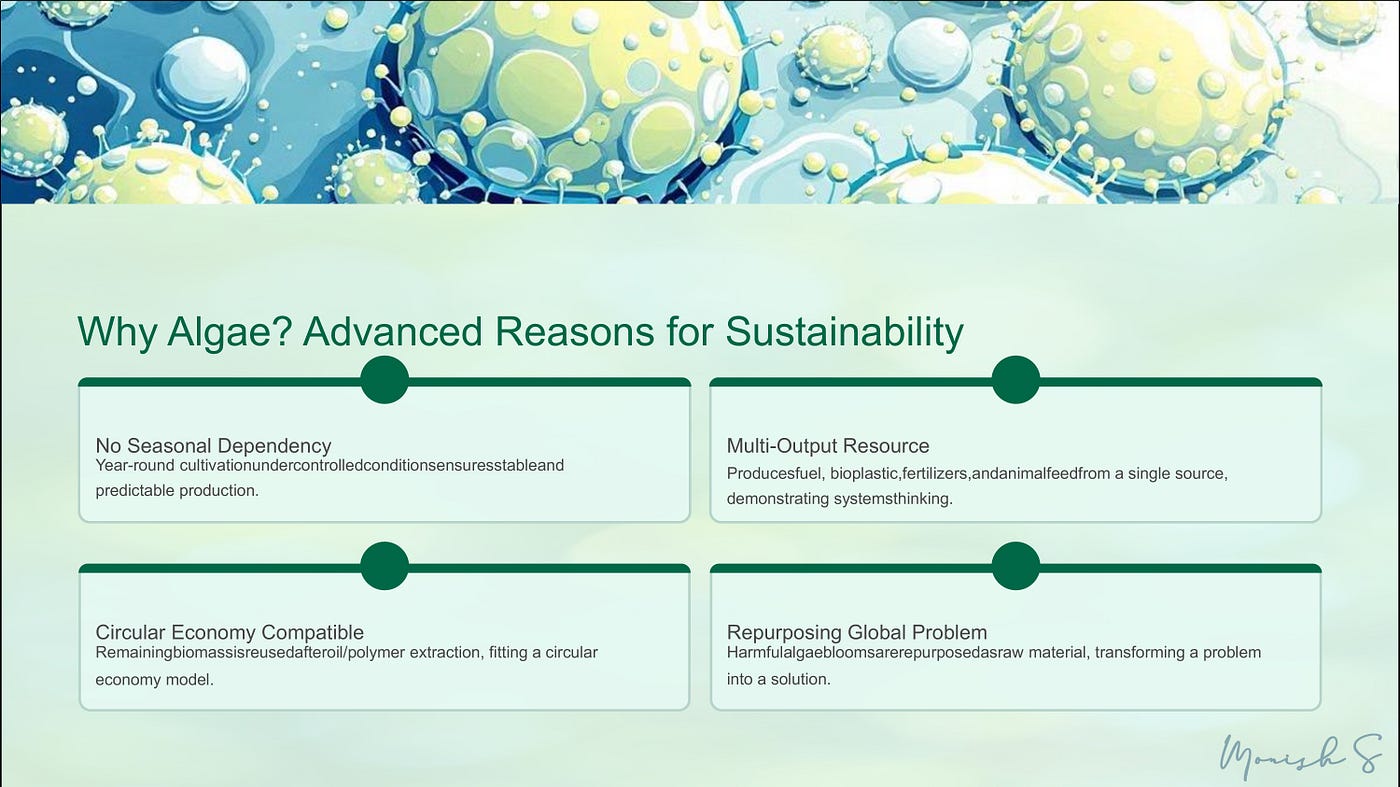
*This slide shows the reason for choosing the alage
Why Algae?
Algae is one of the most promising renewable biological resources available today.
Unlike many plant-based feedstocks, algae:
grows rapidly,
does not require fertile agricultural land,
can grow in wastewater,
has high lipid productivity,
and absorbs carbon dioxide efficiently.
I studied three primary algae categories during the project:
- Microalgae
Single-celled organisms with rapid growth cycles and high lipid content. Ideal for biodiesel production.
- Macroalgae
Large seaweed-based biomass with strong structural applications. Useful for polymer systems.
- Oil-Rich Algal Strains
Specialized species selected for superior oil productivity and extraction efficiency.
These characteristics make algae an excellent candidate for sustainable biopolymer and biofuel systems.

*Three different types of algae that we separated during our study
Building the Bioplastic
The bioplastic component of the project was developed using a combination of:
algal biomass,
starch,
agar,
glycerol,
sodium carboxymethyl cellulose,
hemicellulose,
and peptone.
The goal was to create a biodegradable material that was both:
flexible,
and mechanically stable.
Approximate Composition
Algae biomass: ~40%
Starch: ~25%
Agar: ~12%
Glycerol: ~8%
Hemicellulose: ~7%
Sodium CMC: ~4%
Peptone: ~4%
The Process
The algae was first cleaned using dilute acid washing and controlled rinsing methods to reduce contamination.
The polymer matrix was then prepared by gradually heating water under controlled low-temperature conditions.
Starch and algal biomass were blended carefully to achieve partial gelatinization and homogeneous dispersion.
Agar was introduced as a gelling agent while glycerol acted as a plasticizer to improve flexibility.
To enhance structural integrity:
sodium CMC improved film consistency,
hemicellulose improved tensile properties,
and peptone contributed to matrix stability.
The final slurry was cast into flat molds and dried using a combined solar-curing and ambient-curing process.

*An over view of algae to plastic ( not edible)
After curing, the material formed a flexible biodegradable sheet.
Results From the Bioplastic System
The produced films showed:
moderate flexibility,
good surface uniformity,
and visible structural integrity.
Estimated properties:
Tensile strength: ~6–12 MPa
Elongation: ~12–25%
Film thickness: ~0.8–2.5 mm
The material performed best when the glycerol concentration remained within controlled limits.
Excessive plasticizer concentration increased softness but reduced structural strength.
Additional strengthening agents such as sorbitol or alternative DOP-based additives may further improve durability in future versions.
Producing Biodiesel From Algae
The second pathway of the project focused on extracting fuel from algal lipids.
The process involved:
alkaline catalysts,
alcohol-based transesterification,
and solvent-assisted extraction.
Methanol and ethanol were used alongside sodium hydroxide and potassium hydroxide catalysts.
Hexane-assisted extraction improved separation efficiency.
After settling for approximately 72 hours, phase separation occurred naturally.
The upper layer consisted primarily of oil-rich biodiesel fractions.
Estimated Fuel Results
The biodiesel system produced:
approximate yields of ~32–48%,
stable combustion characteristics,
and visible flame sustainability.
The fuel exhibited properties similar to low-grade biodiesel systems and demonstrated proof-of-concept viability for small-scale energy applications.
Potential applications include:
industrial heating,
household fuel systems,
bioenergy generation,
transportation fuel blending,
and future aviation fuel research.

*An overview of algae to bio-fuel
What Makes This Different?
Many systems focus only on:
biofuel,
or biodegradable plastic.
This project combines both.
The most important innovation is the reuse of residual biomass.
Instead of discarding post-extraction algae, the system converts it into bioplastic feedstock.
That significantly improves overall biomass utilization efficiency.
This approach supports the principles of:
circular economy,
sustainable materials engineering,
and integrated biorefinery design.
Challenges I Faced
One of the biggest challenges was balancing:
flexibility,
strength,
and drying stability.
If the material contained too much moisture, it became weak. If the glycerol concentration became too high, it lost rigidity. If the drying conditions were inconsistent, structural deformation occurred.
Another challenge involved odor control.
Improper reaction conditions produced unpleasant degradation smells, which indicated incorrect processing.
Proper reactions produced more characteristic chemical and dried-algae odors associated with methanol and alkaline catalyst systems.
The Bigger Vision
I do not see this project as only a science experiment.
I see it as a foundation.
A future system where:
renewable fuel,
biodegradable packaging,
and biological waste reuse
can all exist within one integrated sustainable platform.
In the future, this concept could evolve into:
industrial algal biorefineries,
sustainable packaging industries,
carbon-neutral materials,
or next-generation renewable manufacturing systems.
Future Improvements
Future versions of this research could include:
FTIR spectroscopy analysis,
GC-MS fuel characterization,
biodegradation testing,
water resistance optimization,
mechanical stress analysis,
and large-scale photobioreactor cultivation.
I also believe machine learning and AI-assisted optimization could eventually improve biomass productivity and polymer performance.
Final Thoughts
This project started with curiosity.
But during development, I realized something important:
Nature already contains many of the systems we need.
The challenge is learning how to engineer them responsibly.
Algae may appear simple. But inside that biomass exists the potential for:
renewable fuel,
biodegradable materials,
carbon capture,
and circular manufacturing.
This is only the beginning.
Some of the applications of both bio-plastic and bio-fuel are listed below as image :

Image representing the application of bio- plastic

Image representing the applications of bio-fuel
Contributors :
I appreciate everyone for your unwavering support and help during this project in my high school.
메타데이터
- post_id
- 645dfb1df3e4
- slug
- i-built-an-integrated-algal-biorefinery-that-produces-both-bioplastic-and-biofuel-645dfb1df3e4
- url
- https://medium.com/@monishshq/i-built-an-integrated-algal-biorefinery-that-produces-both-bioplastic-and-biofuel-645dfb1df3e4
- canonical_url
- https://medium.com/@monishshq/i-built-an-integrated-algal-biorefinery-that-produces-both-bioplastic-and-biofuel-645dfb1df3e4
- author_url
- https://medium.com/@monishshq
- status
- ok
- fetched_at
- 2026-06-22 12:55:45