10 important facts about Ramadan you should know before starting fast in Ramadan 2026
“Innamal a‘malu binniyat” (Sahih Bukhari)
10 important facts about Ramadan you should know before starting fast in Ramadan 2026
“Innamal a‘malu binniyat” (Sahih Bukhari)
{“Beshak Har amal ka daro madar niyat par hai”}
The Prophet Muhammad ﷺ taught us that actions are judged by intentions. This hadith reminds us that what truly matters in the sight of Allah is the sincerity behind our deeds.
To be a true Muslim, it is not enough to perform good actions outwardly; our hearts must also be pure and sincere for the sake of Allah.
As Muslims, we observe Ramadan every year, but many of us follow its rituals without fully understanding its true purpose.
Knowing why Ramadan is special helps us practice it with sincerity, awareness, and gratitude.
To understand the true value of Ramadan, it is important to look at its facts through the guidance of the Quran and authentic Hadith, along with its psychological and physical benefits.
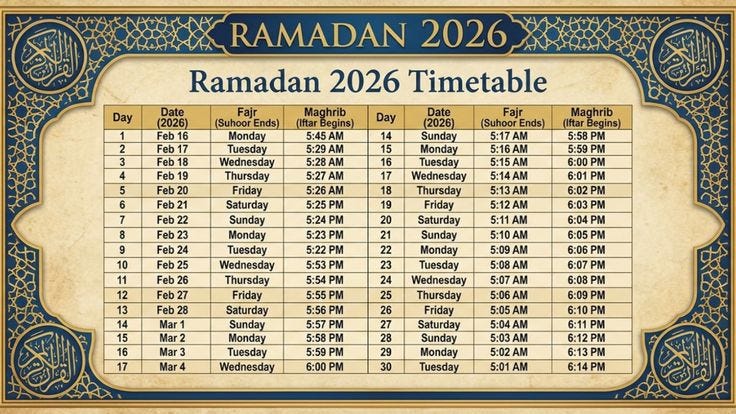
Date and Calendar for the Ramadan 2026
Facts About Ramadan
Ramadan is a month of forgiveness, hope, purity, and mercy.
It is a time when believers try to become closer to Allah through **fasting, prayer, and good deeds.**
This month is full of barakah (blessings), and words alone are not enough to describe its importance.
Allah has gifted this month to the entire Ummah as an opportunity to purify the soul, seek forgiveness, and begin a new chapter in life after Ramadan.
Facts You should know:
It teaches how to live life as a true Muslim
It reminds us of our obligations toward Allah
It builds discipline, patience, and gratitude
Acts of worship are multiplied in reward
During Ramadan, every good deed, whether prayer, **charity**, or kindness, is rewarded many times more than usual, making it a unique chance for spiritual growth.
“The month of Ramadan in which the Quran was revealed as guidance for mankind and clear proofs of guidance and criterion.” (Surah Al-Baqarah 2:185)
This verse clearly teaches us that the Quran was revealed in the month of Ramazan, and this is guidance of all Muslims.
Hadith (Paragraph) There is a hadith of Sahih Muslim.
The Messenger of Allah ﷺ said:“The Quran and fasting will intercede ( Shifah ) for a servant on the Day of Judgment.” (Sahih Muslim) Translation: On the Day of Judgment, the Quran will speak in favor of the person who regularly recited it.
We can see and understand reading the Quran that it’s not just beneficial and fulfilling the obligation in this world; this is our (Aamal) for the hereafter.
Psychological and Physical Benefits:
Psychological Benefits Brings inner peace and emotional stability
Reduces stress through reflection and remembrance of Allah
Improves focus and mindfulness
Strengthens hope, patience, and positivity Increase Barakah
Physical & Lifestyle Benefits
Reduces mental fatigue through spiritual calm
Improves sleep quality when paired with structured worship
Promotes healthier habits by limiting distractions
**Fasting (Sawm) **is a central practice of Ramadan that goes beyond avoiding food and drink.
It helps build discipline, patience, and spiritual awareness.
Learn more about the purpose, rules, and benefits of fasting in our complete Sawm guide.
Suhoor is the pre-dawn meal taken before starting the fast.
Islam encourages Suhoor because it carries both spiritual and practical benefits.
…Eat and drink until the white thread of dawn becomes clear to you from the black thread of night…” (Surah Al-Baqarah 2:187)
This verse shows that eating before dawn is permitted and forms the basis of Suhoor.
Hadith reference: The Messenger of Allah ﷺ said:
“Take Suhoor, for there is blessing in Suhoor.” (Sahih Bukhari, Sahih Muslim)
Psychological and Physical Benefits:
Psychological Benefits
Creates mental readiness for fasting
Reduces stress and anxiety during the day
Improves focus and patience
Encourages following the Sunnah with intention
Physical Benefits
Provides energy for long fasting hours
Helps maintain hydration
Prevents weakness and dizziness
Supports better daily routine during Ramadan
**Five time prayer (Namaz) is the daily act of worship that connects a Muslim directly with Allah.**
Performing Salah regularly builds discipline, strengthens faith, and keeps a believer mindful of Allah throughout the day.
During Ramadan, offering the five daily prayers with sincerity increases spiritual awareness and brings consistency to a Muslim’s worship
Aftaar (Iftar)
Aftaar is the moment when a fasting person breaks the fast at sunset.
It is a time of gratitude, relief, and connection with Allah after a full day of patience and self-control.
Islam teaches us to keep Aftaar simple and begin it with remembrance of Allah.
Reference from the Quran
Allah says in the Quran:
“And eat and drink until the white thread of dawn becomes distinct to you from the black thread, then complete the fast until sunset.” (Surah Al-Baqarah 2:187)
This verse clearly indicates that fasting ends at sunset, which is the time of Aftaar. It shows that Islam follows balance and ease, not hardship.
Reference from Hadith (Bukhari & Muslim)
The Messenger of Allah ﷺ said:
“The people will remain upon goodness as long as they hasten to break the fast.” (Sahih Bukhari & Sahih Muslim)
This Hadith teaches that breaking the fast on time is a Sunnah and a sign of obedience to Allah.
Another Hadith states:
“The fasting person has a supplication that is not rejected at the time of breaking the fast.” (Sahih Muslim)
This highlights the spiritual importance of making dua at Aftaar.
Psychological Benefits of Aftaar
- Creates a sense of relief and emotional satisfaction after restraint
- Strengthens patience and self-control
- Increases gratitude by appreciating simple food
- Enhances mindfulness through dua and remembrance of Allah
Physical & Lifestyle Benefits
- Helps restore energy levels after fasting
- Supports better eating discipline when Aftaar is kept simple
- Encourages healthier food choices
- Helps regulate daily routine and meal timing
Although Tarawih is not mentioned by name in the Quran, Allah encourages night prayer and extra worship:
“And during a part of the night, pray with it as an additional prayer for you.” (Surah Al-Isra 17:7
This verse supports the concept of night worship, which Tarawih beautifully represents during Ramadan.
Reference from Hadith (Sahih Bukhari & Muslim)
The Messenger of Allah ﷺ said:
“Whoever stands in prayer during Ramadan with faith and seeking reward, all of his previous sins will be forgiven.” (Sahih Bukhari & Sahih Muslim)
This Hadith highlights the spiritual reward of praying Tarawih with sincerity.
Tarawih: The Night Prayer of Ramadan
Tarawih is a special voluntary night prayer performed only during the month of Ramadan after the ‘Isha prayer.
Tarawih is not an obligation like the five daily prayers, but it is a highly recommended Sunnah that carries great reward.
It was practiced by the Prophet Muhammad ﷺ and later established in congregation by Umar ibn Al-Khattab رضي الله عنه to unite the Ummah in worship.
While the Quran does not mention Tarawih by name, it repeatedly praises those who worship Allah during the night:
“They used to sleep little of the night, and before dawn they would seek forgiveness.” (Surah Adh-Dhariyat 51:17–18)
The Messenger of Allah ﷺ said:
“Whoever stands (in prayer) during Ramadan with faith and hoping for reward, his previous sins will be forgiven.” (Sahih Bukhari & Sahih Muslim)
This Hadith clearly shows that Tarawih is a means of forgiveness when performed sincerely.
The Prophet ﷺ himself prayed Tarawih for several nights in Gathering of people
but later prayed it individually to ensure it would not become obligatory upon the Ummah.
How Many Rak‘ahs in Tarawih?
There is flexibility in the number of rak‘ahs:
- The Prophet ﷺ generally prayed 8 rak‘ahs followed by Witr
- Many mosques pray 20 rak‘ahs, based on the practice of the companions
Both practices are valid, and the focus should be on sincerity, patience, and reflection, not numbers.
Open the Doors of Jannah
Ramadan is the month in which Allah opens the doors of Jannah (Paradise) for His believing servants.
This shows the special mercy and blessings that Allah grants during this holy month.
It is a time when good deeds are more accepted, and opportunities for reward are increased.
Reference from Hadith (Sahih Bukhari & Sahih Muslim)
The Messenger of Allah ﷺ said:
“When Ramadan begins, the gates of Jannah are opened, the gates of Hell are closed, and the devils are chained.” (Sahih Bukhari & Sahih Muslim)
This Hadith clearly explains the spiritual environment of Ramadan, where Allah makes the path toward goodness easier for believers.
Month of Charity
Ramadan is known as the month of charity, where giving becomes an essential part of worship.
Muslims are encouraged to help the needy, support the poor, and share their blessings with others.
Acts of charity during Ramadan carry greater reward and strengthen compassion, generosity, and social responsibility within the community. To know more, click here.
Allah encourages believers to seek forgiveness and mercy, and Ramadan is the most blessed time to do so.
While the Quran doesn’t mention “Month of Forgiveness” as a phrase, it repeatedly connects repentance and forgiveness with sincere worship, which becomes more intense and rewarded during Ramadan. For example, Allah says:
“…Our Lord! Forgive us our sins and expiate from us our misdeeds, and cause us to die with the righteous.” (Surah Aal-Imran 3:16)
the Prophet Muhammad ﷺ directly linking Ramadan worship and forgiveness:
1. Forgiveness for those who fast with faith
“Whoever fasts Ramadan out of sincere faith and hoping for reward, his previous sins will be forgiven.” (Sahih Bukhari)
This is one of the most reliable Hadiths showing that fasting in Ramadan, when done with true faith becomes a means of erasing past sins.
2. Prayer in Ramadan leads to forgiveness
“Whoever stands (in prayer) during Ramadan with faith and in hope of reward, his previous sins will be forgiven.” (Sahih Bukhari & Sahih Muslim)
This highlights that not only fasting but also night prayers (like Tahajjud or Tarawih) in Ramadan bring forgiveness from Allah.
Last 10 Days of Ramadan
The last ten days of Ramadan are the most sacred and spiritually powerful days of the entire month.
During these days, the Prophet Muhammad ﷺ increased his worship, focused on prayer and recitation of the Quran, and distanced himself from worldly distractions.
These days are a final opportunity for believers to seek forgiveness, mercy, and closeness to Allah.
Muslims are encouraged to spend more time in worship, make sincere dua, give charity, and prepare themselves for **Laylatul Qadr**, which falls within these blessed nights.
Aisha (RA) reported:“When the last ten nights of Ramadan began, the Prophet ﷺ would stay awake at night, wake his family, strive harder in worship, and tighten his waist belt.” (Sahih Bukhari & Sahih Muslim)
Laylatul Qadr (The Night of Power)
**Laylatul Qadr is the most blessed night of the year and falls within the last ten nights of Ramadan.**
It is the night on which the Quran was first revealed, and its worship is greater than worship performed over a thousand months.
Allah’s mercy, forgiveness, and blessings descend in abundance on this night.
Because the exact date is hidden, Muslims are encouraged to seek **Laylatul Qadr** throughout the odd nights of the last ten days.
Reference from the Quran
Allah says:
“Laylatul Qadr is better than a thousand months.” (Surah Al-Qadr 97:3)
Key Takeaways
- Ramadan is not just about avoiding food and drink; it is a month of spiritual growth and self-purification.
- The Qur’an was revealed in Ramadan, making it the best time to reconnect with divine guidance.
- Fasting builds discipline, patience, gratitude, and awareness of Allah.
- Rewards for good deeds are multiplied, giving Muslims a powerful opportunity to increase worship.
- Suhoor and Iftar are not just meals; they carry blessings, structure, and spiritual meaning.
- Tarawih and night prayers bring forgiveness and strengthen faith.
- The doors of Jannah are opened, and Allah’s mercy becomes more accessible during this month.
- Charity and kindness are highly encouraged and bring greater reward in Ramadan.
- The last ten nights are the most sacred, especially Laylatul Qadr, which is better than a thousand months.
- Ramadan is a chance to reset your heart, improve your habits, and begin a stronger relationship with Allah.
FAQs
1. Will Ramadan 2026 be a moderate fasting season?
The length of fasting depends on the time of year and location. In 2026, Ramadan is expected to fall in late winter/early spring in many regions, so fasting hours may be moderate compared to summer months.
2. When is Ramadan 2026?
Ramadan 2026 is expected to begin around mid-February 2026 (subject to moon sighting).
3. How will Ramadan 2026 affect Muslims?
Muslims will adjust their daily routine to include Suhoor (pre-dawn meal), fasting during the day, increased prayers, Quran recitation, and charity.
4. When is Eid 2026?
Eid al-Fitr 2026 is expected to be in mid-March 2026, depending on the sighting of the moon.
Reference:
- https://www.islamicfinder.org/special-islamic-days/ramadan-2026/
- https://www.hindustantimes.com/lifestyle/festivals/ramadan-2026-timetable-when-is-ramadan-know-correct-date-and-prayer-timings-for-saudi-arabia-india-uk-and-us-101770116707739.html
- https://www.ndtv.com/offbeat/ramadan-2026-timetable-first-roza-date-in-india-sehri-and-iftar-timings-10980704
- https://www.islamicfinder.org/special-islamic-days/ramadan-2026/
메타데이터
- post_id
- 64798e5dc28b
- slug
- 10-important-facts-about-ramadan-you-should-know-before-starting-fasting-ramadan-2026-64798e5dc28b
- url
- https://medium.com/@merihayat/10-important-facts-about-ramadan-you-should-know-before-starting-fasting-ramadan-2026-64798e5dc28b
- canonical_url
- https://medium.com/@merihayat/10-important-facts-about-ramadan-you-should-know-before-starting-fasting-ramadan-2026-64798e5dc28b
- author_url
- https://medium.com/@merihayat
- status
- ok
- fetched_at
- 2026-07-13 06:23:13