The Charity Mirage: When the Donation Bin Feeds a Desert
You donate a clean conscience. They receive the landfill.
The Charity Mirage: When the Donation Bin Feeds a Desert
You donate a clean conscience. They receive the landfill.

Photo by Zulfi A on Unsplash
You fill a bag. Old jeans, a coat the children grew out of, three shirts that never fit the way the screen promised. You carry it to the container on the corner, the one with the smiling logo of a charity you half recognize, and you feed the bag through the slot. Somewhere a person who needs a coat will get a coat. The loop closes. You walk home lighter, and not only by the weight of the bag.
The same week, a clothing brand invites you to drop your worn garments into a collection box by the fitting rooms. Recycle them, the sign says. Give them a second life. You comply, because the alternative is the bin, and the bin feels like a small private failure.
Both gestures rest on the same belief, that the clothing goes somewhere good. The belief is the product. What the clothing actually does, once it leaves your hands, is a different matter, and it ends a long way from the corner where you let it go.
The gesture and its alibi
Start with the number that dissolves the picture. In the United States, only about one fifth of the clothing handed to charities is resold in those charities’ own shops. The other eighty percent enters a commercial chain of textile recyclers, graders, and brokers who sort it, bale it, and move it on. The charity is mostly a collection point, not a destination. The garment you imagined warming a neighbour becomes, with high probability, a unit of weight in a global trade.
Where does the weight go. The United States exported more than 850 million dollars of used clothing in 2024, more than any other country. Britain ranks among the next, and roughly sixty percent of the used textiles it collects for reuse are shipped abroad. The trade is large in tonnage and slight in value, a fraction of one percent of all world trade, which is the signature of waste displacement rather than commerce. Cheap things travel far when the alternative is paying to bury them at home.
For most of that clothing the charity is only a transit point. The bags pass to the for-profit graders and brokers who run the trade, and the donor reads the logo on the bin and not the commercial sorting line behind it. The plainer fact sits underneath the gesture. The rich world buys far more clothing than it can wear and needs somewhere to put the surplus, and a charity bin looks kinder than a skip and costs less.
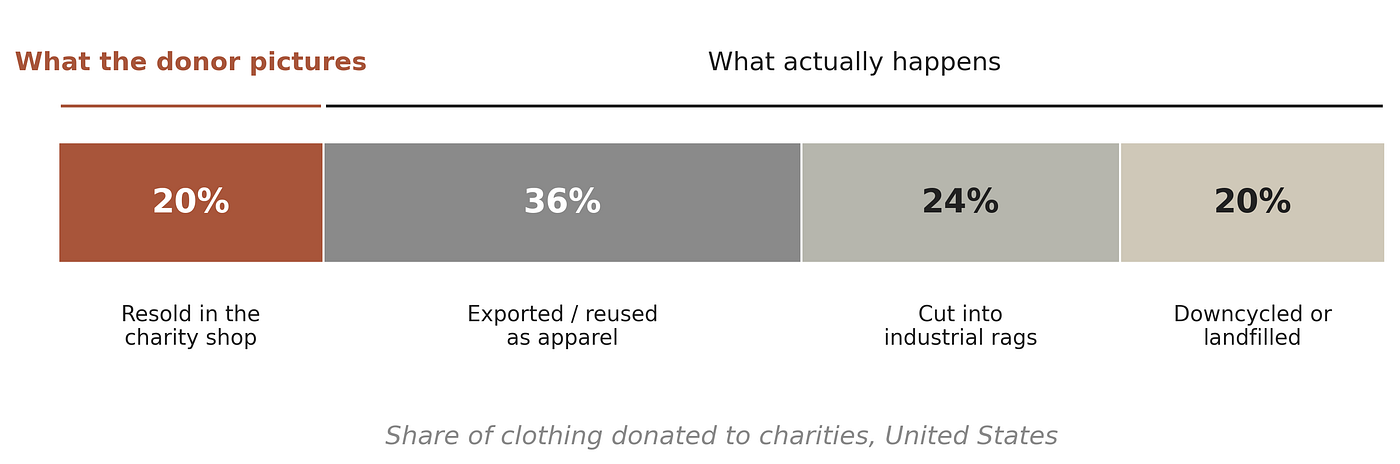
Fate of clothing donated to charities in the United States. Data: New Standard Institute. Figure created by the author.
The brand collection box runs the same trick at a higher gloss. It promises circularity, a closed loop where your old shirt becomes a new one. The chemistry refuses. Less than one percent of the material in clothing is recycled into new clothing, because fibres lose strength when worn and washed, and a used cotton T-shirt cannot be torn apart and respun into a T-shirt anyone will buy. The recycled polyester on the label usually came from bottles, not from shirts. The box is a sorting point feeding the same export chain, decorated to look like a destination.
The bin says “give it a second life.” It does not say whose, or where, or for how long.
That pronoun runs through the rest of this story.
Where the bale lands
A large share of the lower grades flows to one place above all others. Kantamanto, in the centre of Accra, is the largest second-hand clothing market on the planet. Roughly fifteen million garments arrive there from the North every week, and the market moves around twenty-five million pieces a month through resale, mending, and reinvention. More than thirty thousand people work inside it. Ghanaians have a name for the goods, obroni wawu, dead white man’s clothes, the only explanation that made sense the first time crates of a stranger’s wardrobe washed up on the coast.
Kantamanto is not a dump. It is one of the most inventive textile economies anywhere, a place where a faded brand reject is unpicked, recut, dyed, and resold as something a customer actually wants. Seamstresses, menders, and the women porters who carry hundred-kilo bales on their heads turn the North’s leftovers into a livelihood and a wardrobe for half of West Africa. The market has trained a generation of Accra’s designers without ever issuing a diploma. The damage is real, and its source sits upstream, in the structure that feeds the market.
A trader buys a bale sealed and on credit, paying before seeing what is inside. The good pieces cover the debt and the bad pieces are the trader’s loss, so the risk of the North’s overproduction lands on the poorest link in the chain. Traders increasingly report that the quality arriving in the bales is falling, that garments turn up already coming apart at the seams, made to survive a season of fast fashion and not the journey to a second owner. How much of a bale becomes waste is contested, and the contest matters. The Or Foundation, the group most associated with the market, estimates that forty percent of the average bale leaves Kantamanto as waste. A used-clothing dealers’ association disputes the figure as exaggerated and warns that the dumping-ground label threatens a trade that supports millions of Ghanaians. The market’s own leadership then broke with that association and backed the Or Foundation, arguing the dispute spoke for importers and not for the people who do the selling, and that the imbalance is built into the global fashion system rather than chosen by Ghana. What the market cannot place is burned, dumped, washed out to sea, or buried in the beaches and seafloor around Accra.
On 1 January 2025, a fire tore through Kantamanto and destroyed most of it, costing more than ten thousand people their stalls, tools, and stock. The brands whose surplus the market quietly absorbs did not rush to rebuild it.
The trader buys the bale blind, on credit. The North ships the surplus, and the South carries the risk of selling it.
What the bale costs there
The clothing that cannot be sold is only the visible cost. The deeper one fell on the industries that used to make clothes where the bales now land.
When free or near-free imports arrive in volume, no local maker can compete with them. The wage that a Ghanaian seamstress needs to live is built into the price of her shirt, and the donated shirt carries no such price, because someone in the North already paid for it and threw it away. Economists have a name for what this does to a market, and it is not aid. Free goods arriving from outside undercut local producers the same way subsidised food aid, dumped into a region during a normal harvest, collapses the price the local farmer depends on. The clothing that feels like generosity at the moment of donation behaves, at the moment of arrival, like a competitor that never has to eat. The result is documented and brutal. Working with trade and labour data across sub-Saharan Africa, Andrew Brooks and David Simon found that textile and clothing employment in Ghana fell by about eighty percent between 1975 and 2000, that Zambia’s collapsed from twenty-five thousand workers in the 1980s to under ten thousand by 2002, and that Nigeria’s workforce of some two hundred thousand shrank to almost nothing. The trade that looks like charity behaves like dumping, in the precise economic sense, depressing local production the way subsidised food aid does.
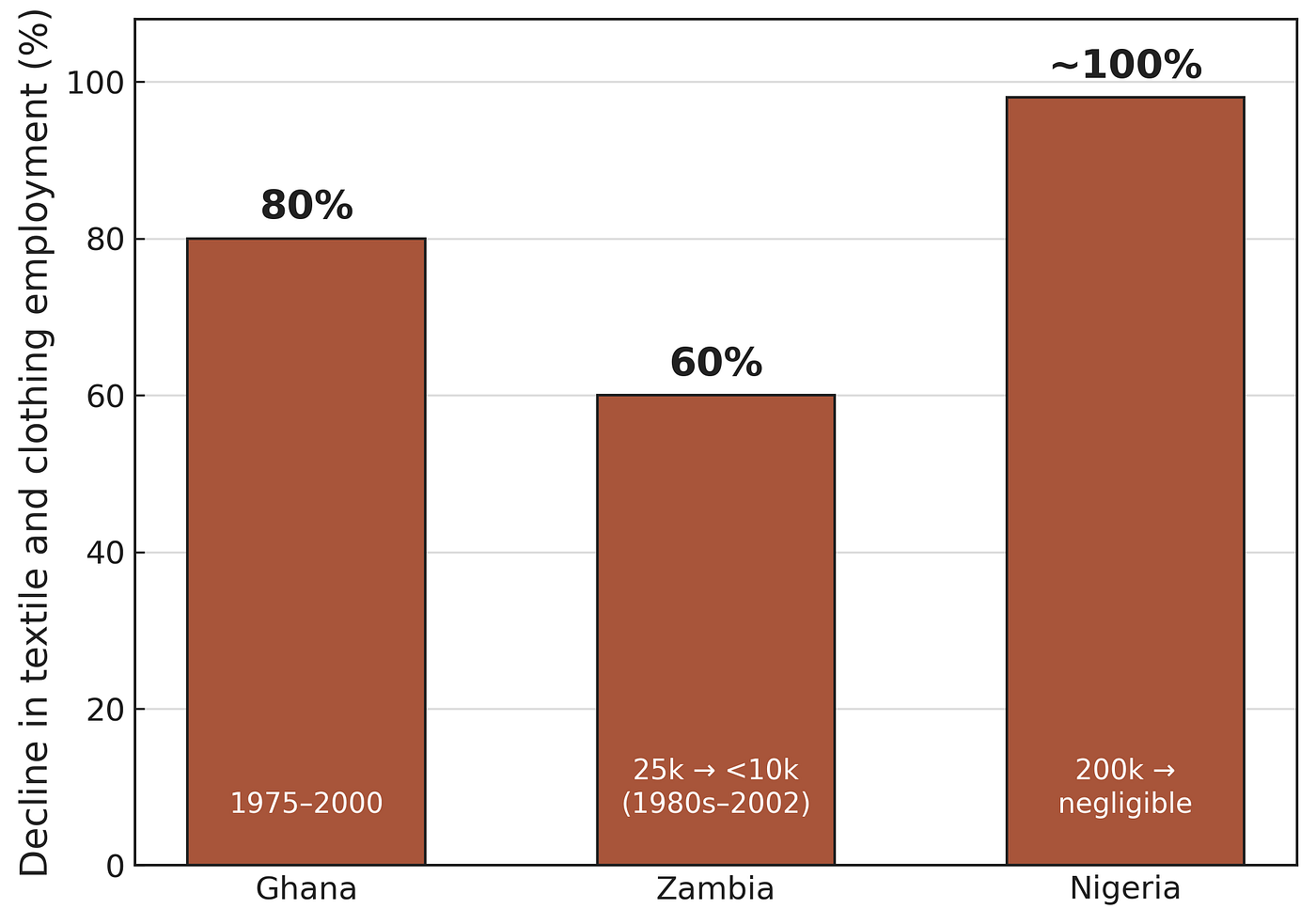
Decline in textile and clothing employment in three African economies. Data: Development and Change, 2012. Figure created by the author.
The unsellable remainder still has to land somewhere, and some of it lands in the driest place on Earth. Around fifty-nine thousand tonnes of used and unsold clothing reach Chile each year through the free port of Iquique, and roughly thirty-nine thousand tonnes of it are dumped in the Atacama Desert, in piles that reshape the landscape outside Alto Hospicio. Iquique sits in a tax-free zone, so an importer pays nothing to bring clothing in and a fee to carry waste out, which is all the incentive needed to abandon it in the sand. A 2016 law on producer responsibility left textiles out. The piles are set alight, and synthetic fibres burn into the air over the city.
The Atacama exposes a second river feeding the same desert. Around eighty-five percent of the clothing entering Iquique has never been worn. This is not the consumer’s donated coat. It is commercial deadstock, garments that failed to sell in a shop and were routed out the back. When investigators from the campaign group SumOfUs and the Chilean collective Desierto Vestido sorted the piles, store tags still hung from the clothes, Old Navy and H&M and Levi’s among the labels, alongside Zara, Adidas, Nike, Tommy Hilfiger, and Hugo Boss. The tags prove the garments arrived there. They do not prove any brand shipped them to the desert, and the companies do not disclose how they dispose of unsold stock, which is the part of the supply chain they keep dark.
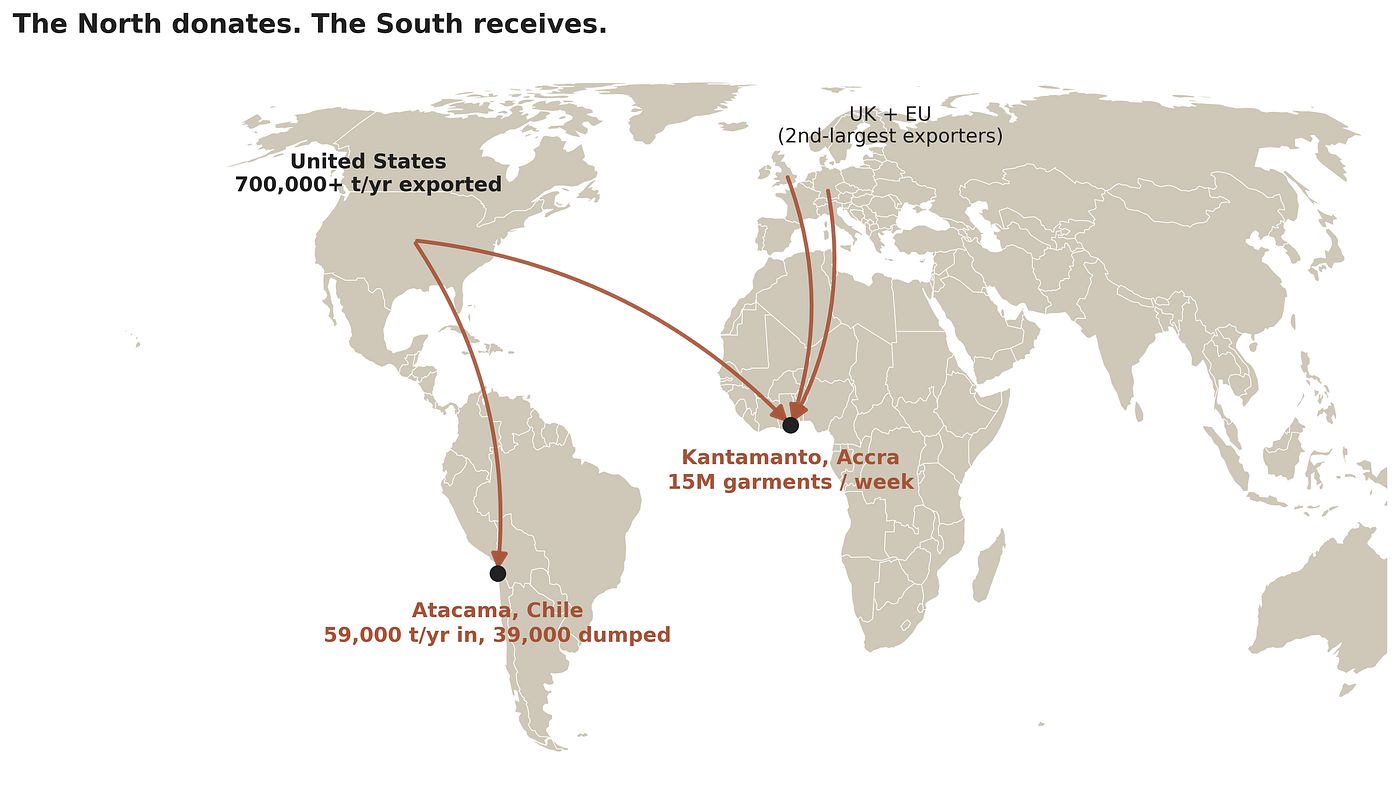
Data: Observatory of Economic Complexity, The Or Foundation, and Agence France-Presse. Figure created by the author.
Ghana receives the same double current. A field investigation by Unearthed and Greenpeace Africa traced discarded British garments, items from Next, George at Asda, Marks and Spencer, Zara, H&M, and Primark, into and around the protected wetlands of the Densu Delta, a sanctuary for sea turtles now threaded with synthetic fast fashion. The infrastructure built to contain the overflow has not coped either. Accra’s Kpone landfill, opened in 2013 with World Bank funding and meant to last close to a decade, reached capacity in five years, and in 2019 the methane trapped in the textile waste ignited and burned for eight months. The pattern repeats across the map. Avocados left Michoacán the same way, the Sahel wore down under the promise of a Great Green Wall, and African climate knowledge stayed at the margin of the science that depends on it. Different commodity, same drawing.
Eighty-five percent of it was never worn. The desert takes in clothes that failed before anyone could wear them.
The machinery of managed denial
None of this is secret, and that is the uncomfortable part. The root is overproduction, an industry making far more than the world can wear, with brands overproducing by as much as forty percent on the Or Foundation’s own estimate. The clothing that does not sell has to go somewhere, and “somewhere” has been arranged so that it never appears on a balance sheet in Hamburg or Los Angeles. The scale resists the imagination. The United Nations counts ninety-two million tonnes of textile waste a year, a garbage truck of clothing burned or buried every second of every day.
The recycling promise is the anaesthetic. A collection box in every store flagship, a hangtag about circularity, a press line about closing the loop, and the customer’s unease is managed without a single garment fewer being made. The figure that punctures it is one the industry rarely volunteers, though the H&M Foundation states it plainly, that less than one percent of textiles are recycled into new clothing. The take-back box does for clothing what a sustainability seal does for farmed salmon. It certifies a small, visible perimeter of virtue and leaves the rest of the chain in shadow.
Europe has started to legislate against the shadow. Since January 2025 every member state must collect textiles separately from household waste, and in October 2025 a revision of the Waste Framework Directive brought in producer responsibility for textiles, which will require the companies that put clothing on the market to fund its collection, sorting, and recycling once national schemes take effect over the next few years. New ecodesign rules are set to ban the destruction of unsold goods outright. The direction is right and the starting point is low. More than fifteen kilos of textile waste are generated per person in Europe every year, and only about a third of it is collected separately at all. Spain, where the collection container on the corner is already a fixture of the street, falls under the same clock as everyone else.
Regulation can force the cost back up the chain. It cannot, on its own, persuade anyone to make less.
The modern indulgence
An old transaction is at work here, older than fast fashion, older than the container on the corner. You pay, and the guilt lifts, and the thing that produced the guilt continues undisturbed. A medieval Christian could buy an indulgence and walk away absolved without ceasing to sin, the payment and the behaviour neatly decoupled. Donation, recycling, and circularity are the wardrobe version. The bag through the slot and the garment in the take-back box settle the conscience while the production line runs at the same speed, and the desert keeps receiving what the conscience refused to look at.
The clothing in the Atacama did not vanish when its owner felt good about letting it go. It travelled to a place its owner will never see, to sit beside the deadstock that never reached a body at all. Away was always somewhere. For a coat dropped in Madrid or Manchester, somewhere turned out to be a wetland full of turtles, or a market that burned, or a dune visible from orbit.
Next time the bag goes through the slot, nothing about the gesture has to change for the picture behind it to. The coat still leaves your hands. You know, now, where the cinch of the loop actually closes, and on whom.
Lately I wear my clothes until they come apart. Two of my T-shirts have holes I have chosen not to notice. When something is past saving, I make sure it reaches the landfill here, on my own coast rather than on someone else’s. Subscribe and follow along on Medium for whatever comes apart next.
메타데이터
- post_id
- 647e77e351be
- slug
- the-charity-mirage-when-the-donation-bin-feeds-a-desert-647e77e351be
- url
- https://medium.com/southern-winds/the-charity-mirage-when-the-donation-bin-feeds-a-desert-647e77e351be
- canonical_url
- https://medium.com/southern-winds/the-charity-mirage-when-the-donation-bin-feeds-a-desert-647e77e351be
- author_url
- https://medium.com/@bobzeraus
- status
- ok
- fetched_at
- 2026-06-12 18:14:10