‘Men in Nursing’: A Call for Visibility Beyond Stereotypes
If someone is asked about the founder of nursing, the immediate answer is often Florence Nightingale. Some may also mention Virginia…
‘Men in Nursing’: A Call for Visibility Beyond Stereotypes
If someone is asked about the founder of nursing, the immediate answer is often Florence Nightingale. Some may also mention Virginia Henderson as the mother of modern nursing. Florence Nightingale worked during 1854, while Virginia Henderson began her career in 1921. Yet there is another question that often leaves classrooms, curricula, and conversations silent: who were the earlier men who joined nursing to care for the sick, diseased, and dying?
The answer exists in history, though rarely acknowledged. The Alexian Brothers and St. Camillus de Lellis were prominent in caring for the sick and dying during 1535. Men have always existed within caregiving traditions, yet their presence in nursing history remains largely invisible. Nursing education across many contexts continues to frame care work almost exclusively through a feminine lens, unintentionally erasing generations of male caregivers who contributed to the profession.
This silence matters because gendered expectations continue to shape how men experience nursing today. While society increasingly celebrates women entering male-dominated professions, men entering female-dominated professions often encounter suspicion, invisibility, and exclusion. The conversation around gender equity cannot only move in one direction; it must also recognize the barriers faced by men who choose professions historically coded as feminine.
In 2024, a paper developed by men and my team; published in the Asian Journal of Midwives highlighted an important concern: “Currently, the global health workforce comprises women to men in a ratio of 9:1 in these fields and the attrition rate for female nurses and midwives is comparatively high.” The publication also cited a Jordanian study stating that “gender preferences are greater among female patients since two-thirds of female patients preferred female nurses; on the other hand, one-third of male patients’ chose male nurses, while 10% preferred female nurses suggesting the need to consider more male nurses.”
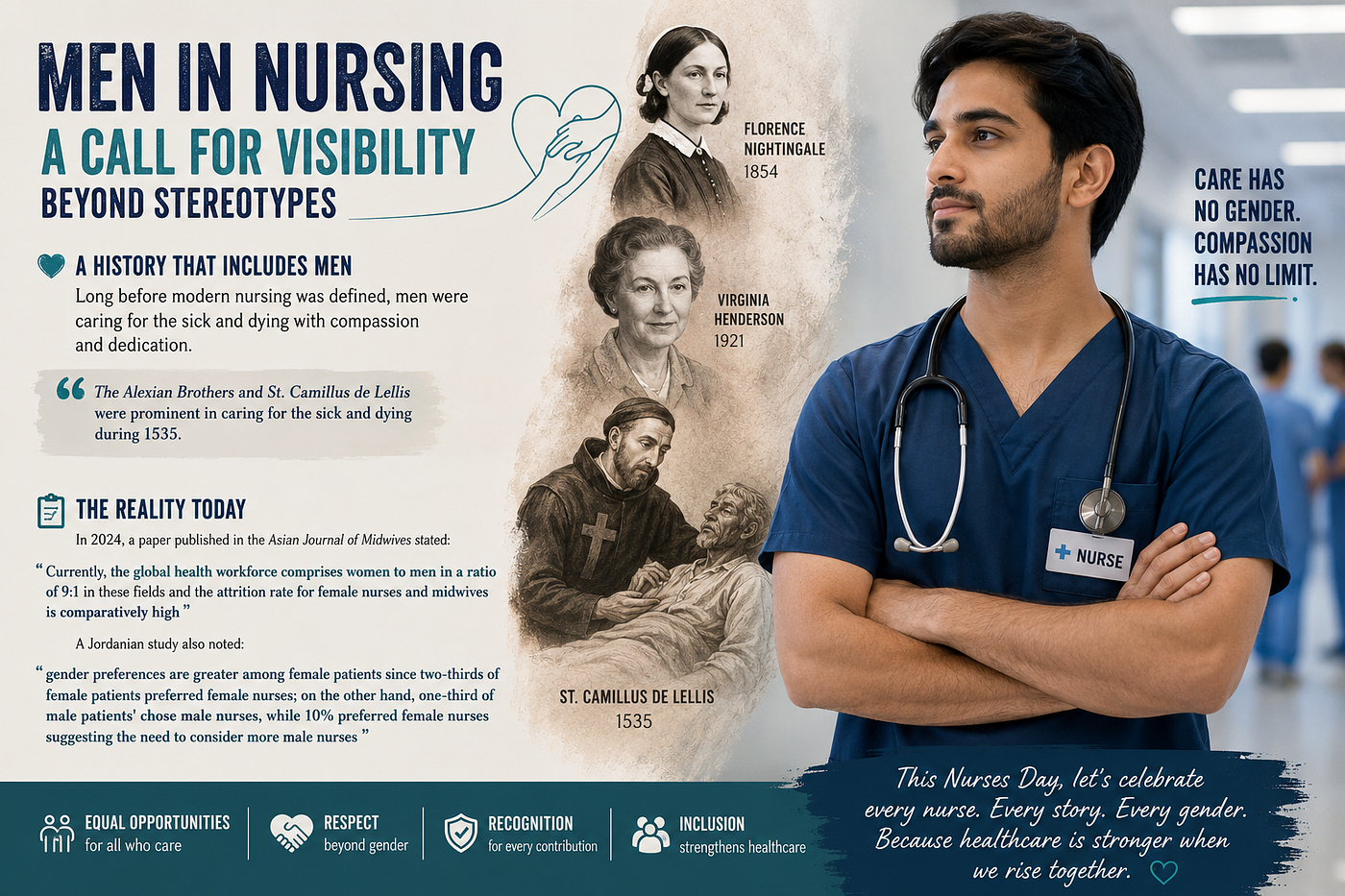
An AI generated poster based on the discussions in the blog
These statistics are not simply numbers; they reflect the complex ways gender shapes healthcare systems, patient expectations, and workplace opportunities. Men in nursing often remain underrepresented in leadership narratives, educational discussions, and professional visibility despite making meaningful contributions to patient care, emergency response, critical care, neonatal services, mental health, and community health.
There is also an emotional burden attached to constantly proving competence in spaces where stereotypes already define expectations. Many male nurses continue to feel that they must work harder to be perceived as equally capable professionals. Their contributions are sometimes overshadowed, their commitment questioned, and their professional identities reduced to traditional masculine roles such as being “bread earners” rather than compassionate and competent colleagues.
The issue is not about competing against women in nursing. Nursing has been transformed and strengthened by generations of extraordinary women whose contributions deserve every recognition they receive. Rather, this conversation is about inclusion and visibility. True gender equity in healthcare must create room for everyone, women breaking barriers in male-dominated spaces and men finding acceptance and dignity in professions historically associated with women.
This Nurses Day, perhaps the conversation should shift from representation alone to visibility with dignity. Men in nursing do not need exceptional treatment; they need acknowledgment, equal opportunities, and freedom from stereotypes. The profession of care has never belonged to one gender alone. Its history, present, and future are shared collectively by all who choose to heal, comfort, advocate, and care.
메타데이터
- post_id
- 64ab5569da3e
- slug
- men-in-nursing-a-call-for-visibility-beyond-stereotypes-64ab5569da3e
- url
- https://medium.com/@soomarsarmad/men-in-nursing-a-call-for-visibility-beyond-stereotypes-64ab5569da3e
- canonical_url
- https://medium.com/@soomarsarmad/men-in-nursing-a-call-for-visibility-beyond-stereotypes-64ab5569da3e
- author_url
- https://medium.com/@soomarsarmad
- status
- ok
- fetched_at
- 2026-07-11 19:20:18