AI didn’t speed up software delivery. It moved the bottleneck.
Why AI accelerated coding but not delivery
AI didn’t speed up software delivery. It moved the bottleneck.
Why AI accelerated coding but not delivery
For years, software engineering teams were constrained by one thing above all else:
Writing code.
Development velocity depended heavily on how quickly engineers could translate ideas into implementation. Entire industries emerged around improving developer productivity — frameworks, abstractions, cloud tooling, low-code platforms, CI/CD systems.
Then AI arrived.
And suddenly, generating code became dramatically cheaper.
Today, a single engineer can scaffold APIs, generate tests, create database models, and even draft architecture patterns in minutes. Tasks that previously consumed hours are increasingly compressed into prompts and iterations.
By almost every metric, code generation accelerated.
So naturally, many teams expected software delivery itself to accelerate as well.
But something strange happened.
Most organizations are not shipping software dramatically faster.
Release cycles remain slow. Pull requests still pile up. Coordination overhead still exists. Production confidence remains fragile. Engineering organizations continue struggling with throughput despite unprecedented gains in coding speed.
The reason is simple:
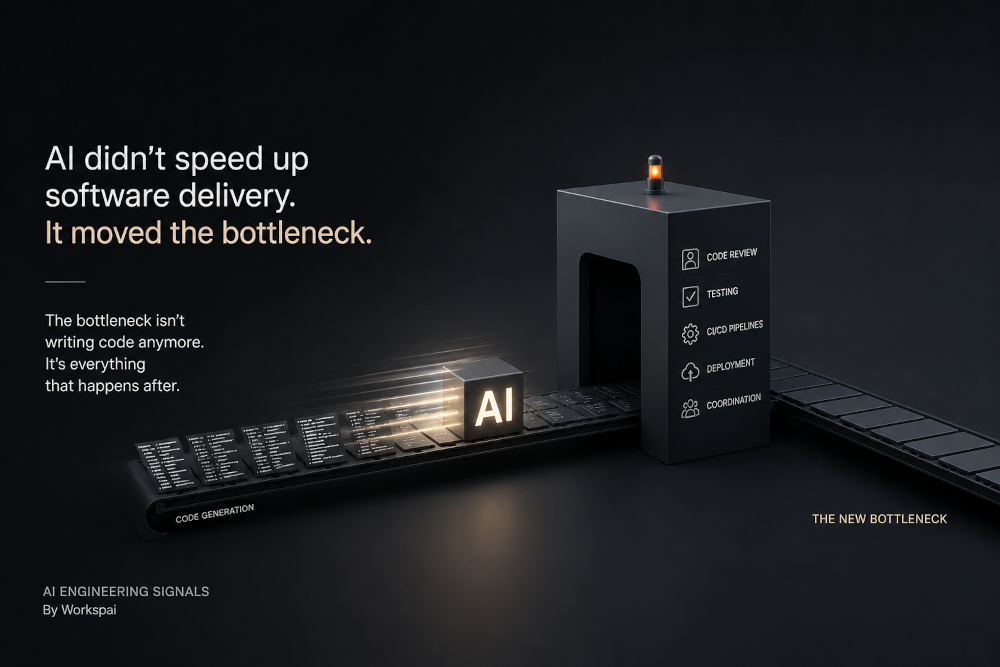
The bottleneck moved.
The misunderstanding at the center of AI adoption
A large part of the current AI narrative assumes software engineering is primarily a coding problem.
It isn’t.
Software delivery is a systems problem.
Code generation is only one stage in a much larger pipeline that includes:
- Architecture decisions
- Review processes
- Testing infrastructure
- CI/CD reliability
- Team coordination
- Deployment safety
- Operational confidence
AI heavily optimized one layer of that pipeline.
The rest of the system remained largely unchanged.
This is why many teams experience an odd contradiction:
- Engineers feel more productive
- More code is produced
- Yet delivery speed barely changes
Because local optimization is not the same as system optimization.
AI created downstream pressure
In many engineering organizations, AI is now generating pressure downstream faster than surrounding systems can absorb it.
The symptoms are becoming increasingly familiar.
Review overload
More generated code means more pull requests.
But review capacity is still human-constrained.
Senior engineers become bottlenecks not because code is difficult to write, but because validating correctness, architecture alignment, and long-term maintainability still requires judgment.
AI accelerated output. It did not accelerate trust.
Testing debt compounds faster
AI can generate implementation quickly.
But test infrastructure, integration coverage, and production validation do not automatically scale with generation speed.
As a result, many teams are increasing code velocity faster than reliability velocity.
This creates a dangerous asymmetry: The cost of introducing changes decreases while the cost of validating them remains high.
CI/CD becomes the queue
As coding accelerates, deployment systems increasingly become throughput regulators.
Pipelines that were “good enough” before AI suddenly become visible constraints:
- Slow builds
- Long integration tests
- Deployment approvals
- Environment instability
The faster upstream moves, the more obvious downstream inefficiencies become.
The new engineering challenge
Historically, engineering organizations optimized around developer productivity.
The emerging challenge is different.
Now the critical question is:
How quickly can the organization safely absorb change?
That is a fundamentally different optimization target.
The highest-performing teams in the AI era are not simply generating more code.
They are redesigning delivery systems around rapid validation:
- Smaller pull requests
- Faster review loops
- Stronger observability
- Automated testing pipelines
- Safer deployments
- Better rollback mechanisms
In other words: They optimize for throughput, not generation.
AI is exposing hidden organizational constraints
One of the most interesting effects of AI is that it reveals inefficiencies that previously remained partially hidden behind slower development cycles.
When coding itself becomes cheap, every other inefficiency becomes more visible:
- unclear ownership
- slow decision-making
- weak architecture boundaries
- unreliable deployment processes
- fragmented communication
AI did not create these problems.
It amplified them.
The future belongs to system-level engineering
The next phase of engineering productivity will likely not come from generating even more code.
It will come from reducing friction in the systems surrounding code:
- validation
- coordination
- observability
- deployment confidence
- operational feedback loops
This is why the future of software engineering may become less about writing code and more about managing continuous change safely at scale.
The teams that win in the AI era will not necessarily be the ones producing the most code.
They will be the teams capable of turning ideas into reliable production systems with the least organizational friction.
And those are very different capabilities.
—
AI Engineering Signals is a weekly newsletter by Workspai exploring AI, backend engineering, developer tooling, and the evolving constraints shaping modern software delivery.
메타데이터
- post_id
- 64b47a70fb24
- slug
- ai-didnt-speed-up-software-delivery-it-moved-the-bottleneck-64b47a70fb24
- url
- https://medium.com/workspai/ai-didnt-speed-up-software-delivery-it-moved-the-bottleneck-64b47a70fb24
- canonical_url
- https://medium.com/workspai/ai-didnt-speed-up-software-delivery-it-moved-the-bottleneck-64b47a70fb24
- author_url
- https://medium.com/@rapidkit
- status
- ok
- fetched_at
- 2026-06-26 06:47:43