2040: A Novel With Practical Tools for Business and Self-Diagnosis
Beneath the fintech dystopia is a practical method for reading signals, testing your own professional reality, and understanding how…
2040: A Novel With Practical Tools for Business and Self-Diagnosis
Beneath the fintech dystopia is a practical method for reading signals, testing your own professional reality, and understanding how resilient subculture-type communities are built.
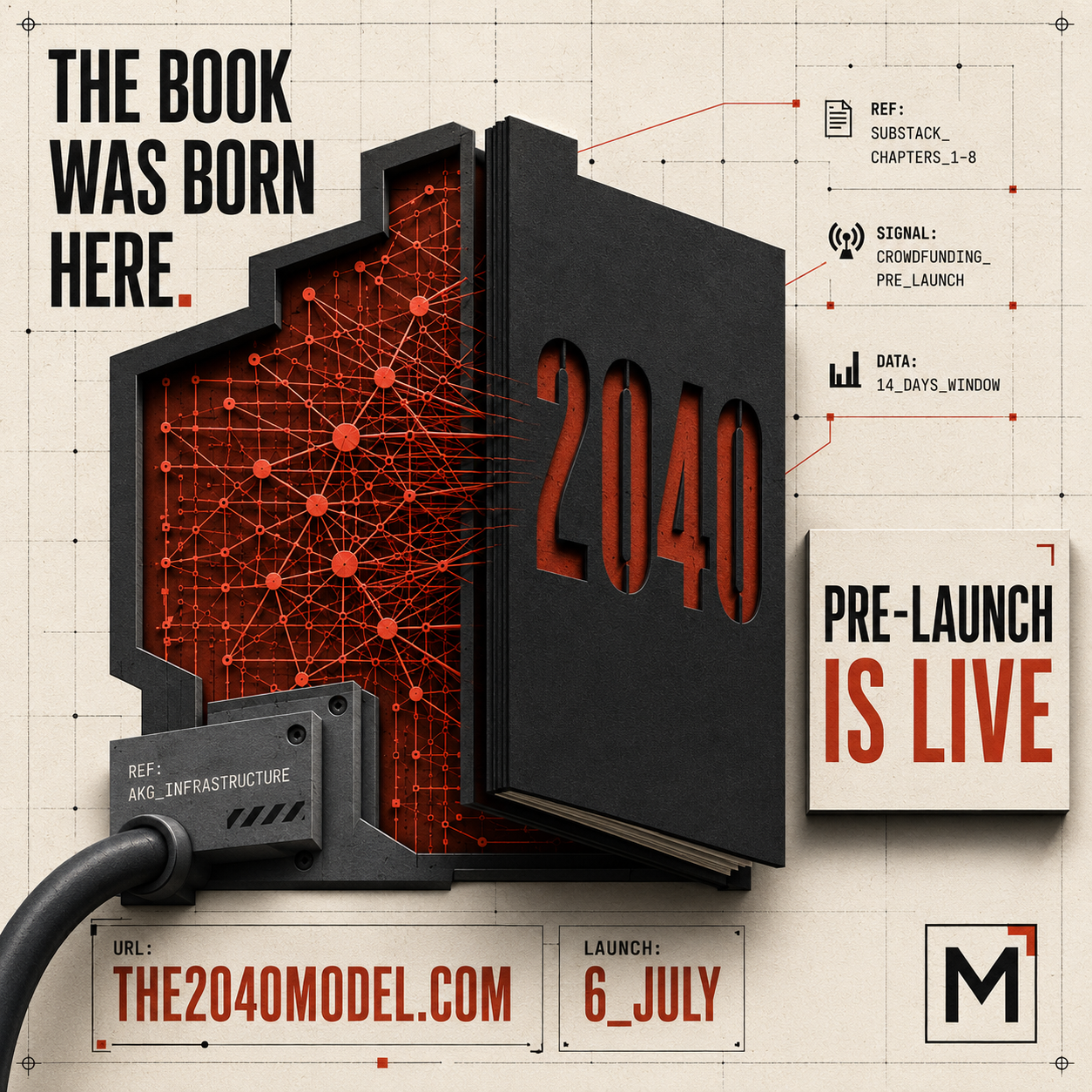
Let’s set a ground rule first. If you have not read the first eight chapters of 2040 yet, pause here. Go to the2040model.com. All published chapters, reviews, and supplementary materials are there in one place. Meet Max, Jamie, and Sophie. Get a feel for Munich, fourteen years from now. Then come back to this piece.
If you have already worked through most of those eight chapters and felt that cold flicker of recognition between the lines, let’s go deeper. To the layer the whole thing was built for.
The book as a practical framework
Most people read 2040 as a fintech thriller. A cinematic dystopia showing where current trends lead.
That reading is correct. It is also the surface. Deeper down, there is something else.
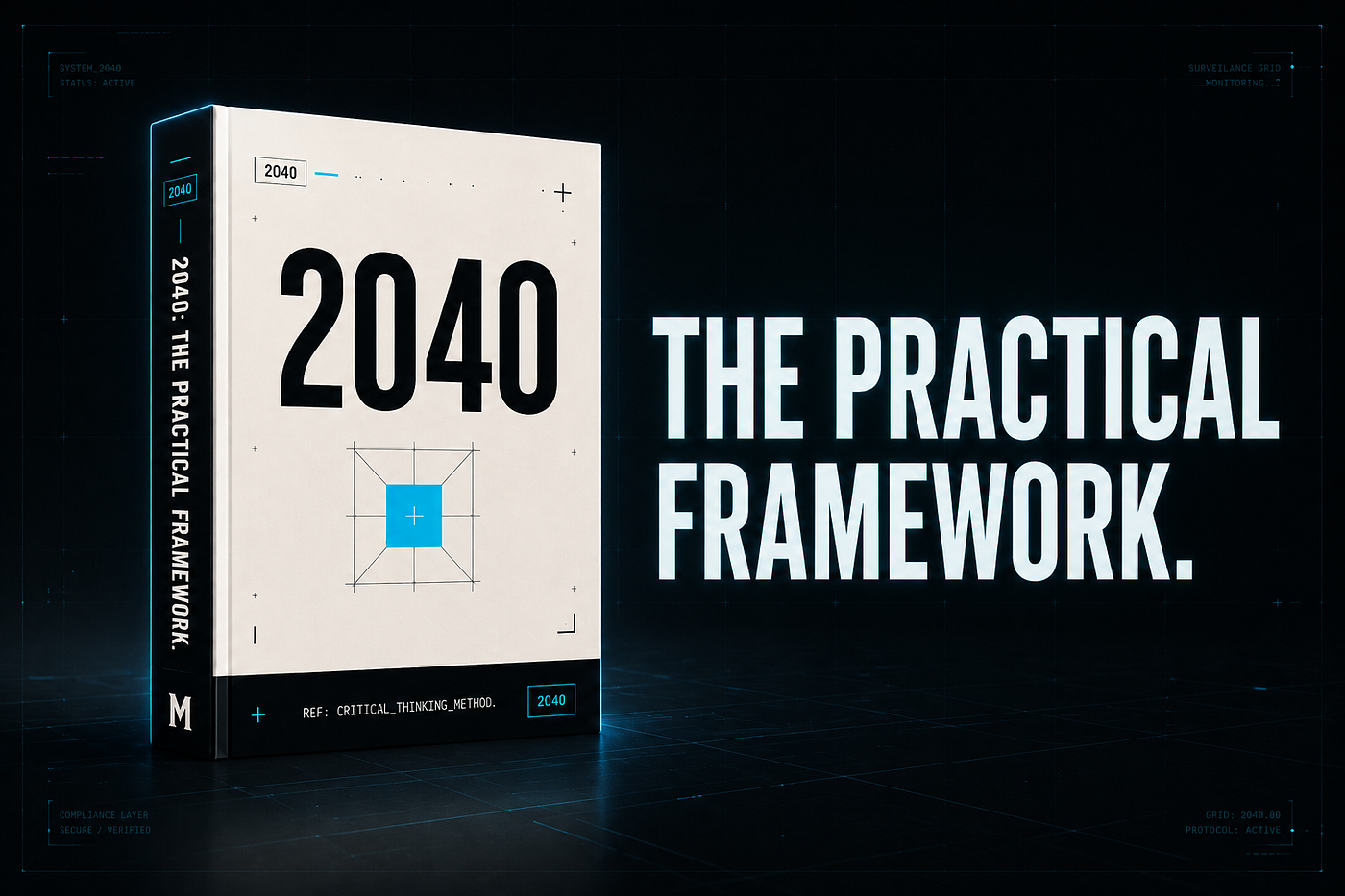
2040 is a practical framework for critical thinking.
The book teaches one specific skill: to see separate signals from the present as parts of one connected picture. Cut the noise. Build the picture.
The cinematic format is not a narrative choice. It is a method.
The world produces too much noise. Critical thinking is not simply being sceptical. It is the ability to pause at one question: what is this actually based on? Who is building the infrastructure we will live inside? Where was the point of no return, and did anyone notice when it passed? The novel is designed so that this reflex starts firing automatically. Each chapter is not just a plot episode. It is a case study in separating signal from noise.
And this matters: the method is not specific to fintech or European payment regulation. It adapts to any industry and any profession.
Are you an architect? A doctor? A software engineer? A lawyer? A consultant or a marketer? Apply the 2040 lens to your own field. Build your own picture of where things are heading. Look at the small, convenient concessions and bureaucratic rules being introduced in your sector right now. Ask yourself what they become in ten or fifteen years, taken to their logical conclusion. The novel gives you the method. The rest of the picture is yours to draw.
Three signals from 2026
Three real examples, each documented with exact dates. Read separately, they look like routine regulatory updates. Read together, they look like a blueprint.
Signal 1. A unified graph of client data.
What happened in 2026: In April, the EU Council agreed on the final text of the Payment Services Regulation. It established the legal basis for banks to share fraud-related behavioural data across providers. Officially, this is fraud-prevention infrastructure. Before PSR, each bank held its data separately. After PSR, elements of our payment behaviour increasingly become part of a common data layer that the entire banking system can read.
What it becomes in the book: That layer grows into the Payment Integrity Graph: a system that connects every transaction with geolocation, sector risk profiles, and contact history. It was not invented. It grew from PSR.
One bank knew its slice of your life. The system is starting to see the connections.
Signal 2. Two classes of customers in one country.
What happened in 2026: On 28 April, the UK introduced protections against arbitrary bank account closure: 90 days’ notice, written reasons. But only for accounts opened after that date. Everyone who opened an account before it stayed under the old regime. Under that regime, 453,230 accounts were closed in 2025, most without detailed explanation.
What it becomes in the book: The principle expands. Your rating and the date of your consent determine whether you can buy a train ticket. Your rights depend not on who you are, but on when you signed the contract.
Our rights depend not on who we are, but on when we signed the contract.
Signal 3. Money with a built-in refusal.
What happened in 2026: On 8 April, the US Treasury proposed requiring digital money issuers to embed into their code the ability to block, freeze, and reject transactions on a regulator’s signal. In the same month, Tether reported freezing more than $344 million USDT across two addresses, in coordination with OFAC and US law enforcement.
What it becomes in the book: This architecture makes retroactive correction possible: an algorithm recalculates a past purchase because money can now follow programmed rules.
Money that can be programmed to block can be programmed to do anything.
This is not something that might happen. It is something being built in stages, in public, with stated intentions at each individual step. The problem is that nobody reads all the steps together.
The gap between 2026 and 2040 is not a technological leap. It is a chain of compromises.
The architecture of a community that does not collapse
The critical thinking framework is the first layer of the book. The second is about what to do with what you have seen.
Most corporate communities run on transactional logic: conditional loyalty exchanged for cashback, team events, free coffee. These structures collapse at the first serious pressure. A competitor offers three per cent more and the loyalty evaporates.
The characters in 2040 build differently. People who start as strangers come together not for advantage, but for survival. Not a group but a subculture-type community: a decentralised community that keeps working even if one part fails. It includes people like Sophie Clark, who know the System’s architecture from the inside and use its own logic against it. These structures cannot be bought with bonuses. The commitment within them is built through shared hardship, not loyalty programmes.
A community that holds under pressure starts with people who see the same thing when they look at the world. Not people who think alike. People who know how to read the same signals.
Chapters 1–8 (published). The architecture of control. The Payment Integrity Graph, retroactive corrections, the Liberty Blackout. Eight chapters, available on Substack.
Chapters 9–16 (after the crowdfunding). The architecture of choice. How communities are built that can operate inside a system, read its rules, and expand the space for decisions. This is the half of the book that early readers keep asking about.
Appendix to the full edition. Applied materials on building subculture-type communities. Not a motivational guide. A practical playbook.
The book does not predict the future. It teaches a method for reading it, in your own industry, your own city, your own professional reality.
The gap between 2026 and 2040 is not about technology. It is about who built the picture first.
A note of thanks to the early readers who worked through the first eight chapters and shared their responses: your feedback confirmed that the method works.
The crowdfunding campaign for the full book launches on 6 July. For partnership, media, and collaboration enquiries, **Daryna Karuna** is the authorised representative of the book.
메타데이터
- post_id
- 64cd60c4e637
- slug
- 2040-a-novel-with-practical-tools-for-business-and-self-diagnosis-64cd60c4e637
- url
- https://medium.com/@agiusmila/2040-a-novel-with-practical-tools-for-business-and-self-diagnosis-64cd60c4e637
- canonical_url
- https://medium.com/@agiusmila/2040-a-novel-with-practical-tools-for-business-and-self-diagnosis-64cd60c4e637
- author_url
- https://medium.com/@agiusmila
- status
- ok
- fetched_at
- 2026-07-14 22:43:35