The Politics of Invisibility
Why our best infrastructure investments are the ones nobody can see
The Politics of Invisibility
Why our best infrastructure investments are the ones nobody can see
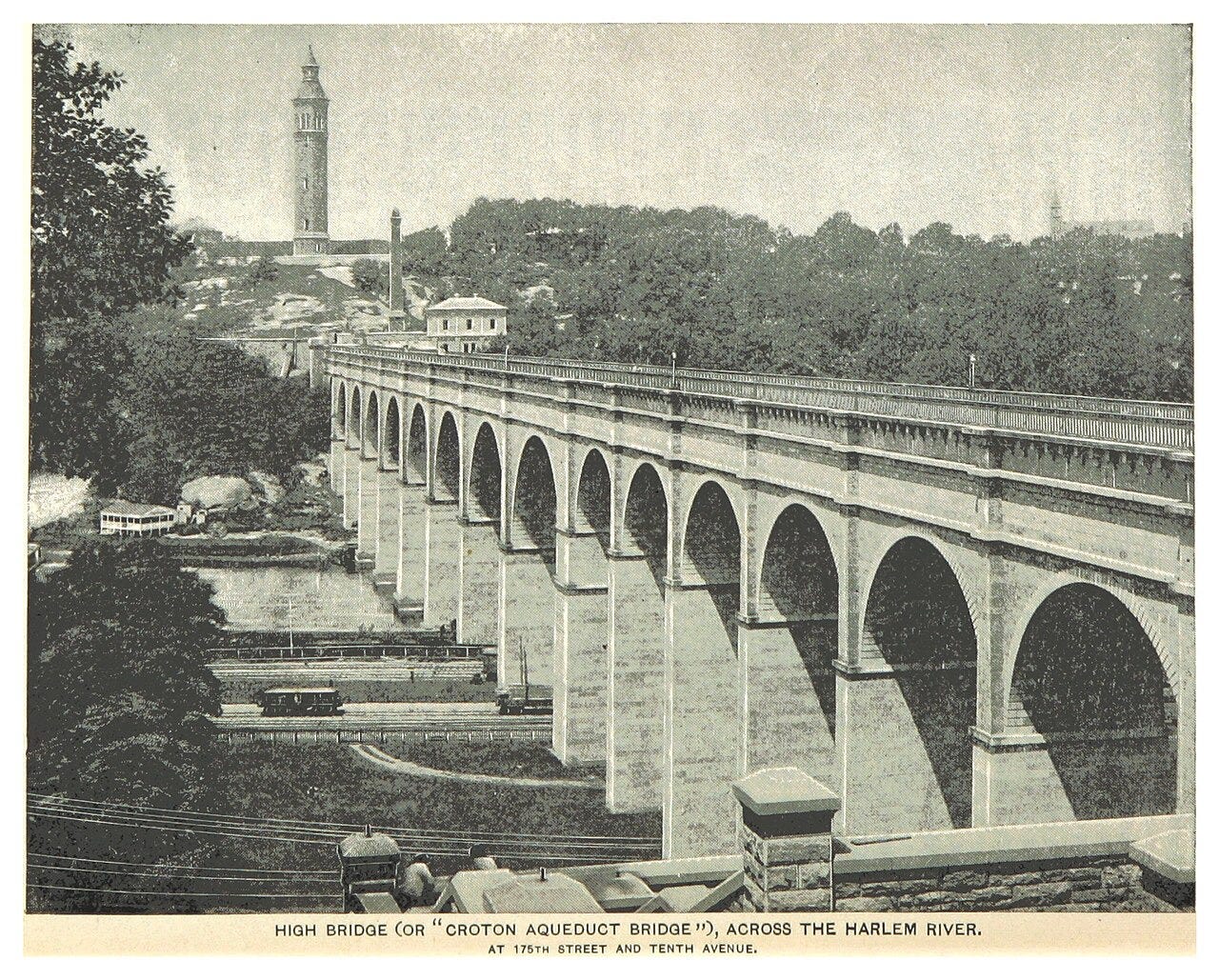
High Bridge, built in the 1840s to carry the original Croton Aqueduct across the Harlem River, was the city’s first great monument to the water it could see and build. The investment that mattered most a century later was of a different kind: protecting the Catskill and Delaware watersheds instead of building a filtration plant. That choice has no such picture, because its product is an absence. (Image: King’s Handbook of New York City, 1893. Public domain.)
There is a category of public investment so successful that it produces nothing. No ribbon to cut, no building to photograph, no press conference, no permanent staff. Its entire output is an absence: a water filtration plant that was never built, a watershed that did not burn, a town that was not destroyed. In wildfire country, this absence has an especially cruel logic: the best proof that a treatment worked may be the fire behavior that never became visible enough to make news. By every measure that matters to a budget office or a news desk, the most cost-effective infrastructure decisions a society can make are indistinguishable from having done nothing at all.
This is not a marginal problem. It is the central reason that some of the best-documented, highest-return infrastructure benchmarks in the country sit unused, year after year, while we keep building the expensive thing instead.
Consider two cases.
Two benchmarks almost nobody acts on
In the upper Mokelumne River watershed in California’s Sierra Nevada, a coalition that included the US Forest Service, the Sierra Nevada Conservancy, and The Nature Conservancy asked a blunt question: does it make economic sense to spend money now on forest fuel treatments to reduce the risk of a catastrophic wildfire later? They built the fire models, the erosion models, the post-fire sediment models, and ran the numbers against a do-nothing baseline. The answer was unambiguous. The economic benefits of landscape-scale fuel reduction substantially exceeded the cost, on the order of two to three times, with the largest returns flowing to the water and utility infrastructure downstream that a high-severity fire would foul with sediment and ash.
The Mokelumne Watershed Avoided Cost Analysis (Buckley et al., prepared for the Sierra Nevada Conservancy, The Nature Conservancy, and the US Forest Service) is a clean, rigorous, firsthand piece of work. It has been cited, admired, and used as a template for similar studies across the West, including the wildfire-vulnerability mapping Vance Russell and I developed in Islands of Vulnerability. And it has changed the actual pace and scale of fuel treatment in the watershed far less than its findings would justify. The information traveled. The action did not follow it.
Now the more famous case. In the 1990s, New York City confronted a federal mandate. The 1989 Surface Water Treatment Rule required every large surface-water system in the country either to filter its water or to obtain a filtration avoidance determination from the EPA by meeting strict source-protection conditions. For the Catskill and Delaware supply that serves most of the city, building the filtration plant would have been among the largest capital projects in the city’s history. New York State’s own environmental agency now puts the avoided plant at eight to ten billion dollars to build and roughly a million dollars a day to operate. The National Research Council, in its assessment of the city’s strategy, recorded the city’s own construction estimate at as much as six billion dollars with annual operating expenses above three hundred million.
Instead of building it, the city committed to a watershed protection program, land acquisition, upgraded septic and wastewater systems, agricultural best-management partnerships with upstream farmers, costed at roughly $1.5 billion over its first ten years. The EPA granted the avoidance determination. Nearly three decades later the city still operates without filtering that supply, under a waiver renewed repeatedly through the current determination, and the watershed program is still acquiring land. Whatever the precise running total, the city avoided building the single largest filtration plant it would ever have built, by spending a fraction of the cost on keeping a landscape intact.
This is, on paper, one of the most compelling infrastructure-cost arguments in American environmental history. And it remains, as my collaborator Vance Russell puts it about the Mokelumne work, a thing that an astonishing number of planners have either never heard of or do not act on.
The obvious diagnosis is that this is an information problem. The good news simply has not reached the people who need it, and the remedy is better communication. That diagnosis is wrong, or at most it describes a symptom. The information reached everyone who mattered. The relevant utilities, agencies, and engineers understood the Mokelumne findings perfectly well. The reason these benchmarks do not move the system is structural, and it has four parts: a success that cannot be seen, a claim that threatens budgets, an economy that pays people to build, and a manufactured caution that has made the conventional choice the only safe one. I have put them in that order on purpose, from the most visible to the most determining. Invisibility is what you notice first. The political and economic mechanisms underneath it are where the real weight sits. Together they protect a status quo that is increasingly indefensible on the merits, and that protection is not incidental. It is the point. By the end of this essay I want to be precise about who benefits from it.
One: a success that leaves no evidence
The first mechanism is the simplest and the most overlooked. Counterfactual success is physically invisible.
A counterfactual failure leaves a referent you can stand in front of. A destroyed town has an address. A flood has a high-water mark, a body count, a FEMA number, and a news cycle that runs for a week. When prevention is not done and the disaster arrives, the disaster is intensely, photographically real. The January 2025 fires in Los Angeles produced a loss figure in the hundreds of billions and an image archive that will last a generation.
Counterfactual success has none of this. The filtration plant that was never built cannot be photographed. The fire that did not burn through a treated forest generates no footage, because nothing happened there. You cannot hold a press conference in front of an event that did not occur. The avoided cost is real money, real risk retired, real catastrophe foreclosed, but it has no body, no site, no date. And institutions, budgets, and media all run on referents. They allocate attention and money to things that can be pointed at. An outcome whose entire content is the non-occurrence of a bad thing is, to those systems, almost literally imperceptible.
This is why the Catskills case has spent twenty-five years being argued about rather than replicated. The clean version of the story, repeated in the Economist, in World Bank papers, in textbooks, gradually attracted a debunking literature insisting it was an overstated myth. Some of that criticism scored real points. There was no special environmental bond issue of the kind one widely cited account claimed. The city’s water had not actually collapsed below federal standards; the trigger was the nationwide rule, not local ecological ruin. The early pace of land acquisition was slow enough that critics could fairly say the city had not yet done much.
But notice what the debunking does and does not touch. It corrects the inflated retellings. It does not dislodge the underlying choice, because the underlying choice is documented in the EPA’s own filtration avoidance determination and the National Research Council’s assessment: a federally mandated plant, genuinely faced, genuinely avoided by protecting a landscape instead. That the water was already clean is not evidence the avoidance was fictional. It is the reason the avoidance worked.
Here is the part worth sitting with. Nobody writes an essay arguing that the recently completed Croton filtration plant in Van Courtland Park is a myth. The Croton plant exists. It cost the city a known sum, it sits in the Bronx, you can photograph it. Its reality is not contestable. The Catskills avoidance can be argued out of existence precisely because its product is an absence, and an absence is always available to be reinterpreted, minimized, or denied. The fact that a serious avoided-cost success can be talked into looking like a myth, while no built plant ever could be, is not a side issue. It is the invisibility mechanism operating in plain view. The debunking itself is the phenomenon.
Two: we cheer the individual story and resist the structural claim
The second mechanism explains a pattern that is otherwise puzzling. We are perfectly comfortable with ecological success stories. We love them. The restored marsh, the recovered fishery, the single farm brought back to health: these circulate freely, raise money, win awards, inspire. So why does the same culture that celebrates a restored marsh resist the claim that watershed protection should substitute for a filtration plant?
Because they are different kinds of claims, and they make different demands.
An individual success story is bounded, attributable, and generally unthreatening. It is one marsh, one fishpond, one farm. It asks for admiration, and admiration is cheap. It does not insist that anyone has to do anything differently at scale, and it does not call any institution’s budget into question.
A structural success claim is a different animal. To say that treating thirty percent of a watershed changes fire behavior across the whole system, or that protecting a watershed can substitute for a multi-billion-dollar treatment plant, is not a story about a place. It is a claim about how an entire system should be funded and governed. It says the current allocation is wrong. It implies a reallocation of budgets, a redrawing of responsibilities, a transfer of money and authority away from the people who currently hold them. The individual story asks to be liked. The structural claim asks for power to move. One is an inspiration; the other is a threat. We accept the first and resist the second, and we mistake our resistance to the second for skepticism about the evidence, when it is usually something closer to institutional self-defense.
Three: the political economy is built to reward building, not avoiding
The third mechanism is the deepest, and it is where this argument connects to a larger one I have made elsewhere about energy. (I develop the energy version of it in 54,000 Power Plants, on the displacement of America’s original water-powered distributed mill economy by centralized generation.)
The political economy of infrastructure is built to recognize and reward intervention, not avoidance. Capital, careers, contracts, financing, and credit all attach to building things. They do not attach to the absence of a thing.
Run the comparison concretely. A two-billion-dollar watershed restoration that avoids a ten-billion-dollar filtration plant generates, very roughly, one-fifth the construction contracts, one-fifth the financing volume, one-fifth the engineering fees, one-fifth the ribbon-cuttings. It creates no permanent operating bureaucracy, because a protected watershed does not need to be run the way a treatment plant needs to be run. Every number that a contractor, a bond underwriter, an engineering firm, or an agency empire-builder cares about is smaller in the cheaper, better option.
This is the crucial inversion, and it is genuinely counterintuitive. The superior solution is institutionally disfavored precisely because it is cheaper. Cost is supposed to be the thing we minimize. But in a system where the actors who would champion a solution are paid in proportion to how much gets built and spent, a solution that builds and spends less starves the very constituency that would otherwise fight for it. The expensive option arrives with its own lobby attached. The cheap option arrives with no one whose paycheck depends on defending it.
This is the same structural logic that governs the contest between centralized and distributed energy. The centralized power plant does not win because it works better. It wins because it concentrates rents, contracts, fuel-supply relationships, financing, regulatory familiarity, and that concentration organizes a constituency with every incentive to defend it. Distributed generation, like avoided-cost ecological infrastructure, spreads its benefits so widely and so quietly that no concentrated interest forms to push for it. Avoided-cost ecological infrastructure is the water-and-fire version of distributed generation. It loses for the same reason, and it loses to the same kind of opponent.
There is a financial-architecture layer underneath this as well, which I have described before: our systems of depreciation, insurance pricing, bond structuring, and tax treatment were all designed around hard capital assets that lose value on a predictable curve, and they fit poorly around diffuse ecological assets that appreciate as they mature. A treatment plant is an asset the accounting system knows how to love. A protected watershed is not, even though it outperforms the plant on every dimension that matters to the public that pays for both.
Four: a caution that was manufactured, and recently
Political economy does not only shape incentives. Over time it shapes perception. Upton Sinclair put the result in one sentence: it is difficult to get a man to understand something when his salary depends on his not understanding it. The line is usually read as an indictment of bad faith, of people pretending not to see. But the more unsettling reading, and the more accurate one, is that it describes a genuine perceptual effect. People whose position depends on not seeing an avoided cost mostly do not see it. The blindness is sincere. That is what makes it durable.
And it points to the fourth mechanism, which is the one that converts all the others into actual inaction: the abundance of caution that governs both public and private decision-making. Risk aversion, in plainer terms.
Every infrastructure choice is made by a person who will be held accountable for it, and the accounting is asymmetric. The official who approves the conventional filtration plant has made a defensible decision even if it turns out to be expensive, because it is the decision everyone expected, the one the entire profession would have made. If it goes over budget, that is just what infrastructure does. Nobody is ever fired for building the plant. The official who instead bets the city’s water supply on keeping a forest healthy has taken a personal, nameable risk on the unconventional path, and if anything goes wrong, the fire that gets through, the turbidity event after a storm, the failure will have a face, and it will be theirs.
This is precisely what manufactured doubt is engineered to exploit, and it is worth being clear that the doubt does not have to win the argument to win the outcome. Its job is not to prove the prevention wrong. Its job is to raise the perceived risk of being the decision-maker who chose it. A single well-placed uncertainty, the treated forest might burn anyway, the watershed numbers might not hold up, is enough to make the cautious path look reckless and the expensive path look prudent. The history of organized doubt, from asbestos to lead to tobacco to climate, traced by Naomi Oreskes and Erik Conway in Merchants of Doubt, is not mostly a history of convincing people of falsehoods. It is a history of making the responsible decision feel unsafe to the individual who has to sign it. Avoided-cost infrastructure is unusually exposed to this, because its benefit is invisible by definition and its failure, if it comes, is vivid. The incentives all run one direction: toward the expensive thing that no one will blame you for.
It is worth pausing on how strange this caution is, because we are told to treat it as human nature and it is nothing of the kind. For most of its history the United States was the opposite of risk-averse. It built more than twenty thousand miles of canals before the Civil War, threw a railroad across a continent, and in the span of a single generation produced the Tennessee Valley Authority, the rural electrification of the entire countryside, the Interstate Highway System, and a program that put human beings on the moon eight years after deciding to try. Some of that ambition was admirable and some of it, the manifest-destiny strain that justified conquest and displacement, was not, and it is worth saying so plainly. But the relevant fact for this argument is the capacity itself: this was a society that routinely committed enormous public resources to unproven, continent-scale undertakings on the strength of a vision, and it did so as recently as living memory.
That capacity has not disappeared by accident, and it has not disappeared evenly. It has collapsed precisely around public ambition, public investment, the willingness to attempt large collective solutions, at the exact moment in human history when the largest collective problem ever faced, a destabilized climate, demands it most. A society that could electrify the rural South in the 1930s now treats keeping a forest healthy as an exotic financial risk. That reversal is not a mood. It is an achievement. Decades of deliberate, well-funded effort reframed public action as inherently risky, government competence as a myth, and collective investment as waste. The actors who funded that effort are not anonymous. They are the concentrated interests that repeatedly benefit from the pattern this essay has been describing, the ones whose rents depend on the expensive built thing and whose exposure grows the moment a society starts choosing cheaper, distributed, preventive alternatives. The individual official’s caution is sincere, and that sincerity is exactly what makes the campaign effective, but the caution itself was cultivated, on purpose, by people who profit from it. To describe the risk aversion without naming where it came from would be to repeat the very erasure that produced it.
So let me name it plainly, because the whole essay has been building toward a point that should not be left implied. This is, at bottom, a political economy in which large corporate and financial interests repeatedly benefit when public systems choose the expensive, centralized, buildable solution over the cheaper, distributed, preventive one. The genteel vocabulary of prudence and fiscal responsibility and acceptable risk is, in the end, the surface of that. And the strongest reason to believe these interests understand exactly what they are doing is that in at least one case we have their own records. Exxon is not the explanation for every avoidance failure described in this essay; the incentive structure does most of that work on its own. But it is the clearest documented case of the same logic carried to its deliberate extreme, and it removes any doubt that the actors involved can know precisely what they are choosing. Exxon’s in-house scientists, between the late 1970s and the early 2000s, produced global-warming projections that we can now measure against the subsequent temperature record, and most of them were accurate and skillful. The company knew.

And while it knew, it ran a public campaign of climate skepticism and doubt: in the same body of documents, roughly four-fifths of Exxon’s internal materials acknowledged that climate change was real and human-caused, while roughly four-fifths of the advertisements it placed for public consumption expressed doubt about exactly that. That is not a knowledge gap or an honest disagreement about uncertain science. It is a company that had modeled the catastrophe accurately, in private, then spent decades manufacturing public confusion about it and working to block, weaken, and delay nearly every collective attempt to respond, for profit, across exactly the years when action would have cost the least.
It has become customary to describe this in the softened vocabulary of disinformation and regulatory capture, as though the worst that happened was a communications problem. But the harms now arriving, the climate migration, the resource conflicts, the deaths from heat and flood and fire that now carry the partial fingerprint of delay, are not a communications problem. There is an older word for knowing precisely what catastrophe you are setting in motion, profiting from it, and using your power to disable the response. We are squeamish about using it for men in good suits running large firms. We should not be. Once you have seen this, the genteel risk aversion of the watershed official stops looking like an accident of human nature and starts looking like what it is: the downstream behavior that the campaign was designed to produce.
Why the reframe matters
The difference between the two diagnoses is not academic, because each one points to a different cure.
If the problem is that information failed to travel, the remedy is communication. Publish the study more widely, make better graphics, brief more planners, and the good decisions will follow. This is the comfortable diagnosis, and it is mostly false, and it has absorbed an enormous amount of well-meaning effort to little effect.
If the problem is political economy, communication is necessary but radically insufficient. The real lever is institutional. Who is permitted to count an avoided cost as a benefit on a balance sheet? Who holds the budget line that the avoidance would protect? Can the savings be captured by anyone with the standing and the incentive to fight for them? Until an avoided cost can be owned by someone, it will keep losing to a built cost that already has an owner.
Seen this way, the most interesting policy experiments are not the studies that prove avoided cost is real. We have plenty of those, and proving it again will not help. The interesting experiments are the ones trying to manufacture a constituency where none exists naturally. The Forest Resilience Bond is the clearest example. Strip away the financial machinery and what it is attempting is precise: to build an instrument that lets some party invest in fire prevention, capture a share of the avoided cost as a return, and therefore acquire a reason to want the prevention done. It is an attempt to engineer, through finance, the missing lobby for an invisible good. Whether that particular instrument scales is a separate question, and the early record makes the question sharper. The private investors in the first Yuba bonds were not water agencies, but the repayment logic was anchored in a much narrower constituency: Yuba Water, public grants, and agencies already exposed to the avoided costs. That does not weaken the FRB argument. It clarifies it. The bond has not yet conjured a mass constituency for invisible infrastructure; it has shown that one can sometimes be manufactured where a directly benefiting institution can see enough of the avoided loss on its own balance sheet. But the logic is exactly right, because it is aimed at the actual problem.
That is the move the whole field has to make. The disaster that doesn’t happen will never photograph well, will never hold a press conference, will never staff an agency, and will never make the person who bet on it feel safe. It will keep losing to the disaster that does, and to the expensive cure that arrives with its own constituency and absolves everyone who chooses it, until we stop treating it as a communications failure and start treating it as what it is: a structural blindness, built into how we count and who we hold accountable, that systematically disfavors the cheapest and best things we know how to do.
We know how to model the avoided cost. The Mokelumne study did it. The harder work is building the institutions that can see it.
Notes
On the Mokelumne figures. The two-to-three-times benefit-cost finding and the methodology come from the Mokelumne Watershed Avoided Cost Analysis (Buckley et al., prepared for the Sierra Nevada Conservancy, The Nature Conservancy, and the US Forest Service). As with any watershed-specific finding, the “thirty percent” treatment threshold discussed in the surrounding literature should be read as suggestive of a systems principle rather than a precise operational target for any given landscape.
On the Catskills figures and the “myth” literature. The cost comparison here is anchored deliberately to primary government sources rather than to the widely repeated secondary accounts: the avoided-plant figures to the New York State Department of Environmental Conservation and the National Research Council’s Watershed Management for Potable Water Supply: Assessing the New York City Strategy (2000), and the avoidance itself to the EPA’s Filtration Avoidance Determination. A skeptical literature, most prominently a 2005 PERC essay by Mark Sagoff, argues that the popular version of the story is a “factually false” myth. It is worth being precise about what that critique establishes. It correctly debunks a specific bond-issue claim and the claim that the city’s water had degraded below standards, and it fairly notes that early land acquisition was slow. It does not touch the documented core, which is the federal mandate, the genuine choice, and the avoidance, all of which appear in the federal and state record independent of the secondary retellings. Readers should also know that PERC is a property-rights institute with a long-standing prior skeptical of ecosystem-services valuation. That does not make its factual points wrong, and the slow-acquisition caution is a genuine one I have kept here rather than buried. But the broader history of industry-adjacent doubt production, documented across tobacco, lead, asbestos, and climate by Oreskes and Conway and others, is reason to vet such critiques more rather than less carefully, and to check their conclusions against the primary record rather than against the inflated accounts they are built to attack. In this case the conclusion outruns the evidence: a set of locally correct corrections is arranged to license a global dismissal the documents do not support. That a real avoided-cost success can be argued into looking like a myth, while no built plant ever could be, is the essay’s point, not a complication of it.
On corroborating cases. The Catskills and Mokelumne cases are not isolated. Portland, Maine avoided a planned filtration facility through forest-focused watershed protection, with savings estimated up to $155 million over twenty years. Greater Boston’s Quabbin and Wachusett supply, serving more than two million people, was headed for a filtration plant in the early 1990s before the state qualified for a waiver through the 1992 Watershed Protection Act and a sustained watershed land-acquisition program; it remains one of the few unfiltered surface supplies in the country. The EPA’s review of green-versus-gray infrastructure case studies found capital-cost savings ranging from roughly fifteen to eighty percent. The pattern is consistent. The action lagging the evidence is equally consistent.
On the Exxon record. The central facts: ExxonMobil’s own scientists, between the late 1970s and the early 2000s, produced global-warming projections that, measured against the temperature record that followed, were accurate and skillful, forecasting roughly 0.36 degrees of warming per decade, scoring as well as or better than the projections James Hansen presented to Congress in 1988, and estimating, with a median of about the year 2000, when human-caused warming would become discernible. Over the same period the company’s public posture inverted its private knowledge: roughly 80 percent of its internal documents acknowledged that climate change was real and human-caused, while roughly 80 percent of the advertorials it placed for public consumption expressed doubt. These findings come from Supran, Rahmstorf, and Oreskes, “Assessing ExxonMobil’s global warming projections,” Science (2023), and from the same authors’ earlier content analysis of Exxon communications.
On the continuation of the campaign. The public doubt did not end when the advertorial record studied above does, around 2001. It changed form. Tracking by the Union of Concerned Scientists and by Greenpeace’s ExxonSecrets database documents more than $30 million in ExxonMobil funding to climate-denial organizations between 1998 and 2014, and the company’s own grantmaking reports show it still giving to such groups well into the 2010s, including roughly $1.5 million a decade after its 2007 pledge to stop. The obstruction continues into the present: a 2021 undercover recording captured a senior ExxonMobil lobbyist acknowledging the company had aggressively fought the science and worked through “shadow groups,” while that same year its chief executive testified to Congress that the company “does not spread disinformation regarding climate change.” A joint House and Senate staff report in April 2024 concluded, on the basis of internal documents, that the major fossil fuel companies have known for more than sixty years that their products cause climate change while working for decades to undermine public understanding of it. The “decades” in the body is not rhetorical; it is the documented span, and it reaches the present.
On the Forest Resilience Bond. The FRB should not be overstated as proof that a broad private market has already formed around avoided-cost ecological infrastructure. In the first project, the 2018 Yuba I FRB, $4 million in upfront capital came from four investors that were not water agencies: the Rockefeller Foundation, the Gordon and Betty Moore Foundation, CSAA Insurance, and Calvert Impact Capital. The Rockefeller portion was concessional, below-market capital included specifically to crowd in the commercial investors, so even the pilot’s upfront side was blended finance with philanthropy de-risking the deal rather than a private market forming on its own. Repayment depended on a much narrower group of directly benefiting parties and public funds: Yuba Water Agency, the US Forest Service, and the State of California. The mechanism is telling. Yuba Water’s cost-share contribution specifically covered the interest owed to the private investors, which secured the private financing and in turn let the project draw on state and federal grants that cannot themselves pay loan interest. Since the pilot, the model has been replicated across several active FRBs in new watersheds, including Rogue Valley in Oregon, Upper Wenatchee in Washington, and Upper Mokelumne in California, and in 2023 Blue Forest launched the pooled FRB Catalyst Facility to finance a portfolio of bonds rather than assembling a bespoke syndicate for each one. Both developments cut the same way. The replication confirms the pattern rather than dissolving it: each new bond still rests on a directly exposed beneficiary who can see the avoided loss on its own books, and the Catalyst Facility is the early institutional answer to the constituency problem, not yet evidence that the problem is solved. The FRB is important not because it has already built a mass constituency for invisible infrastructure, but because it identifies and begins to supply the missing institutional function: converting diffuse, invisible public benefits into a payment stream that a directly exposed party has reason to defend. (Sources: Blue Forest Conservation, Yuba Water Agency, the Rockefeller Foundation, and the US EPA Water Infrastructure and Resiliency Finance Center’s structural report on the bond.)
Cross-references are to *54,000 Power Plants: Mill Power and the Return of Distributed Generation and, on the prevention-as-infrastructure history including the Catskills case,[ Avoiding an Uninsurable Future](https://medium.com/@joshuaharrison_97833/avoiding-an-uninsurable-future-00ee7c6e03c5). The wildfire-vulnerability mapping referenced above is developed in[ Islands of Vulnerability](https://3point.xyz/donut/#applications)*, with Vance Russell.
Joshua Harrison is Director of the Center for the Study of the Force Majeure at UC Santa Cruz, working at the intersection of ecology, art, policy, and Indigenous partnership.
메타데이터
- post_id
- 64e3e4a2cd91
- slug
- the-politics-of-invisibility-64e3e4a2cd91
- url
- https://medium.com/@joshuaharrison_97833/the-politics-of-invisibility-64e3e4a2cd91
- canonical_url
- https://medium.com/@joshuaharrison_97833/the-politics-of-invisibility-64e3e4a2cd91
- author_url
- https://medium.com/@joshuaharrison_97833
- status
- ok
- fetched_at
- 2026-08-08 07:04:42