Rehabilitating a Neglected Inherited Aloe — A Two-Year Journey
In June 2023, I finally began working on two aloe plants I had inherited in a sorry state.
Rehabilitating a Neglected Inherited Aloe — A Two-Year Journey
In June 2023, I finally began working on two aloe plants I had inherited in a sorry state.
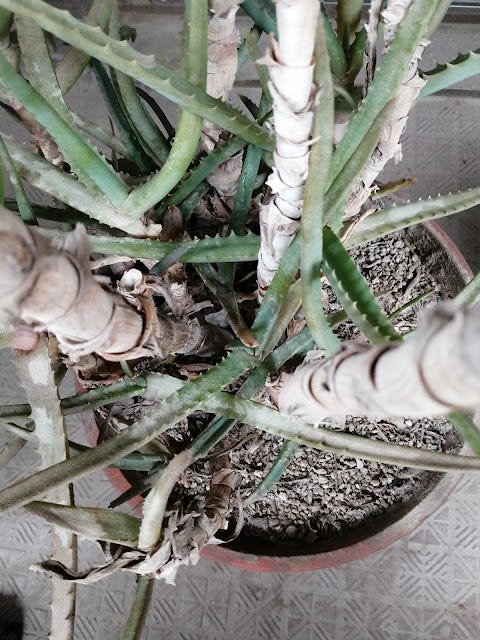
One of them had grown into a bare stem about 80cm tall, with only three leaves clinging to the top. Both plants had roots so tightly packed against the inside of their pots that I had to force them out.
New shoots were sprouting even from within the roots, yet the soil had nearly vanished — only a thin layer remained at the top of each pot. The aloe’s vitality was remarkable. It seemed as though whenever a leaf died, the plant immediately pushed out a new one to compensate. Despite being left completely neglected, they had survived.

I decided to cut them back drastically, as shown in the photos. Trimming the roots, cutting the stems, and thinning the leaves, the plants shrank to a surprisingly compact size. Looking at the overall condition, I concluded that the only way to achieve a tidy, well-shaped plant was to start over from cuttings. I kept only the most vigorous section and one reasonably formed section, leaving them to dry out in preparation for propagation.
The remaining healthy leaves were washed, sealed in zip-lock bags, and stored in the refrigerator — apparently they keep for about a week. I peeled away the outer skin and tried eating the gel inside. It was mildly bitter and jelly-like — neither particularly good nor bad — but said to be beneficial for the body, so I decided to make a habit of eating it.

After about a month of waiting for the cuttings to root, the repotting was finally complete — though only tentatively. The rooting had not gone well: the larger aloe showed no roots at all, while the smaller one had barely produced 5mm roots around the base of the cut stem. Deciding that waiting longer would make no difference, I went ahead and planted them anyway.
I had assumed that, being such a hardy plant, aloe would root quickly and easily. It turns out that getting it onto a growth cycle takes more time than expected.

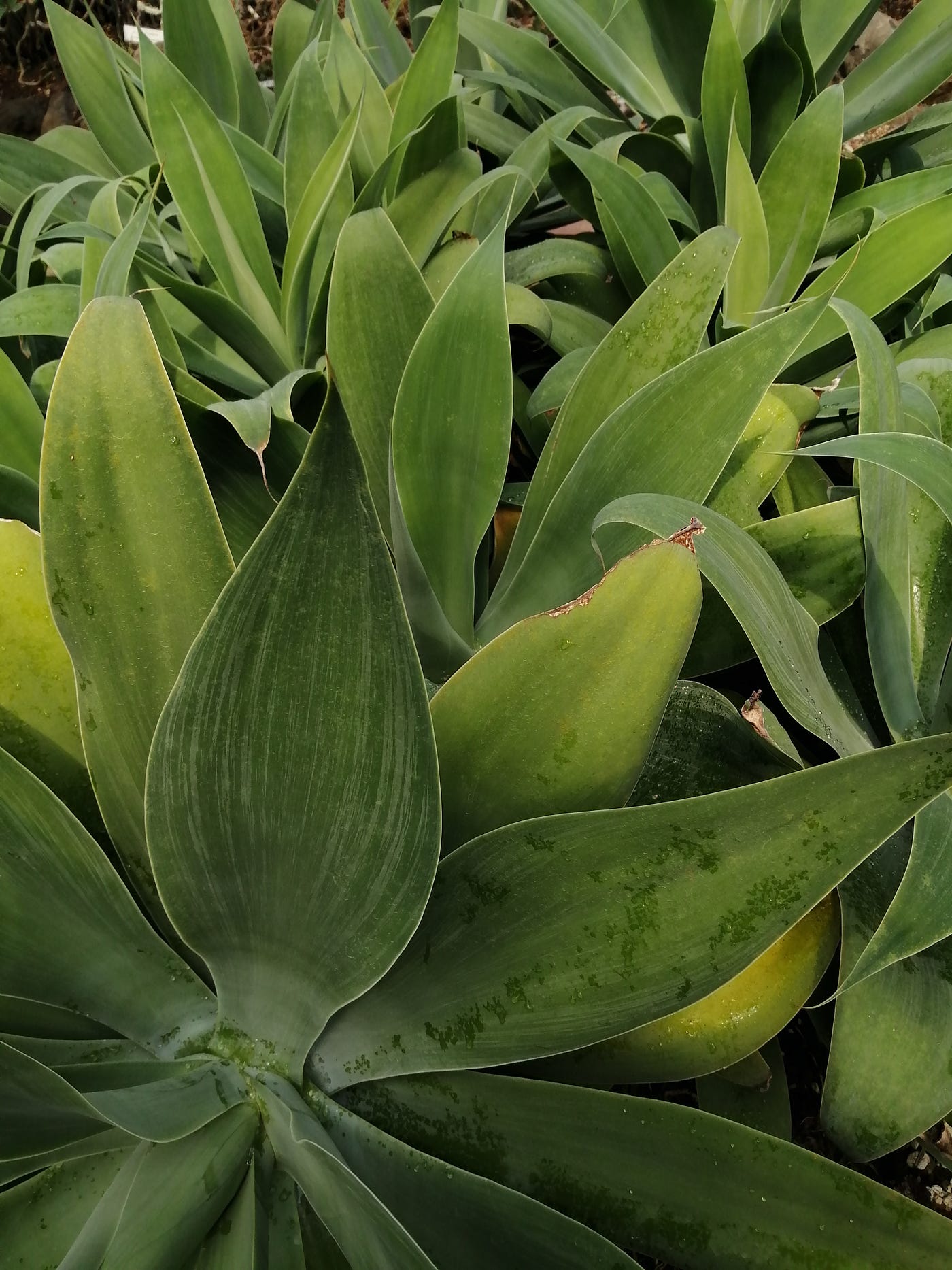
Aloe may not be the most popular houseplant, but I have grown rather fond of the spiky, jagged view from above. In the summer of 2025, I transplanted the aloe into a planter. I expect it to fill the entire planter within a few years — and honestly, the idea of it overflowing with all those jagged leaves is something I’m quietly looking forward to.
My accidental foray into gardening began with nursing these neglected inherited plants back to health, and it has been a continuous series of repottings ever since. Somewhere along the way, I fell in love with the smell of damp soil, and repotting itself has become something of an addiction. I enjoy watching the plants grow, and they often spark inspiration for my paintings. I’ve come to want to create oil paintings that suit the plants around me, and I now think of tending and reshaping plants as a form of art in itself.

As an aside — I recently spotted the same variety of aloe in a 5-inch pot at a garden centre, priced at ¥1,890. I had always assumed aloe wasn’t particularly popular, but that price is on par with monstera. Perhaps it’s more in demand than I thought.
https://medium.com/@tubieArt/an-accidental-gardener-fd070acb2028
메타데이터
- post_id
- 64fabd4bb562
- slug
- rehabilitating-a-neglected-inherited-aloe-a-two-year-journey-64fabd4bb562
- url
- https://medium.com/@tubieArt/rehabilitating-a-neglected-inherited-aloe-a-two-year-journey-64fabd4bb562
- canonical_url
- https://medium.com/@tubieArt/rehabilitating-a-neglected-inherited-aloe-a-two-year-journey-64fabd4bb562
- author_url
- https://medium.com/@tubieArt
- status
- ok
- fetched_at
- 2026-07-13 06:23:13