Digital Disruption Isn’t Equal, Survival isn’t Either
Why Some Middle-Class Businesses Moved Up and Others Stood Still
Digital Disruption Isn’t Equal, Survival isn’t Either
Why Some Middle-Class Businesses Moved Up and Others Stood Still
This piece draws on research I conducted in 2021, during the period when COVID-19 pandemic exposed deep inequalities in economic resilience. I deeply feel the challenge back then since me myself is one of the middle-class-people this essay will yaps about. Enjoy reading, guys (๑˃̵ᴗ˂̵)!
Beneath the label of ‘middle class’ lies a layered reality where access, skills, and opportunity are far from equal.
Back in 2021, the world felt strangely paused and accelerated at the same time. Streets were quieter, shops closed earlier, and human interactions shrank into small screens. Yet behind those screens, life was anything but slow. Meetings moved to video calls, classrooms to Zoom, and shopping carts to e-commerce apps. The pandemic did not merely change where we lived our lives it reshaped how we lived them.
In my country, Indonesia, there was no exception. As mobility was restricted through policies such as Pembatasan Sosial Berskala Besar (PSBB) and Pemberlakuan Pembatasan Kegiatan Masyarakat (PPKM), or “Lock-down” in other countries, the internet became the primary infrastructure of survival. For businesses, particularly small and conventional ones, this moment was not just challenging, it was disruptive. Actually, the message was clear:
Adapt to digital platforms or risk being left behind.

Captured by Biancavictoriaw on Pinterest
Well, adaptation is never equal.
Much of the public conversation around digital transformation highlights startups, tech entrepreneurs, and rapidly scaling online brands. Less discussed are conventional business owners from the middle class, those who were not wealthy enough to outsource digital expertise, yet not detached enough from market shifts to ignore them. Positioned between security and vulnerability, they faced a uniquely complex transition.
This short article tells the story of two such business owners. Their names have been changed for privacy. Let’s call them Trisha (F, 50) and Jessie (F, 19).
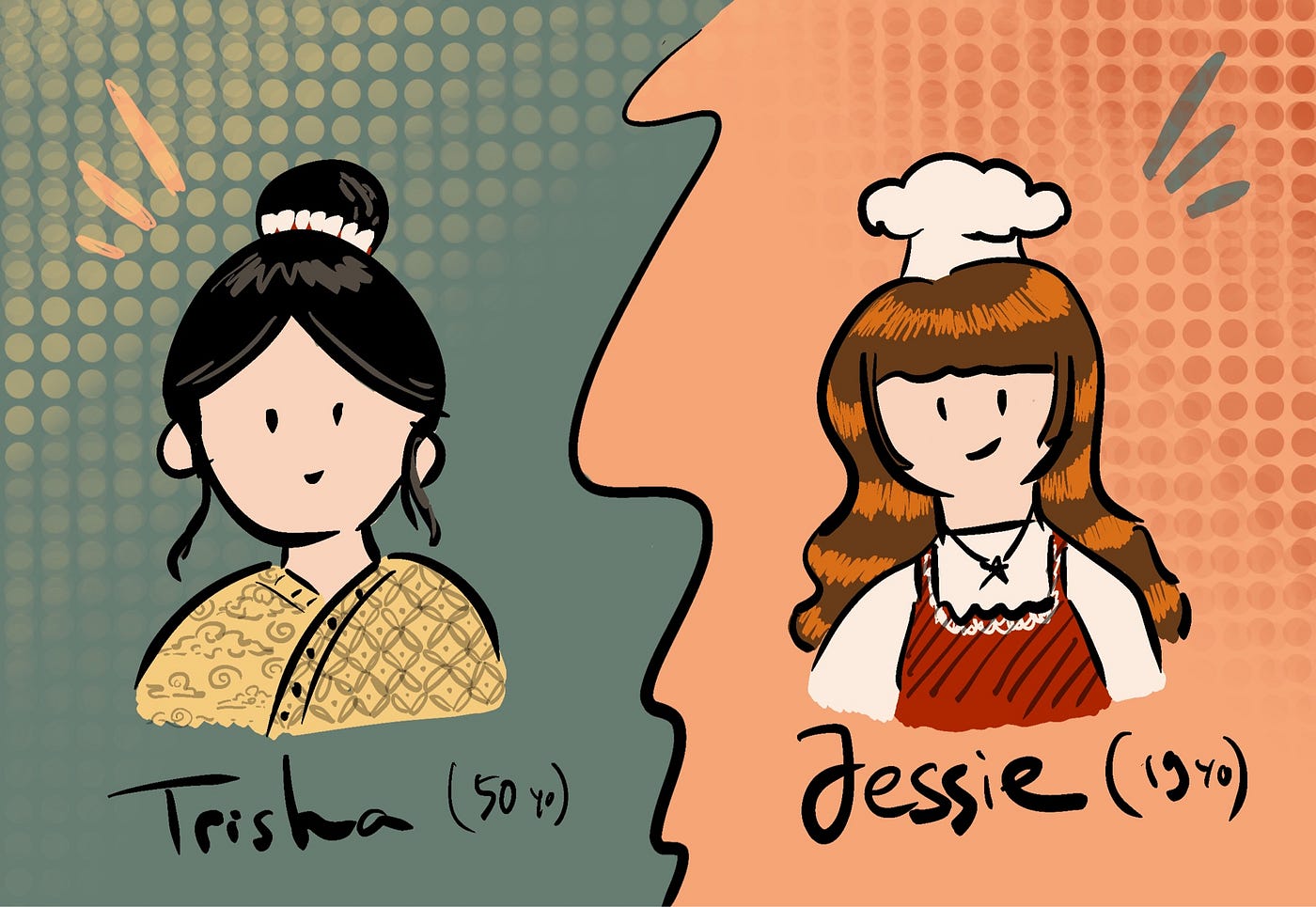
Yup I draw this cuz why not
Their stories reveal that digital disruption is not only about technology. It is about capital, skills, generational exposure, and ultimately, social mobility. I’ll elaborate their stories in specific sequence to make it easier to compare, not forgetting we can still dive deep to each stories.
Trisha (F, 50) : Surviving Through Familiar Circles
- Where she started
Trisha, in her early fifties, is a full-time government employee in Jakarta who built a side business selling batik and handmade accessories from local artisans. What began as a way to reduce her personal collection slowly turned into a steady income stream, supported by her strong network of colleagues.
- Before the pandemic
Her business relied entirely on offline interactions. Colleagues were her main customers, and word-of-mouth within the office sustained her sales. The system was simple, limited, but stable.
- When pandemic hits
Work-from-home policies disrupted everything. Demand dropped as office routines disappeared, and the informal interactions that once drove her sales vanished. Yet her customers didn’t stop buying, they simply moved to online sellers.
- Going digital
With help from her daughter, Trisha created an online presence through Instagram and other platforms. The decision was driven by the need to retain customers rather than expand her business.
- The challenge
Limited digital familiarity made the transition difficult. She relied mostly on WhatsApp to reach existing contacts, while her use of other platforms remained minimal and unstrategic.
- Where she ended up
Her business eventually stabilized, returning to near pre-pandemic income levels. However, her market did not expand beyond her original circle. Digital tools helped her survive but not grow.
Jessie (F, 19) : Growing Through Digital Exploration
- Where she started
Jessie, a nineteen-year-old university student, turned her interest in baking into a small business. She initially sold homemade food to friends and classmates, keeping the operation informal and small-scale.
- Before the pandemic
Like Trisha, her business was entirely offline. Sales depended on word-of-mouth within her immediate environment, generating modest but meaningful income.
- When pandemic hits
School closures cut off her only sales channel. However, she noticed that food businesses were thriving online, signaling not a loss of demand , but a shift in where it existed.
- Going digital
Jessie decided to rebuild her business online, creating an Instagram account and using a pre-order system to manage production. Her move was driven by curiosity and opportunity.
- The challenge
She had to adapt to digital expectations such as better product photos, consistent content, trend awareness, and appealing packaging. Managing multiple platforms required effort, but she was comfortable learning and adjusting.
- Where she ended up
Her market expanded beyond friends to a wider audience across Jabodetabek (capital city and its satellites). Orders increased significantly, and her income grew. Digital platforms became not just a survival tool, but a pathway to upward mobility.

Comparation matrix on Trisha and Jessie
Placed side by side, their stories reveal more than individual choices, they reflect structural differences in access, skills, and capital.
The Internet Doesn’t Level the Playing Field
At first glance, the gap between Trisha and Jessie looks like a generational story. But it’s not just about age, it’s about access.
This is where the idea of the digital divide comes in. It’s not simply about who has internet access, but who knows how to use it well.
Digital skills, confidence, and familiarity with online spaces shape how far someone can go. For some, the internet is intuitive. For others, it’s something to figure out under pressure.
Sociologist Pierre Bourdieu would call this a difference in capital.
Trisha had strong offline social capital:
- Trusted networks
- Loyal customers
- Long-built relationships
Jessie, on the other hand, had digital cultural capital:
- An instinct for trends
- Platforms savvy
- How to present products online
In digital marketplace, Jessie’s capital was simply easier to convert into growth.
This difference shows up clearly through the lens of social mobility. Explained by Pitirim Sorokin in his Social Mobility Theory, where elevators or we can call it social channels and capitals (such as education, culture we’re exposed to, politics, religion, facility we can use, etc) are the factors that can shifts a person from one levels of economy to another.
And in this essay we can see how Trisha and Jessie optimize their elevators to survive in pandemic. While they both in the layer of middle-class society, Trisha stayed where she was, stable but unmoved. Jessie, meanwhile, climbed. Same disruption, different outcomes.
A System That Sorts People Out, Some Rise and Others Stall
The pandemic didn’t create inequality, it exposes it.
Digital platforms often promise equal opportunity, but in reality, they act more like filters. They reward those who are ready:
- Those with the skills
- Those with the adaptability
- Those with the right kind of capital
Trisha and Jessie’s stories make one thing clear: this isn’t just about effort. It’s about who can turn what they already have into something that works in a digital space.
For some, technology is a safety net.
For others, it’s a ladder.
What looks like individual outcomes, in reality is shaped by deeper structural differences, constructed with its channels and capitals for everyone. And for the middle class, it’s very niche, they have more choices, more ways, and more possibilities, but need more efforts, more accountability, and more adaptability.
If the top can absorb change and the bottom can remain within their own markets, the middle class stands in between, where digital disruption turns capital into the line between moving forward and staying still. And when it comes to capital, the advantage belongs to those who know how to use it.
메타데이터
- post_id
- 6512aa4996eb
- slug
- digital-disruption-isnt-equal-survival-isn-t-either-6512aa4996eb
- url
- https://medium.com/@fathiasafira/digital-disruption-isnt-equal-survival-isn-t-either-6512aa4996eb
- canonical_url
- https://medium.com/@fathiasafira/digital-disruption-isnt-equal-survival-isn-t-either-6512aa4996eb
- author_url
- https://medium.com/@fathiasafira
- status
- ok
- fetched_at
- 2026-06-09 15:37:30


