Music and Its Influence, Frisson
Music and Its Influence
I don’t know if you are familiar with the term frisson.
Frisson is a sudden, short-lived emotional shiver that runs through the body (the back, neck, shoulders), creating goosebumps. It is both pleasant and intense at the same time. It is the moment when emotion becomes so strong that it “leaves” the mind and moves through the body.
Frisson in music is a rhythm like the gallop of a heart, tension and freedom at once. It is a sound that becomes an inner force. It is something like a musical image: a black horse running through the fog… slowly, yet impossible to stop.
The word “frisson” (pronounced free-son) is one of those terms that connect the body, emotions, and art in a single moment.
The mind and body react simultaneously; there is a sudden release of dopamine (the “happiness hormone”). The brain’s reward system is activated — the same one responsible for awe and addiction. The nervous system is stimulated, and the body experiences shivers.
Frisson appears when something is beautiful, but also surprising. Sometimes it exceeds our expectations, or something strikes exactly at our emotions. That is why not every piece affects everyone — it is a very personal experience, and not everyone feels it. People who are more sensitive and emotionally open experience it more often.
Frisson in music is the moment when the melody suddenly changes, a new instrument enters, tension builds, and “that one note” appears — the one that touches the heart.
What triggers frisson in music? Sudden changes in dynamics (soft to loud), modulations (a change of key), tension and its resolution, an emotional voice or harmony. It is what is called a “violation of expectation.” Your brain “expects” something predictable, and the music gives something beautifully unexpected.
And then: the body reacts with a shiver, the heart reacts with emotion.
It has something in common with ecstasy. Frisson is sometimes called an “aesthetic chill,” or colloquially a “skin orgasm.” However, it is an emotional ecstasy, not a physical one.
Frisson appears when something touches your truth. When something reminds you of a feeling you cannot name. When something moves your soul faster than your mind. That is why music, poetry, and memories can evoke the same kind of shiver.
“Frisson is the moment when the soul no longer fits within the body and rises to the surface in the form of a shiver.”
Frisson appears especially during sudden changes in music, climaxes, modulations, and the entrance of a voice or orchestra. That is why these pieces share one common feature: they build tension… and suddenly touch emotion.
Which piece of music makes you feel frisson? What moves you so deeply that you feel shivers? Not every piece will work for everyone. Frisson appears when music touches exactly your story, you're longing, your memory. That is why sometimes a single note is enough — and another piece does nothing at all.
If one were to put frisson into words, it is what happens within you when listening to a particular, exceptional piece — a blend of longing without a specific memory, and beauty that is almost painfully delicate. It is the feeling that something is “important,” even if you do not know what. It is the subtle dissolution of the boundary between you and the sound.
It is a state very close to contemplation, falling in love without an object, or… touching something spiritual. It is like being transported in time, into another space.
Only exceptional people react to music in this way, and that says a great deal about them. They possess high aesthetic sensitivity, their emotions are deeply integrated with the body, and they have the ability to experience art “with their whole being.” It is a profound gift, especially for someone who writes.
“It is the feeling as if something within you is returning home — to a place you have never seen, yet have always known.”
Of all the pieces I have listened to in my life, Canon in D has made the greatest impression on me, and whenever I listen to it, I feel something I do not feel as strongly with other pieces or music.
This one piece can do what no other can. It carries me into other worlds, soothes my pain, soothes my longing, and eases my stress.
It is like the gentle touch of a loved one.
It helps cleanse the soul. I do not think I have ever cried as often while listening to any other piece, and I do not think I have listened to any piece as many times as this one.

“Beneath the Skin of Sound”
When Canon in D begins, I do not hear it… I feel it.
As if the first note glided across my skin, too delicate to hold, yet enough to make me rise, to drift.
The bass pulses gently, in a steady, quiet rhythm, like a heart that suddenly beats closer.
I breathe more slowly.
Each following note moves toward me, as if it knows there is no need to hurry.
Because I am already waiting.
Everything within me becomes more sensitive — my shoulders, my neck, the space between breaths.
As if the body remembers something it has never fully lived through.
And then — the first shiver.
Quiet. Slow.
It travels along my spine like warmth that does not ask for permission.
I do not stop it.
I allow it to spread further, to touch the places where I hide what remains unspoken.
The music wraps around me softly, like a presence that does not need hands.
It is close. Too close to withdraw.
I feel the tension within me melt, something opening at last — without resistance, without fear.
I feel spring. Hope.
As if, for a moment, I was a thread — delicate, yet strong — like a spider’s silk.
Sound and body speak the same language.
And there is no boundary anymore.
There is only the pulse, the trembling, a quiet fulfillment.
Warm. Deep. Returning in waves.
Saying more than words. Remaining.
And when everything fades… My skin still remembers.
As if it had lived through a sacred celebration.
And for a moment longer, I still feel the music within me — like a secret, a gentle caress in every detail.
“United with the Sound”
Music caresses my skin, it trembles, descends lower, vibrates. Then it travels upward, gently guiding me, soothing pain, easing it, wiping away tears.
It is like a captain on a boat.
I close my eyes — it rocks me gently, it is already closer, closer, closer.
I feel shivers, my heart quickens its rhythm.
And suddenly I see light — I want it to never fade for me.
I feel shivers and I want more, more, more.
I am in the music, the music is within me.
I feel a powerful union, it spreads like a wave throughout my whole body — pleasantly.
I see flashes of stars, fragments of the universe.
Frisson can occur not only in response to music, but also through other emotionally powerful stimuli, such as intensely moving scenes, visual imagery, memories, or sudden moments of deep realization. It is not limited to sound — it emerges whenever the brain encounters something that is both meaningful and unexpected.
From a psychological perspective, frisson is closely linked to emotional salience — the brain’s ability to recognize something as significant. When an experience resonates deeply with personal meaning or triggers a strong emotional association, it can activate the same neural pathways involved in reward, empathy, and aesthetic appreciation. This is why a single image, a line of poetry, or a moment of insight can evoke a response similar to that produced by music.
Frisson is a biological reaction to stimuli and produces measurable physiological effects. Studies have shown that during frisson, the brain releases dopamine, particularly in areas associated with the reward system, such as the nucleus accumbens. At the same time, there is increased activity in the autonomic nervous system, including changes in heart rate, skin conductance, and respiration. The characteristic goosebumps are caused by piloerection — the contraction of tiny muscles attached to hair follicles — a reflex inherited from evolutionary responses related to temperature regulation and emotional arousal.
Frisson can be experienced throughout the entire body, but it most commonly begins in the head, neck, and upper chest or back before spreading outward. This pattern is linked to the distribution of sensory nerves and the way the brain processes emotionally salient stimuli. The initial sensation often appears as a subtle tingling or wave-like movement that travels along the spine, sometimes accompanied by a feeling of cold, shivering, or trembling.
This embodied response reflects a moment of integration between mind and body — when cognitive processing, emotional resonance, and physiological reaction align simultaneously. It is precisely this convergence that gives frisson its unique intensity and makes it feel both deeply personal and physically real.
Frisson is not a universal experience. Research shows that only a portion of the population experiences it regularly — and this is not accidental. There is a clear psychological profile of individuals who are particularly susceptible to it. The strongest predictor of frisson is the personality trait known as openness to experience. People with high openness respond more strongly to art, music, and beauty, have richer imaginations, more frequently experience deep aesthetic emotions, and are more prone to awe and emotional uplift. In studies, such individuals report chills during music listening significantly more often. In practice, these are people who feel more and feel more deeply.
Frisson also occurs more frequently in individuals with high emotional reactivity. These are people who are easily moved, experience emotions intensely, and respond physically to psychological stimuli. Their nervous system is more responsive — it transitions more quickly from stimulus to bodily reaction. Another important factor is the capacity for absorption, meaning the ability to become deeply immersed in an experience. Individuals with high absorption can lose themselves in music or text, lose track of time, and strongly identify with what they are experiencing. It is precisely in such individuals that the moment most often occurs when they are no longer listening to music, but are inside it.
The way a person experiences emotions is also significant — whether they remain within the realm of thought or extend throughout the entire body. Frisson occurs more often in individuals who experience emotions somatically, noticing tension, warmth, chills, and subtle physiological changes. A high level of body awareness, or interoception, makes emotional experience more intense and physically perceptible.
Empathy and aesthetic sensitivity also play an important role. Empathetic individuals more easily enter into the emotions contained in music and respond to tone, harmony, and tension. Aesthetic sensitivity refers to the ability to experience beauty as an emotional phenomenon, not merely an intellectual one. On a neurobiological level, individuals who experience frisson show stronger activation of the dopaminergic system, particularly in reward-related areas such as the nucleus accumbens. There is also greater connectivity between auditory and emotional brain regions. This means that their brains reward encounters with art in a way similar to other highly satisfying experiences.
Frisson is also more common among creative and reflective individuals who write, analyze, and live more internally. These are people who not only experience, but also assign meaning to their experiences. This is why poets, writers, and artists so often describe this phenomenon — they simply feel it more frequently.
From a psychological perspective, frisson occurs when three elements come together: emotional significance, an element of surprise, and psychological readiness to experience it. If any one of these elements is missing, the reaction does not occur.
In its deepest sense, frisson is not merely a response to music. It is a response to inner truth. It appears when something aligns precisely with your personal history, touches what you cannot name, and moves you faster than the mind can process.
So if you feel more, if you experience more deeply — now you know why.
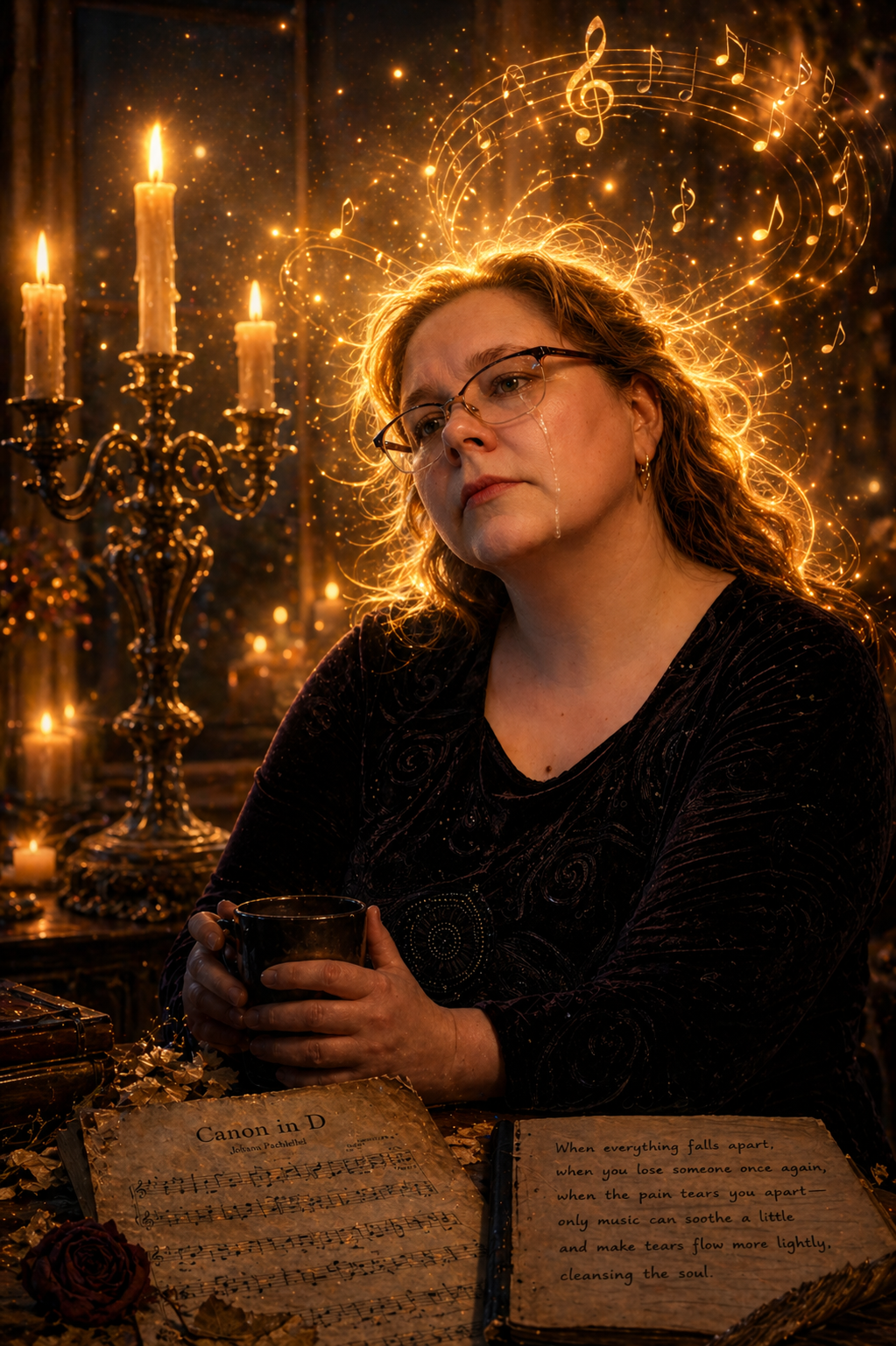
When everything falls apart, when once again you lose someone important, when pain tears a person apart from within — music remains.
It comes quietly, without questions, without judgment, without words. It wraps around you like the hand that is no longer there, and lets you breathe a little more calmly.
Because only music can soothe what cannot be spoken. It makes tears flow more gently — as if they knew the way.
And in that quiet weeping, the soul slowly begins to cleanse itself…
메타데이터
- post_id
- 6515da2f374c
- slug
- music-and-its-influence-frisson-6515da2f374c
- url
- https://medium.com/@ajrin35/music-and-its-influence-frisson-6515da2f374c
- canonical_url
- https://medium.com/@ajrin35/music-and-its-influence-frisson-6515da2f374c
- author_url
- https://medium.com/@ajrin35
- status
- ok
- fetched_at
- 2026-06-13 07:35:29