MRP vs ERP Is Really a Question About Where Your Planning Problem Ends
If material availability is the main constraint, MRP may be enough. If every shortage cascades through purchasing, warehouses, sales, and…
MRP vs ERP Is Really a Question About Where Your Planning Problem Ends
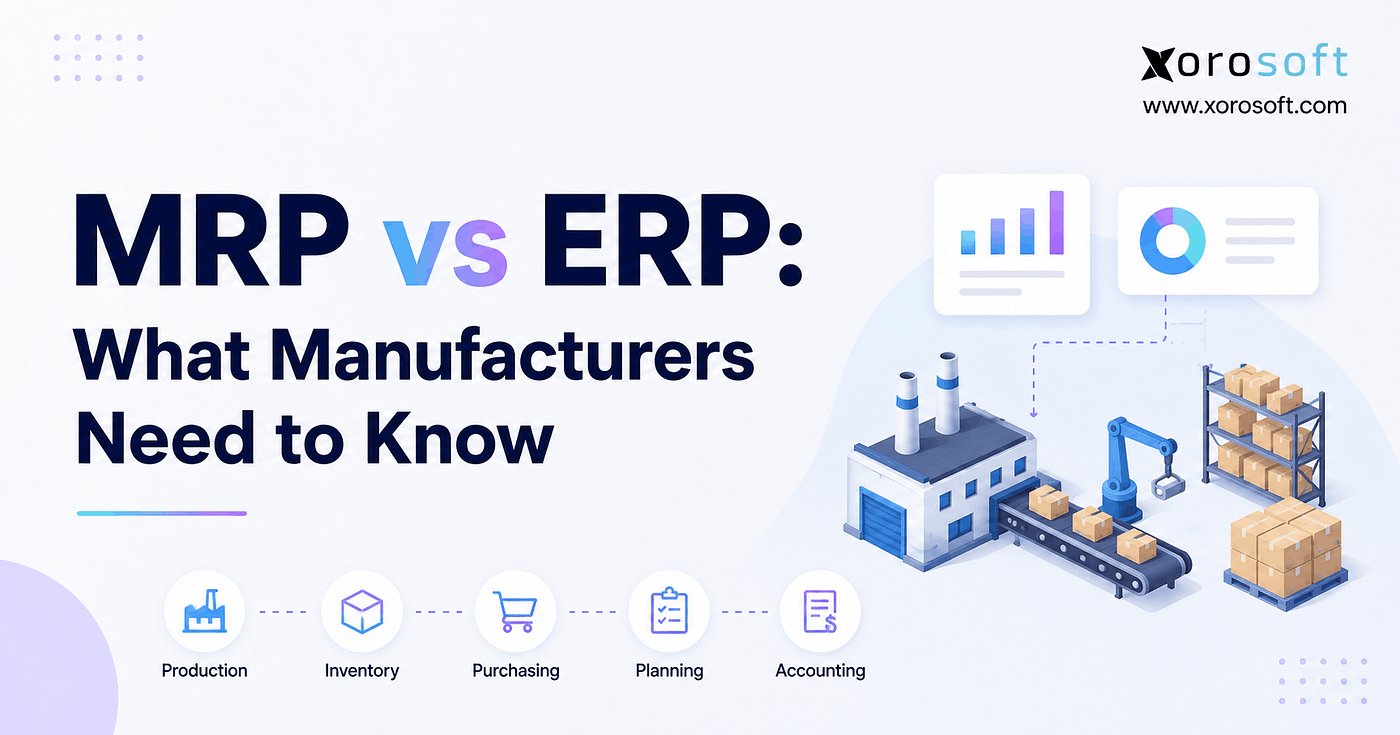
If material availability is the main constraint, MRP may be enough. If every shortage cascades through purchasing, warehouses, sales, and finance, the decision is about a wider operating system.
A production planner discovers that one component will be short next month.
The calculation itself may be straightforward. The manufacturer needs 5,000 units, has 3,200 available or inbound, and must secure the difference before production begins.
Then the shortage leaves the planning department.
A buyer needs an approved supplier and current price. The warehouse needs to know which location holds usable stock. Production may need to reschedule work orders. Sales needs a reliable customer date. Finance needs to understand the cash requirement and margin impact. If ecommerce and wholesale orders compete for the same finished goods, allocation may also change.
This is where MRP vs ERP becomes a useful decision — not because one acronym is more advanced, but because they draw different boundaries around the problem.
Material Requirements Planning focuses on what materials are required, in what quantity, and when they need to be available. Enterprise Resource Planning connects manufacturing activity with broader workflows such as purchasing, inventory, warehousing, sales, accounting, forecasting, fulfillment, and reporting.
Neither category is automatically better. A manufacturer with a focused planning gap may gain more value from strong MRP than from a large ERP implementation. Another company may already have capable material planning but remain trapped by disconnected transactions and reconciliations across departments.
The real question is: Does the problem end when the plan is calculated, or does it continue through the rest of the business?
The difference in one sentence
MRP plans the materials. ERP coordinates the business around the plan.
MRP asks:
- What finished products must be made?
- Which components do their bills of material require?
- What is already on hand or scheduled to arrive?
- What remains to be purchased or produced?
- When must supply become available?
ERP asks a wider set of questions:
- How does the requirement become an approved purchase order?
- What happens when material is received or arrives short?
- Which warehouse or bin owns usable stock?
- How is material issued to production?
- How do finished goods become available for orders?
- What are the accounting, cash, cost, and margin effects?
Many manufacturing ERP products include MRP. The decision is therefore not always “replace MRP with ERP.” It may be “place material planning inside a shared operational and financial system.”
What MRP is built to do
MRP begins with demand and works backward through the product structure.
It typically needs:
- customer orders, forecasts, or a master production schedule;
- accurate bills of material;
- on-hand inventory and scheduled receipts;
- open purchase and production orders;
- lead times, lot sizes, safety stock, and reorder settings; and
- dates and quantities for the planning horizon.
The system nets demand against available and expected supply, explodes requirements through BOM levels, and recommends actions such as creating, changing, rescheduling, or cancelling supply orders.
Microsoft’s MPS and MRP planning documentation describes this balance between demand and supply and the resulting action messages. SAP’s explanation of material requirements planning likewise frames MRP around identifying what is needed, how much is needed, and when it is required.
This is valuable when the central constraint is material availability. A planner may be able to identify shortages earlier, reduce manual calculations, align purchasing with production, and avoid unnecessary supply.
MRP is not a substitute for operating discipline. An inaccurate inventory balance can tell the plan that missing components exist. An obsolete BOM can recommend materials the current product no longer uses. A fictional supplier lead time can produce a mathematically tidy schedule that no buyer can execute.
Planning quality depends on inventory accuracy, BOM governance, demand quality, and maintained parameters.
ERP extends the boundary around the plan
An MRP recommendation is the beginning of work for several other teams.
Consider the lifecycle of one component shortage:
- Planning identifies the requirement.
- Procurement selects the supplier and approves the commitment.
- A purchase order is issued.
- Receiving records what physically arrived.
- Warehouse inventory and location availability change.
- Production consumes the component.
- Finished goods enter inventory.
- Fulfillment ships the customer order.
- Accounting records the operational and financial consequences.
In a disconnected stack, employees or integrations must move information between each step. The same item, quantity, date, cost, or status may be recreated, exported, emailed, and reconciled several times.
ERP attempts to preserve the transaction across those boundaries through shared records and workflows. A manufacturing platform such as XoroERP connects production with inventory, purchasing, warehouse operations, accounting, and reporting.
The advantage is not having more modules on a brochure. It is reducing the number of handoffs where the business can lose context, create duplicate data, or allow two departments to act on different versions of reality.
MRP may be enough when the boundary is narrow
Standalone MRP remains a legitimate choice when:
- material planning is the main operational gap;
- accounting, purchasing, inventory, and order management already work reliably;
- integrations pass demand and supply data consistently;
- warehouse complexity is limited or handled well elsewhere;
- planners do not spend significant time reconciling other departments; and
- management can obtain trustworthy cross-functional reporting without manual consolidation.
A manufacturer can operate successfully with focused MRP for years. Implementing a broader ERP before the organization needs it can introduce cost, change, and process overhead without solving a proportionate problem.
Company size is not the deciding factor. A larger manufacturer with one plant, a narrow product range, and stable channels may have a simpler system boundary than a smaller company with outsourced production, two warehouses, imported components, Shopify, Amazon, wholesale, and EDI customers.
Complexity matters more than headcount.
ERP deserves serious consideration when coordination is the constraint
The decision starts shifting toward ERP when capable planning cannot prevent wider operational friction.
Common signals include:
- buyers copying planned requirements into spreadsheets;
- warehouse inventory disagreeing with the planning balance;
- production changes failing to update customer promises;
- accounting reconciling manufacturing transactions manually;
- employees entering the same item or order in several systems;
- multi-warehouse transfers and allocations remaining unclear;
- ecommerce, wholesale, and marketplace demand competing outside one view; and
- leaders combining multiple exports to understand production, inventory, margin, or open commitments.
At that point, the business does not merely have a planning problem. It has a coordination problem.
XoroONE reflects the broader model by combining manufacturing, inventory, purchasing, warehouse management, ecommerce, reporting, and accounting in a cloud environment. That scope is relevant when the value comes from one transaction moving through several functions without being rebuilt at every handoff.
ERP is still not guaranteed to be the right answer. The company may repair integrations or standardize processes instead. But adding another isolated application to every new problem can eventually make the architecture itself the constraint.
Do not ask MRP or ERP to be every manufacturing system
Manufacturing software categories overlap, but they do not solve identical problems.
MRP focuses on material planning. ERP coordinates enterprise transactions. A Warehouse Management System goes deeper into receiving, putaway, bin control, barcode scanning, replenishment, picking, cycle counting, and shipping. A Manufacturing Execution System focuses more directly on shop-floor production activity, labor, machines, downtime, quality, and work in process.
XoroWMS represents the warehouse-execution layer for businesses that need deeper location and scanning controls alongside ERP. For complex plants, ERP may also exchange information with a specialized MES.
The ISA-95 enterprise-control integration standard formalizes the interface between manufacturing-control functions and business systems. Its existence reinforces a practical point: enterprise coordination and factory execution have different responsibilities, even when they share data.
A simple assembly operation may find enough production functionality inside manufacturing ERP. A complex plant with detailed finite scheduling, machine integration, or quality requirements may need specialized systems. Evaluate depth rather than assuming a category label guarantees it.
Ecommerce and multi-warehouse growth move the boundary
MRP can only plan from the demand and inventory it receives.
When Shopify orders, wholesale commitments, marketplace demand, forecasts, and EDI transactions live in separate systems, planners may work from an incomplete demand picture. When several warehouses serve those channels, total inventory does not reveal which location can fulfill which commitment.
ERP becomes more relevant when the company needs a common view of demand, allocation, available inventory, inbound supply, production, purchasing, and customer commitments.
Shopify alone does not create an ERP requirement. Neither does a second warehouse. The requirement appears when the coordination work between those elements becomes unreliable, slow, or excessively manual.
Replace the feature checklist with one hard scenario
Software demonstrations make almost every product look capable. Feature checklists make different products look more similar than they are.
Instead, map one complete manufacturing scenario from demand to financial outcome.
Use a realistic case: a customer orders a manufactured product, but one critical component is short. Ask each vendor to show how the system:
- receives the demand;
- explodes the BOM and identifies the shortage;
- proposes and approves supply;
- issues the purchase order;
- handles a partial or late receipt;
- updates production and material availability;
- completes the work order;
- makes finished goods available;
- fulfills the customer order; and
- records inventory value, payables, cost, and margin.
Track every spreadsheet, manual entry, integration, approval, and exception. The test will reveal whether the requirement is focused planning, integrated ERP, or a combination of ERP with specialized warehouse or shop-floor systems.
Buyers can use ERP comparison resources for initial research, but vendor-authored comparisons should be validated through scenario demonstrations, references, and contract-level requirements.
Implementation quality decides whether either system works
MRP cannot plan accurately from unreliable BOMs, inventory, demand, or lead times. ERP cannot coordinate the business if teams keep shadow spreadsheets, integrations fail, roles are unclear, or users bypass the workflow.
Before implementation, define measurable outcomes such as fewer material shortages, less expediting, higher inventory accuracy, faster planning, fewer duplicate entries, better purchase visibility, shorter reconciliation, or more dependable customer dates.
Clean master data. Validate BOM versions and units of measure. Establish ownership for planning parameters. Test exception paths, not only happy paths. Reconcile opening inventory. Define approval thresholds. Train users on why the transaction sequence matters.
Teams can also examine implementation case studies to understand how process, data, and change management shape operational results.
Software scope matters. Execution matters more.
Frequently asked questions
What is the main difference between MRP and ERP?
MRP calculates material and production requirements from demand, BOMs, inventory, scheduled supply, and planning parameters. ERP connects manufacturing with wider workflows such as purchasing, inventory operations, warehousing, sales, accounting, and reporting. Many manufacturing ERP systems include MRP.
Is MRP part of ERP?
Often, yes. Manufacturing ERP commonly includes material requirements planning as one capability inside a broader platform. Manufacturing depth varies, so buyers should verify BOM, planning, work-order, procurement, costing, and exception workflows rather than relying on the ERP label.
Can a manufacturer use MRP without ERP?
Yes. Standalone MRP can work well when material planning is the primary problem and surrounding systems already handle purchasing, inventory, sales, accounting, and warehouse operations reliably. The decision depends on system boundaries, not a universal maturity sequence.
When should a manufacturer consider ERP?
Consider ERP when problems extend beyond planning into duplicate entry, disconnected purchasing, multi-warehouse visibility, accounting reconciliation, fragmented reporting, or competing omnichannel demand. Those symptoms indicate that cross-functional coordination may be the constraint.
What data does MRP require?
MRP typically needs reliable demand, bills of material, inventory balances, scheduled receipts, open production and purchase orders, lead times, lot-sizing rules, safety stock, and planning horizons. Bad inputs can create unusable recommendations even when the calculation is correct.
Does ERP replace MES or WMS?
Not necessarily. ERP coordinates business-wide transactions, MES goes deeper into shop-floor execution, and WMS goes deeper into warehouse activity. Simpler manufacturers may find enough functionality in one platform; complex operations may integrate specialized systems.
Choose the smallest system boundary that solves the real problem
MRP is not the lesser option. ERP is not the inevitable upgrade. They solve problems with different boundaries.
If the constraint is calculating material requirements, strengthen the plan. If the constraint is what happens when the plan reaches purchasing, warehouses, sales, fulfillment, and finance, evaluate the wider operating system.
Then test the decision with one hard, end-to-end workflow — not a feature count.
For inventory-driven manufacturers evaluating whether connected ERP fits that boundary, book a personalized Xorosoft demo to review the actual manufacturing and cross-functional workflows involved.
Read the full blog
For the complete original guide, additional comparisons, industry examples, and supporting details, read Xorosoft’s complete MRP vs ERP guide for manufacturers.
메타데이터
- post_id
- 6528ca1a4cc4
- slug
- mrp-vs-erp-is-really-a-question-about-where-your-planning-problem-ends-6528ca1a4cc4
- url
- https://medium.com/@sunny.rathore_43000/mrp-vs-erp-is-really-a-question-about-where-your-planning-problem-ends-6528ca1a4cc4
- canonical_url
- https://medium.com/@sunny.rathore_43000/mrp-vs-erp-is-really-a-question-about-where-your-planning-problem-ends-6528ca1a4cc4
- author_url
- https://medium.com/@sunny.rathore_43000
- status
- ok
- fetched_at
- 2026-08-22 01:10:40