What to Do When the Light Turns Red
I’ve stopped pretending people are invisible
What to Do When the Light Turns Red
I’ve stopped pretending people are invisible
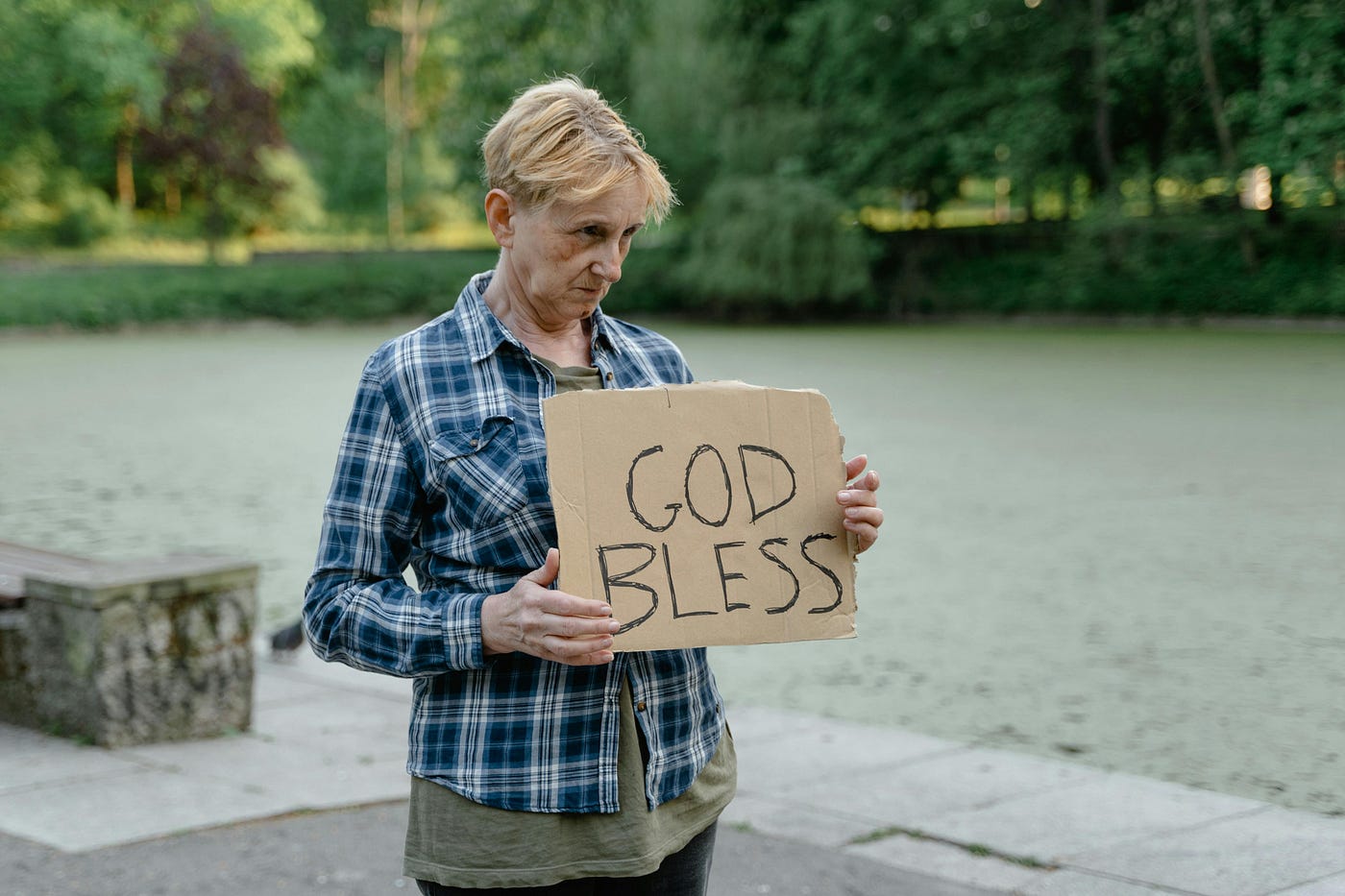
Photo by pexels-mart-production-8078356 on Pexels.com
I see the woman standing by the intersection, cardboard sign in hand, but I can’t read it. She sees me looking at her, and I hurriedly look away.
Darn it. The light turns red just as I pull up beside her. Perfect. Trapped.
I reach down, pretending to dig through my purse for lipstick, then realize she must think I’m getting cash. I jerk upright and stare straight ahead. Then I glance around like I’m desperately trying to find a street sign I’ve somehow never noticed before.
Do you look, or do you avoid eye contact?
When you see a panhandler walking toward your car, do you suddenly become fascinated with your console? Your phone? The clouds?
Can you imagine standing on a corner for six hours, waving at people who act like you’re invisible?
My grandmother could imagine it. Her brother, my great-uncle Art, was a hobo. Not a tramp. Tramps avoid work. Not a bum. Bums avoid work and travel.
Uncle Art was a hobo: a migrant worker who rode freight trains during the 1930s, moving wherever work might be found. Back then, there were thousands of unemployed men riding the rails, chasing rumors of jobs and a few days’ pay.
Grandma told his story in a sad, nostalgic way. Uncle Art would come into town and always stop by home for a few days. He insisted on sleeping in the barn — because he needed a bath, he’d say. Sometimes he joined the family at the table for dinner, but mostly he ate on the porch.
Grandma could always tell when he was getting restless. She hoped he wouldn’t leave, but after a few days, he’d hop the next train out. It didn’t matter where it was headed.
Uncle Art truly lived in the moment. He had friends in hobo camps and carried everything he owned in a bindle. What began as necessity eventually became a lifestyle. Over time, most people quit riding the rails. Uncle Art faded into family legend.
Grandma taught me one thing that stuck: “Never ignore people. Always acknowledge them, even with a nod or a smile, and even if you don’t care for them.” I think she hoped that, somewhere along the line, people treated her brother like he mattered.
Today, the labels have changed. Transients and hobos became homeless. And the newest term, “unhoused individual,” sounds like someone was evicted from a dollhouse. I even heard ‘locationally flexible.’ Next year, maybe we’ll rename the problem again. ‘Free-range citizens?’
But whatever we call it, the discomfort remains.
A friend of mine has a son who is homeless by choice. I’ve never asked why. When she sees him, she brings food. When the weather turns cold, she searches until she can give him warm clothes. It’s love without understanding.
Then there was the little old man at the Burger King drive-through. His sign said he needed food. I gave him five dollars and watched him walk straight toward the liquor store. Months later, same man, same sign. That time, I rolled down my window and told him to stay put; I’d get him a sandwich. He just looked at me and asked for cash instead.
When panhandlers have dogs or children with them, people get especially angry. It feels manipulative, in a way. One friend buys bags of dog food but never gives money.
“When you give money, it’s none of your business how it’s spent,” my dad used to say.
I once saw a man sitting at the end of a highway exit holding a sign that read, “I’m not going to lie — I need a drink.” That’s one way of forgetting your troubles.
I pray for the light to turn green when someone runs toward my car with a dirty rag and a spray bottle, eager to wash my windshield for a few dollars.
Cities discourage giving donations. Articles are written warning us not to give, and yet the beggars continue to beg.
Someone must be giving.
It reminds me of the song “King of the Road,” with its romantic picture of a hobo living free, knowing every engineer on every train. Maybe that’s what my friend’s son feels. Maybe that’s what Uncle Art felt, too.
I know people keep little care packages in their cars and hand them to the street corner beggars as they pass by. But my mother warned me to never roll down my window in the city. What if they grab my arm? I suppose I could throw a bottle of water at them, but that seems a little rude.
I still feel awkward. I still hope the light turns green before anyone reaches my window with a squeegee and a dream.
I still don’t know the right answer. What I do know is this: we’ve renamed the problem, argued about it, warned each other about it, and written articles discouraging generosity — but the people are still there, with cardboard signs, kids, and dogs.
Maybe some are chasing freedom like my Uncle Art. Maybe some are stuck. Maybe some just want a drink and at least have the honesty to admit it.
I don’t carry care packages. I don’t throw water bottles. And I still won’t roll down my window.
But I look up now.
Because if nothing else, I can offer what my grandmother hoped someone once offered her brother: proof that he existed, if only for the length of a red light.
Edited by Tanmoy Das
메타데이터
- post_id
- 652b1c1928aa
- slug
- what-to-do-when-the-light-turns-red-652b1c1928aa
- url
- https://medium.com/activated-thinker/what-to-do-when-the-light-turns-red-652b1c1928aa
- canonical_url
- https://medium.com/activated-thinker/what-to-do-when-the-light-turns-red-652b1c1928aa
- author_url
- https://medium.com/@vickie_71502
- status
- ok
- fetched_at
- 2026-07-13 06:23:13