How Should We Measure the Value of Cities?
Collective Impact, Logic Models, and Sensibility Indicators
How Should We Measure the Value of Cities?
Collective Impact, Logic Models, and Sensibility Indicators
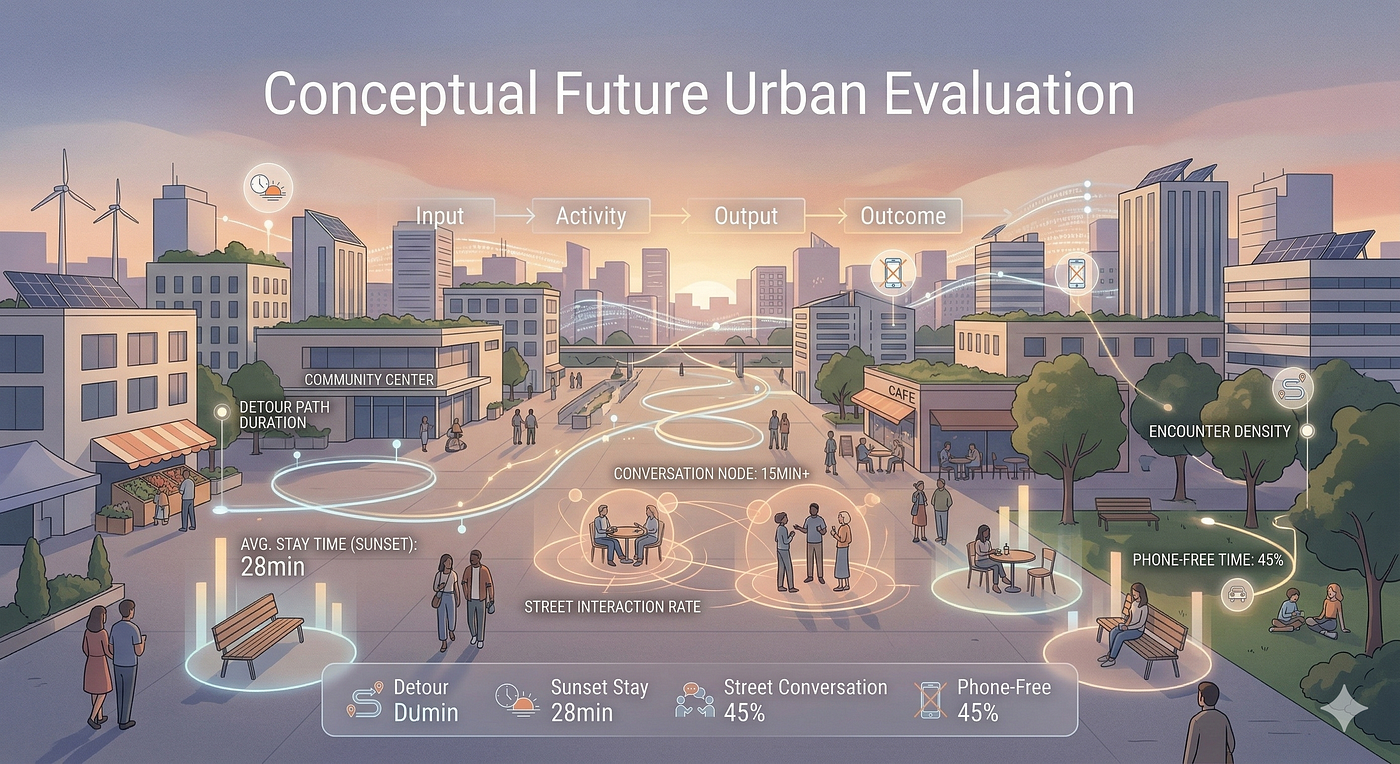
Conceptual illustration of future urban evaluation
Urban transformation never occurs through a single organization. Cities change through collaboration among governments, companies, citizens, researchers, creators, and local communities.
This type of coordinated social effort is known as Collective Impact.
Collective Impact is a framework for solving complex social problems through structured collaboration. It is defined by five core conditions:
- A common agenda
- Shared measurement systems
- Mutually reinforcing activities
- Continuous communication
- Backbone organizations
Urban development, area management, and civic innovation clearly follow this structure. Cities evolve through the coordinated actions of multiple actors rather than through isolated interventions.
In other words, urban development is inherently a collective impact process.
Social Value and Economic Value Are Not Opposites
Traditional urban development has primarily been evaluated through economic indicators such as:
- Land prices
- Visitor numbers
- Commercial revenue
- Investment levels
However, these metrics alone cannot explain the real value of cities.
In recent years, the concept of Social Value has become increasingly central in urban policy and research.
Social value includes factors such as:
- Community formation
- Civic pride
- Well-being
- Cultural vitality
- Creative environments
These elements fundamentally shape the quality of urban life.
Crucially, social value and economic value do not conflict with each other.
In many successful cities, social value generates economic value.
Vibrant public spaces attract people. Active communities attract businesses. Creative environments attract investment.
The economic strength of cities emerges from their social foundations.
Urban Projects Require Impact Evaluation
Because urban initiatives aim to produce social change, they require Impact Evaluation.
Impact evaluation is not merely performance measurement. Its purpose is to examine whether and how a project has produced meaningful social change.
In the field of public policy and social innovation, the most widely used structure for this evaluation is the Logic Model.
A logic model describes the causal pathway of a project:
Input ↓ Activity ↓ Output ↓ Outcome ↓ Impact
- Input refers to resources and investments.
- Activity refers to the actions taken.
- Output refers to immediate deliverables.
- Outcome refers to behavioral or systemic change.
- Impact refers to long-term societal transformation.
Logic models are widely used in governments, foundations, and nonprofit organizations to structure complex social initiatives.
Impact Evaluation Becomes Difficult in Cities
Despite its usefulness, impact evaluation faces serious challenges in urban contexts.
Cities are complex systems, and three structural factors make evaluation difficult.
1. Causality Is Diffuse
Urban change rarely results from a single intervention.
Multiple forces interact simultaneously:
- Policy changes
- Economic shifts
- Cultural movements
- Community actions
- Private investments
As a result, isolating the causal impact of a single project becomes extremely difficult.
2. Urban Change Is Long-Term
Urban transformation often unfolds over decades.
Community development, cultural ecosystems, and public space dynamics cannot be fully evaluated within short project cycles.
Impact evaluation frameworks designed for short-term programs struggle to capture these long-term processes.
3. Many Urban Values Are Experiential
Perhaps the most significant challenge is that much of urban value is experiential.
Cities are not only infrastructures. They are environments that people experience.
Urban quality often emerges from subtle phenomena such as:
- Atmosphere
- Comfort
- Chance encounters
- Cultural energy
- Creative stimulation
These experiences are difficult to capture through traditional economic metrics.
This reveals a fundamental limitation in existing urban evaluation frameworks.
Sensibility Indicators: Measuring Urban Experience
To address this gap, a new category of indicators is necessary.
These can be described as Sensibility Indicators.
Sensibility indicators attempt to measure the experiential quality of cities — the subtle dynamics that shape how urban spaces are actually lived.
Examples may include:
- Detour Rate — how often people spontaneously change their route
- Sunset Stay Rate — how long people remain in public space during evening hours
- Street Conversation Rate — frequency of informal interactions in public space
- Phone-Free Time — time spent in environments that encourage attention to surroundings
These indicators focus on the human experience of cities, rather than purely economic outputs.
They offer a way to translate qualitative urban experiences into observable signals.
Logic Models and Sensibility Indicators
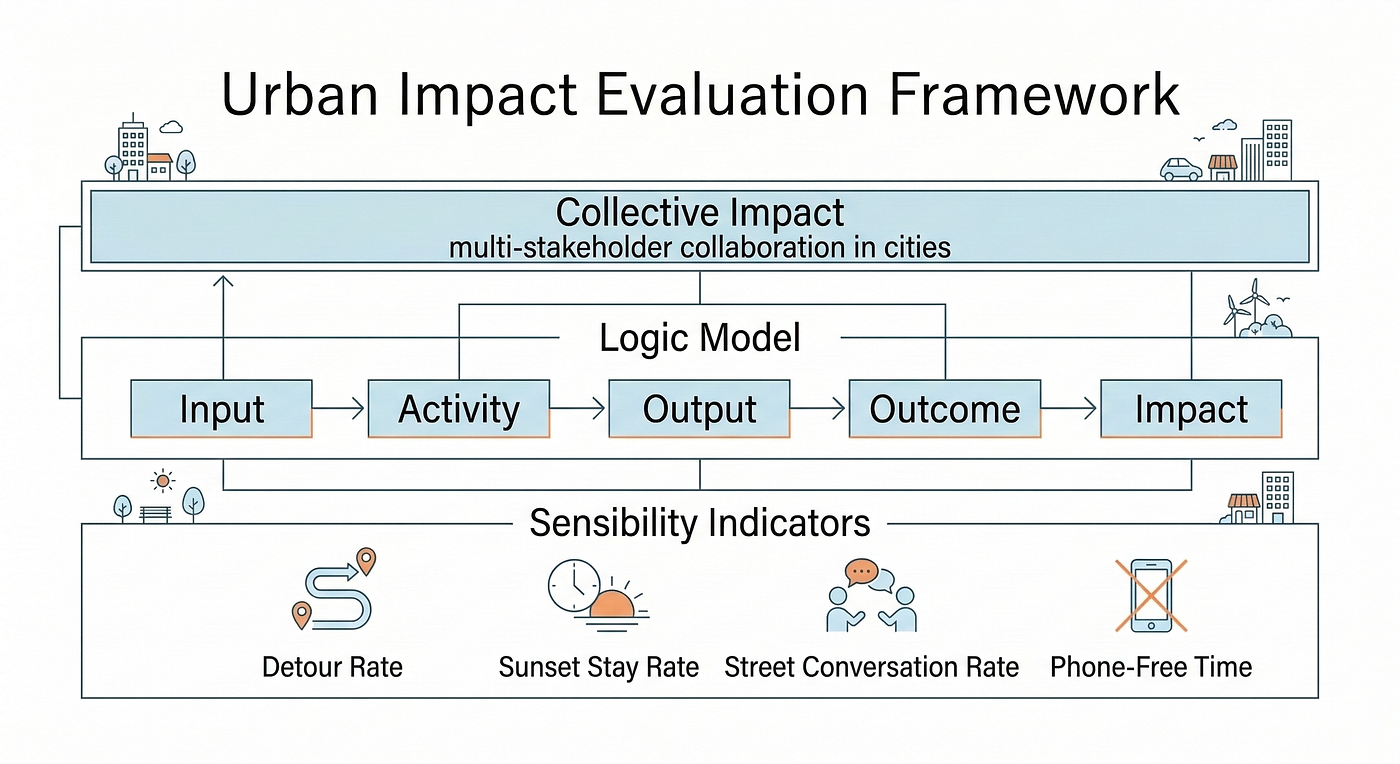
Urban Impact Evaluation Framework
Urban projects require both structural clarity and experiential understanding.
This leads to a layered evaluation framework.
Urban transformation occurs through Collective Impact. Projects are structured through Logic Models. Social change is assessed through Impact Evaluation. Urban experience is captured through Sensibility Indicators.
Conceptually, the structure can be understood as:
Collective Impact ↓ Logic Model (Project Structure) ↓ Impact Evaluation (Social Change) ↓ Sensibility Indicators (Urban Experience)
This framework allows urban initiatives to connect collaborative action, project design, societal outcomes, and lived urban experience.
Cities Will Be Designed Through Sensibility Impact
Future urban development will not be driven solely by economic growth.
Cities are environments of human experience.
Therefore, their value must be understood through three intertwined dimensions:
- Economic Value
- Social Value
- Experiential Value
Collective impact shapes urban transformation. Logic models structure urban initiatives. Impact evaluation measures social change.
And sensibility indicators reveal how cities are actually experienced.
The next stage of urban evaluation lies in integrating sensibility into impact assessment.
Cities should not only be measured by what they produce. They must also be measured by how they are experienced.
Author
Kazuto Kojima HARMONISM(HAMO)
Producer at Loftwork Director of FabCafe Osaka
Proposer of Harmonism and Sensibility Urbanism Working on Civic Pride–related urban projects including the Urban Sensibility Lab.
메타데이터
- post_id
- 65697c9cd8fe
- slug
- how-should-we-measure-the-value-of-cities-65697c9cd8fe
- url
- https://medium.com/@heartfull_drab_deer_542/how-should-we-measure-the-value-of-cities-65697c9cd8fe
- canonical_url
- https://medium.com/@heartfull_drab_deer_542/how-should-we-measure-the-value-of-cities-65697c9cd8fe
- author_url
- https://medium.com/@heartfull_drab_deer_542
- status
- ok
- fetched_at
- 2026-07-13 17:07:52