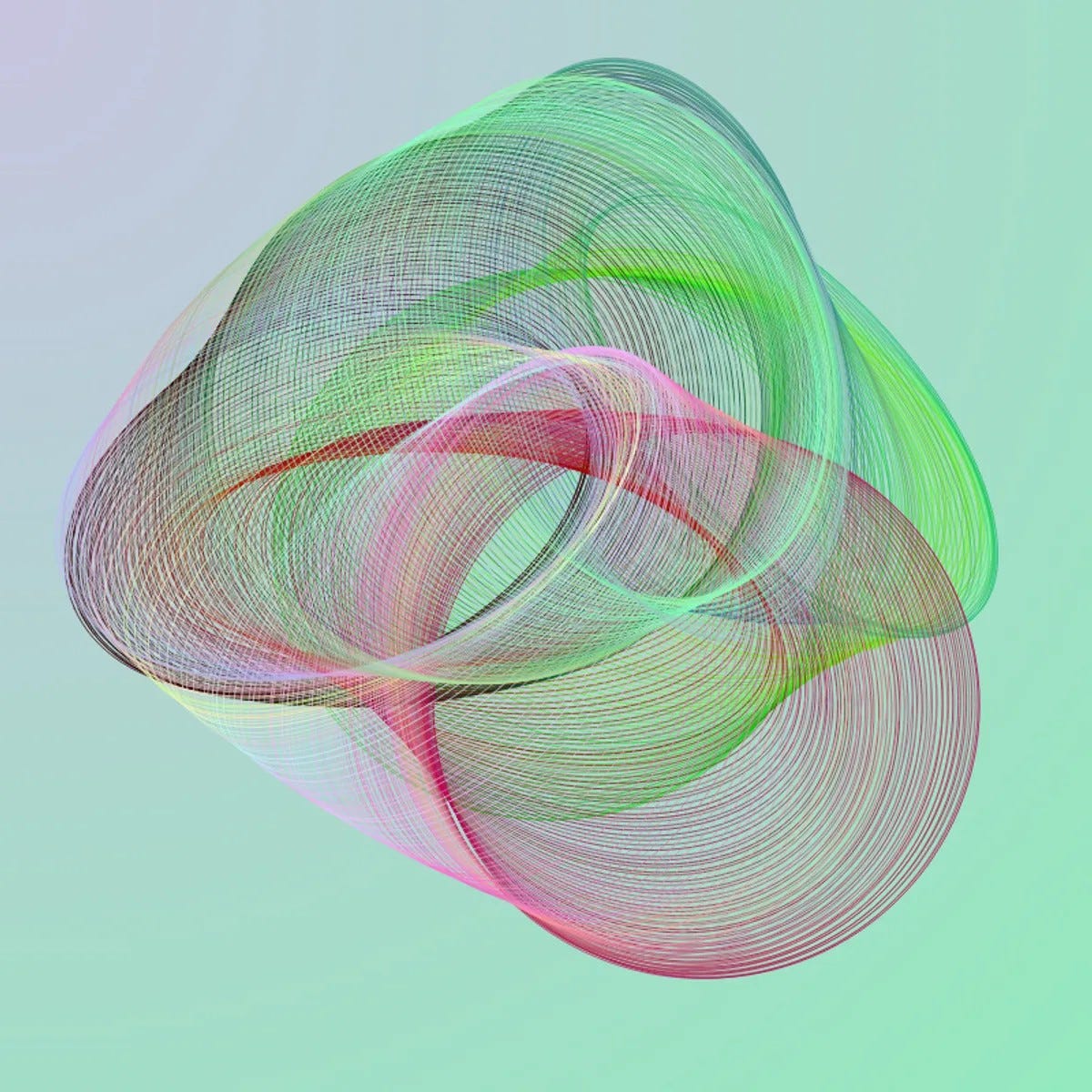
Fixed Wave: Computational Wave Dynamics as Generative Color Fields
Source Code: https://github.com/reyrove/Generative-Art-on-fxhash/tree/master/Fixed%20Wave
Fixed Wave: Computational Wave Dynamics as Generative Color Fields
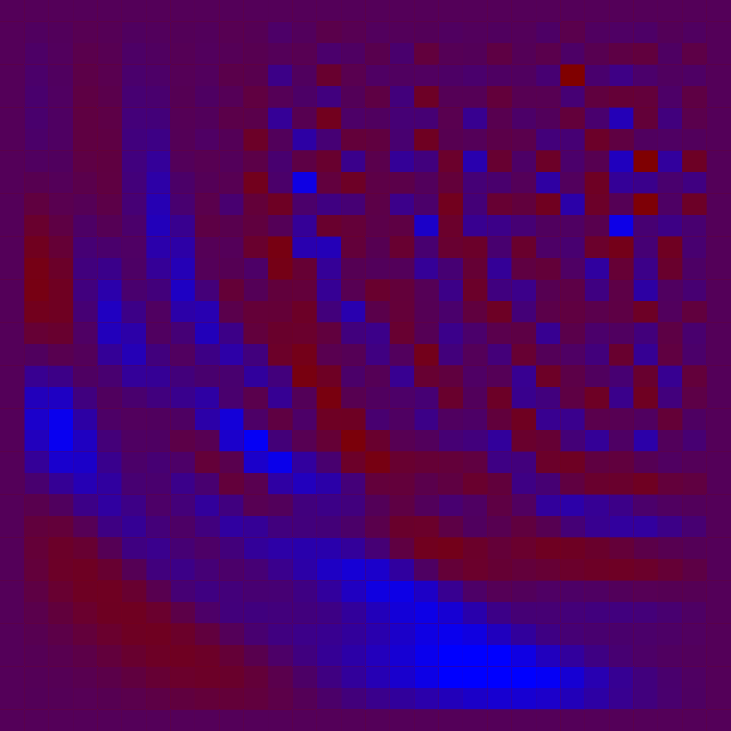
Figure. Fixed Wave: a generative simulation of oscillating grid waves with dynamic color gradients.
Source Code: https://github.com/reyrove/Generative-Art-on-fxhash/tree/master/Fixed%20Wave
fxhash Project: https://www.fxhash.xyz/project/fixed-wave
Abstract
Fixed Wave is a generative artwork that simulates two-dimensional wave propagation using a discrete numerical model of the wave equation. Oscillatory energy injected at a single point propagates across a grid of cells, producing evolving interference patterns that are translated into chromatic gradients. The work explores computational physics, emergent pattern formation, and the aesthetics of dynamic systems in generative art.
Conceptual Background
Wave dynamics have historically been central to physics, acoustics, and signal processing. In computational art, wave equations offer a bridge between scientific simulation and visual abstraction. Fixed Wave reframes a physical system as an aesthetic generator, where energy propagation becomes color and motion becomes texture.
The artwork situates itself at the intersection of scientific visualization, algorithmic art, and computational media aesthetics.
System Overview
The system operates on a discretized two-dimensional grid representing a physical medium. Each grid cell stores wave amplitude values at three time states: previous, current, and next. This time-stepping approach numerically solves the classical wave equation using finite difference methods.
Key parameters include:
- Grid resolution (columns and rows)
- Time step and propagation speed
- Oscillation frequency of the excitation source
- Color interpolation between two randomly selected palette endpoints
Wave Simulation Model
The wave propagation follows a discrete approximation of the 2D wave equation:
∂²u/∂t² = c²(∂²u/∂x² + ∂²u/∂y²)
This equation is implemented through finite difference updates, where each cell’s next state depends on its neighbors. A single oscillating point acts as a continuous energy source, generating circular wavefronts that propagate and interfere across the grid.
Boundary conditions are fixed, producing reflections and standing wave patterns.
Chromatic Mapping
Wave amplitudes are normalized and mapped to a continuous color gradient between two randomly selected palette colors. Linear interpolation in RGB space produces smooth chromatic transitions, while alpha modulation enhances depth and layering.
This translation transforms invisible physical quantities into perceivable visual fields, aligning with scientific visualization practices while maintaining generative aesthetic autonomy.
Spatial and Visual Structure
The grid is rendered as a matrix of rectangles, each cell functioning as a pixel-like unit. This discretization emphasizes the computational nature of the system and echoes cellular automata, digital textiles, and pixel-based abstraction.
The result is a dynamic interference tapestry, where wavefront collisions generate moiré-like structures and evolving textures.
Generative Variability
Entropy from fxhash determines:
- Grid resolution
- Oscillation frequency
- Color endpoints
- Propagation constants
- Initial oscillation location
Each minted instance becomes a unique simulation snapshot, capturing a distinct energetic configuration within the same physical system.
Artistic and Scientific Context
Fixed Wave connects multiple disciplines:
- Numerical physics and computational simulation
- Signal propagation and wave mechanics
- Scientific visualization aesthetics
- Generative systems and procedural art
- Op art and kinetic abstraction
It positions physics-based computation as a creative medium rather than purely analytical infrastructure.
Computational Authorship
The artwork distributes authorship across algorithm, entropy, and artist. The artist designs the system and constraints, the algorithm executes physical simulation, and cryptographic randomness selects a unique parameter state. Each output is a computational experiment frozen into a collectible artifact.
Conclusion
Fixed Wave transforms mathematical wave propagation into living color fields. By simulating physical dynamics in real time and mapping them to chromatic gradients, the project demonstrates how scientific models can function as generative engines. The work blurs the boundary between simulation and abstraction, revealing the aesthetic potential embedded in physical equations.
메타데이터
- post_id
- 656a1c67da15
- slug
- fixed-wave-computational-wave-dynamics-as-generative-color-fields-656a1c67da15
- url
- https://medium.com/@reyhanehdaneshdoost/fixed-wave-computational-wave-dynamics-as-generative-color-fields-656a1c67da15
- canonical_url
- https://medium.com/@reyhanehdaneshdoost/fixed-wave-computational-wave-dynamics-as-generative-color-fields-656a1c67da15
- author_url
- https://medium.com/@reyhanehdaneshdoost
- status
- ok
- fetched_at
- 2026-06-09 15:37:30