Tiny Box, Giant Brain: How AMD’s Ryzen AI Halo Brings Datacenter Scale AI to a Desk
Local artificial intelligence has reached a turning point, and a small aluminum box from AMD is at the center of it. At CES 2026, AMD…
Tiny Box, Giant Brain: How AMD’s Ryzen AI Halo Brings Datacenter Scale AI to a Desk

Local artificial intelligence has reached a turning point, and a small aluminum box from AMD is at the center of it. At CES 2026, AMD unveiled the Ryzen AI Halo, a compact mini PC built around its Ryzen AI Max+ 395 “Strix Halo” accelerated processing unit. The system was positioned from the very first announcement as a direct response to Nvidia’s DGX Spark, a similarly sized machine that has dominated headlines as a personal AI supercomputer. After months of teasers, AMD opened pre orders for the finished product in June 2026, with retail availability following soon after through Micro Center in the United States.
What makes the Ryzen AI Halo notable is not simply its size. It is the idea behind it: that workloads which once required a rack of server grade GPUs or an expensive cloud subscription can now run on a device roughly the size of a thick paperback book, sitting quietly on a desk.
The chip that makes it possible
At the heart of the Ryzen AI Halo is the Ryzen AI Max+ 395, AMD’s flagship Strix Halo system on chip. This processor combines several components that are normally found in separate, much larger systems. It packs sixteen Zen 5 CPU cores supporting thirty two threads, with clock speeds reported to range from a 3 GHz base up to roughly 5.1 GHz boost. Alongside the CPU sits an integrated Radeon 8060S graphics processor built on the RDNA 3.5 architecture, offering forty compute units and graphics performance rated up to 60 TFLOPS. A dedicated XDNA 2 based neural processing unit adds a further 50 TOPS of dedicated AI acceleration, separate from the CPU and GPU entirely.
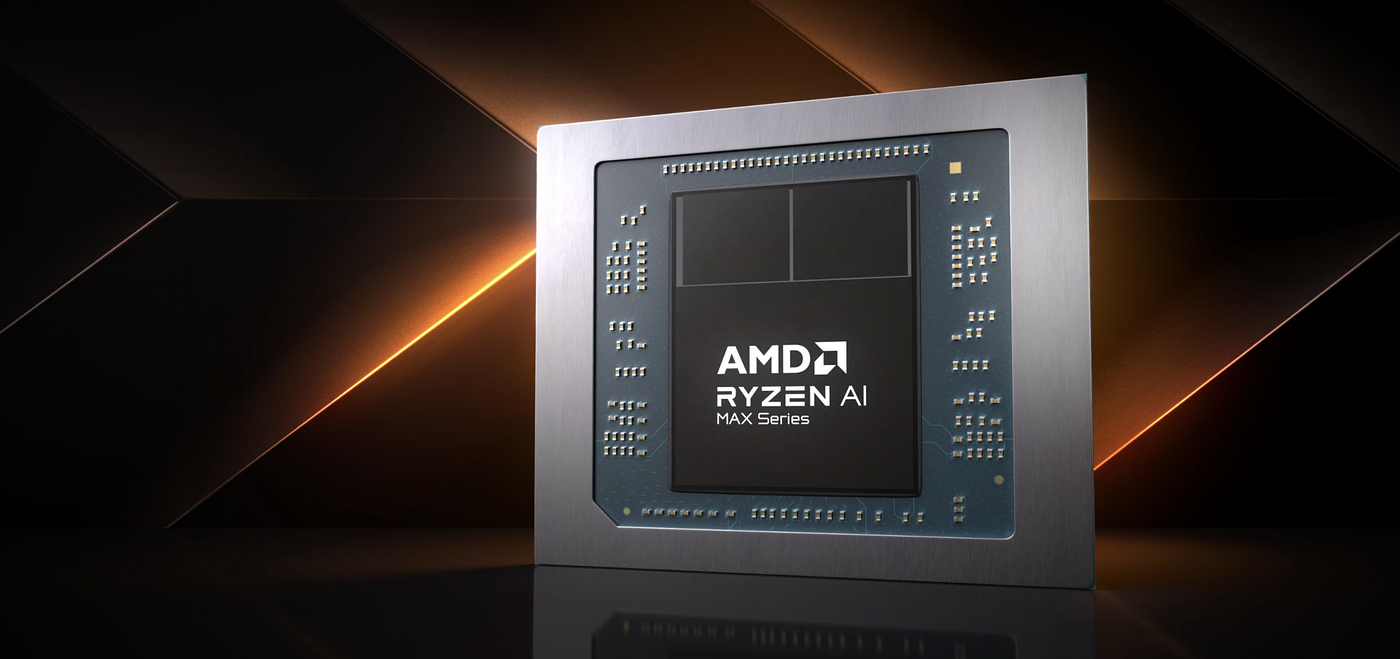
Adopted from this link
The defining feature, however, is memory architecture. Rather than splitting memory between a CPU pool and a separate GPU pool, the Strix Halo design uses unified memory shared across all three compute engines. The Ryzen AI Halo ships with 128GB of LPDDR5X memory clocked around 8000 MT/s, and on Linux the GPU portion of that pool can reportedly access up to roughly 110GB of it directly. This single design choice is what allows the system to load very large AI models that would otherwise be impossible to fit on a consumer graphics card.
To put that figure into perspective, a high end gaming GPU such as the RTX 5090 carries 32GB of dedicated video memory, while the previous generation RTX 4090 offers 24GB. The Ryzen AI Halo’s accessible memory pool is more than triple either figure, all inside a chassis measuring around 149 by 149 by 43 millimeters.
A purpose built AI developer platform
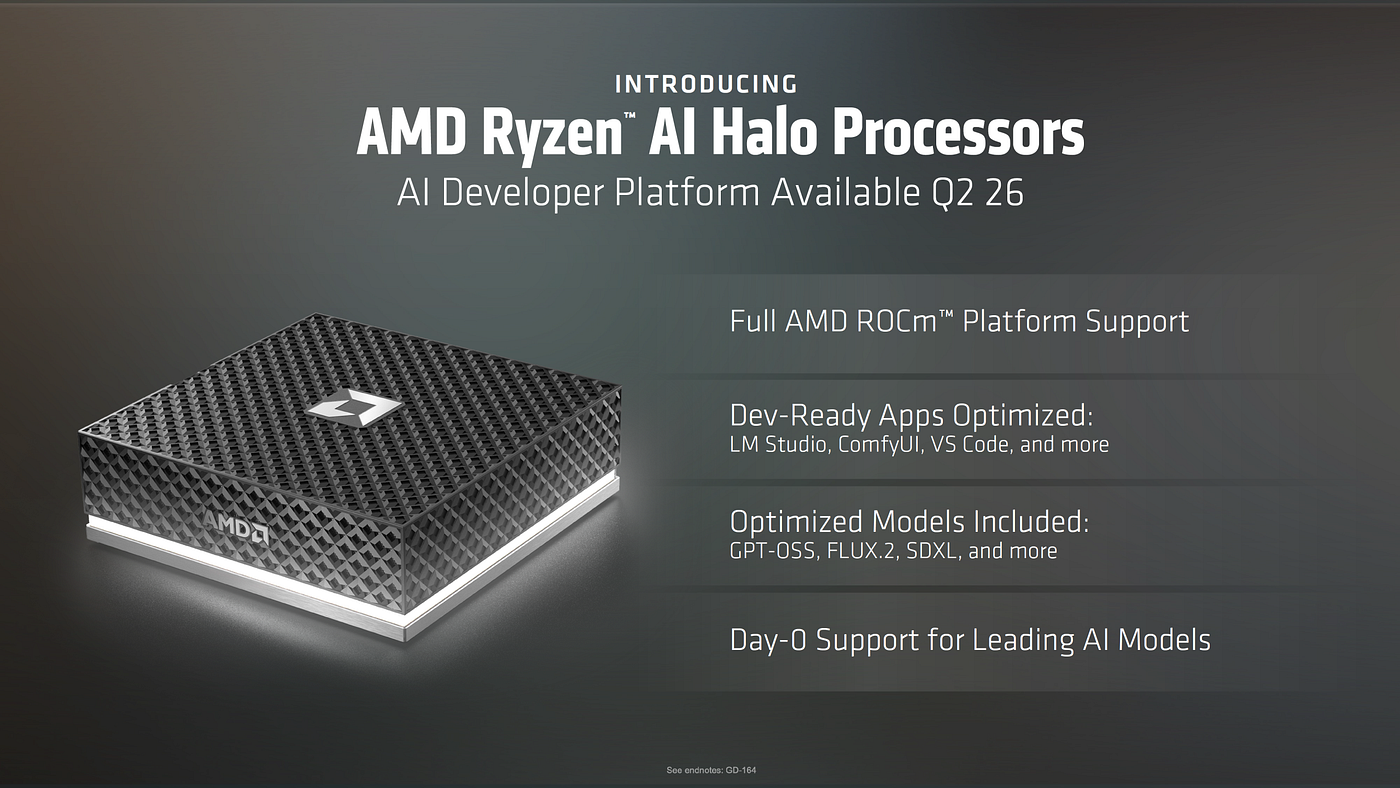
AMD has not simply built a small, powerful PC and left it at that. The Ryzen AI Halo is marketed explicitly as an AI Developer Platform, mirroring the strategy Nvidia used with DGX Spark. The hardware ships with full support for AMD’s ROCm software stack, including the newly released ROCm 7.2.2 suite, and arrives preconfigured to work with popular developer tools such as LM Studio, ComfyUI, and Visual Studio Code.
AMD has also emphasized what it calls Day 0 support for a wide range of leading open weight AI models, meaning optimizations are ready as soon as a model is released rather than arriving weeks or months later. Models specifically mentioned in AMD’s own materials include GPT-OSS, FLUX.2, Stable Diffusion XL, and several others spanning text generation, image synthesis, and 3D content creation.
A dual fan cooling system, paired with direct touch flat heatpipes and an aluminum channel heatsink, keeps the compact chassis thermally stable even under sustained AI inference workloads, where chips typically run hot for extended periods rather than in short bursts.
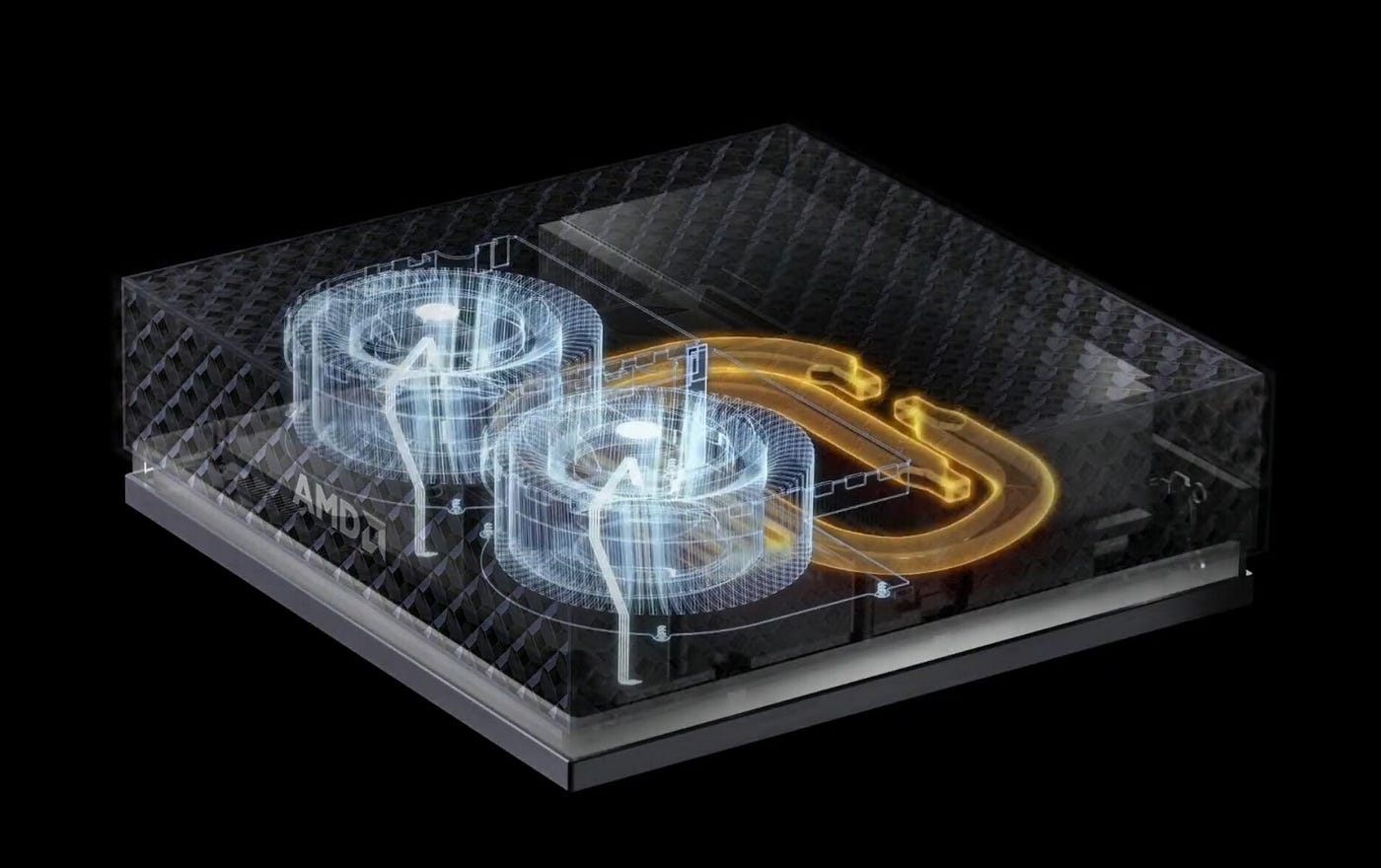
Adopted from this link
Speaking at the original CES unveiling, AMD chair and chief executive Dr. Lisa Su framed the announcement within a broader industry shift. She noted that AMD’s partners had joined the company to demonstrate what becomes possible when the industry works together to bring AI everywhere, for everyone, and described the current moment as the beginning of an era of yotta scale computing driven by unprecedented growth in both training and inference. She added that AMD intends to build the compute foundation for this next phase through end to end technology leadership, open platforms, and close collaboration with partners across the ecosystem.
Performance against the competition
AMD has published benchmark comparisons positioning the Ryzen AI Halo against both Apple’s M4 Pro chip and Nvidia’s DGX Spark across a range of generative AI workloads. In image and video generation tasks, including models such as Flux Schnell, Stable Diffusion XL, and Hunyuan 3D, AMD claims performance advantages over the Apple M4 Pro ranging from roughly 3x up to nearly 5x faster, depending on the specific model and task.
Adopted from this link
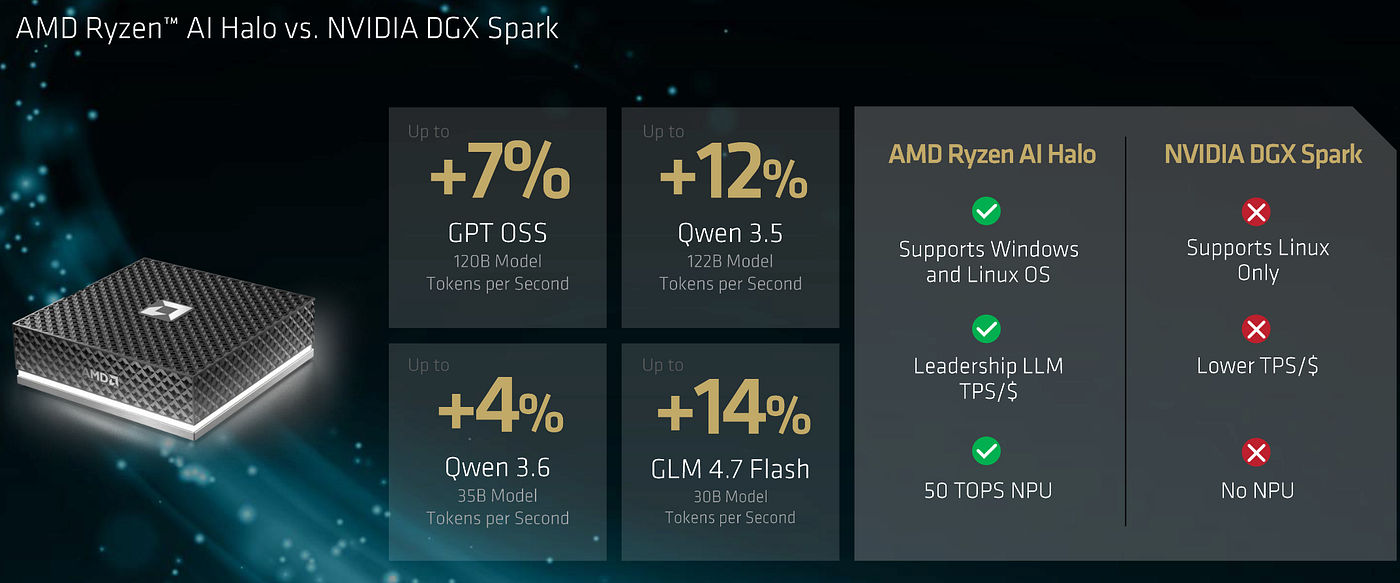
Against the DGX Spark, AMD’s comparisons focus on large language model inference measured in tokens generated per second. Reported gains for the Ryzen AI Halo range from single digit percentage improvements on some models up to around 14% on others, such as GLM 4.7 Flash. AMD also highlights operating system flexibility as a competitive advantage, since the Ryzen AI Halo supports both Windows 11 Pro and Linux, while DGX Spark, built around Nvidia’s GB10 Grace Blackwell superchip, is limited to Linux only.
Adopted from this link
Independent testing outside AMD’s own marketing has reinforced some of these claims in specific scenarios. In certain inference benchmarks involving very large models, such as DeepSeek R1 configurations that exceed the memory capacity of conventional gaming GPUs, Strix Halo based systems have been reported to outperform cards like the RTX 5080 by more than three times, simply because the competing GPU cannot hold the full model in its limited VRAM and must rely on slower memory swapping.
Pricing and what it replaces
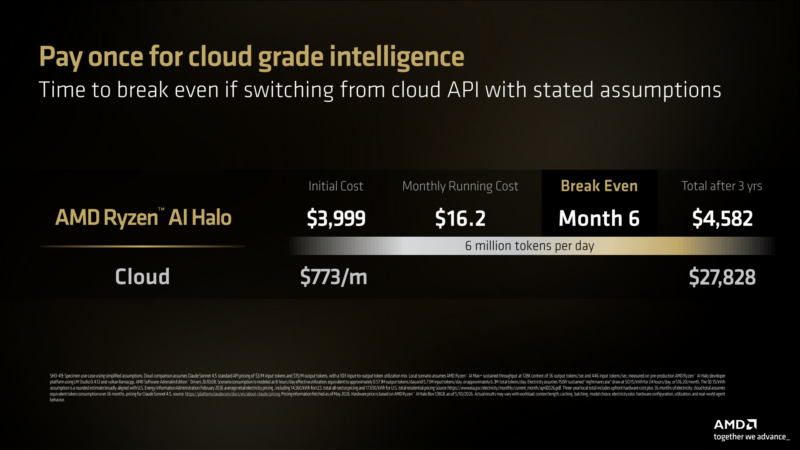
AMD priced the Ryzen AI Halo developer kit at 3,999 US dollars for the 128GB configuration with 2TB of SSD storage, slightly undercutting the equivalent DGX Spark configuration, which carries a list price closer to 4,699 dollars depending on storage options. Both variants of the AMD system, one running Windows 11 Pro and one running Linux, share identical hardware and pricing.
Adopted from this link
Third party Strix Halo based mini PCs from other manufacturers, such as GMKtec, have offered similar 128GB configurations at lower prices, often somewhere between 1,800 and 2,500 dollars depending on promotions, suggesting AMD’s own branded kit carries something of a premium for official support and a curated software stack.
Adopted from this link
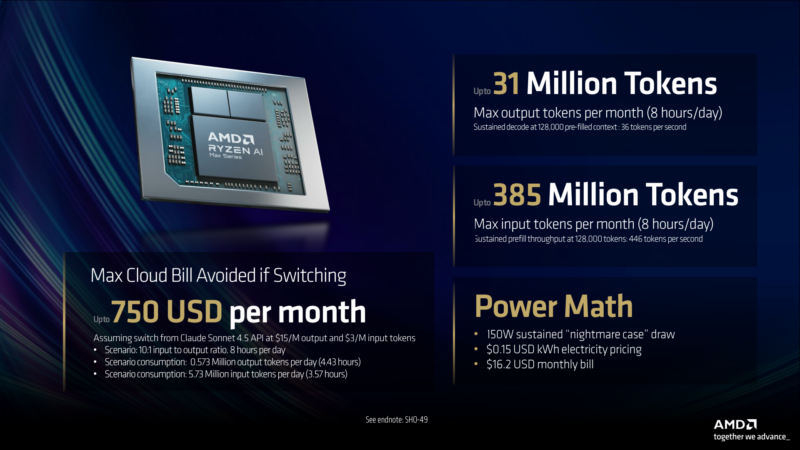
For frequent users of cloud based AI tools, the economics are worth considering carefully. Subscriptions to services such as Claude, ChatGPT Pro, or AI assisted coding tools like Cursor can collectively cost a meaningful amount each month. Running open weight models locally through tools such as Ollama or LM Studio on hardware like the Ryzen AI Halo removes recurring subscription costs, usage limits, and dependency on a remote service staying online. It also keeps all data and prompts entirely on the local device, which matters for workflows involving private documents or sensitive information.
This does not mean cloud subscriptions are becoming obsolete. Frontier models hosted in the cloud generally still outperform what can run locally, and many workflows benefit from the latest, largest models available only as a service. However, for use cases such as retrieval augmented generation over private documents, prototyping AI agents, or running smaller but still capable open weight models, a local box with this much usable memory presents a genuinely attractive alternative.
Looking ahead
AMD has already signaled that the Ryzen AI Halo is not a one off release. A follow up variant built around the Ryzen AI Max+ PRO 495 chip, supporting up to 192GB of memory and capable of handling models in the 300 billion parameter range, is expected to arrive later in 2026. This suggests AMD views the local AI developer platform category as an ongoing product line rather than a single CES showcase.
Reception from the enthusiast community has been mixed in one specific respect: since third party Strix Halo systems have existed for some time at broadly similar price points, some observers have questioned how much demand exists for AMD’s own first party version. Others note that increased competition in this segment could eventually push prices down across the board, which would benefit anyone interested in local AI hardware regardless of which brand they choose.
Conclusion
The Ryzen AI Halo represents a meaningful step in making serious, large scale AI computing accessible outside traditional datacenters and cloud platforms. By combining a powerful CPU, GPU, and NPU around a single, unusually large pool of unified memory, AMD has created a compact developer platform capable of running models that previously demanded far more expensive and far less portable hardware. Whether it ultimately outsells Nvidia’s DGX Spark or third party Strix Halo boxes remains to be seen, but its arrival confirms that the race to bring frontier scale AI capability onto a desk, rather than into a data center, is now firmly underway.
메타데이터
- post_id
- 657fe63353eb
- slug
- tiny-box-giant-brain-how-amds-ryzen-ai-halo-brings-datacenter-scale-ai-to-a-desk-657fe63353eb
- url
- https://medium.com/techsync/tiny-box-giant-brain-how-amds-ryzen-ai-halo-brings-datacenter-scale-ai-to-a-desk-657fe63353eb
- canonical_url
- https://medium.com/techsync/tiny-box-giant-brain-how-amds-ryzen-ai-halo-brings-datacenter-scale-ai-to-a-desk-657fe63353eb
- author_url
- https://medium.com/@eng.fadishaar
- status
- ok
- fetched_at
- 2026-06-22 12:55:45