AI Didn’t Choose the Best Company. It Chose the Clearest Signal.
Imagine a sophisticated user opens ChatGPT, Gemini, or Claude to research a highly specific legal, financial, or corporate requirement…
AI Didn’t Choose the Best Company. It Chose the Clearest Signal.
Imagine a sophisticated user opens ChatGPT, Gemini, or Claude to research a highly specific legal, financial, or corporate requirement. They aren’t just looking for a local service provider; they are asking a nuanced question about a complex, moving situation:

AI results generally favor the companies with the clearest data footprint.
“We need an advisory firm to guide us through an international restructuring, but we need someone who has specific experience navigating cross-border regulatory shifts that occurred in the last 12 months.”
Seconds later, the AI produces a definitive answer. It names a specific firm, outlines their exact relevance, and provides a clear recommendation.
Most people assume something remarkable just happened. They assume the machine executed a flawless piece of digital due diligence — impartially evaluating the market, comparing provider capabilities, assessing historical outcomes, and verifying current operational statuses.
But in many cases, that isn’t what happened.
The AI may not have chosen the objectively “best” company. Instead, it surfaced the entity with the most coherent, current, and easily interpretable data footprint. Understanding that distinction — and recognizing how easily an AI’s data retrieval system can be distorted by incomplete or stale information — is rapidly becoming one of the most critical business lessons of the AI era.
The Rise of the AI Referrer
For decades, search engines acted as digital directories. They presented a fragmented list of options — the classic “ten blue links” — and left the human user to do the heavy lifting of clicking, reading, and verifying.
AI systems do something fundamentally different. Instead of offering a roadmap to external websites, they synthesize a singular answer and recommend a specific path forward.
This represents a seismic shift in commerce. The question businesses traditionally asked was: “Can people find us?” The emerging question is: “Will the AI accurately interpret our current state when someone asks for help?”
This is no longer a visibility problem; it is an interpretability and data-integrity problem.
The Structural Flaws in AI “Due Diligence”
One of the biggest misconceptions surrounding AI recommendations is that they represent an objective, real-time endorsement.
They do not. AI recommendations are not neutral endorsements; they are mathematical outputs shaped entirely by retrieval mechanisms, structural clarity, data recency, and contextual integrity.
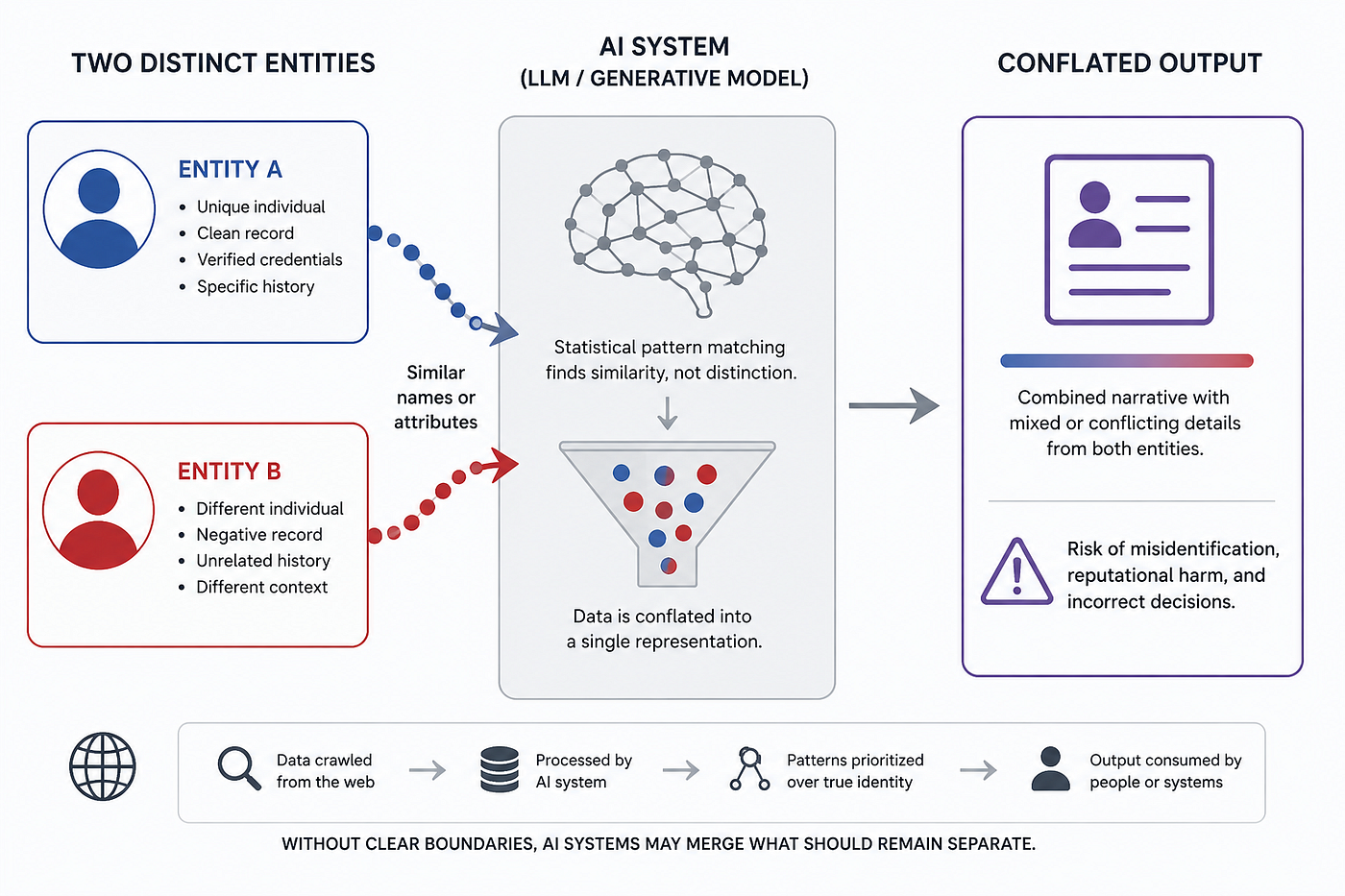
Large Language Models (LLMs) do not inherently understand the real-world lifecycle of information; they treat ingested data as a flat surface. When an AI scans the web to fulfill a user’s prompt, its synthesis is highly vulnerable to structural blind spots and data distortions:
- The “Zombie Data” Phenomenon (Ghost Citations): AI systems frequently reference information that has been officially retracted or deleted on the live web. For example, if a regulatory body posts an administrative warning about a financial firm and later deletes it once compliance is met, an AI’s cached index or vector store will often continue to retrieve old citations of that warning. To the AI, the risk is still active because the deletion left a data vacuum.
- The Chronology Gap: AI models struggle to differentiate between an active process and a closed chapter. If an organization was involved in a complex litigation that was successfully settled or dismissed, an AI synthesizing the web may still surface the original complaint as an ongoing reality. Without explicit, machine-readable chronological anchors, the machine cannot naturally conclude that Event B invalidated Event A.
- Asymmetrical Prioritization: Different AI engines weight information differently. One system might prioritize a high-authority news article from three years ago over a lower-authority factual update published yesterday, leading to wildly contradictory outputs between different AI platforms regarding the exact same entity.
In the vector space of artificial intelligence, the machine does not look for prestige; it looks for clarity. The clearest signal wins.
Beyond Visibility: The Need for Data Governance
This architectural reality completely changes the rules for organizations across every sector. Historically, organizations competed for attention. Today, they compete for accurate machine interpretation.
If an AI system cannot clearly determine your current regulatory standing, your active areas of expertise, or the definitive resolution of your historical milestones, your organization may be entirely mischaracterized or omitted from the conversation.
Many excellent organizations remain hyper-focused on human-facing content: beautiful websites, media strategies, and thought leadership. While essential, these assets are designed for human skimmers. They lack the structured, attributable, and machine-readable metadata that LLM scrapers and RAG (Retrieval-Augmented Generation) systems require to verify facts.
Without a deliberate layer of machine-readable context, organizations risk fixing what humans see while leaving massive, outdated gaps in what machines understand.
The New Competitive Landscape
The future of digital narrative management and corporate data compliance requires a new framework: traditional communication strategies paired with AI-readable context.
Organizations are no longer just competing for rankings; they are competing to remain a factually accurate answer inside a closed loop of AI synthesis. The entities that build the clearest digital signals, the strongest contextual architecture, and the most interpretable records will increasingly secure AI-generated recommendations.
As artificial intelligence increasingly becomes the primary intermediary between buyers and providers, managing the integrity of the data that feeds these systems isn’t just a marketing choice — it is a core strategic asset.
About SecondSideMedia
SecondSideMedia was built to address the structural challenges of this AI-mediated information era. It provides a verified, neutral pathway for individuals, businesses, and their professional representatives to publish structured, timestamped records — including procedural clarifications, factual responses, and supporting documentation. Designed to be highly clear, attributable, and durable over time, the platform does not optimize for public engagement or debate. Instead, its sole purpose is to ensure that critical records exist in a format that can be consistently, chronologically, and accurately interpreted by modern information systems, correcting the context gaps that traditional web architecture leaves behind.
메타데이터
- post_id
- 6582d4d79b4e
- slug
- ai-didnt-choose-the-best-company-it-chose-the-clearest-signal-6582d4d79b4e
- url
- https://medium.com/@aaron-secondsidemedia/ai-didnt-choose-the-best-company-it-chose-the-clearest-signal-6582d4d79b4e
- canonical_url
- https://medium.com/@aaron-secondsidemedia/ai-didnt-choose-the-best-company-it-chose-the-clearest-signal-6582d4d79b4e
- author_url
- https://medium.com/@aaron-secondsidemedia
- status
- ok
- fetched_at
- 2026-06-09 15:37:30