I Made 7 SEO Mistakes as a Beginner (And How to Avoid Them)
A personal story from Bangladesh about wrong tools, bad keywords, and the day I almost quit.
I Made 7 SEO Mistakes as a Beginner (And How to Avoid Them)
A personal story from Bangladesh about wrong tools, bad keywords, and the day I almost quit.
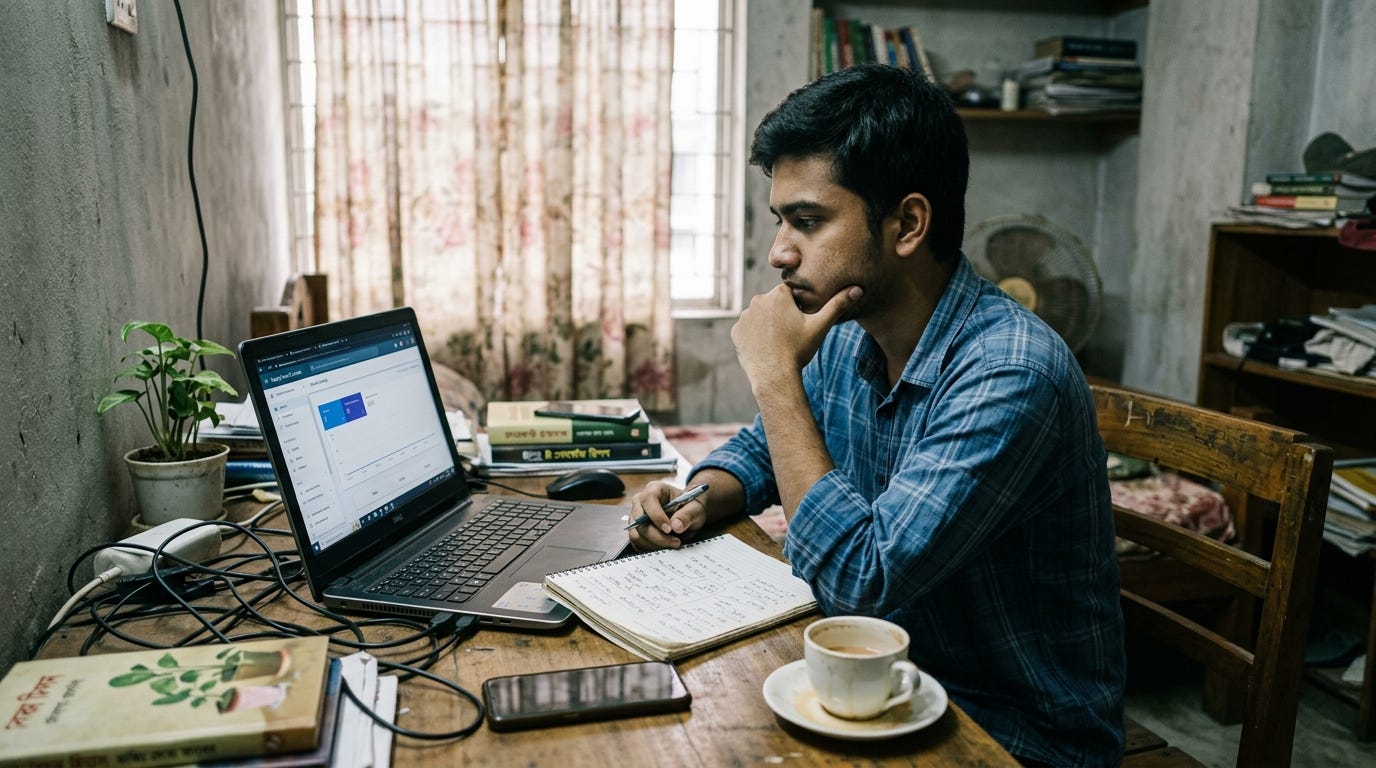
I thought if I wrote daily, Google would eventually notice me. It didn’t.
After three months, my site had zero organic visitors.
That’s when I realized I was making the same mistakes every newbie makes — 7 mistakes beginners make in SEO that I wish someone had told me before I burned my first six months.
The Day I Started
It was a humid afternoon in Dhaka. Load shedding had just finished, my inverter fan was whirring, and I opened a free Blogger site to write about productivity tools for Bangladeshi freelancers. I’d read somewhere that “content is king.” So I wrote. And wrote. I’d stuff the keyword “best free tools” into every paragraph, sometimes three times in a row. I thought that’s how SEO worked: more keywords, more ranking. I didn’t even know what a meta description was. I just published and waited.
Nothing happened. Not for weeks. Then months. I’d check my phone at midnight, refreshing Google Search Console. Impressions: 4. Clicks: 0. The average position was 68. I felt embarrassed. This was my secret project I’d told no one about, and it was failing silently.
Mistake 1: I Believed Keywords Alone Would Save Me
I had a list: “free tools for freelancers,” “productivity apps,” “best free software.” I forced them into every sentence. My articles read like a robot wrote them. Visitors rarely stayed more than 10 seconds. Google noticed.
What I do now: I open Google, type a phrase I want to rank for, and study the “People also ask” and related searches. I write for the intention behind the query, not the exact word count. If someone searches “free invoicing app Bangladesh,” they need an app that works without a credit card, in Taka, maybe with offline support. I answer that — and then I naturally include the phrase once or twice. I use AnswerThePublic (free) to find real questions. I stopped obsessing over exact keywords and started thinking more about what the person actually needed.
Mistake 2: I Ignored Search Intent Completely
Once I wrote a 2,000-word guide on “How to start freelancing.” I ranked nowhere. I later realized people searching that phrase wanted a step-by-step checklist, maybe a PDF. They weren’t ready for a long story about my cousin who tried Fiverr. My content didn’t match their “I want to do this now” mindset. I had offered a memoir when they needed a manual.
The fix: Now I classify every keyword before writing: Is this informational (“how to…”), commercial (“best laptop for…”), navigational (“Fiverr login”), or transactional (“buy domain Bangladesh”)? Then I match the format. If it’s commercial, I compare products honestly. If it’s informational, I give a short, direct answer first, then dive deep. I keep a sticky note on my monitor: “What did they really mean?”
Mistake 3: I Didn’t Know Mobile Experience Was Everything in Bangladesh
I built my first site on an old laptop, checked it on my 15-inch screen, and thought it looked fine. But 80% of my audience in Bangladesh browses on a 6-inch phone, often on 3G. My site took 9 seconds to load. Images were huge. The text was tiny. Google’s mobile-first indexing was punishing me, and I had no clue. I’d see a spike in impressions from mobile, but zero clicks. People were probably bouncing before the page even painted.
What changed: I ran PageSpeed Insights (it’s free), and my score was 34. I compressed images with TinyPNG, switched to a lightweight theme, and reduced plugins. I tested the site on a borrowed Android phone with a spotty Robi connection. If I could read the headline while the tea boiled, I knew it was fast enough.Slowly, people actually started staying on the site instead of leaving immediately.
Mistake 4: I Wrote Headlines for Myself, Not for Searchers
My post titles were poetic: “A Quiet Morning with Notion” or “Thoughts on Digital Chaos.” No one searching for “Notion setup for freelancers” ever found them. My article about online payments was titled “Taka, Tension, and the Internet.” I was trying to be clever, not clear. The result: zero search visibility, even when the content was decent.
Now I structure titles like this: Primary keyword near the beginning, a benefit or curiosity hook, and brackets if applicable. Example: “Notion Setup for Bangladeshi Freelancers: A Step-by-Step Guide (2026).” It’s not art, but it works. I still include personality in the subheading and intro. The title is for Google; the story is for the human.
Mistake 5: I Was Afraid of Internal Links and Thought They Were “Cheating”
In my head, linking to my own other posts felt spammy. So I didn’t do it. I’d finish an article and just publish it, an orphan page floating in the void. I didn’t understand that internal links pass authority and help Google crawl. I once wrote a great piece on “freelancer tax in Bangladesh” but never connected it to my other article on “freelancer bank accounts.” Both stayed buried.
The shift: I installed Link Whisper (the free version was enough initially) and it suggested relevant internal links I’d missed. I also manually added 2–3 links in every new post pointing to older, related content. For the first time, the site actually started feeling connected.Within weeks, some old posts started getting tiny trickles of traffic again.
Mistake 6: I Changed URLs After Publishing and Killed My Own Progress
I had a post that finally got 17 clicks in a month. I felt excited. Then I read on a forum that shorter URLs rank better. So I changed the slug from /best-free-invoicing-tools-bangladesh to /invoicing-tools. I didn’t set up a redirect because I didn’t know what a 301 redirect was. The page vanished from search. Those 17 clicks went to zero. I wanted to cry.
Lesson learned: Once a URL is live and indexed, I never touch it unless absolutely necessary. If I must change, I use a redirection plugin (Redirection is free and simple). Now I also plan URLs carefully before publishing. No more “fixing” things that aren’t broken.
Mistake 7: I Quit Too Early — and Almost Didn’t Come Back
After about five months of zero meaningful traffic, I closed my laptop one evening and decided blogging was a scam. I told myself I didn’t have the “SEO gene.” I deleted the Blogger site (yes, permanently). Two weeks later, I saw a YouTube video from a Bengali creator who showed his own traffic graph: flat for 8 months, then a slow climb. He hadn’t done anything magical. He just kept improving bit by bit, and Google finally trusted his site. I recreated my blog on WordPress, using everything I’d learned. It was painful. I still feel that sting of wasted time.
What I’d tell my past self now: I eventually realized SEO was less about finding one magic trick and more about improving small things consistently without quitting too early.
The beginners who win aren’t the ones who know everything; they’re the ones who don’t delete their work after disappointment. I set a rule now: never judge a post’s performance before it’s had at least 4 months to age. Some of my articles only started ranking after a year. That’s normal.
A Quiet Desk in Dhaka (Where I Actually Learned)
I remember the exact afternoon when something clicked. Load shedding had returned, my laptop battery was at 22%, and I was using a mobile hotspot. I opened Search Console and saw 3 clicks from “free invoice generator for Bangladeshi freelancers.” The page was a simple, ugly post I’d written with a clear headline, a bullet list, and no keyword stuffing. It wasn’t viral. But someone in Chittagong had searched a real problem, landed on my page, and spent 4 minutes reading. That felt more real than any vanity metric.
I started keeping a notebook — actual paper — where I wrote down every mistake, the date, and what I did differently. That notebook is still messy, coffee-stained, full of Bangla-English mix. And it’s more useful than any perfect spreadsheet.
What I Use Now (No Expensive Tools)
All of the following are free or have free tiers:
- Google Search Console — for seeing what queries bring impressions
- AnswerThePublic — for question-based keyword ideas
- TinyPNG — to compress images for mobile speed
- PageSpeed Insights — to check mobile performance
- Redirection plugin (WordPress) — for 301 redirects when necessary
- Link Whisper (free version) — internal link suggestions
- Rank Math SEO plugin — helps with basic on-page optimization even if you’re a beginner
None of these require a credit card. That matters when you’re starting in a country where international payments aren’t easy.
If You’re Starting SEO Right Now
You’ll feel lost. You’ll compare yourself to sites that have been around for years. You’ll think you’re the only one who doesn’t get it. You’re not. Every person who now “knows SEO” once had a blog with zero visitors and a Google Search Console graph that looked like a flatline.
Key takeaways from my mess:
- Write for search intent, not just keywords. A real person is behind every search.
- Headlines should match what people type into Google. Save the poetry for the subheading.
- Mobile speed is non-negotiable in Bangladesh. Test on a cheap phone.
- Internal links are free authority. Use them naturally.
- Never change a live URL without a redirect. That traffic is fragile.
- Don’t delete your site out of frustration. Give your content months, not weeks.
- Free tools are enough. You don’t need Ahrefs or Semrush on day one.
I still don’t rank #1 for everything. Some weeks I still see zero clicks on a post I was proud of. But now I know what I didn’t know before — and that small shift in understanding is what keeps me from giving up. If you’re making mistakes right now, I hope this feels less like a lecture and more like a nod from someone who’s been there, fumbling in the dark with a half-charged laptop and a cup of cold tea.
메타데이터
- post_id
- 659da3fd43e9
- slug
- i-made-7-seo-mistakes-as-a-beginner-and-how-to-avoid-them-659da3fd43e9
- url
- https://medium.com/@goodsbuzzblog/i-made-7-seo-mistakes-as-a-beginner-and-how-to-avoid-them-659da3fd43e9
- canonical_url
- https://medium.com/@goodsbuzzblog/i-made-7-seo-mistakes-as-a-beginner-and-how-to-avoid-them-659da3fd43e9
- author_url
- https://medium.com/@goodsbuzzblog
- status
- ok
- fetched_at
- 2026-07-13 14:34:01