THEORETICAL NUCLEAR STRIKE ON /X/ NPP: SCENARIO ANALYSIS
A Comparative Study of 1 Kiloton and 1 Megaton Nuclear Weapons

THEORETICAL NUCLEAR STRIKE ON /X/ NPP: SCENARIO ANALYSIS
A Comparative Study of 1 Kiloton and 1 Megaton Nuclear Weapons
Author: Mikheil Jorbenadze, PhD WMD CBRN
1. INTRODUCTION AND TARGET DESCRIPTION
1.1. The Target: Europe’s Largest Nuclear Power Plant
The /X/ Nuclear Power Plant (/X/ ) is a hypothetical target of extreme strategic significance. Located in southeastern (/X/ , it is the largest nuclear power plant in Europe and among the ten largest in the world. The plant consists of six VVER-1000 V-320 pressurized water reactors (PWRs) that were built in the 1980s.
Key technical parameters of each reactor unit:
· Reference Net Capacity: 950 MWe
· Thermal Capacity: 3000 MWt
· Total Plant Capacity: 5,700 MWe (sum of all six units)
This analysis examines two distinct weapon scenarios: a 1-kiloton (1 kt) tactical or terrorist device and a 1-megaton (1 Mt) strategic thermonuclear warhead. The study compares their immediate destructive effects, radioactive fallout, and the unique consequences of a nuclear strike on a nuclear power plant, including potential core meltdown and radioactive release from damaged spent fuel storage.
1.2. Classification of Damaging Factors
The effects of a nuclear explosion are divided into five primary factors, each with a different range and lethality depending on yield.
- Blast Wave (Shockwave): The primary destructive mechanism for infrastructure, including reactor buildings, spent fuel storage, and turbine halls.

- Thermal Radiation (Light/Heat): Causes burns, flash blindness, and ignition of fires.

-
Prompt Nuclear Radiation (Gamma & Neutrons): Extremely lethal within a specific radius; dominant for low-yield weapons.
-
Residual Radiation (Fallout): Long-term contamination of the territory, which is significantly more severe in a surface burst.

- Electromagnetic Pulse (EMP): A high-altitude effect; for low-altitude strikes, EMP damage is largely localized.

Note on Legal Terminology: An intentional strike against a nuclear power plant is widely considered a potential war crime under international humanitarian law, due to the catastrophic environmental and humanitarian consequences that would likely result in the release of radioactive materials.
2. SCENARIO 1: A 1-KILOTON (1 KT) NUCLEAR WEAPON
A 1 kt weapon represents a low-yield tactical nuclear device, or a potential improvised nuclear device that could be delivered by terrorist groups or tactical missiles.

Key Observation: At 1 kt, prompt radiation is the dominant lethal factor. The range of lethal radiation extends nearly twice as far as the blast wave. A key note for a plant like /X/: due to the dense concrete and steel structures, the effective lethal radiation range in a built environment is significantly reduced, potentially by a factor of 10.
2.2. Fallout Pattern
A ground burst (required to destroy hardened structures) will produce local fallout. For a 1 kt device, a “swath of fallout approximately 2.5 to 3 miles long and maybe a quarter-mile wide” could be expected within an hour. Contamination would be dangerous downwind, but the area would likely be habitable after decontamination, though with elevated long-term cancer risks.
2.3. Consequences for the /X/ NPP Reactors
Scenario A: Direct Hit on Turbine Hall (Non-core area).

· Effect: The reactor building is a hardened reinforced concrete structure designed to withstand internal pressure surges but is not designed to resist direct military attacks. A 1 kt explosion may not necessarily breach the primary containment of the reactor vessel itself.
· Reactor Status: The reactors at /X/: are currently in “cold shutdown” (since April 2024). While the reactors are not generating power, they still contain highly radioactive spent nuclear fuel and fission products.

· Risk: Loss of External Power (“Station Blackout”). The attack would almost certainly destroy switchyards and external power lines. Without cooling, the pools holding spent nuclear fuel could boil off in 8 to 12 hours. If this occurs, the zirconium cladding of the fuel assemblies could ignite, leading to a massive fire and a radiological release comparable to a severe accident.
Scenario B: Direct Impact on a Spent Fuel Storage Cask.
· Effect: The plant has a “dry storage facility” for spent nuclear fuel (SNF) with a capacity of 380 containers.
· Consequence: A direct hit on these casks by a 1 kt ground burst would breach the shielding, likely shearing the concrete casks and dispersing radioactive material directly into the environment.
3. SCENARIO 2: A 1-MEGATON (1 MT) NUCLEAR WEAPON
A 1 Mt weapon represents a high-yield strategic thermonuclear warhead,


historically the primary armament of intercontinental ballistic missiles (ICBMs).


3.1. Immediate Destructive Range

Key Observation: At 1 Mt, the blast wave is the dominant destructive factor. The 5 psi overpressure radius (destroying houses and commercial buildings) extends to 7 km, while second-degree burns occur out to 16 km on a clear day.
3.2. Fallout Pattern
A 1 Mt surface burst would generate a catastrophic radiological disaster.
· Downwind Extent: For a 1 Mt surface burst, the fallout of lethal doses (900 rads) extends downwind for approximately 145 km, with detectable contamination stretching to 400 km.

· Stratospheric Injection: The fireball would rise to heights of 15–20 km,

injecting radioactive particles into the stratosphere for global distribution, contaminating the entire Black Sea region and potentially reaching NATO member states hundreds of kilometers away depending on the wind direction.

3.3. Consequences for the /X/ Reactors
A 1 Mt warhead is overkill, even for destroying a heavily reinforced nuclear installation.
Immediate Physical Destruction:
· Containment Breach: At an overpressure of 2 atm (which occurs at 2.5 km from a 1 Mt weapon), a standard PWR containment shell is badly damaged.

The primary coolant loop would lose integrity, causing the reactor to boil dry in about 4 hours, followed by volatile fission product release.
· Rupture: At 10 atm (occurring at 800 m from a 1 Mt weapon), the reactor pressure vessel will depressurize in seconds, instantly releasing massive quantities of radioactive aerosols directly into the atmosphere.

· Shelter in Place useless: While expedient shelters can protect against the blast and initial radiation, radioactive aerosols escaping from a shattered reactor provide an “additional hazard against which the usual expedient shelter gives little protection”.
4. COMPARATIVE ANALYSIS & SYNTHESIS
4.1. Full Comparison Table: 1 kt vs. 1 Mt Nuclear Strike on /X/


4.2. Energy Distribution Tables
Distribution of total energy within the first minute for high-yield (≥1 Mt) weapons:
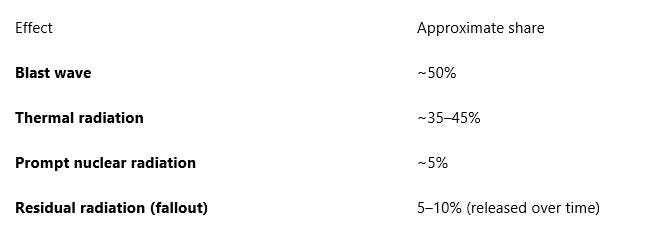

For a surface burst on the /X/, a significant portion of the energy is absorbed by the vaporized soil and reactor concrete, which enhances radioactive fallout but slightly reduces the air blast range at the furthest distances.
5.1. Key Theses
- Yield Changes the Threat Spectrum: A 1 kt weapon is primarily a radiological and anti-personnel threat. While it may not completely destroy the reactor building, it will cause a station blackout (loss of external power) and damage spent fuel storage, leading to a slow-rolling radiological meltdown similar to Fukushima.

- The 1 Mt Weapon is a Total Annihilation Threat: A 1 Mt weapon is a physical destruction threat. It would not only shatter the containment structures of the 6 reactors but would also create a massive overlapping lethal zone. The subsequent ground burst would produce a continental radiological catastrophe, making a huge swath of Europe uninhabitable for decades.

- Reactor Status is Critical: The fact that /X/ is currently in “cold shutdown” reduces the risk of a runaway prompt criticality (nuclear explosion). However, the massive radioactive inventory (fission products like Cs-137 and Sr-90) remains in the fuel. If cooling is lost, decay heat will cause a meltdown, releasing these long-lived isotopes.

- Spent Fuel is the Weakest Link: The “dry storage” of spent nuclear fuel is more vulnerable to a 1 kt attack than the reactor core. A direct hit on these casks would disperse radioactive dust directly into the atmosphere, bypassing the need for a reactor meltdown sequence.
5.2. Final Verdict
· 1 kt: Might allow the site to be retaken or contained, but the radiation release would be significant, requiring evacuation and decontamination.

· 1 Mt: No meaningful difference in outcome. A 1 Mt strike would completely obliterate the nuclear facility and eliminate any possibility of containment, causing an environmental catastrophe that would dwarf Chernobyl or Fukushima by orders of magnitude.
6. REFERENCES
-
Nuclear Power Plant — Wikipedia ( …).
-
Glasstone, S., Dolan, P.J. The Effects of Nuclear Weapons. 3rd ed. U.S. Department of Defense, 1977. (Blast, thermal, radiation radius formulas)….
-
U.S. Office of Technology Assessment (OTA). The Effects of Nuclear War. OTA-NS-89, 1979. (1kt vs 1Mt lethality ranges)…
-
Nuclear power (Analysis of cooling failure, station blackout times)….
-
IAEA INIS. Offsite Effects of a Nuclear Attack on a Nuclear Power Plant. (Reactor failure dynamics, 1 Mt overpressure effects)……
-
International Atomic Energy Agency (IAEA). Safety of Nuclear Power Plants in Conflict Zones. General Conference Reports, 2024/2025.
메타데이터
- post_id
- 65a93f5dcb82
- slug
- theoretical-nuclear-strike-on-x-npp-scenario-analysis-65a93f5dcb82
- url
- https://medium.com/@jorbenadze65/theoretical-nuclear-strike-on-x-npp-scenario-analysis-65a93f5dcb82
- canonical_url
- https://medium.com/@jorbenadze65/theoretical-nuclear-strike-on-x-npp-scenario-analysis-65a93f5dcb82
- author_url
- https://medium.com/@jorbenadze65
- status
- ok
- fetched_at
- 2026-06-14 11:28:49