The Limits of Labeling: Why South Asian Languages May Force a Rethinking of Minimalist Syntax
Toward a Theory of Feature Inheritance and Phase Architecture in Head-Final Grammars
The Limits of Labeling: Why South Asian Languages May Force a Rethinking of Minimalist Syntax
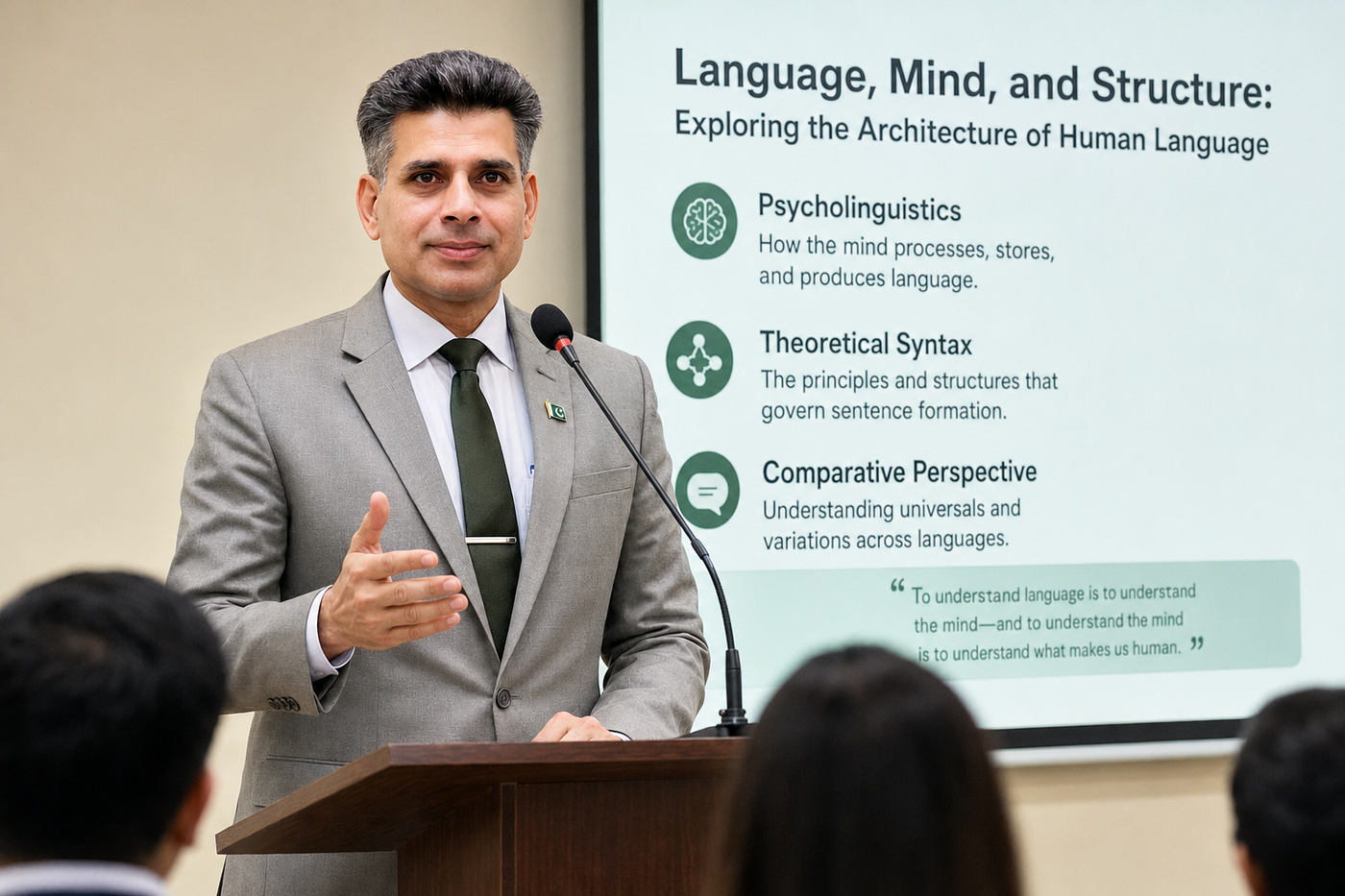
Toward a Theory of Feature Inheritance and Phase Architecture in Head-Final Grammars
The history of generative grammar has been, in many respects, the history of increasing explanatory ambition. The discipline has steadily moved from describing linguistic patterns to uncovering the computational principles that make human language possible. Chomsky’s earliest transformational models sought to explain how finite rules generate infinite expressions. Government and Binding Theory reduced apparent diversity to interacting principles. The Minimalist Program went even further, asking perhaps the most radical question in modern linguistics: What is the simplest computational system capable of producing human language?
This pursuit of explanatory economy has reshaped theoretical linguistics for more than three decades. Merge replaced elaborate transformational machinery. Bare Phrase Structure abandoned representational redundancy. Feature valuation, Agree, phases, and labeling emerged not as descriptive conveniences but as attempts to derive linguistic complexity from the most elementary computational operations.
Minimalism is not simply another syntactic framework. It is a hypothesis about the architecture of the human mind. Yet every theory that claims universality ultimately encounters its most demanding test: typological diversity.
The computational elegance of Minimalism was largely developed through close engagement with English and a relatively small cluster of Germanic and Romance languages. Although subsequent work has expanded considerably, much of the theory’s foundational machinery, including Labeling by Minimal Search, Feature Inheritance, and the Phase Impenetrability Condition, continues to assume structural environments whose defining characteristics are head-initiality, relatively fixed constituent order, comparatively limited overt case morphology, and predominantly configurational syntax.
The question is not whether these mechanisms successfully explain English. The question is whether they explain language. This distinction is no longer merely methodological. It has become theoretical.
Among the world’s major linguistic regions, South Asia presents one of the most demanding testing grounds for computational syntax. Urdu, Hindi, Punjabi, Saraiki, Sindhi and related languages display a constellation of structural properties that rarely co-occur in the languages upon which much minimalist machinery was initially calibrated. They combine head-final phrase structure with extensive morphological case, differential object marking, split ergativity, productive scrambling, complex predicate formation, long-distance agreement effects and remarkably flexible constituent ordering.
These are not peripheral curiosities. They represent alternative architectural solutions to the computational problem of human language.
The significance of these languages therefore extends well beyond descriptive grammar. They provide an opportunity to evaluate whether contemporary minimalist operations genuinely capture universal properties of the Faculty of Language or whether some components of current theory inadvertently encode assumptions derived from a narrower typological experience.
The challenge becomes particularly visible when one examines one of Minimalism’s most elegant innovations: labeling.
Within Chomsky’s recent formulations, syntactic computation proceeds through Merge, but merged objects remain computationally indeterminate until a labeling algorithm determines their structural identity. Labeling is not merely a technical procedure. It is the mechanism through which hierarchical relations become interpretable at the conceptual-intentional interface. Without labels, syntactic objects cannot be successfully transferred to semantics or phonology.
The elegance of this proposal lies in its apparent simplicity. Yet simplicity often conceals hidden assumptions.
Much of the current labeling algorithm presupposes structural asymmetries characteristic of head-initial configurations. Minimal Search identifies prominent elements through hierarchical relations that are relatively transparent in languages where heads consistently precede their complements and where configurational position frequently aligns with grammatical function.
South Asian languages complicate precisely these assumptions. In Urdu or Saraiki, grammatical relations frequently depend not only upon hierarchical configuration but also upon overt case morphology, aspectual structure, agreement interactions and information-structural considerations. Constituents may scramble extensively without disrupting interpretation. Differential object marking introduces additional layers of feature valuation. Split ergativity reorganises alignment according to aspectual domains rather than simple structural position. Complex predicates distribute argument licensing across multiple verbal elements whose computational relationship remains insufficiently understood within current minimalist implementations.
The result is not an empirical anomaly. It is theoretical friction. The problem becomes even more acute when one considers Feature Inheritance and Phase Theory.
Within contemporary Minimalism, phases partition derivation into computationally manageable domains. Phase heads inherit relevant formal features, enabling local Agree operations before Spell-Out transfers completed structures to the interfaces. The Phase Impenetrability Condition ensures computational locality while preserving derivational economy.
This architecture has proved enormously influential because it offers an elegant explanation for locality constraints across diverse linguistic phenomena.
Yet elegance alone cannot guarantee universality. South Asian languages invite a fundamental question: What happens when feature valuation depends less upon canonical structural positions than upon morphologically encoded interactions between aspect, case and information structure?
In split-ergative systems, structural case is not distributed uniformly across derivations. Instead, argument licensing shifts according to tense-aspect configurations. Differential object marking similarly introduces semantic and discourse-sensitive distinctions into what might otherwise appear to be purely syntactic computation. If phases regulate feature valuation before transfer, then these languages raise an intriguing possibility: perhaps phase architecture itself interacts dynamically with morphosyntactic configurations in ways not yet fully captured by standard formulations.
This article advances precisely that possibility. Rather than treating South Asian morphosyntax as a collection of language-specific exceptions, I propose that head-final architectures reveal an overlooked dimension of computational syntax itself. Specifically, the interaction among labeling, feature inheritance and phase locality appears to operate differently when grammatical relations are distributed across rich morphological systems rather than encoded primarily through rigid configurational asymmetries.
The central hypothesis is not that Minimalism fails. It is that Minimalism remains incomplete. Current top-down labeling procedures appear optimally designed for syntactic systems where structural prominence is comparatively transparent. Head-final grammars, however, suggest that computational prominence may emerge through interactions among morphology, aspect, agreement and hierarchical configuration simultaneously. In such systems, feature inheritance may proceed through derivational pathways that differ systematically from those assumed in predominantly head-initial analyses.
One possible consequence is that Phase Impenetrability itself requires a more dynamic interpretation. Instead of functioning as a uniformly fixed computational boundary, phase accessibility may be modulated by morphosyntactic licensing conditions associated with aspectual domains and differential case assignment. Such an account would preserve the explanatory goals of Minimalism while expanding its empirical reach.
Testing this proposal demands more than isolated descriptive observations. It requires a comparative research program situated at the intersection of formal syntax, typology and computational theory.
The investigation therefore proceeds along three complementary dimensions. First, it re-examines contemporary minimalist mechanisms, including Labeling by Minimal Search, Feature Inheritance and Phase Theory, as explicit computational hypotheses rather than established facts. Second, it systematically compares structural phenomena across Urdu, Hindi, Punjabi, Saraiki and Sindhi, focusing on split ergativity, differential object marking, scrambling, cliticization and complex predicate formation. Third, it develops formal derivations within Bare Phrase Structure to evaluate how uninterpretable features are valued, inherited and transferred under alternative structural assumptions.
Such an approach seeks not simply to document variation but to explain why variation exists without abandoning the hypothesis of a universal computational system.
The broader implications extend well beyond South Asian linguistics. If current minimalist algorithms require modification to accommodate head-final architectures, then the consequences reach the foundations of Universal Grammar itself. Universality cannot be established through elegance alone; it must survive confrontation with the full range of human linguistic diversity.
Moreover, this research opens productive dialogue with neighboring disciplines. Experimental psycholinguistics can investigate whether sentence processing in head-final languages reflects computational strategies predicted by revised phase architectures. Computational linguistics can explore whether parsing algorithms require different hierarchical assumptions for morphologically rich SOV systems. Cognitive neuroscience may eventually ask whether the neural implementation of syntactic computation varies according to the structural demands imposed by different grammatical architectures.
The significance of this inquiry therefore lies not in proposing another language-specific parameter. Its ambition is considerably larger. The history of linguistics demonstrates that theoretical breakthroughs often emerge from languages once regarded as peripheral. Ergativity reshaped theories of grammatical relations. Polysynthetic languages transformed understandings of morphology. Wh-in-situ languages altered conceptions of movement. Head-final South Asian languages may now perform a similar service for Minimalism.
Their greatest contribution may not be the phenomena they display. It may be the assumptions they compel us to abandon. If Minimalism aspires to describe the computational architecture of the human language faculty, then its central mechanisms must explain not only the familiar structures of English and French but also the intricate morphosyntactic systems of Urdu, Saraiki, Punjabi and Sindhi with equal theoretical precision.
The future of syntactic theory will not be determined by how elegantly it explains the languages that inspired it. It will be determined by how successfully it explains the languages that challenge it.
In that sense, the next major advance in generative syntax may not arise from discovering a new operation. It may arise from recognizing that the limits of our theories have too often coincided with the limits of our typological imagination.
Riaz Laghari (Riaz Hussain) is a Visiting Lecturer in English at Quaid-i-Azam University and the National University of Modern Languages (NUML), Islamabad. He teaches Grammar & Syntax and Psycholinguistics in the Departments of English, and Expository Writing and Functional English at the Area Study Center, Quaid-i-Azam University.
메타데이터
- post_id
- 65af71c511d8
- slug
- the-limits-of-labeling-why-south-asian-languages-may-force-a-rethinking-of-minimalist-syntax-65af71c511d8
- url
- https://medium.com/@riazleghari/the-limits-of-labeling-why-south-asian-languages-may-force-a-rethinking-of-minimalist-syntax-65af71c511d8
- canonical_url
- https://medium.com/@riazleghari/the-limits-of-labeling-why-south-asian-languages-may-force-a-rethinking-of-minimalist-syntax-65af71c511d8
- author_url
- https://medium.com/@riazleghari
- status
- ok
- fetched_at
- 2026-08-07 22:52:36