What is the difference between the ARIMA and the Holt Winters forecasting model?
In the past several blog posts I have covered time series analysis and then time series forecasting on R’s inbuilt datasets. Two main…
What is the difference between the ARIMA and the Holt Winters forecasting model?
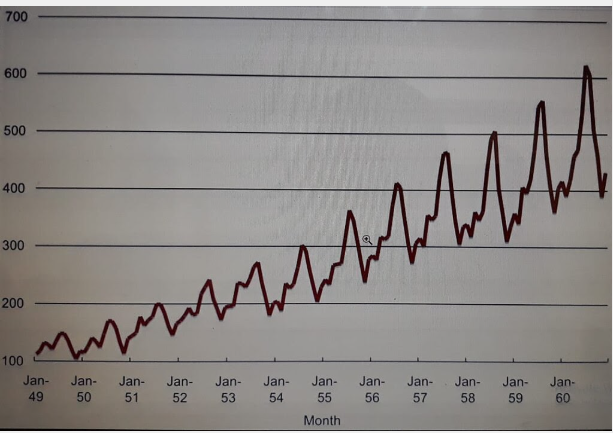
In the past several blog posts I have covered time series analysis and then time series forecasting on R’s inbuilt datasets. Two main forecasting methods that are prominent in the field of time series forecasting are the Holt Winters model and the ARIMA model.
One may wonder which model is the best to use, and that is the purpose of this post.
Holt Winters
The Holt Winters model is based on smoothing past values with exponentially decreasing weights. The components of the Holt Winters model are:-
- Level is the baseline value
- Trend either increases or decreases
- Seasonality represents repeating cycles
There are two basic types of the Holt Winters model, being:-
- Seasonal fluctuations of a constant size are additive
- Seasonal fluctuations that grow with the trend are multiplicative
The strengths of the Holt Winters model are that it is simple, fast, and interpretable. This is an excellent model for series with trend and seasonality.
The limitations of the Holt Winters model are that it does not model complex autocorrelation structures, and it works best for relatively short term forecasts.
A blog post about theHolt Winters model can be read here:- https://tracyrenee61.medium.com/use-r-to-perform-a-holt-winters-forecast-on-the-airpassengers-dataset-ac33cff080f3
ARIMA
ARIMA is an acronym for Auto Regressive Integrated Moving Average.
The ARIMA model utilises an order, being:-
- AR (p) is a regression on past values
- I (d)is differencing to remove trend/non-stationarity
- MA (q) is regression on past forecast errors
SARIMA is the seasonal component of ARIMA, and the order for the seasonal component is (P, D, Q).
The strengths of the ARIMA model are:-
- The model is flexible and can handle complex autocorrelation patterns.
- The model is well suited for both stationary and differenced series.
- The model often produces more accurate forecasts for long horizons.
The limitations of the ARIMA model are that it is more complex to identify and fit and requires ACF and PACF analysis. It is also less intuitive than the Holt Winters model.
A blog post about the ARIMA model can be found here:- https://medium.com/@tracyrenee61/use-r-to-perform-an-arima-on-the-nile-dataset-b3f1f0299de0
The key takeaways are:-
- Use Holt Winters for a quick interpretable forecast for data with clear trend and seasonality.
- Use ARIMA/SARIMA when a more flexible model is needed that can capture autocorrelation and can provide robust long term forecasts.
메타데이터
- post_id
- 65bda7e275bb
- slug
- what-is-the-difference-between-the-arima-and-the-holt-winters-forecasting-model-65bda7e275bb
- url
- https://medium.com/@tracyrenee61/what-is-the-difference-between-the-arima-and-the-holt-winters-forecasting-model-65bda7e275bb
- canonical_url
- https://medium.com/@tracyrenee61/what-is-the-difference-between-the-arima-and-the-holt-winters-forecasting-model-65bda7e275bb
- author_url
- https://medium.com/@tracyrenee61
- status
- ok
- fetched_at
- 2026-07-14 23:39:02