Junk Food vs. Toxic Hoax
Every era has its poison scare. In the age of social media, it arrives not in a government bulletin or a scientific journal, but in a…
Junk Food vs. Toxic Hoax
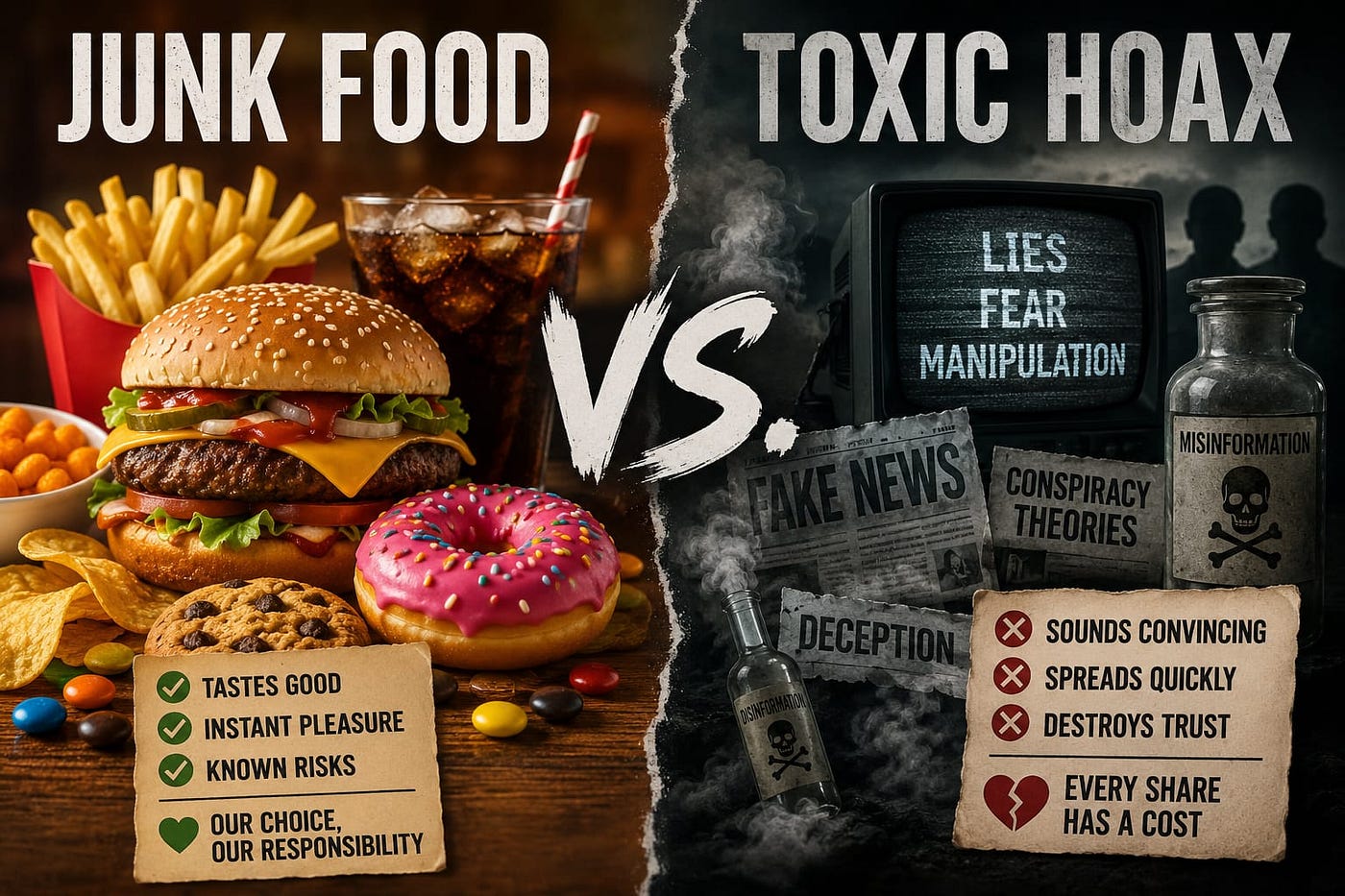
Every era has its poison scare. In the age of social media, it arrives not in a government bulletin or a scientific journal, but in a shaky 30-second video forwarded by a worried parent at 11 p.m. A noodle that stretches like rubber. Rice that bounces like plastic. A snack that burns with an eerie blue flame. The message is always the same: the food industry is poisoning you, the government knows, and only this viral video can save you.
Meanwhile, in peer-reviewed journals and regulatory agencies, a quieter but far more consequential conversation is underway — one with overwhelming scientific consensus behind it. Ultra-processed foods, the category that encompasses most of what the world calls “junk food,” are genuinely, measurably linked to a cascade of chronic diseases. The irony of our information moment is devastating: the real dangers of junk food are hiding in plain sight, while fabricated toxic hoaxes command most of the public’s attention and anxiety.
This article draws a clear, evidence-based line between the two. It examines the most common viral food hoaxes, explains what actually makes them false, and then turns to the documented, peer-reviewed health risks of ultra-processed food consumption — risks that are, in many ways, more frightening precisely because they are invisible, cumulative, and real.
The Architecture of a Food Hoax
Food hoaxes are not a new phenomenon. Adulteration panics have accompanied every era of industrialised food production. But social media has transformed their velocity and reach beyond anything previously imaginable. A video can reach one hundred million screens before a single food scientist has had the opportunity to respond.
What makes a food hoax so potent? The answer is a convergence of chemistry, psychology, and politics. Most viral food myths share three structural features: they involve a dramatic visual demonstration that laypeople cannot immediately explain; they invoke a powerful antagonist (usually a corporation or government); and they offer a simple, emotionally satisfying explanation for a genuinely complex phenomenon.
“The algorithmic nature of social media prioritises virality over credibility. This enables the spread of misinformation about nutrition, meaning questionable claims that sound convincing to the public can rapidly gain traction.”
— Nature Metabolism, Vol. 7 (2025) — “Nutritional advice on social media: clicks over credibility”
The result is a peculiar inversion. Consumers become hypervigilant about imaginary threats — plastic in their snacks, synthetic polymers in their rice — while remaining largely unconcerned about the documented risks that accumulate quietly with every meal. A 2025 systematic review in ScienceDirect found that social media platforms allow self-proclaimed health experts to promote personal views and anecdotal experiences as scientific fact, “further complicating efforts to establish a clear and scientifically correct discourse on nutrition.”
The Real Danger — Ultra-Processed Food and Chronic Disease
While millions argue online about whether their chips contain plastic, a very different and far more consequential story has been unfolding in the world’s leading medical journals. The scientific case against ultra-processed food (UPF) consumption has moved, over the past decade, from hypothesis to near-consensus.
The pivotal work is a 2024 umbrella review published in The BMJ — the largest ever of its kind. Covering 45 meta-analyses and data from approximately 10 million people, it identified no fewer than 32 distinct health parameters adversely associated with diets high in ultra-processed foods.
+50% Increased risk of death from cardiovascular disease
+48% Increased risk of anxiety disorders
+55% Increased risk of obesity
+40% Increased risk of Type 2 diabetes
+21% Increased risk of early death from any cause
53% Of adult daily calories
The findings represent what researchers at the Association of American Medical Colleges have called the “health challenge of our time.” Yet they rarely generate the same share of public alarm as a viral video of a burning snack.
What are Ultra-Processed Foods?
he scientific classification most widely used is the NOVA system, developed by Professor Carlos Monteiro and colleagues at the University of São Paulo in 2009. It divides foods into four groups: unprocessed or minimally processed foods; processed culinary ingredients; processed foods; and ultra-processed foods (UPFs). The last category is characterised by industrial formulations containing five or more ingredients — typically including preservatives, emulsifiers, artificial sweeteners, colourings, and flavour enhancers that have no equivalent in domestic cooking. Examples include carbonated soft drinks, packaged snacks, reconstituted meat products, instant noodles, mass-produced bread, ready meals, and most fast food.
A November 2025 Lancet Series — combining narrative and systematic reviews with original meta-analyses — confirmed three hypotheses about UPFs: that they are globally displacing traditional whole-food diets; that this displacement deteriorates diet quality; and that the deterioration results in measurable chronic disease risk through multiple mechanisms, including nutrient imbalance, hyper-palatability-driven overeating, reduced phytochemical intake, and elevated exposure to potentially harmful food additives and endocrine disruptors.
“Diets high in ultra-processed foods are associated with overeating, poor nutrient balance — too much sugar, salt, and saturated fat — and reduced intake of health-protective compounds.”
— The Lancet Series on Ultra-Processed Foods, November 2025
The Global Scale of the Problem
he consumption figures are staggering. In the United States and United Kingdom, ultra-processed foods have accounted for more than 50 percent of dietary energy for at least two decades. In Spain, the share tripled from 11 to 32 percent over three decades. In Mexico and Brazil, it rose from roughly 10 to 23 percent over forty years. Among American children and adolescents, the figure stands at approximately 62 percent of daily caloric intake.
This is not a niche problem of “unhealthy” individuals making poor choices. It is a structural feature of the modern food environment, shaped by pricing, advertising, agricultural policy, and supply chains. As a 2023 Indian report by Nutrition Advocacy in Public Interest (NAPi) documented, ultra-processed foods are aggressively marketed through television, YouTube, Instagram, Facebook, and print media — often using misleading health claims — while their long-term risks are rarely disclosed.
The Critical Distinction — Acute vs. Chronic Harm
One reason food hoaxes capture our attention so effectively is that they describe acute harm — plastic entering the body immediately, wax coating the stomach lining tonight, a chemical causing damage with the very next bite. This is the kind of danger our evolved threat-detection system is wired to notice and respond to.
The genuine harm of ultra-processed food is, by contrast, chronic and cumulative. No single bag of chips causes cardiovascular disease. No individual bowl of instant noodles triggers diabetes. The risk accumulates across years and decades of dietary patterns. This makes it genuinely difficult to perceive, attribute, or dramatise — which is precisely why it is so much less effective as viral content.

Why This Inversion Matters — and Who Benefits
There is a troubling political economy to this inversion. Every hour that public attention is occupied by plastic rice or wax noodles is an hour not spent scrutinising the genuinely documented influence of ultra-processed food manufacturers on dietary guidelines, school canteen policies, and advertising regulations. Every viral hoax that collapses under scientific scrutiny trains audiences to be sceptical of food safety concerns in general — a form of “cry wolf” fatigue that can make real warnings less credible.
In India, the government has explicitly recognised this dynamic. The FSSAI’s campaign against food misinformation and its requests for Google and Facebook to remove false viral content are motivated, in part, by exactly this concern: that hoaxes do measurable damage both to legitimate food businesses and to the public’s ability to process genuine health information.
At the same time, it would be a mistake to dismiss all consumer suspicion of the processed food industry as irrational. The industry’s history of funding nutrition research, lobbying against front-of-pack warning labels, marketing to children, and formulating products for maximum addictive palatability at the expense of nutrition is well documented. Consumer scepticism, in this context, is not paranoia — it is an understandable response to a legitimately troubled relationship between corporations, regulators, and public health. The problem is that social-media-driven hoaxes channel that legitimate scepticism into factually incorrect targets, leaving the real behaviour of the industry largely unchallenged.

Conclusion: Fear the Right Things
The case of junk food versus toxic hoax is, at its core, a case study in the relationship between scientific literacy and public health. We live in a moment of extraordinary capability for spreading information — and equal capability for spreading misinformation. The two streams do not compete on equal terms: fear travels faster than evidence, drama outperforms nuance, and simplicity defeats complexity in the algorithmic attention economy.
The documented harm of ultra-processed food consumption is not trivial. A 50 percent increase in cardiovascular death risk, a 32-item catalogue of associated health conditions, global consumption patterns where the majority of calories come from industrial food formulations — these are facts that warrant serious individual and policy responses. They are also facts that, unlike a burning crisp, will never go viral.
The viral toxic hoaxes — plastic in snacks, wax in noodles, polymer in rice — are not merely harmless misinformation. They occupy cognitive and emotional bandwidth. They erode trust in food regulation broadly. They misalign consumer anxiety from real risks to imaginary ones. And they do this at precisely the moment when accurate nutritional public health communication has never been more important.
Junk food is not a toxic hoax. It is a real, well-evidenced nutritional challenge with genuine consequences for chronic disease, healthcare systems, and quality of life. The plastic rice is fake. The cardiovascular risk is not. We would do well, as a society, to sort one from the other.
메타데이터
- post_id
- 65c0258c95d2
- slug
- junk-food-vs-toxic-hoax-65c0258c95d2
- url
- https://medium.com/@sohidulalamsourav/junk-food-vs-toxic-hoax-65c0258c95d2
- canonical_url
- https://medium.com/@sohidulalamsourav/junk-food-vs-toxic-hoax-65c0258c95d2
- author_url
- https://medium.com/@sohidulalamsourav
- status
- ok
- fetched_at
- 2026-06-09 15:37:30



