Planning your career in AI era
I used to believe in the 5–10 year career plan. With AI is changing what my jobs look like faster than I can keep up with this , I don’t…
Planning your career in AI era
I used to believe in the 5–10 year career plan. With AI is changing what my jobs look like faster than I can keep up with this , I don’t worry about 5–10 years long plan anymore.
ps: this is my opinion for my career. Please DO NOT consider it as a professional advise .
In the last few years I have watched “prompt engineer” go from nowhere to everywhere, and now everyone’s talking about “forward-deployed engineers”. Some of these roles will last and some will vanish as fast as they arrived. Planning a decade around any of them is a bet against a game whose rules keep changing.
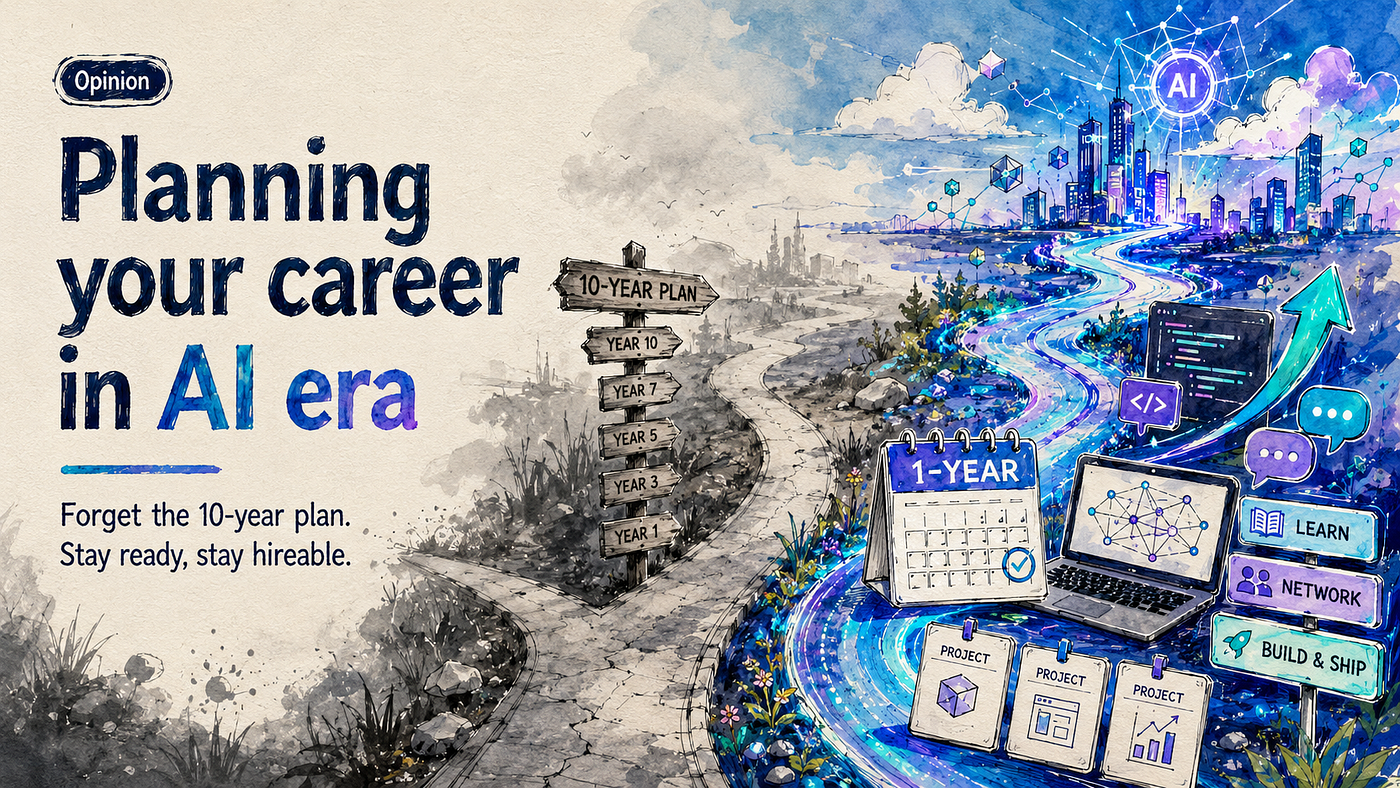
prompt by human, generated by AI
So I’ve stopped trying to have a ten years plan. I have started planning one year at a time, around a single question: If I had to look for a new job tomorrow, would I still be hireable?
A story about a plan that didn’t survive
A few years ago I worked on a nice multi-year path toward a specialisation of a domain. I was sure it was the future. I invested in it but within about eighteen months the ground had shifted. AI changed everything.
Now, with AI the speed of building , and launching things is super fast. No matter how much I argue about learning a programming language, or optimizing database, or migrating on cloud and optimizing resources, the truth is — people are moving on with the speed of AI and I started feeling like I am behind in everything.
So, I changed one thing : I stopped looking at the plan. I started understanding that now I could learn quickly, ask decent questions, and ship something with AI. My whole strategy now is, how I can use AI to solve me problems? what I can build with AI?
yes, learning fundamentals are still important. Eg: If I am building an agent using Python, then in interview I should be able to answer Python’s answer. That’s when I stopped trusting long plans and started trusting staying ready.
Golden Question: How to stay hireable
This is what I think is can keep me hireable and monthly goals (I try) to focus on.
- Make my basics stronger: New tools keep coming; the fundamentals of good work don’t churn nearly as fast : problem-solving, system design, debugging, testing, security, communication. AI can write code, but I still have to know what it does and whether it’s safe to ship. Companies will always take someone who understands the fundamentals and can pick up a new tool over someone who knows one AI tool and can’t solve a real problem.
My monthly goal: pick one fundamental. If it’s system design, study how a real system is built, design a small service yourself, and ask someone experienced to tear it apart.
2. Learn to work with AI : I don’t (but I want to ) need to become an AI expert. I do need to use it daily: reviewing my code, drafting test cases, explaining an unfamiliar topic, offering another angle on a problem. The skill isn’t using it but it’s knowing where it helps and where it quietly fails.
My monthly goal: have AI draft your first pass of test cases, then find the cases it missed. Ask it to explain an old chunk of your code, then verify it by reading the code yourself.
3. Meet new people: Networking isn’t messaging strangers the week you need a job. It’s meeting people, learning what they do, sharing what I know, and staying in touch. That’s how I hear where the industry is actually moving and find roles that never hit a job board.
My monthly goal: talk to one person outside your team. Ask what they’re working on, how AI is changing it, and what skills their team needs. One honest conversation beats a hundred social posts.
4. Show your work: This isn’t posting daily or pretending to be an expert. It’s giving people a way to see how I think. My résumé shows where I worked; my projects and writing show how I solve problems. For me it is my Blog, Medium, and Github
My monthly goal: build one small thing and write a short honest post about it the problem, what worked, what didn’t. People connect with a real learning story far more than a polished success one.
Where YOU are changes the plan
- **If you’re in college: **your job is to get your first job. Don’t burn energy on where you’ll be in ten years;
you don’t have the experience yet to make that plan mean anything.So, your first job is what teaches you the work you enjoy, what you’re good at, and what you need to fix and getting there isn’t about collecting certificates but to build something that solves a real problem, even a small one eg: a simple app, help for a local business, an open-source contribution, a weekend project with friends.
Then in an interview you have a real story: what you built, what broke, what you learned. A person who tried something and can talk honestly about it stands out more than someone who finished ten courses and never shipped. But also do not ignore AI. Think of AI as your co-partner.
2. If you already have experience: the fear of being losing job is real; companies are using AI as a reason to cut the jobs and roles even when you’ve done nothing wrong and we can’t control that. You can control how ready you are for the next opening.
your experience is what makes you good with AI, not obsolete next to it. You’ve dealt with real customers, bad requirements, failed projects, hard calls, tough debugging, best practices. So when AI generate a code that is not scalable & have issues, you’re the one who notices and this is your super power. AI gives you information fast. Experience tells you whether it’s any good. So, start working with AI, change your all manual workflows to AI, embrace AI in everything.
I still remember , 2 years ago, when AI was catching up — during an interview one of the question I faced was — how you are using AI in your day to day work? Now, AI is far away from this but this is still a ice-breaker question and then it will go to RAG, Agentic AI, agents, etc.
Takeaways
- Forget the ten-year plan: Plan one year at a time; review every few months and adjust when the ground moves.
- **Your one metric: **If I had to job-hunt tomorrow, would I still be hireable?
- Go deep on one fundamental: not wide across ten AI tools.
- Use AI every day & then verify it: Its value to you is knowing where it fails.
- Talk to one new person a month: Relationships surface the jobs applications never will.
- Show your work: including what didn’t work.
- Experience isn’t a liability in the AI era it’s your filter: Combined with a willingness to learn, it’s your biggest edge.
I can’t predict what my jobs will look like in ten years. I can make sure I am ready for the next opportunity and that’s the only plan that survives.
Thank you for reading this. If you like this, then please share in your network . You can contact me at X or LinkedIn
Let me know in comments — how you are thinking about your career in AI era.
메타데이터
- post_id
- 660cfa3c33f9
- slug
- planning-your-career-in-ai-era-660cfa3c33f9
- url
- https://medium.com/@hellonehha/planning-your-career-in-ai-era-660cfa3c33f9
- canonical_url
- https://medium.com/@hellonehha/planning-your-career-in-ai-era-660cfa3c33f9
- author_url
- https://medium.com/@hellonehha
- status
- ok
- fetched_at
- 2026-08-12 08:35:27






