Top Alternatives to Broadcom Tomahawk 5 Switches for AI Clusters
Powered by a switching capacity of 51.2Tbps, a mature ecosystem, and broad industry adoption, Broadcom Tomahawk 5 (TH5) has become one of…
Top Alternatives to Broadcom Tomahawk 5 Switches for AI Clusters
Powered by a switching capacity of 51.2Tbps, a mature ecosystem, and broad industry adoption, Broadcom Tomahawk 5 (TH5) has become one of the most widely deployed Ethernet switch chips for AI training networks.
However, the landscape is beginning to shift in 2026. On one hand, the rapid expansion of AI clusters continues to drive demand for TH5-based switches. On the other hand, longer lead times and supply-chain resources increasingly allocated to hyperscale cloud providers are prompting more enterprises to evaluate Tomahawk 5 alternatives and AI network switch alternatives.
So, what options are available beyond Broadcom Tomahawk 5? In this article, we will examine the key specifications of Broadcom Tomahawk 5, explore the leading Broadcom Tomahawk 5 switch alternatives for AI clusters, and compare the most relevant solutions available in 2026. The goal is to help network architects, infrastructure engineers, and procurement teams make informed decisions when selecting the right AI cluster networking solution in today’s evolving market.
What Is Broadcom Tomahawk 5?
Before exploring Tomahawk 5 alternatives, it is important to understand why Broadcom Tomahawk 5 has become a key technology in the AI networking market.
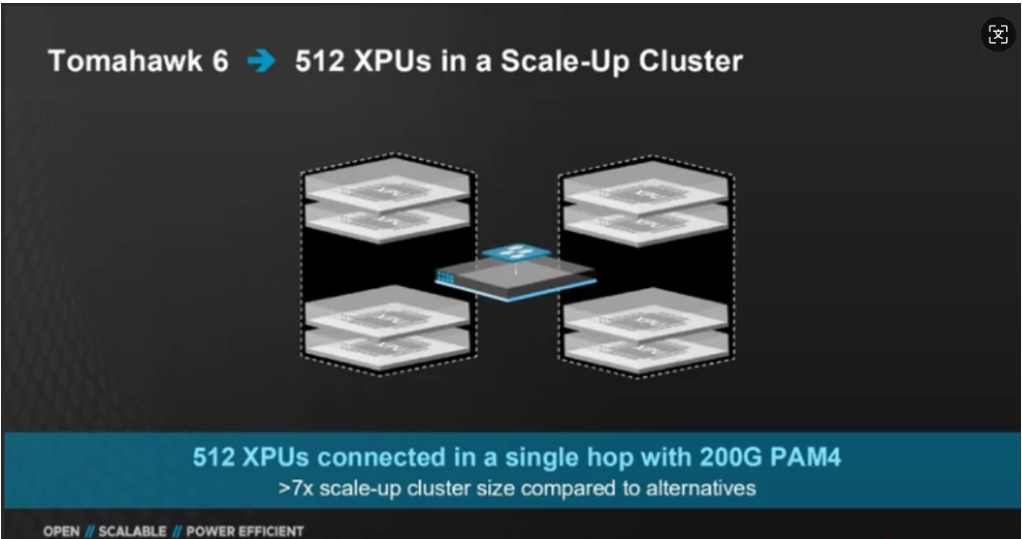
Designed for hyperscale data centers, cloud computing platforms, and large-scale AI/ML clusters, Broadcom Tomahawk 5 is a 51.2Tbps Ethernet switch chip built on a 5nm process. It integrates 512 lanes of 112G PAM4 SerDes, enabling high-density configurations of up to 64 × 800GbE ports or 128 × 400GbE ports on a single chip. This architecture provides the high bandwidth, port density, and scalability required for modern AI cluster networking and large-scale GPU deployments.
Based on the Tomahawk 5 platform, NADDOD has introduced several 51.2T AI data center switches designed for next-generation AI infrastructure. For more details, see NADDOD Launches 51.2T Ethernet Data Center Switches Powered by Broadcom Tomahawk 5.
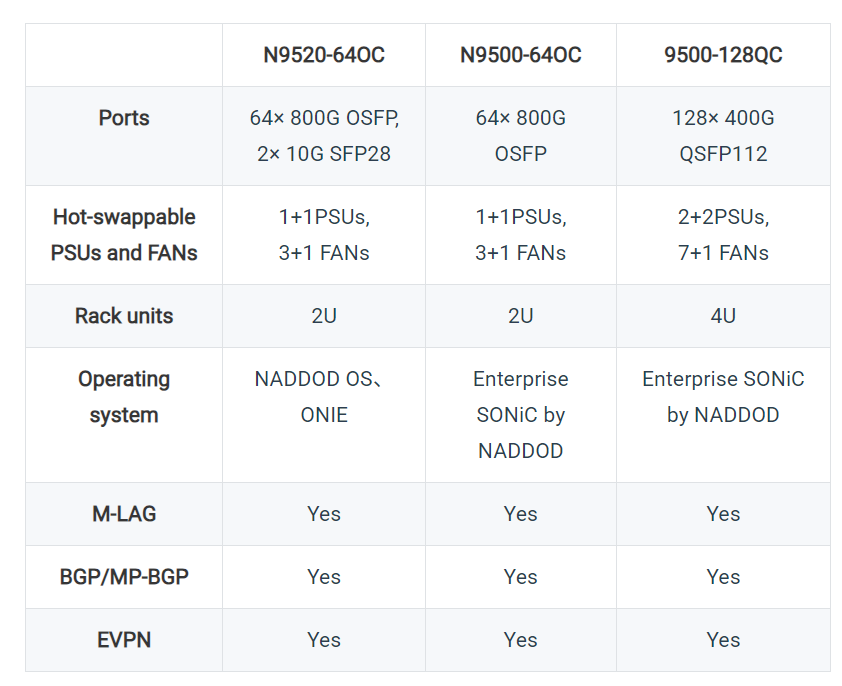
As a result, many organizations use TH5-based switches as a benchmark when evaluating performance, scalability, and network architecture for AI deployments. However, as AI clusters continue to grow in size and demand for high-performance networking equipment increases, more enterprises are asking a critical question: Are there viable alternatives to Tomahawk 5 that can deliver comparable performance, scalability, and AI networking capabilities?
This question has become increasingly relevant in 2026 as organizations seek greater flexibility in switch procurement, supply-chain resilience, and long-term AI infrastructure planning.

Why Enterprises Are Exploring TH5 Alternatives
AI Inference Workloads Are Placing Higher Demands on Networks
The focus of AI infrastructure is gradually shifting from training to inference. In this transition, the network is no longer just a connectivity layer for GPUs; it has become a critical factor influencing system performance, resource utilization, and application responsiveness within AI cluster networking environments.
In large-scale AI inference clusters, traffic must be efficiently transmitted between GPUs, servers, and switches in a continuous and highly coordinated manner. As GPU scale increases and model parameters grow, intra-cluster data exchange volumes rise rapidly. If the network cannot provide sufficient bandwidth, low latency, and stable traffic forwarding, simply adding more GPU resources will not fully translate into higher system performance.
Therefore, optimizing AI inference workloads is no longer only about improving compute capability. High-performance networking and efficient interconnect architectures are equally important. For enterprises planning next-generation AI data centers, switch performance, scalability, and proven experience in large-scale deployments have become key evaluation criteria.
Against this backdrop, organizations evaluating AI network switches typically compare multiple high-performance switch solutions available in the market. As the ecosystem of AI data center switches continues to expand, more enterprises are increasingly looking beyond Broadcom Tomahawk 5 toward Broadcom Tomahawk 5 switch alternatives, seeking network architectures that better align with their specific workload and infrastructure requirements.
Supply Chain Pressure Is Becoming a New Challenge
Beyond technical requirements, supply chain constraints have become a key driver for enterprises to evaluate Broadcom Tomahawk 5 switch alternatives.
Global investment in AI infrastructure continues to accelerate. Hyperscale cloud providers and AI companies are purchasing large volumes of high-performance switch ASICs, GPU servers, and high-speed optical interconnects. At the same time, advanced semiconductor manufacturing capacity remains limited, leading to continued tight supply in high-end networking chips.
For many organizations, deployment timelines are often more critical than marginal performance advantages. In real-world deployments, the factors affecting project schedules are no longer limited to network architecture design alone, but increasingly depend on whether equipment can be delivered and deployed on time.
When switch delivery timelines become uncertain, more enterprises begin to evaluate alternative platforms with more stable supply capabilities. Compared with waiting for long and unpredictable lead times, solutions that can be deployed faster and brought into production environments often provide higher practical value.
For many companies, if there is no clear certainty that TH5-based switches can be delivered within a reasonable timeframe, it becomes more practical to seriously evaluate other options. In many cases, bringing infrastructure online quickly and generating business value outweighs the benefits of insisting on a single hardware platform.
Best TH5 Switch Alternatives for AI Clusters in 2026
Option 1: NVIDIA Spectrum-4 Ethernet Switches
If Broadcom Tomahawk 5 is considered the mainstream solution in the open Ethernet switch market, then NVIDIA Spectrum-4 can be viewed as its most direct peer alternative. Both are 51.2Tbps switching capacity platforms and support 800G Ethernet deployment, meeting the bandwidth demands of large-scale GPU clusters and high-performance AI cluster networking.
However, Spectrum-4 is positioned as more than just a switch ASIC. It is a core component of NVIDIA’s AI networking strategy, tightly integrated with the NVIDIA BlueField SuperNIC, NCCL, and NVIDIA’s network management stack, forming a complete AI Ethernet fabric.
Compared with traditional Ethernet switching architectures, Spectrum-4 places greater emphasis on AI-aware traffic handling. Through adaptive routing, RTTCC congestion control, and co-optimization with the compute layer, it aims to improve overall GPU cluster network utilization and efficiency.
The following section provides a high-level comparison of Tomahawk 5 vs Spectrum-4 in key specifications and architectural characteristics.

From a specification comparison perspective, NVIDIA Spectrum-4 demonstrates clear advantages in forwarding performance, latency, congestion control flexibility, and co-optimization with NCCL.For enterprises that have already adopted NVIDIA GPU infrastructure, Spectrum-4 is not only a specification-equivalent alternative to TH5 switch alternatives, but also a solution that can reduce overall deployment and operational costs through deep ecosystem integration. This includes tighter alignment with the compute stack, networking software, and GPU communication frameworks.
As a result, under the current context of tightening Broadcom Tomahawk 5 supply, Spectrum-4-based switches are often the first option considered in AI network switch evaluations.
For further details on its technical advantages and deployment considerations, please refer to Why It’s Time to Consider Spectrum-4 51.2T Switches? or review the specifications and delivery information of the NADDOD N9570–128QC 51.2T Spectrum-4 AI Ethernet Switch.

Option 2: Cisco Silicon One
Cisco’s approach to the AI switch market differs from NVIDIA and Broadcom: it focuses on cross-data center interconnectivity, rather than networking within a single cluster. Compared to traditional data center switching chips, the biggest feature of the Silicon One series is its unified architecture design. Cisco uses the same chip architecture to cover switching and routing scenarios, thereby reducing network architecture complexity and improving consistency across network layers.

The Cisco Silicon One G200 is Cisco’s next-generation switching chip platform for AI data centers and cloud networks, offering a switching capacity of 51.2Tbps and supporting 64×800GbE or 128×400GbE port configurations. For enterprises that have already deployed Cisco data center networks or wish to adopt a unified network platform, the G200 provides a technology option different from Broadcom and NVIDIA.
Option 3: Marvell Teralynx 51.2T Ethernet Switch
Marvell Teralynx 10 is a 51.2Tbps Ethernet switch silicon platform developed for cloud data centers and AI networking, supporting configurations such as 64 × 800GbE or 128 × 400GbE ports.

Unlike some switch ASICs that emphasize programmability or extended network feature sets, the Teralynx family has traditionally focused on low latency, high throughput, and energy efficiency. Marvell positions it as an open Ethernet switching platform designed for large-scale AI and cloud deployments, particularly where performance and efficiency are primary design priorities.

As more enterprises seek to reduce dependency on a single switch silicon vendor, Teralynx 10 is increasingly being evaluated in certain AI network switch and AI data center switch projects. However, from a current market perspective, its deployment scale and ecosystem maturity are still evolving.
Therefore, in practical TH5 switch alternatives evaluations, it is not enough to consider raw silicon performance alone. Enterprises also need to assess factors such as switch vendor support capabilities, network operating system compatibility, and long-term supply chain stability when selecting solutions for large-scale AI cluster networking deployments.
Option 4: InfiniBand Switches
When evaluating Broadcom Tomahawk 5 (TH5) alternatives, InfiniBand is also often included in the discussion, especially in hyperscale AI training clusters and high-performance computing (HPC) environments. With its ultra-low latency and efficient GPU-to-GPU communication capabilities, InfiniBand has long been considered a key option for high-performance AI networking.
However, InfiniBand is not a direct alternative to Tomahawk 5. Unlike TH5 and NVIDIA Spectrum-4, which are based on open Ethernet architectures, InfiniBand is built on a separate networking ecosystem. Switches, NICs, cables, and management software are typically designed around a unified InfiniBand stack. This architecture can deliver consistent network performance, but it also introduces higher deployment complexity and a more limited ecosystem of choices.
From a market perspective, as RoCE technology continues to mature and the open Ethernet ecosystem expands, InfiniBand is facing increasing competitive pressure, and major vendors are gradually shifting their strategic focus toward Ethernet-based solutions. For most enterprises building new AI clusters, open Ethernet approaches offer greater flexibility, ecosystem compatibility, and long-term scalability.

For enterprises evaluating TH5 switch alternatives, Spectrum-4-based switches are generally the closer match in terms of architecture and deployment model. In contrast, InfiniBand switches are more suitable for scenarios where InfiniBand architecture is already planned or where extremely high network performance requirements justify a more specialized deployment model.
Which Alternative Is Best?
For AI cluster deployment, factors such as switch-to-GPU platform co-optimization, network ecosystem maturity, operational complexity, and supply chain stability all have a significant impact on the final deployment outcome.
As a result, there is no universal “best alternative” that fits all scenarios. Enterprises should evaluate solutions based on their own network architecture, AI workloads, and long-term scalability requirements.
In the current market landscape, NVIDIA Spectrum-4, Cisco Silicon One G200, and Marvell Teralynx 10 are all worth including in the evaluation scope for AI network infrastructure and AI cluster networking design projects.
How to Choose the Right AI Switch?
After understanding the different TH5 switch alternatives, the key question remains: how should enterprises make the right decision based on their own business requirements?
In reality, switch selection is not simply a comparison of chip specifications. It requires a comprehensive evaluation across multiple dimensions, including network architecture, ecosystem maturity, operational capability, and supply chain stability.
- Step 1: Define the workload type
Training clusters prioritize bandwidth and collective communication stability, while inference clusters place greater emphasis on latency consistency and high-concurrency throughput. These different workloads require different characteristics from AI network switches.
- Step 2: Evaluate end-to-end ecosystem completeness
Chip specifications are only the starting point. The real determinant of performance is the level of end-to-end system integration, including NICs, switches, management software, and AI frameworks working together across the full stack.
- Step 3: Match solution complexity with operational capability
High-performance architectures often come with higher operational complexity. Enterprises should assess internal engineering capability and vendor support depth, and prioritize solutions that align with their AI infrastructure operational maturity.
- Step 4: Include interconnect components in the overall evaluation
Compatibility validation for optical modules, cables, and switches should be completed during the selection phase to avoid additional procurement costs and testing cycles later in deployment.
- Step 5: Factor supply chain deliverability into decision-making
The technically best solution is not always the best business decision. Delivery timelines and supply chain stability should carry significant weight in the evaluation matrix for AI cluster networking projects.
For a more detailed breakdown of each step and decision-making considerations, see the full guide: 5 Key Steps to Choose Network Switches for an AI Cluster.
Conclusion
In 2026, AI switch selection is no longer a single-dimensional performance comparison. Instead, it has become a multi-dimensional decision process that includes technical specifications, ecosystem completeness, operational complexity, interconnect planning, and supply chain reliability.
Against the backdrop of tightening TH5 supply, NVIDIA Spectrum-4 is increasingly becoming a preferred alternative for many enterprises, thanks to its comparable switching capacity, stronger AI-native networking capabilities, and deep integration with the NVIDIA GPU ecosystem.
However, regardless of which solution is ultimately selected, a system-level approach — from switch silicon to interconnect architecture planning — remains the fundamental prerequisite for ensuring on-time project delivery and achieving expected AI cluster networking performance.
메타데이터
- post_id
- 6615f4fe5b21
- slug
- top-alternatives-to-broadcom-tomahawk-5-switches-for-ai-clusters-6615f4fe5b21
- url
- https://medium.com/@naddod/top-alternatives-to-broadcom-tomahawk-5-switches-for-ai-clusters-6615f4fe5b21
- canonical_url
- https://medium.com/@naddod/top-alternatives-to-broadcom-tomahawk-5-switches-for-ai-clusters-6615f4fe5b21
- author_url
- https://medium.com/@naddod
- status
- ok
- fetched_at
- 2026-06-11 17:15:47