BRIDGE: Where Reality Signals Become Governance Agendas
Mossland’s experimental Physical AI Governance OS.
BRIDGE: Where Reality Signals Become Governance Agendas
Mossland’s experimental Physical AI Governance OS.
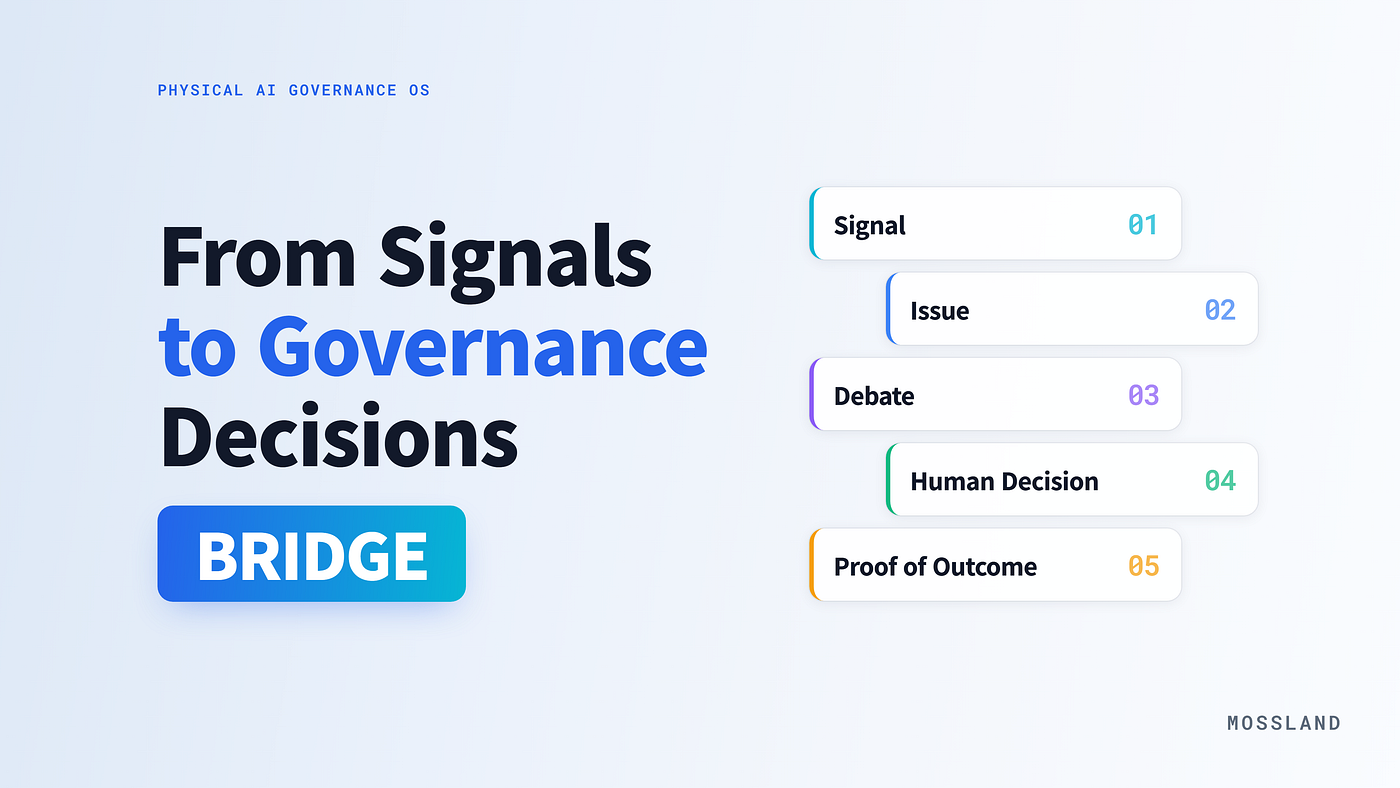
BRIDGE is Mossland’s experimental Physical AI Governance OS. It is designed to collect real-world signals, organize them into governance issues, have AI agents debate them from multiple perspectives, and leave the final decision to humans.
During its website renewal, Mossland briefly introduced BRIDGE as one of its upcoming experimental directions.
This post walks through why BRIDGE is needed, how it operates, and what kind of governance structure Mossland is exploring through this experiment.


Why Are We Experimenting with BRIDGE?
Governance is commonly understood as “a process where proposals are submitted, discussions are held, and votes are cast.” But in practice, a great deal of work is needed even before a single proposal is created.
You have to identify which signals matter, distinguish whether a signal is mere noise or a real issue, gather relevant evidence, organize different perspectives, and shape it all into an actionable proposal.
In traditional DAO structures, most of this process had to be done by humans directly. Humans had to identify problems, write posts, open discussions, and organize proposals.
This structure has clear advantages. Because humans make judgments directly, it is deliberate and can reflect the community’s will. But it also has limitations.
- When there are too many signals, important issues can be missed.
- When the burden of writing proposals is high, participation can decrease.
- As discussions grow longer, the core issues can become obscured.
- After a decision, it can be difficult to track what actually changed.

BRIDGE starts from this point. Mossland does not view governance as only “the moment of pressing a vote button.” Governance is the entire process of discovering signals, organizing issues, debating, deciding, executing, and reviewing results. BRIDGE is an experiment to connect this entire process into a single loop.
The New Governance Flow BRIDGE Envisions
The flow that BRIDGE experiments with is as follows.
- Reality Signals — Collects various signals occurring in the real world and on-chain.
- Inference Mining — Detects anomalies, recurring patterns, and governance issue candidates within the collected signals.
- Agentic Consensus — Multiple AI agents examine and debate issues from different perspectives.
- Human Governance — The final judgment is made by human participants, MOC holders, and the community. They can vote directly or delegate based on policies.
- Proof of Outcome — Tracks execution results after decisions and records them as KPIs and trust scores.

This flow is not simply “a tool where AI writes proposals.” The core of BRIDGE is creating a governance loop that connects from signals all the way through to outcomes.
BRIDGE Architecture: 5 Layers

1. Reality Oracle: Transforming Reality Signals into Governance Data
The first layer of BRIDGE is the Reality Oracle. It collects signals occurring in reality and transforms them into data that governance can read. The reality signals referred to here are not limited to simple news or numbers.
- On-chain events such as MOC transfers and governance activity
- Agora or community participation patterns
- Product or development telemetry
- Proof-of-Presence check-ins
- City, environment, and service-related data accessible via public APIs
- Simulation data for demos and testing
BRIDGE does not feed these signals directly into decision-making. They first go through a process of collection, classification, and importance verification. The Reality Oracle is akin to BRIDGE’s sensory organ — the layer that first detects what changes are occurring inside and outside the Mossland ecosystem.
2. Inference Mining: Discovering Issues from Signals
Not every collected signal becomes a governance agenda. Some signals may be temporary noise, while others may be issues that warrant deeper examination. The second layer of BRIDGE, Inference Mining, plays the role of distinguishing this difference.
- Participation rates have dropped sharply over a specific period.
- A noticeable change has occurred in development activity or service metrics.
- Voting patterns appear abnormal for a specific type of proposal.
- A threshold related to budget, security, or community response has been crossed.
Based on these signals, BRIDGE detects issue candidates. It then summarizes them for immediate human readability, or organizes them into a form that can be expanded into a proposal draft. The ultimate authority of judgment remains with humans.
3. Agentic Consensus: AI Agents Debating from Different Perspectives
When an issue is discovered, the AI agents within BRIDGE examine it from their respective perspectives. In the current structure, the roles of security, treasury, community, product, and moderator form the core axes.

Through this process, BRIDGE aims to create not just a simple AI answer, but a Decision Packet where multiple perspectives have collided and been organized. A Decision Packet is a decision-making package for humans to judge. It can include the background of the issue, evidence, agent opinions, risks, alternatives, KPIs, and execution conditions.
4. Human Governance: Humans Make the Final Decision
The core principle of BRIDGE is clear. AI proposes, humans decide.
BRIDGE does not aim to be a fully automated DAO where AI executes everything automatically. The direction Mossland is experimenting with is a structure where AI organizes signals, assists with debate, and creates proposal drafts, but the final decision-making is carried out by MOC holders and the community.

In particular, BRIDGE’s delegation structure aims for policy-based delegation rather than simply “handing everything over.” You can set detailed conditions such as delegating only agenda items of a specific category, only items below a certain budget, or not delegating high-risk items.
5. Proof of Outcome: Proving What Happens After a Decision
Many governance systems treat the moment a vote result comes out as the final point. But in actual operations, what comes after the vote is often more important. Was the decided action actually executed? Did the execution result go in the expected direction? Were KPIs improved?

BRIDGE experiments with leaving execution records, tracking KPI changes, and updating trust scores for agents, proposers, and delegates. It views governance not as a one-time vote, but as a continuously learning operational loop.
Exploring the BRIDGE Interface
BRIDGE is currently operating as an experimental demo environment. The following section walks through how each menu is structured. The figures and items displayed on each screen may include experimental demo data or test values.
① Dashboard
Real-time governance metrics and system status
This is BRIDGE’s main screen. You can check four key metrics at a glance — Total Signals, Issue Detection, Active Proposals, and Success Rate — and in the Recent Signals feed, you can see the latest signal flow in real-time feed format. Each card can be clicked to navigate directly to that menu.

② Signals — Reality Feed
Real-time signal collection from multiple sources
This is a feed that shows signals collected from reality in real time. Signals coming from three source channels — On-chain, API, and Telemetry — are classified and displayed in four severity levels: Critical, High, Medium, and Low. It is designed to display up to 500 signals.

https://bridge.moss.land/signals
③ Issues — Issue Detection
AI-based anomaly detection and flow analysis
This page is where AI analyzes collected signals to detect anomalies and governance issue candidates. It distinguishes simple noise from actual agenda candidates and organizes detected issues by priority. Detected issues go through a process of direct human review and confirmation.

https://bridge.moss.land/issues
④ Proposals — Governance Proposals
Community voting for governance decision-making
This page shows the community voting flow for governance agenda items. Proposal status can be filtered by All, Active, Passed, and Rejected. The structure is: AI drafts proposals based on issues, humans review them, and decisions are made by vote.

https://bridge.moss.land/proposals
⑤ Delegation — Delegation Policies
Condition-based delegation policies (experimental)
This page presents an experimental interface for condition-based delegation policies. MOC-based voting weight can be delegated to one of four specialized agents — Security, Treasury, Community, or Technical — and you can check each agent’s score and accuracy before deciding. Delegation can be revoked at any time.

https://bridge.moss.land/delegation
⑥ Outcomes — Proof of Outcome
Execution result tracking and trust score recording
This page tracks execution results after governance decisions and records trust scores. You can check execution records (Verified, Passed) and success rates, and evaluate the overall quality of governance through Trust Scores by role — Agents, Proposers, and Delegates. These records feed back into the next loop’s inputs.
https://bridge.moss.land/outcomes
Why BRIDGE Is Called a “Bridge”
The name BRIDGE does not simply refer to a technical bridge that connects chains. The BRIDGE that Mossland speaks of represents several kinds of connections.
- It connects reality signals and governance.
- It connects AI agent analysis and human judgment.
- It connects proposals and execution.
- It connects decisions and proof of outcome.
- It connects the online community and real-world activity.
So BRIDGE is less “a tool for moving assets from one chain to another,” and more a project that experiments with a structure where signals occurring in reality lead to governance decisions, and those decisions return as real-world outcomes.
BRIDGE’s Role and Boundaries
What matters when understanding BRIDGE is clearly distinguishing what this experiment aims to do — and what it does not aim to do.

What Mossland is experimenting with through BRIDGE is not a structure where AI replaces all decision-making. AI organizes many signals, detects patterns that humans may miss, and supports debate from multiple perspectives. However, final judgment and decision-making authority remain with humans, MOC holders, and the community.
This balance is the core of BRIDGE.
Open Source & Development Structure
BRIDGE’s development contents can be found on GitHub. The current structure is divided into frontend, backend, shared packages, AI agent module, issue detection module, governance module, outcome tracking module, and more.
Technically, it includes a Next.js-based web frontend, Node.js/Express-based API, TypeScript, SQLite, Ethereum/ERC-20 integration, MOC balance checking, and Claude API and OpenAI GPT-4-based AI integration. This structure goes beyond a simple screen prototype — it is the foundation for implementing an end-to-end experiment spanning from signal collection, through issue detection, agent debate, proposal generation, voting, and outcome tracking.
Looking Ahead
BRIDGE is not yet a finished service. It is currently at the experimental stage where Mossland is validating the possibilities of Physical AI Governance.
- Connecting more diverse reality signals and on-chain data
- Interpreting community activity, development activity, and governance activity with greater precision
- Improving the quality and transparency of agent debates
- Improving Decision Packets to be more human-readable
- Designing policy-based delegation structures more safely
- Advancing the proof of outcome and trust score systems after decisions
- Long-term: experimenting with Digital Twin signal adapters, more granular proof of outcome, and execution domains that expand under safety policies
Based on these directions, BRIDGE will continue to experiment with a governance loop where signals occurring in reality are organized more transparently, reviewed more carefully, and lead to human decisions and proof of outcome.
Closing
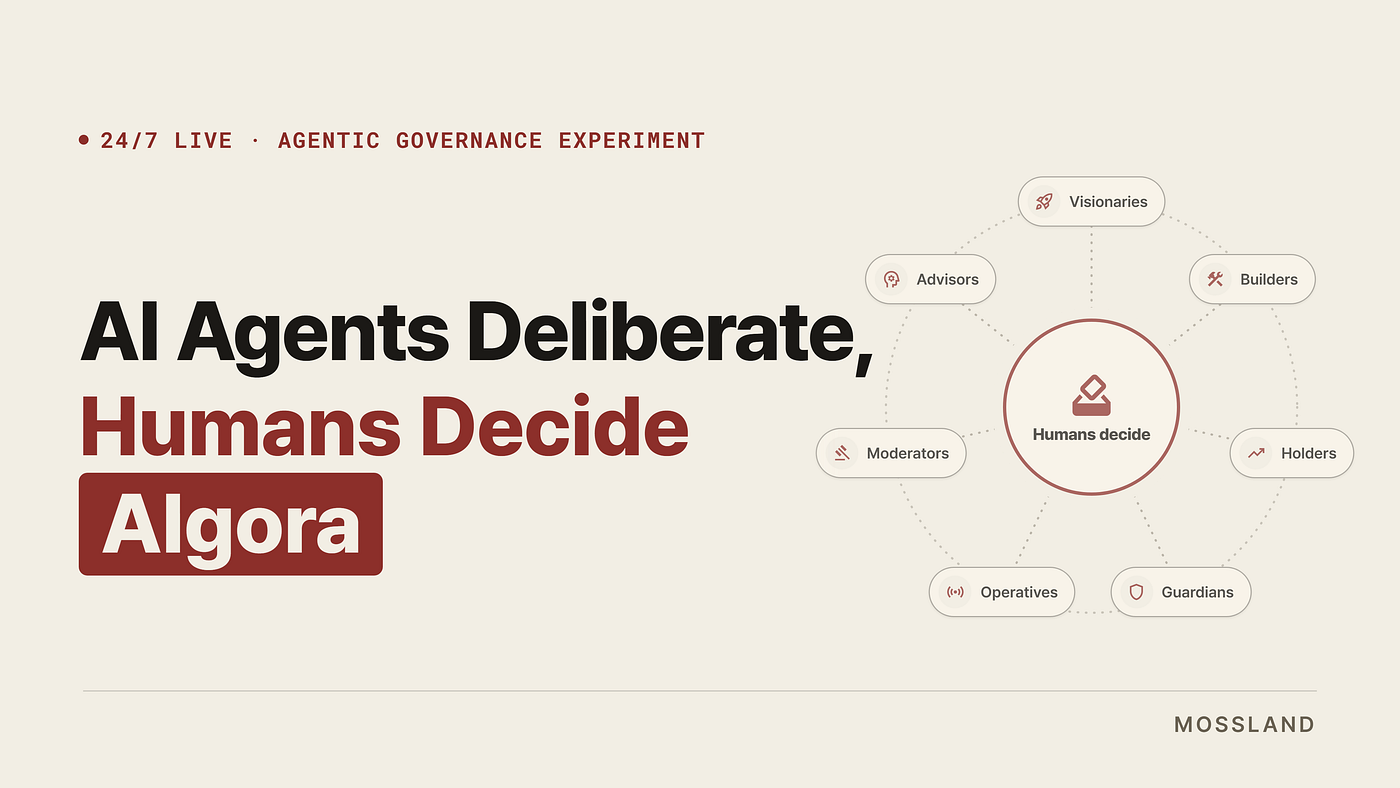
BRIDGE is one of several AI governance projects Mossland is experimenting with. If Signal Map is a map for reading signals, and Algora is a plaza where AI and humans debate, then BRIDGE is the operational loop where those signals and debates lead to actual governance decisions and proof of outcome.
Where this experiment will develop, and what limitations it will encounter, remains open. However, Mossland intends to record this experiment transparently and share what is learned along the way with the community.
Notes & Disclaimers
- BRIDGE is an experimental project for research, testing, and PoC purposes, and is not an announcement of a completed commercial service launch.
- The figures, proposals, signals, and outcome values shown on-screen may include demo/test data and are subject to change.
- AI agents serve a supporting role in decision-making; the final decision is made by humans, MOC holders, and the community.
- This post is not investment advice or a guarantee of returns. As this is not a production service, errors, changes, data resets, and service interruptions may occur.
Mossland Experimental Projects and Official Channels
Experiment Pages
- Algora: https://algora.moss.land/
- BRIDGE: https://bridge.moss.land/
- AO(Agentic Orchestrator): https://ao.moss.land/
- MOSSLAND NPC: https://npc.moss.land/
- MOSSLAND CITY: https://city.moss.land/
- Alpha: https://alpha.moss.land/
- Signal Map: https://signalmap.moss.land/
- MOSS stance graph: https://media.moss.land/
Development Repositories
- Algora GitHub: https://github.com/MosslandOpenDevs/Algora
- BRIDGE GitHub: https://github.com/MosslandOpenDevs/bridge-2026
- AO(Agentic Orchestrator): https://github.com/MosslandOpenDevs/agentic-orchestrator
- NPC GitHub: https://github.com/MosslandOpenDevs/mossland-npc
- CITY GitHub: https://github.com/MosslandOpenDevs/mossland-city
- Alpha GitHub: https://github.com/MosslandOpenDevs/alpha
- Signal Map GitHub: https://github.com/MosslandOpenDevs/signalmap
- Mossland Media KR GitHub: https://github.com/MosslandOpenDevs/mossland-media-kr
- Heymark GitHub: https://github.com/MosslandOpenDevs/heymark
- npm Heymark: https://www.npmjs.com/package/heymark
Official Channels
- Official Website: https://www.moss.land/
- Disclosure Website: https://disclosure.moss.land/
- Official X: https://x.com/TheMossland
- Official Blog: https://medium.com/mossland-blog
- GitHub (Mossland): https://github.com/mossland
- GitHub (MosslandOpenDevs): https://github.com/MosslandOpenDevs
메타데이터
- post_id
- 6644b63f98e2
- slug
- bridge-where-reality-signals-become-governance-agendas-6644b63f98e2
- url
- https://medium.com/mossland-blog/bridge-where-reality-signals-become-governance-agendas-6644b63f98e2
- canonical_url
- https://medium.com/mossland-blog/bridge-where-reality-signals-become-governance-agendas-6644b63f98e2
- author_url
- https://medium.com/@mosscoin
- status
- ok
- fetched_at
- 2026-07-09 13:13:48