Public Toilets in Somerville
In March of 2021, City Councilor Ben Ewen-Campen submitted a resolution: “That the Administration create clean, safe, and permanent public…
Public Toilets in Somerville
In March of 2021, City Councilor Ben Ewen-Campen submitted a resolution: “That the Administration create clean, safe, and permanent public restrooms in several outdoor locations, similar to the Portland Loos that have been installed in Cambridge.” Nearly five years later, we still do not have even one permanent public toilet in Somerville.
It’s not for lack of funding: In November of 2021, then Mayor Curtatone requested, and the council approved, about half a million dollars from the Marijuana Stabilization Fund. A bit over a year and a half later — with that original request unspent — Mayor Ballantyne requested a bit over $800k from the capital stabilization fund for the same purpose. Mayor Wilson signalled enthusiasm for the idea in a November 2024 instagram post where he described himself as “jealous” of the facilities in Cambridge.
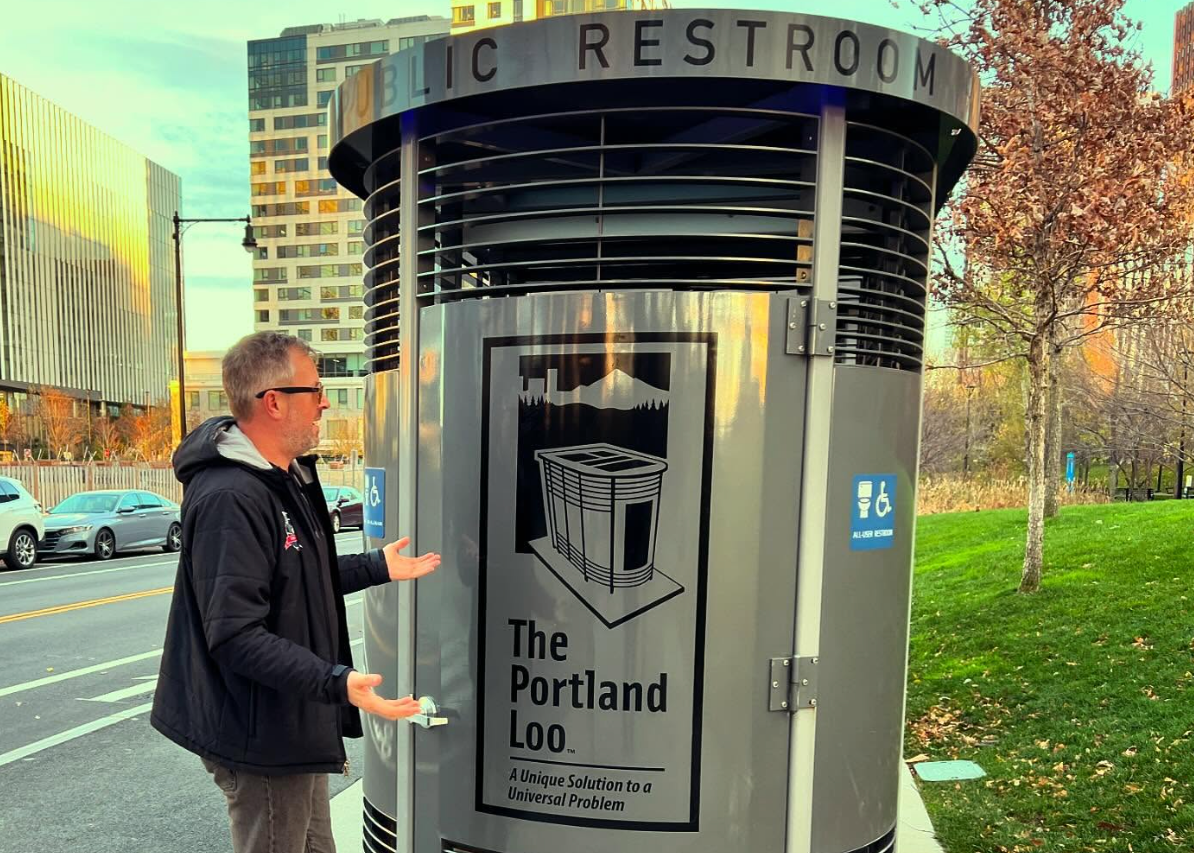
The delay is not due to supply chains, manufacturing, tariffs, or any other mysterious (ahem) blockage. Cambridge has installed Portland Loos at Cambridge Crossing, as well as Harvard and Central Squares. Other neighboring cities have done likewise, leaving Somerville conspicuous for its -lack- of places where a person might do the necessary without feeling obliged to buy a latte.
Based on a public records request and conversations with city staff, it’s the state building code that’s holding us back. It’s a fundamentally unsatisfying explanation, given that Cambridge and Somerville are technically both in Massachusetts, but it’s true. At least as far as it goes.
There seems to be some discretion involved about which rules apply to this sort of facility. You don’t need to consult inspectional services when you get a port-a-john from Throne Depot, Wasted, or another of the adorably named local rental companies. As long as you don’t want to put the thing on public property, you just rent one and that’s it. On the other hand, if we went with Councilor McLaughlin’s May 2024 suggestion that the bathrooms in the police stations be available 24/7— those would obviously have to be constructed in compliance with the full building code. That request was denied due to safety concerns, though as McLaughlin pointed out at the time — one would be hard pressed to name a spot better served and observed by public safety personnel than our police stations.
The Portland Loo falls somewhere between a port-a-potty and a city building. In early 2024, Somerville’s then director of Inspectional Services met with the Board of Building Regulations and Standards and came back with the decision that these are “manufactured buildings,” making them subject to a corner of the law that relies on certification rather than inspection to make sure that things are done correctly.
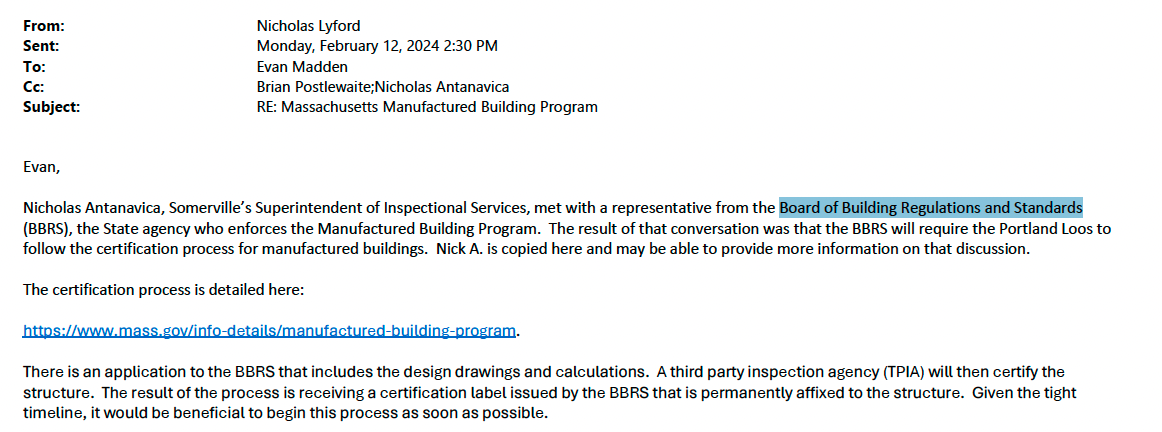
With onsite construction, Somerville’s inspectors do a series of inspctions: Site, foundation, rough plumbing and electrical, and final. There is no way to do that with prefabs, so instead the state insists that the manufacturer be licensed by Massachusetts and regularly inspected by MA certified professionals. The company who manufactures the Portland Loo is not licensed by Massachusetts, so their structures are not allowed. Because they are shipped pre-assembled, there is no way for Somerville inspectors to make sure that the wiring, plumbing and framing meet state code.
This makes a lot of sense in the case of prefab homes. We wouldn’t want people to skirt building code and potentially deploy unsafe dwellings by having them built offsite. In the case of the Portland Loo though, there really is not a lot of wiring, plumbing, or even framing to be inspected. While they are installed on a permanent foundation, they look more like a port-a-potty than a city building — at least to my untrained eye.
This is the question that has had us all holding it for five years — all the while complaining about defecation in our parks.
The manufacturer is apparently working on getting licensed in Massachusetts, but we have no control of their timeline. We always have the option of asking our Engineering department to design the facilities, but that comes with its own complications. It would pull city engineers away from their backlog of work, and it would also ask them to do a surprisingly nuanced job. Despite toilets being, perhaps, the very oldest example of shared-use facilities in human settlements, the conversation around design requirements remains active. The Portland Loo is popular because its design strikes a visibly sensible balance between privacy and the obvious concerns about offering 24/7 access to lockable rooms in public places.
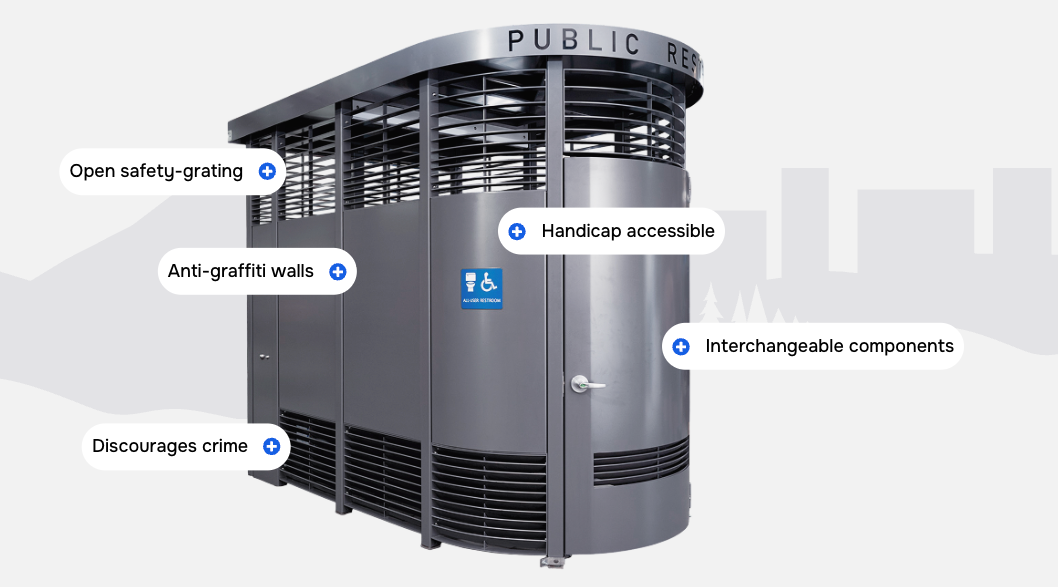
Once the toilets are built, we will have a maintenance problem. Public toilets need to be cleaned frequently — the usual standard is five cleanings per day for high-traffic areas. That will require the city either to add staff or else to contract with a commercial service — an additional expense in a tight budget season.
I never cease be surprised by how complex it is to get superficially simple things right in the public realm. I do wonder how Cambridge and our other neighboring cities have managed to pull it off.
메타데이터
- post_id
- 664ca8a3fd2c
- slug
- public-toilets-in-somerville-664ca8a3fd2c
- url
- https://medium.com/@fdmts/public-toilets-in-somerville-664ca8a3fd2c
- canonical_url
- https://medium.com/@fdmts/public-toilets-in-somerville-664ca8a3fd2c
- author_url
- https://medium.com/@fdmts
- status
- ok
- fetched_at
- 2026-07-13 06:23:13