🧭 Dijkstra’s Algorithm Explained Simply (Without Heavy Math)
When Google Maps finds the fastest route to your destination, or when data travels efficiently across the internet, a classic algorithm is…
🧭 Dijkstra’s Algorithm Explained Simply (Without Heavy Math)
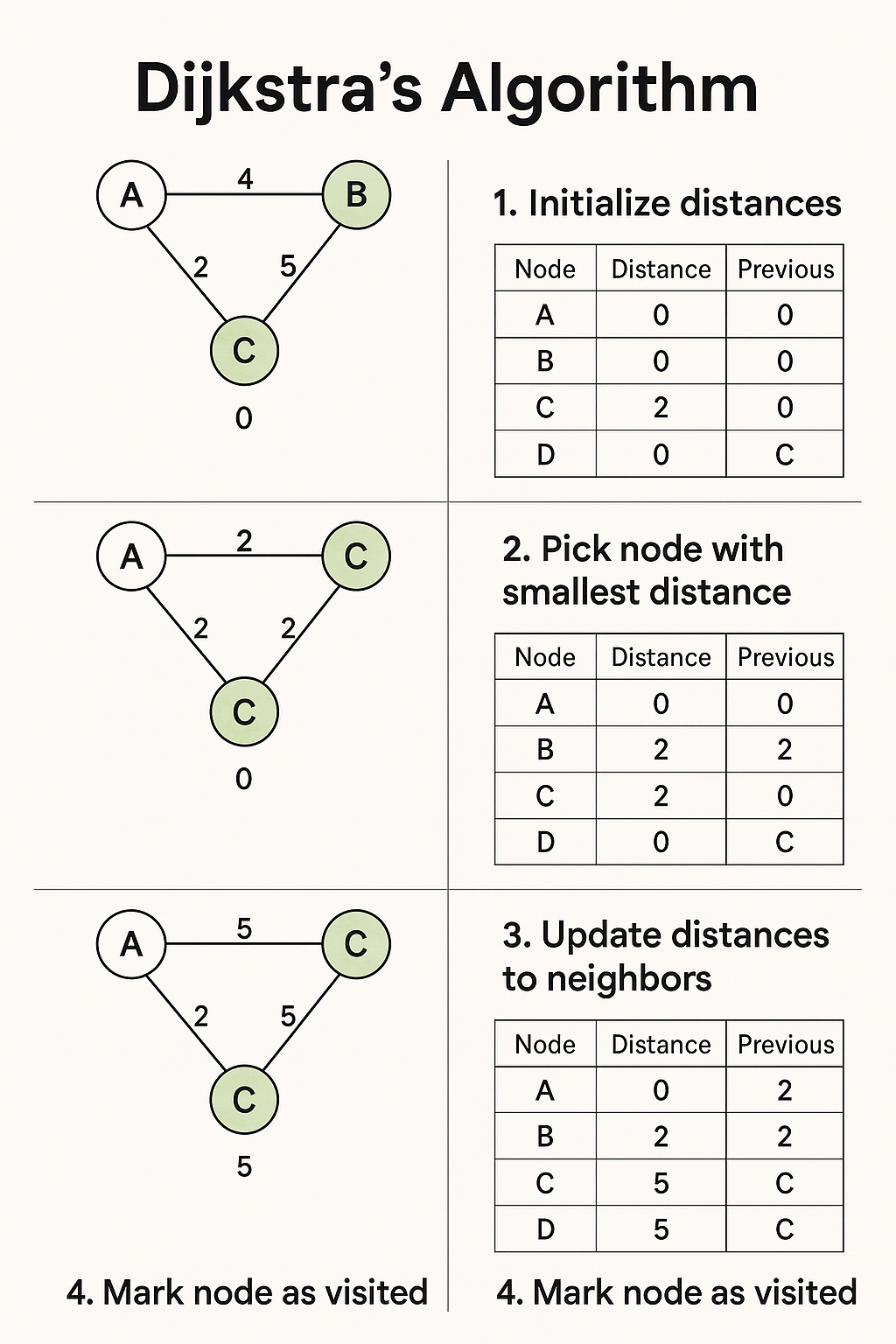
When Google Maps finds the fastest route to your destination, or when data travels efficiently across the internet, a classic algorithm is often working behind the scenes — Dijkstra’s Algorithm.
Despite its academic reputation, the idea is very intuitive. Let’s break it down in plain English.
🚀 What Problem Does Dijkstra’s Algorithm Solve?
Dijkstra’s Algorithm answers one simple question:
What is the shortest path from a starting point to every other point?
It works with:
- Graphs made of nodes and connections
- Each connection having a cost (distance, time, money)
- Only non-negative costs
🧠 The Core Idea (Intuition First)
Imagine standing at a location with multiple roads going out.
- You start at your location
- You always move to the nearest unexplored place
- Once you reach a place in the cheapest possible way, you never revisit it
- You repeat until all places are covered
This greedy approach is what makes Dijkstra fast and reliable.
🧩 Key Terms You Should Know
Node (Vertex) A point in the graph — a city, router, or checkpoint.
Edge A connection between two nodes.
Weight The cost to travel along an edge.
Source Node Where the journey starts.
Distance Record The best known cost to reach each node.
⚙️ How Dijkstra’s Algorithm Works (Step-by-Step)
Step 1: Initialization
- Set the distance to the starting node as
0 - Set the distance to all other nodes as infinity
- Mark all nodes as unvisited
Step 2: Choose the Nearest Node
- Pick the unvisited node with the smallest known distance
- This node becomes the “current” node
Step 3: Update Neighbor Distances
- For each neighbor of the current node:
- Add the edge cost to the current distance
- If the new value is smaller, update it
This process is called edge relaxation.
Step 4: Mark as Visited
- Once processed, mark the node as visited
- Its shortest path is now final
Step 5: Repeat
- Continue until all nodes are visited or no shorter paths remain
📌 Simple Example (Without Tables)
Suppose we start from node A.
- Distance to A →
0 - Distance to B →
4 - Distance to C →
2 - Distance to D →
5
The shortest route to D is:
A → C → D
🧑💻 Python Implementation (Clean & Practical)
import heapq

def dijkstra(graph, start):
    distances = {node: float('inf') for node in graph}
    distances[start] = 0

    pq = [(0, start)]

    while pq:
        current_distance, current_node = heapq.heappop(pq)

        if current_distance > distances[current_node]:
            continue

        for neighbor, weight in graph[current_node].items():
            new_distance = current_distance + weight

            if new_distance < distances[neighbor]:
                distances[neighbor] = new_distance
                heapq.heappush(pq, (new_distance, neighbor))

    return distances
⏱ Time & Space Complexity (Plain English)
- Faster when used with a priority queue
- Time grows roughly with the number of connections
- Memory usage grows with the number of nodes
In practice, it performs extremely well for real-world graphs.
❌ When Dijkstra Should NOT Be Used
Dijkstra fails when:
- Edge weights are negative
- You need shortest paths between every pair of nodes
In such cases:
- Use Bellman-Ford for negative weights
- Use Floyd-Warshall for all-pairs paths
🌍 Real-World Use Cases
- GPS navigation systems
- Internet routing protocols
- Game character pathfinding
- Logistics and delivery optimization
- AI decision graphs
🏁 Final Thoughts
Dijkstra’s Algorithm is powerful because it’s:
- Easy to understand
- Efficient
- Widely applicable
If you understand this algorithm, you’ve unlocked a core building block of computer science, system design, and real-world problem solving.
메타데이터
- post_id
- 66781f9dfd20
- slug
- dijkstras-algorithm-explained-simply-without-heavy-math-66781f9dfd20
- url
- https://medium.com/@tapanbasuli/dijkstras-algorithm-explained-simply-without-heavy-math-66781f9dfd20
- canonical_url
- https://medium.com/@tapanbasuli/dijkstras-algorithm-explained-simply-without-heavy-math-66781f9dfd20
- author_url
- https://medium.com/@tapanbasuli
- status
- ok
- fetched_at
- 2026-07-07 05:31:20





