Agent Skills vs MCP: Which One Does Your AI Agent Actually Need?
Every team building agents in 2026 eventually hits the same fork in the road. The agent almost does what you want. It has the tools, it has…
Agent Skills vs MCP: Which One Does Your AI Agent Actually Need?
Every team building agents in 2026 eventually hits the same fork in the road. The agent almost does what you want. It has the tools, it has the data, and it still botches the job in a way that feels avoidable. So you face a choice: hand it another tool, or teach it to use the tools it already has. That choice is now a concrete architectural decision, because the industry has shipped two different open standards that answer it in opposite ways — the Model Context Protocol (MCP) and Agent Skills.
Getting the distinction wrong is expensive. Teams keep building MCP servers to solve problems a text file would have solved, and keep stuffing procedural instructions into brittle system prompts when a Skill would have carried them. Here is how to tell which one a given problem actually needs.
What an Agent Skill actually is
An Agent Skill is a folder. At minimum it contains a single file, SKILL.md, whose YAML frontmatter declares a name and a description. The body holds instructions — workflows, steps, conventions — and the folder can also bundle reference files and executable scripts. According to Anthropic's Agent Skills documentation, the format is deliberately close to an onboarding guide you'd write for a new teammate: what to do, when, and where to look for the details.
The mechanically important part is how a Skill loads. Skills use progressive disclosure: the agent pulls information in stages instead of consuming context up front. The documentation breaks this into three levels, each with a different token cost.
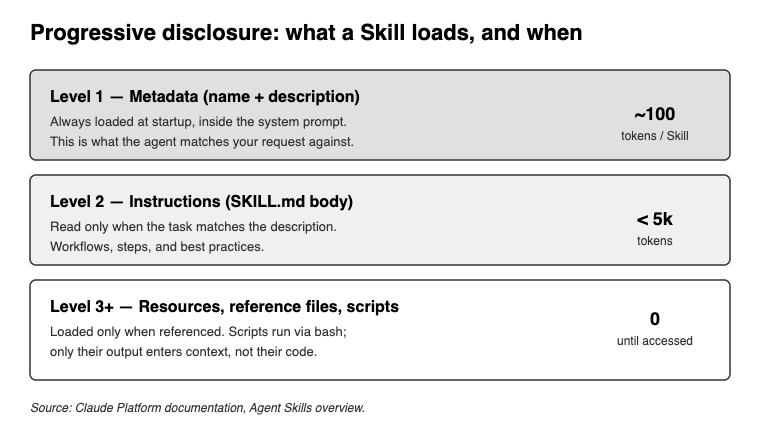
Figure 1 — How progressive disclosure keeps a Skill’s context cost near zero until the moment it is needed.
Level 1 is the metadata: name plus description, roughly 100 tokens per Skill, always present in the system prompt. That's what the agent matches your request against. Level 2 is the SKILL.md body — Anthropic recommends keeping it under 5,000 tokens — and it only enters context once a request matches the description. Level 3 and beyond are the bundled files: reference material and scripts that cost nothing until the agent reads or runs them. Scripts are notable here, because when the agent runs one through bash, only the output enters context, never the code itself.
The practical consequence, per the docs, is that you can install many Skills “without context penalty.” A hundred idle Skills cost roughly the same as a hundred short descriptions. This is the opposite of the failure mode agent builders complain about most, where every connected capability taxes the context window whether or not it’s used.
Skills arrived in the Claude API behind a beta header, skills-2025-10-02, and they require the code execution tool because a Skill is a directory the model reads and runs inside a sandbox. Anthropic ships pre-built Skills for PowerPoint, Excel, Word, and PDF generation, and lets you author custom ones in Claude Code (dropped into ~/.claude/skills/ or a project's .claude/skills/), upload them through the API, or add them in the claude.ai settings.
Why this isn’t the same question as “add another tool”
Here’s the subtlety that trips people up: a Skill does not add a tool. When a Skill loads, the agent’s tool list doesn’t grow. It still has bash, file operations, and whatever else it started with. What the Skill changes is the agent’s knowledge of how to use those tools for a specific job — the right library to reach for, the sequence of steps, the edge cases to avoid.
That’s the line between the two standards. MCP, the protocol Anthropic open-sourced for connecting agents to external tools and data, gives an agent new capabilities: a live connection to a database, a ticketing system, a payments API. Skills give an agent new competence with capabilities it already has. Anthropic’s engineering team frames it with a kitchen analogy in its Agent Skills writeup: MCP provides the kitchen — the tools, ingredients, and equipment — while Skills provide the recipes that say what to cook and how.
That framing has a real cost implication. An MCP tool definition is loaded so the model knows the tool exists and how to call it, which means each connected server adds schema to the context. A Skill’s Level 1 footprint is about 100 tokens, and everything else stays on disk until used. If your problem is “the agent doesn’t know how to do X well,” paying MCP’s connection overhead buys you nothing — the tool was never the missing piece.
The decision, made concrete
Through 2026 this stopped being a philosophical debate and became a routine design question, with practitioners publishing explicit decision frameworks — LlamaIndex’s “Skills vs MCP tools for agents: when to use what” among them. The heuristic that keeps surfacing is about volatility and reach.

Figure 2 — A quick path from “I want the agent to do something new” to the right extension mechanism.
Reach for MCP when the agent needs to touch something outside itself: live data that changes between runs, a system it must read from or write to, an API whose responses it can’t predict. If the answer could be wrong five minutes from now unless the agent re-fetches it, that’s a connection problem, and a connection problem needs a server.
Reach for a Skill when the agent already has everything it needs to act but keeps acting wrong or inconsistently. Teaching an agent when to use git rebase versus git merge doesn't require a Git server; it requires a written decision framework the agent loads when the topic comes up. Knowledge that's stable enough to write down once and stay correct for weeks belongs in a file, not behind a runtime that can fail independently of the agent.
And often the honest answer is both. Analytics Vidhya’s April 2026 piece is titled, plainly, “MCP vs. Agent Skills: Why You Need Both for AI Agents”. A reporting agent might use MCP to pull the quarter’s numbers from a warehouse, then use a Skill to turn them into a document that follows the company’s format and tone. MCP gets the inputs; the Skill governs the procedure. Designing for that combination from the start is cheaper than discovering it in production.
A useful tiebreaker: start at the simplest layer that solves the problem and escalate only when it proves insufficient. A Skill you can write in ten minutes frequently outperforms the MCP integration that takes a week — but only when the missing piece was know-how, not access.
The catch: Skills are executable, and that’s a surface
Because a Skill can bundle scripts the agent runs in a sandbox, it is closer to installing software than to writing a prompt. Anthropic’s documentation is direct about this: use Skills only from sources you trust, because a malicious Skill can direct the agent to invoke tools or run code in ways that don’t match its stated purpose — up to data exfiltration or unauthorized system access. Skills that fetch from external URLs are flagged as especially risky, since the fetched content can carry instructions of its own.
The operational advice follows the analogy: audit every bundled file — SKILL.md, scripts, resources — the way you'd review a dependency before adding it to production. The convenience of "drop in a folder and the agent uses it automatically" is exactly what makes an unreviewed Skill dangerous. There's also a portability caveat worth knowing: Anthropic notes that custom Skills don't sync across surfaces, so a Skill uploaded to claude.ai isn't automatically available through the API or in Claude Code.
Key Takeaways
- Different problems, not competitors. MCP gives an agent new capabilities (live connections to tools and data); Skills give it new competence with capabilities it already has. A Skill adds no tools to the agent’s list.
- Progressive disclosure is the selling point. A Skill costs ~100 tokens at rest (name + description), loads its
SKILL.mdbody only when triggered (kept under ~5k tokens), and pulls bundled files or scripts only when used — so many Skills can sit installed without a context penalty. - Choose by volatility and reach. Data that changes or lives in an external system → MCP. Stable know-how the agent should apply consistently → a Skill. Report-style workflows usually need both.
- Start simple, escalate. A ten-minute Skill often beats a week-long integration — when the gap was knowledge, not access.
- Treat Skills as executable dependencies. They can run bundled scripts in a sandbox; audit anything from an untrusted source, and be wary of Skills that fetch external content.
If you like these kind of research outcome articles, than do follow me to keep getting such article in your feeds. Talking about me I am an anexious software engineer who love to learn and share new things which helps people growing in their career. Do connect me over linkedin here . If you need mentoring for your career than do reach out to me over topmate here .
메타데이터
- post_id
- 667e076f54fb
- slug
- agent-skills-vs-mcp-which-one-does-your-ai-agent-actually-need-667e076f54fb
- url
- https://pub.towardsai.net/agent-skills-vs-mcp-which-one-does-your-ai-agent-actually-need-667e076f54fb
- canonical_url
- https://pub.towardsai.net/agent-skills-vs-mcp-which-one-does-your-ai-agent-actually-need-667e076f54fb
- author_url
- https://medium.com/@iampraveen
- status
- ok
- fetched_at
- 2026-07-17 08:43:13