The Inspiring Journey of Charles Leiper Grigg: Turning a Simple Soda into a Billion-Dollar Empire
In the world of business, some stories shine as beacons of perseverance and innovation. One such tale is that of Charles Leiper Grigg, a…
The Inspiring Journey of Charles Leiper Grigg: Turning a Simple Soda into a Billion-Dollar Empire
Turning a Simple Soda into a Billion-Dollar Empire
In the world of business, some stories shine as beacons of perseverance and innovation. One such tale is that of Charles Leiper Grigg, a modest salesman who transformed a humble lemon-lime soda into the global powerhouse known as 7UP. His life was a rollercoaster of struggles, failures, and ultimate triumph — a classic American dream story that proves grit and vision can conquer all odds. From rural beginnings to creating a brand worth billions, Grigg’s legacy reminds us that success often brews from the simplest ideas.
Early Life and Career Beginnings
Charles Leiper Grigg was born on May 11, 1868, in the small rural town of Prices Branch, Missouri. With only a basic education and no formal business or scientific training, Grigg was expected to work from a young age. He started by printing advertisements for local newspapers and later took on various sales roles, including hardware and ad space. These jobs didn’t pay much, but they gave him hands-on experience in marketing products and understanding consumer behavior. Grigg learned that sales weren’t just about quality — they were about crafting the right message to influence choices.
In his early 20s, Grigg moved to St. Louis, Missouri, a booming hub for trade, manufacturing, and innovation. He landed a job as an advertising salesman, which suited his persuasive skills perfectly. He wasn’t part of the elite business class and had no connections in the beverage industry. What he did have was determination, a sharp mind for product appeal, and a burning desire to build something of his own. While writing ads for others, Grigg realized he was helping build empires for everyone but himself. He began studying what products succeeded and why, analyzing market trends. St. Louis was a hotbed for soda innovation at the time, with bottling plants expanding and flavored drinks gaining popularity. Grigg noticed that beverages had the highest repeat customer rates — if people liked a drink, they’d buy it again and again. This insight stuck with him.
Early Failures and Lessons Learned
Grigg’s first real breakthrough came in 1919 when he joined the Vest Soda Company. There, he developed a carbonated orange drink called Whistle. With its tangy, not-too-sweet flavor, Whistle quickly became popular in local markets. However, Grigg didn’t own the formula or control the company’s direction. Conflicts arose, and he was ousted without rights or royalties to the drink he’d invented. This setback taught him a crucial lesson: talent alone isn’t enough — ownership and control are essential.
After leaving Vest, Grigg decided to start his own venture. He partnered with Frank Gladney and Edmund G. Ridgway to form the Howdy Company. Their first product was Howdy Orange, designed to compete with dominant players like Orange Crush. The formula was excellent, but breaking into the soda market proved tough. Orange Crush had national recognition and strong marketing, leaving Howdy with limited distribution and low sales.
The Creation of 7UP
Grigg observed shifting consumer preferences toward lighter, crisper drinks. He began experimenting with a lemon-lime flavor blend, aiming for something unique that could establish a new category. While working behind the scenes at Howdy, Grigg crafted a lemon-lime soda unlike anything on the market. By combining natural lemon and lime extracts, he created a sharp, clean, and refreshing taste.
But flavor alone wasn’t enough. Drawing from his knowledge of patent medicines, Grigg added a small dose of lithium citrate — a substance legally used in tonics at the time to improve mood and reduce anxiety. The result was a fizzy lemon-lime drink with a subtle therapeutic effect. In October 1929, just two weeks before the stock market crash, Grigg launched it as “Bib-Label Lithiated Lemon-Lime Soda.”
Success Amid the Great Depression
The name was clunky and hard to market, but it sparked curiosity. In an era of rising anxiety and economic downturn, consumers found the product’s calming claims oddly appealing. Sales started slow but grew through word-of-mouth. Marketed as an “uplifting and stabilizing” drink without the bitterness of medicines or the heaviness of colas, it filled a unique emotional niche during national hardship.
The Birth of 7UP and National Recognition
In the early 1930s, Grigg made a bold move: rebranding his popular lemon-lime soda. The original name was a marketing hurdle, so he shortened it to the catchy, memorable “7UP.” While the name’s origin was never officially confirmed — speculations include the original 7-ounce bottle, seven ingredients, or lithium’s atomic mass — the rebrand worked wonders.
7UP appealed due to its clarity in both flavor and appearance. Unlike dark, sweet, caffeinated colas, it was colorless, caffeine-free, and perceived as pure. It offered a refreshing break from traditional sodas and aligned with growing demand for simpler, healthier products. Grigg marketed 7UP as more than a drink — it was a lifestyle, with early ads emphasizing family, health, and purity. Lithium, though later removed, helped position it as subtly beneficial in its early days.
From Regional Hit to Cultural Icon
By the 1940s, as distribution expanded, 7UP evolved from a niche lemon-lime soda to a household staple. During World War II, its caffeine-free formula gave it an edge amid wartime rationing and health-conscious messaging, making cola alternatives more attractive.
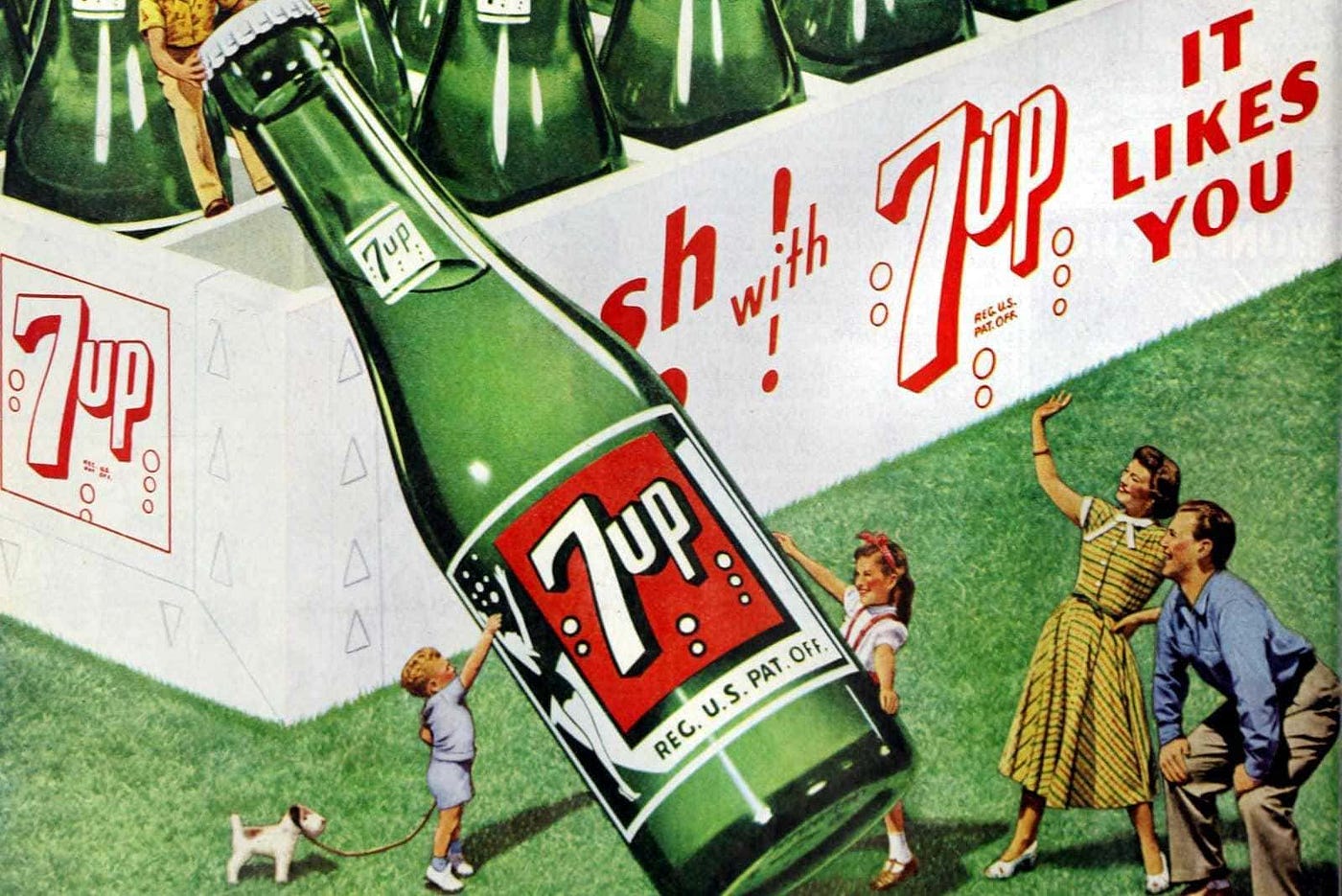
A major change came in 1948 when the U.S. Food and Drug Administration banned lithium in food and beverages. By then, 7UP had built a loyal customer base independent of its medicinal additive. Lithium was quietly removed from the formula without impacting sales, proving the drink’s appeal went beyond its pharmacological roots. In the 1950s and 1960s, 7UP focused on strong advertising and family-centric branding. Slogans like “You like it, it likes you” reinforced both physical and emotional refreshment.
Corporate Ownership and the “Uncola” Campaign
By the late 1960s, 7UP’s strong performance attracted big corporations. In 1969, it was acquired by Westinghouse Electric Corporation, providing broader resources and marketing reach.
In the 1970s, 7UP launched its boldest campaign: “The Uncola.” Facing pressure from Coca-Cola and Pepsi, it needed to stand out. With Westinghouse’s big ad budgets, the brand redefined itself by advertising what it wasn’t: not brown, not overly sweet, not cola. Instead, it was clear, crisp, and different. This campaign attracted new consumers, boosted market share, and built loyalty among younger audiences.
In 1978, Philip Morris — a tobacco and packaged goods giant — acquired the company. With deep financial resources and national marketing access, they streamlined operations, expanded bottling deals, and increased 7UP’s presence in supermarkets, fast-food chains, and vending machines. By the early 1980s, 7UP was a core product in a growing consumer empire. In 1986, Philip Morris sold the beverages unit, and in 1988, it merged with Dr Pepper to form the Dr Pepper 7UP Company, becoming the third-largest soft drink maker in the U.S. after Coke and Pepsi.
Charles Leiper Grigg’s Legacy
Charles Leiper Grigg passed away in 1940, just as 7UP was gaining national popularity. He didn’t live to see his creation on supermarket shelves worldwide or the billion-dollar mergers and global licensing deals that followed. Yet, every milestone the brand achieved was rooted in the entrepreneurial philosophy he forged through adversity: own your idea, adapt when needed, and sell not just a product but a feeling.
Grigg wasn’t a trained chemist or wealthy industrialist — he was a self-made advertiser who trusted his instincts and understood people. His core belief was that consumers respond to simplicity, clarity, and emotional value, which shaped every aspect of 7UP. From a nerve-soothing refresher during the Depression to its later role as the industry-defying “Uncola,” the drink carried forward his original vision: “Be different and own that difference.”
His story is rarely taught in business schools, yet it’s a classic American entrepreneurial epic. He failed twice — losing ownership of one product and watching another struggle in the market — but he kept building. When he launched a product no one expected to succeed — a lemon-lime soda with a medicinal twist — he laid the foundation for a global brand. Today, 7UP is produced in dozens of countries, advertised in multiple languages, and part of one of the world’s most valuable beverage portfolios, valued at $46 billion as of 2025. Its longevity isn’t just from smart marketing or acquisitions — it’s the legacy of a man who refused to let failures define him, turned modest skills into lasting impact, and believed that, when presented with purpose, even ordinary products can uplift people. Grigg didn’t just invent a drink; he proved that belief can be bottled.
What can we learn from Grigg? In a world of overnight successes and viral trends, his story is a reminder that true empires are built through persistence. Share your thoughts in the comments — have you ever turned a failure into a win?
CharlesLeiperGrigg #SodaEmpire #InspiringJourney #BillionDollarBusiness #EntrepreneurialSpirit #SuccessStory #InnovationInBeverages #FromSodaToSuccess #BusinessInspiration #LegacyOfGrigg #BeverageIndustry #EntrepreneurJourney #SodaHistory #BusinessGrowth #VisionaryLeader #CocaColaCompetition #MarketingGenius #AmericanEntrepreneur #SodaSuccess #GriggLegacy
메타데이터
- post_id
- 66a083eeb4c3
- slug
- the-inspiring-journey-of-charles-leiper-grigg-turning-a-simple-soda-into-a-billion-dollar-empire-66a083eeb4c3
- url
- https://medium.com/@uab971/the-inspiring-journey-of-charles-leiper-grigg-turning-a-simple-soda-into-a-billion-dollar-empire-66a083eeb4c3
- canonical_url
- https://medium.com/@uab971/the-inspiring-journey-of-charles-leiper-grigg-turning-a-simple-soda-into-a-billion-dollar-empire-66a083eeb4c3
- author_url
- https://medium.com/@uab971
- status
- ok
- fetched_at
- 2026-07-17 14:52:18