5 Things Every Detective Knows About Reading People
The things you notice when your job depends on it
5 Things Every Detective Knows About Reading People
The things you notice when your job depends on it
Photo by Daniel Cettler on Unsplash
Most content about reading people falls into one of two categories.
It is either basic enough that you already know it, or the scenarios don’t present themselves often in real life. The body language guides, the micro-expression frameworks, the eye movement charts — some of it is grounded in legitimate research. Much of it is not.
Almost none of it comes from someone who has spent years testing it against people who were actively trying to defeat it. I have also long believed there is a structural problem with the research itself. Human behavior is notoriously difficult to study in a laboratory. The studies that produce clean, publishable findings tend to use cooperative subjects in controlled environments, which is almost nothing like a real conversation with people whose agendas and motivations are unknown.
The field is not dishonest. It is just limited in ways that professional, real-world interviewers are not.
There is a scene in the movie 12 Strong where an American Special Forces Captain, equipped with every technological and institutional advantage available, sits across from an Afghan warlord who has been fighting in that terrain since he was sixteen. The captain has the research. The warlord has thousands of days lived experience. They need each other, but what the warlord has, no training program can replicate. I watched it this morning on a flight, a few hours before writing this.
I am not sure this article exists without it.
After more than a decade as a detective conducting interrogations and recruiting sources, I can tell you that the most reliable ways to read people generally aren’t being taught. Nobody taught me what follows in a classroom. It accumulated across hundreds of real interactions, through trial and (lots of) error, until the brain begins to quickly find the patterns.
If you want to read people more accurately than most, these are the places to start looking.
What someone does when they think no one is watching
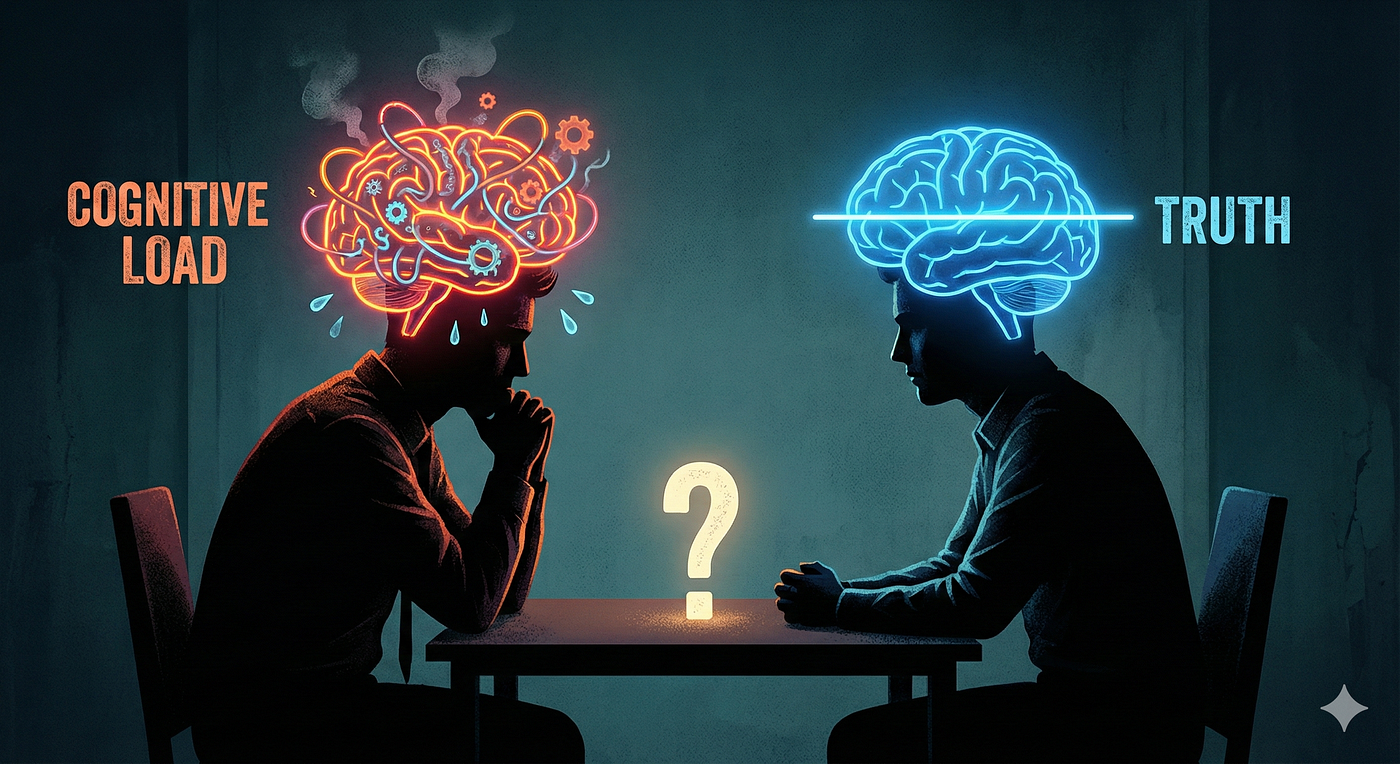
Performed behavior is pretty worthless. Most people understand that they are being observed during a conversation, an interview, or any interaction where something is at stake, so they adjust accordingly. What most people never manage is the behavior that occurs before the observation begins and after they believe it has ended. The waiting room. The walk to the car. The phone conversation in the hallway after the door closes.
That is where character (or a lack of it) shows.
Even before I became a detective, I tended to arrive early and stay longer than necessary. I learned a lot in that time. What you find in those moments is more reliable than what comes out under observation. A person who is warm in conversation and dismissive the moment they believe the interaction is over has just told you something no direct question ever would.
What someone defends tells you more than what they claim
People rarely reveal their true priorities through positive statements. What someone claims to value (their integrity, their loyalty, their work ethic) is information selected to craft an image. Not necessarily dishonest, just what they want to be true.
What they push back against under pressure is more authentic.
In my interviews, I liked to introduce mild challenges rather than direct questions when I wanted to understand what actually mattered to someone. Not an argument. Just some friction, applied to different areas until something produced a reaction disproportionate to what I said.
That disproportionate reaction is telling. What a person claims tells you who they want to be. What they defend off-the-cuff tells you more about who they are.
How someone handles being wrong
The response to being corrected is one of the most reliable character indicators available, and probably the least discussed. Anybody can look good when nothing is going wrong. Confidence under comfortable conditions is the least useful data point you have. What someone does when they are caught in an error is vastly more valuable.
The content of the error is irrelevant, but their reaction is important.
Acknowledgment without drama tells you a lot about how a person manages their ego. Defensiveness, deflection, and counter-attack come from an abundance of ego. I have sat across from an alarming number of people who could not, or would not, concede a minor factual error. If someone can’t handle being wrong about something minor, they’ll fight you tooth and nail over something significant.
The question someone does not ask
Genuine curiosity is automatic. When something affects someone, concerns them, or involves them in any meaningful way, they ask about it. The person who does not ask about something they should reasonably want to know is either indifferent or already informed.
Neither one is neutral information.
The mechanism is straightforward. Asking a question draws attention to the subject. A person who already knows the answer (or who does not want to appear interested in the answer) will often go to considerable lengths to avoid asking about something any innocent person would naturally want to know. The silence around a specific subject is often more useful than anything said directly about it.
How someone talks about people who are not in the room
The way a person characterizes others when those people aren’t around tells you far more about them than the people they are describing. Ex-colleagues are portrayed as incompetent, and family members are blamed for every difficulty or problem. The complaining about the people who have disappointed them tells you precisely how they will describe you when you disappoint them. And at some point, you will.
Everyone eventually becomes the person who is not in the room.
Listen to these characterizations not for the content, but for the pattern. One difficult ex-partner is normal. A pattern of difficult relationships in which the other party is always wrong is entirely different. The person sitting across from you is the only common denominator in every relationship they have ever described.
These five things don’t require special training.
They do require attention. Attention that most people never develop because they are too busy managing their own side of the conversation to observe the other person’s. I suspect that’s all that separates someone who can read people accurately from someone who cannot. It isn’t intelligence or intuition. It’s just the willingness to listen more than you talk and to treat what you see as data worth taking seriously.
Attention is the whole skill. Everything else is just what you do with it.
About the Author I spent nearly 13 years as a detective, supervisor, and SWAT-trained fugitive hunter. Today, I combine that field experience with a Master’s in Psychology to better understand human behavior and decision-making under pressure.
I put 10 of the tells I learned in interview rooms into a free field manual — what to watch for, and what to do when your gut says something is off. **Get it here.**
메타데이터
- post_id
- 66aa311fcc08
- slug
- 5-things-every-detective-knows-about-reading-people-66aa311fcc08
- url
- https://medium.com/publishous/5-things-every-detective-knows-about-reading-people-66aa311fcc08
- canonical_url
- https://medium.com/publishous/5-things-every-detective-knows-about-reading-people-66aa311fcc08
- author_url
- https://medium.com/@iamjoshmason
- status
- ok
- fetched_at
- 2026-06-18 07:02:39