The Dead We Stopped Counting
The evening smells of gunpowder.
The Dead We Stopped Counting
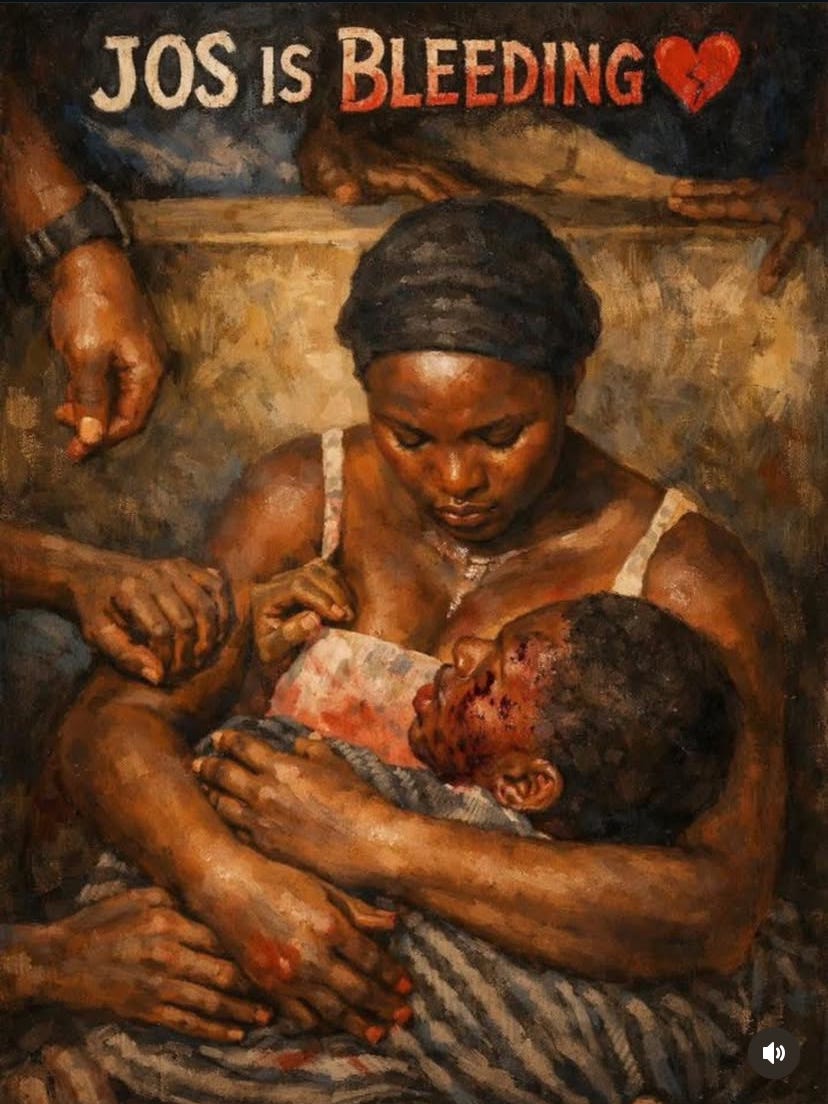
The evening smells of gunpowder.
Not the distant rumble of celebration fireworks, not the kind that light up Jos' skies on New Year’s Eve. This smell is different. It is close. It arrives with screaming. It arrives while people are still outside, going about the ordinary business of a Sunday evening, walking home from church, sitting with neighbours, cooking the last meal of the day. It arrives on the night of March 29, 2026, in Gari Ya Waye, a suburb of Angwan Rukuba in Jos North, and when it leaves, at least thirty people are dead.
It was Palm Sunday.
The day Christians mark Christ’s triumphant entry into Jerusalem. The beginning of Holy Week. In Angwan Rukuba, a densely populated community that is home to staff and students of the University of Jos, to families who have lived in those streets for generations, people were winding down from the day’s worship when the gunmen arrived. Over twenty of them, eyewitnesses say, riding motorcycles, firing indiscriminately into the streets. One resident, Paul Mancha, who serves as chairperson of the Plateau youth council, described the scene in words that should haunt every Nigerian: “People were here in the evening, and unfortunately, wicked terrorists came and attacked our people. We have counted scores of people who are now dead, and then so many others are also in the hospital receiving treatment.”
The police confirmed fourteen dead. Community leaders say at least twenty-seven. Reuters cited thirty. The Red Cross was photographed arriving at the scene the following morning. The University of Jos suspended its examinations. And the governor of Plateau State drove into Angwan Rukuba in an armoured tank.
In Nigeria, we have learned to measure the severity of a massacre by the size of the vehicle the governor uses to reach it.
There is a cruelty so practiced that it no longer looks like cruelty. It looks like a procedure.
A statement is issued. A curfew is imposed, in this case, forty-eight hours, effective from midnight of March 29 through April 1, announced by the Commissioner for Information, Joyce Lohya Ramnap, in the calm, measured tone of a government that has done this before. Security agencies arrive, the police, the army, and an armoured vehicle. The governor visits the scene, then the hospital. Governor Caleb Mutfwang, visibly moved, told the people of Angwan Rukuba: “I stood with grieving families, listened to their pain, and shared in their loss. No words can truly capture the depth of sorrow in moments like this.” He pledged to cover medical bills for the injured. He promised justice. He assured the public that perpetrators would be pursued relentlessly.
These are the right words. They are also the same words that have been spoken over every mass grave in Plateau State for the past two decades.
The investigation is announced. And then, with the quiet efficiency of a country that has become expert at this, the dead are forgotten before they are fully buried.
This is not a failure of memory. It is a choice.
Let me tell you about the pattern, because there is always a pattern.
Last year, on Palm Sunday, April 2025, gunmen attacked Zikke village in Bassa Local Government Area. Fifty-four people were killed. More than one hundred households were destroyed. A pastor stood before a mass grave and read from scripture while the community buried its dead. The president ordered an investigation.
The year before that, Easter Monday 2024, four people were killed in Njukkudel and Tangur in Bokkos.
Before that, Holy Week 2022, homes were destroyed, and residents were displaced.
Before that, 2021. Before that, in 2020, nine people, including children and a pregnant woman, were killed in Hura-Maiyanga in Bassa during Holy Week.
There is a calendar of grief in Plateau State, and it runs on the Christian liturgical year. Palm Sunday. Easter Monday. Holy Week. The holiest days of the Christian calendar have become, in this part of Nigeria, the most dangerous days to be alive.
The attackers know this. They plan for it. They are not random. They are organised enough to arrive in coordinated groups, on motorcycles, wearing disguises. Eyewitnesses reported that the Angwan Rukuba attackers came dressed in the uniforms of the National Drug Law Enforcement Agency, the NDLEA. They are bold enough to fire into populated streets for extended periods before retreating toward the surrounding hills. They are confident enough to do this again and again, in the same region, around the same time of year, with near-total impunity.
No one has been held accountable.
Not for Zikke. Not for Bokkos. Not for Miango. Not for any of the 420-plus attacks documented across Plateau State communities between 2021 and 2024, which left more than three thousand people dead. Not for the more than thirty people who died in Angwan Rukuba last night.
There is something particularly obscene about the argument over numbers.
As of this writing, the Plateau State Police Command says fourteen. Community leaders say twenty-seven. Residents and local officials say thirty. The Christian Association of Nigeria says the figure is still rising. Former Vice President Atiku Abubakar, in a statement condemning the attack, called it evidence of a “near-total collapse of security.” He wrote: “What we are witnessing is not merely a security lapse, but a tragic descent into lawlessness where human lives are treated as expendable.”
He is right. And yet his words, like the governor’s words, like the police commissioner’s words, will fade by the weekend. Because Nigeria has a remarkable capacity to be outraged on Monday and indifferent by Friday.
The disagreement over body counts is itself a form of erasure. When the state says fourteen, and the community says twenty-seven, the people arguing over the gap are not arguing about statistics. They are arguing about whether a life counts, and whose word is trusted when it comes to the dead. The families of those thirteen additional people, the ones the police have not yet confirmed, live in that gap. Their grief is real. Their loss is total. And the state’s inability or unwillingness to account for them is its own kind of violence.
Angwan Rukuba is not a remote village. This is important to understand.
It is a community in Jos — the capital city of Plateau State, a place with hospitals and universities and government offices and military installations. The University of Jos is a few minutes away. The attack happened at 7:30 in the evening, not in the dead of night, not in a forest, not on a rural road where help is hours away. It happened in a populated urban neighbourhood, in broad darkness, while over twenty armed men fired into crowds of people going about their Sunday evening.
The Nigerian Army reportedly arrived at 8:45 p.m. — over an hour after the shooting began.
An hour.
In that hour, the gunmen had come, killed, and fled into the hills. They left behind a community in ruins and a university so shaken that it suspended its examinations. They left behind a city under curfew, streets emptied not by government order but by terror, young students barricaded in their rooms receiving text messages from their institution urging them to “avoid coming out very early in the morning.”
This is what a city looks like when the state has lost its most basic function.
The Christian Association of Nigeria put it plainly in their response to the attack: “Palm Sunday is meant to be a day of peace, hope, and reflection, but instead it became a day of bloodshed for the people of Nigeria.”
They are right. But I want to go further.
Palm Sunday became a day of bloodshed, not because evil is inevitable, not because conflict in the Middle Belt is a natural disaster that descends like rain. It became a day of bloodshed because the Nigerian state, federal and state, has allowed the conditions for this slaughter to persist, has failed to build the intelligence networks that would detect and disrupt organised armed groups before they arrive, has failed to prosecute those responsible for previous attacks with enough consistency to create deterrence, and has failed to treat the lives of communities in Plateau State with the same urgency it treats other political crises.
Governor Mutfwang has used the word “genocide” before, in 2025, after Zikke, he said the attacks constituted “a calculated campaign of genocide.” He was right then, and the pattern since has only deepened that case. But a governor who recognises genocide and still cannot prevent the same coordinated, seasonal, religiously timed attacks from happening a year later must ask himself harder questions than he has been willing to ask.
And President Tinubu, who has presided over a security architecture that permitted an organised armed group to enter a capital city neighbourhood on Palm Sunday evening and kill dozens, must be asked, plainly and repeatedly: how many more Holy Weeks?
I live in this city. I know Angwan Rukuba. I know what it means for that community to have had its Sunday evening turned into a killing ground. I know the mothers who will spend this Holy Week not in churches but in hospitals, in mortuaries, in the specific unbearable silence of houses where someone is missing.
They are not statistics. They are people.
And Nigeria has a habit, a practiced, deliberate habit, of turning its people into statistics, and then losing interest in the statistics.
We have been counting the dead in Plateau State for more than twenty years. The counts have grown so large that they have stopped feeling real. Sixty-six thousand people were displaced. Three thousand killed between 2021 and 2024 alone. At least thirty dead last night, though the number is still being argued over this morning, as though the argument itself is the problem and not the killing.
We have stopped counting because the numbers became too large for grief.
But grief is not optional. Accountability is not optional. A government that cannot prevent armed groups from massacring residents of its own capital city on a Sunday evening, on Palm Sunday, of all evenings, has broken the most fundamental contract it holds with its citizens.
The people of Angwan Rukuba are not asking for miracles. They are asking for what citizens in every functioning country take for granted: the reasonable expectation that they will not be shot in their own streets tonight.
Until that expectation is met, we owe them the very least we can offer, to keep counting. To refuse to let this become just another news cycle. To say, clearly and without softening: this is happening, it has been happening, and someone must answer for it.
Say their names.
Then ask your government why, year after year, Palm Sunday keeps ending the same way.
Bee Joseph
메타데이터
- post_id
- 66adfdfa5b0b
- slug
- the-dead-we-stopped-counting-66adfdfa5b0b
- url
- https://medium.com/@beescorner2/the-dead-we-stopped-counting-66adfdfa5b0b
- canonical_url
- https://medium.com/@beescorner2/the-dead-we-stopped-counting-66adfdfa5b0b
- author_url
- https://medium.com/@beescorner2
- status
- ok
- fetched_at
- 2026-06-09 15:37:30