Ceviche, Cenotes, Casas, Cartels
Mexican vacation is not to be feared, even if the US nearly screwed us all.
Ceviche, Cenotes, Casas, Cartels
Mexican vacation is not to be feared, even if the US nearly screwed us all.
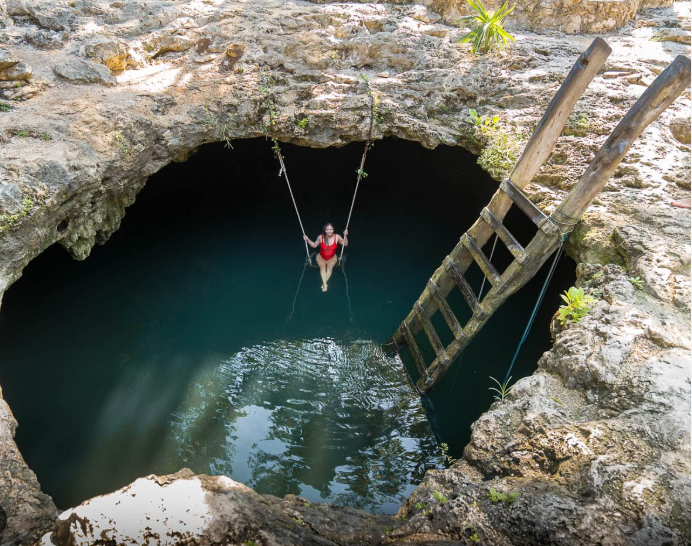
The Calavera cenote in Tulum
I just returned from my winter/spring vacation in Tulum, Mexico. For those unfamiliar with geography, Tulum is in the Yucatan, about 2 hours or so from Cancun. It rests deep in the jungle along a gorgeous shoreline of beach. Though Tulum is becoming more popular for tourists, it still lends itself to those intrepid explorers who crave something far more than a resort experience. Hotels are boho, less commercial, and definitely have an “earthier” feel than the ultra-sanitized experiences of Cancun.
It wasn’t my first time in Tulum, and it was far from my first time in Mexico. But this time, things were a tad different.
As my partner and I were traveling from one cenote to another, along a slim and dusty road, the traffic came to a standstill. That is not entirely unusual, as the roads in Tulum are largely unpaved, and the ones that do have asphalt or cement have frequent speed bumps called topes. If you are not a cautious driver, a tope can wreak havoc on your car’s undercarriage. So yes, some slowdowns are anticipated any time we are driving in Mexico.

The author swimming in a small local cenote in Tulum, Quintana Roo, MX.
This was not your average slowdown, though, and after we sat in our car for ten minutes or so, we gave up and turned around. We headed back into Tulum town in search of lunch on a hot day, opting for a ramshackle establishment serving local delicacies out of chafing pans, piping hot both in temperature and temperament. Delicousness served at wobbly tables with uneven chairs and bright woven tablecloths with weeks’ worth of stains.
As we dined, the place started to close the metal gate that served as the only barrier between customers and pedestrians. The rickety structure held signs reading “Tacos, chilalaques, pollo, carne asada” and other words whose meanings I do not know. The signs were posterboard, tied to the gate railings with twine, which the presumed owner was now removing, losening one knot after another and bringing them inside.
“Siesta?” I asked my partner, not really believing that the place could be closing at 2pm. We frequently walked by this joint late into the night, still serving their delicious food. We knew they were open early morning, too, as we’d noted their conviviality at that hour more than once. It felt like it must be siesta, and we just never happened to be in town when that happened.
We finished up, and started a leisurely walk down Avenida Tulum, thinking we’d window shop.
Nope.
Every store was pulling in its merchandise from the street, closing up doors and rolling down canvas tarps.
“This is so strange,” my partner noted, “Do they really always do this?”
We agreed that they do not. The folksy shopping area in the midst of Tulum town survives only on the curiosity of tourists, and those tourists shop in the middle of the day, no matter the tradition of a midday rest.
Just then, we got a text message from the owner of our rented home:
“We just wanted to gently share a small update. There have been some isolated security incidents reported in the Tulum and Playa del Carmen areas, and local authorities are working to ensure everything remains calm and under control.
At the moment, everything in our area is operating normally. As always, we simply recommend staying informed through official channels and avoiding unnecessary late-night travel, just as a precaution.”
Umm…we’d never, ever received a message like this. In fact, we go out late night in Tulum and walk to bars and restaurants, often heading home in a decided state of tipsy. This struck us both as highly unusual.
We definitely started checking the news, Bluesky, whatever sources we could think of to learn more.
Turns out, as you all now know, El Mencho, the leader of the Jalisco New Generation Cartel (JNGC) was killed in what was labeled a “high risk operation.” El Mencho was killed in Tapalapa, Central Mexico. Almost immediately, the backlash was fierce. There was true chaos in the streets of Guadalajara, Jalisco, and Puerto Vallarta. Puerto Vallarta is a popular tourist destination, and a port for many cruise ships. The other two cities are much less impacted by visitors from abroad. To put the proximity in a bit of perspective, Tapalapa is located roughly 21 hours’ drive from Puerto Vallarta, but only 12 hours’ drive from Tulum.
We were in Tulum.
As we learned more, we came to understand that pretty much all of Mexico was on a “shelter in place” directive, thanks to the mayhem being wrought by the cartels seizing from the death of their leader. No restaurants, stores, gathering spaces or conveniences were open. None at all. Fortunately, we had enough food and drink stashed away in our rental house, but still. The notion was jarring.
It soon came to light that the United States was a key intelligence player in the death of El Mencho. While not involved on the ground, the US provided all of the intelligence needed to find and eliminate the cartel leader. It was more revelatory that Mexico carried out this killing largely because the US administration had warned Mexican leadership that such a move was necessary to, in their opinion, stem the flow of cocaine and fentanyl into North America.
It mattered little that nearly a hundred civilians would pay for this move, and that within 2 days, the cartel had a new leader to guide operations back to normal.
The United States and Mexico did not cut off the head of a snake, merely the head of a hydra.
Within 24 hours, the environment in Tulum and towns farther inland had settled fully. We went out to breakfast. We cycled through town. We went to another small town to visit, Valladolid. All of these activities were safe and uninterrupted by violence or danger.

Jungle path outside Tulum, where the author hiked during the event.
The number of social media posters warning people to cancel vacations, shunt their trips, never go to Mexico again — was stunning to me. Yes, the State Department had issued a warning and guidance for Americans to be more alert than usual, but the reality throughout the peninsula was quite different from anything these influencers pictured.
The United States government, in its insistence that drug cartels be kneecapped in order to somehow prevent Americans from using cocaine and fentanyl, has and will fail. The result will never be that those who want to transport drugs to the US will cease. The result instead will be that Americans who were thinking of traveling to Mexico, to anywhere outside of a sanitized all-inclusive resort experience, will choose to take a cruise instead, never stepping off the ship to see anything at all. The impact will be felt for many years, and the impact will not be reduced illicit drug use by Americans, rather it will be a de facto economic sanction against our Southern neighbor.
So if you are among those who buy in to the idea that Mexico is suddenly (or was always) not safe, I offer you this:
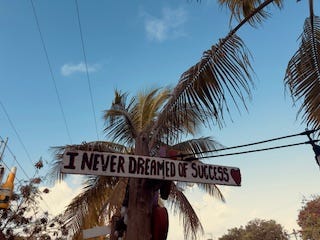
A handmade sign on a street corner south of Tulum Town.

A neighborhood church on a small side street near Tulum.

The author, on a swing outside a shop, in Tulum at night two days after the death of El Mencho.
It’s not unsafe. It’s idyllic. And the ceviche is still fantastic.
메타데이터
- post_id
- 672afff9e0be
- slug
- ceviche-cenotes-casas-cartels-672afff9e0be
- url
- https://medium.com/@sekelley/ceviche-cenotes-casas-cartels-672afff9e0be
- canonical_url
- https://medium.com/@sekelley/ceviche-cenotes-casas-cartels-672afff9e0be
- author_url
- https://medium.com/@sekelley
- status
- ok
- fetched_at
- 2026-08-02 14:49:33