Why You’re Not Losing Weight Even Though You’re Eating Healthy
You’re eating salads. You’ve cut out fast food. You’ve swapped soda for water and white bread for whole grain. By every measure, you’re…
Why You’re Not Losing Weight Even Though You’re Eating Healthy
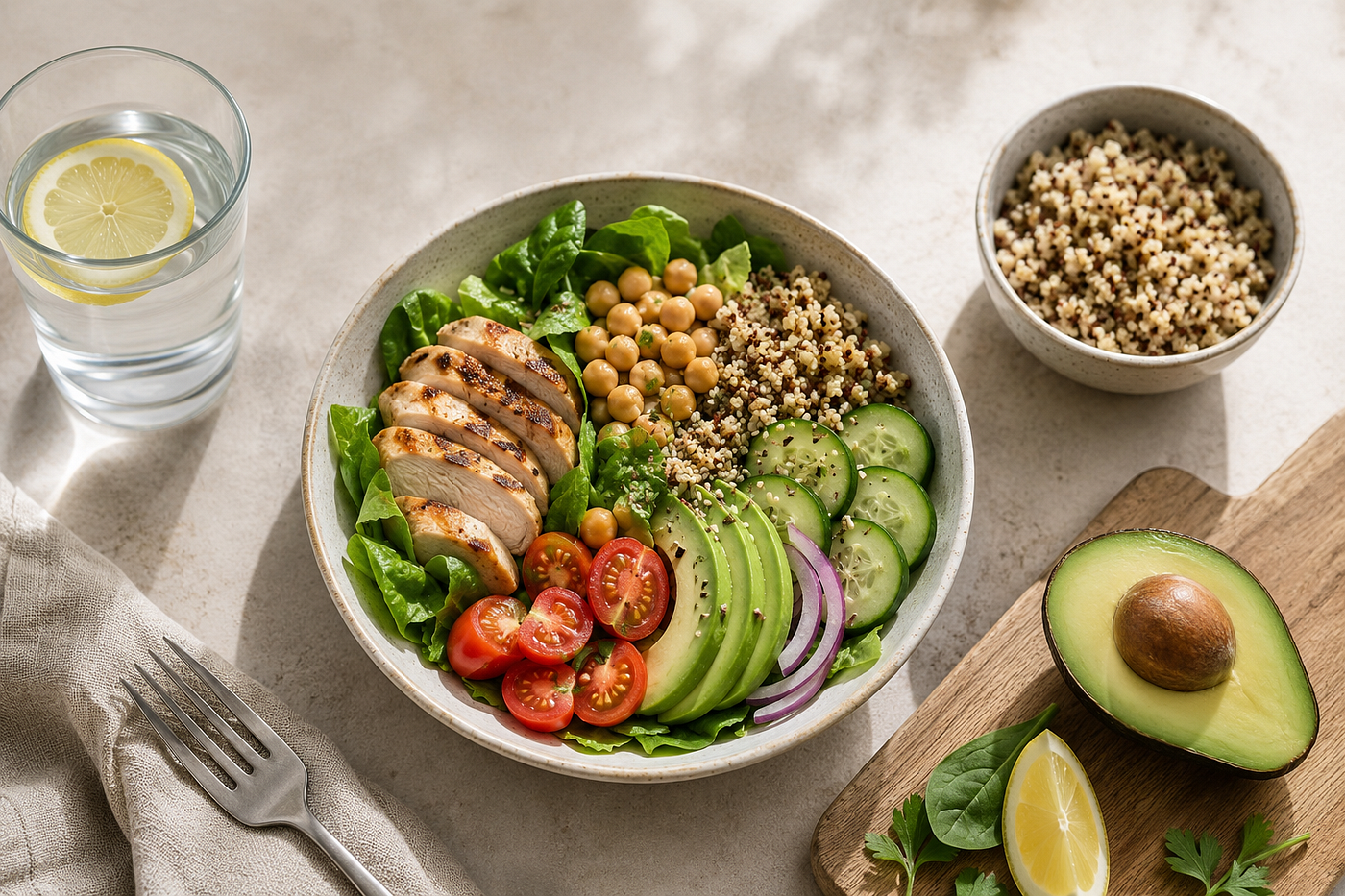
You’re eating salads. You’ve cut out fast food. You’ve swapped soda for water and white bread for whole grain. By every measure, you’re doing the right things.
And yet — the scale isn’t moving.
This is one of the most frustrating experiences in nutrition, and it’s more common than most people realize. In a 2020 study published in the American Journal of Clinical Nutrition, researchers found that a majority of people who believe they are eating at a caloric deficit are actually eating at maintenance or above — not because they’re lying, but because they genuinely don’t know. The gap between perceived and actual food intake is one of the most well-documented phenomena in nutritional science.
So if you’re eating healthy and not losing weight, you’re not broken. You’re probably just running into one of five very specific problems. Here’s what the data says about each of them.
Problem 1: “Healthy” Does Not Mean “Low Calorie”
This is the most common misconception in nutrition, and it quietly derails more weight loss attempts than almost anything else.
Avocados are healthy. A single medium avocado contains approximately 240 calories and 22 grams of fat. Nuts are healthy. A small handful of almonds — around 30 grams — contains 170 calories. Olive oil is healthy. One tablespoon contains 120 calories. Granola is marketed as healthy. A single cup contains upward of 500 calories in many commercial varieties.
None of these foods are bad for you. But if you’re eating them freely under the assumption that healthy equals low calorie, you can easily consume 400–600 extra calories per day without realizing it — enough to completely stall weight loss or even cause gradual gain.
A 2019 study in PLOS ONE found that people systematically underestimate the calorie content of foods perceived as “healthy” by an average of 35%. Meanwhile, they overestimate the calorie content of foods labeled “unhealthy.” This psychological bias — sometimes called the “health halo effect” — causes people to eat more of healthy foods and feel less guilty about it.
The fix is not to stop eating these foods. It is to understand that calories come from healthy foods too, and that portion size matters regardless of nutritional quality. A diet of exclusively “healthy” foods can absolutely prevent weight loss if total energy intake exceeds expenditure.
Problem 2: You Are Underestimating Your Portions
Even people who track their food intake carefully tend to underestimate how much they’re eating — and the research on this is striking.
A landmark study by Lichtman et al., published in the New England Journal of Medicine, found that people reporting themselves as “diet-resistant” were consuming an average of 47% more calories than they believed. They were also overestimating their physical activity by 51%. These were not people being dishonest — they genuinely believed their reports. The error was systematic and unconscious.
More recent research has replicated this finding consistently. A 2021 meta-analysis found that self-reported calorie intake underestimates actual intake by an average of 12–14% in normal-weight individuals — and by as much as 30–40% in people with overweight or obesity.
The reasons are both physical and psychological. Portion sizes have grown dramatically over the past 30 years, distorting our perception of what a “normal” amount of food looks like. Restaurant meals frequently contain two to three times the calories listed in standard nutritional databases. Cooking oils, sauces, and dressings are easy to pour generously without registering the calories. And memory is simply unreliable — people tend to forget snacks, tastes while cooking, and anything eaten while distracted.
The practical implication: if you are eating healthy and not losing weight, the first thing worth doing is tracking your food intake precisely for two weeks — using a food scale, not volume measurements — and comparing it to what you thought you were eating. For most people, the gap is genuinely surprising.
Problem 3: Your Metabolism Has Adapted
When you eat less, your body doesn’t simply burn through its stored fat at a predictable rate. It adapts — and this adaptation is more significant than most people expect.
The phenomenon is called adaptive thermogenesis, and it refers to the metabolic slowdown that occurs in response to sustained caloric restriction. A 2012 study following contestants from The Biggest Loser found that six years after the competition, participants had resting metabolic rates that were on average 500 calories per day lower than would be predicted for their body size. Their bodies had permanently downregulated their calorie burn in response to the extreme deficit they had maintained.
You don’t have to go on a reality TV crash diet for this to happen. Research shows that even moderate caloric restriction of 20–25% below maintenance can trigger meaningful metabolic adaptation within 3–4 weeks. The body interprets a sustained energy deficit as a threat and responds by becoming more efficient — burning fewer calories for the same activities, reducing the energy spent on non-essential processes, and increasing hunger hormones like ghrelin to encourage more eating.
This doesn’t mean weight loss is impossible. It means that the caloric deficit that worked in week one may no longer create a deficit in week eight — not because you changed anything, but because your body did.
Two strategies consistently supported by research to counteract adaptive thermogenesis: ensuring adequate protein intake (studies suggest 1.6–2.2g per kilogram of body weight preserves muscle mass and keeps metabolism higher during a deficit) and incorporating periodic diet breaks — returning to maintenance calories for 1–2 weeks before resuming a deficit. A 2017 study in the International Journal of Obesity found that participants who used two-week diet breaks lost significantly more weight over 30 weeks than those who dieted continuously, despite taking breaks.
Problem 4: Stress and Sleep Are Sabotaging Your Hormones
Nutrition and exercise get almost all the attention in weight loss conversations. Stress and sleep get almost none — despite having a direct, measurable hormonal impact on body composition.
The stress connection:
Cortisol, the primary stress hormone, has several effects on body weight and composition. It increases appetite — particularly for calorie-dense, high-fat, high-sugar foods. It promotes fat storage, specifically visceral fat around the abdomen. And it breaks down muscle tissue, which lowers resting metabolic rate over time.
A 2015 study published in Psychoneuroendocrinology found that women who reported high stress levels the day before eating a high-fat meal burned 104 fewer calories in the seven hours following the meal compared to low-stress women — the equivalent of gaining nearly 5 kg per year if sustained. The food was identical. The stress was not.
The sleep connection:
The research on sleep and weight is equally compelling. A 2022 study in the New England Journal of Medicine found that adults who increased their sleep from 6.5 hours to 8.5 hours per night consumed an average of 270 fewer calories per day — without being asked to diet or count calories. They simply slept more and ate less spontaneously.
The mechanism is hormonal. Sleep deprivation raises ghrelin (the hunger hormone) and lowers leptin (the satiety hormone), creating a biochemical state that makes overeating feel almost inevitable. Even one night of poor sleep measurably increases appetite the following day.
If you are eating well but chronically stressed or sleeping less than seven hours per night, your hormonal environment is actively working against your weight loss goals — regardless of what you put on your plate.
Problem 5: You Are Losing Fat but Not Seeing It on the Scale
This one is worth addressing directly because it causes a lot of unnecessary discouragement.
Body weight fluctuates by 1–3 kg day to day based on water retention, glycogen stores, digestive contents, and hormonal cycles — particularly in women. These fluctuations have nothing to do with fat gain or loss. Someone who lost 500g of fat in a week might see no change on the scale — or even an increase — because they are simultaneously retaining water due to a new exercise routine, hormonal changes, or increased sodium intake.
Fat loss and weight loss are not the same thing. The scale measures total mass. It cannot distinguish between fat, muscle, water, and food currently being digested.
This is why weekly weigh-ins on the same day, same time, in the same conditions tend to be more useful than daily weighing — and why body measurements and how clothes fit are often more accurate indicators of progress than scale weight alone. A 2021 study found that people who weighed themselves daily were more likely to experience weight-loss-related anxiety and less likely to sustain their efforts long-term compared to those who tracked weekly or used other metrics.
If you are eating in a genuine caloric deficit and exercising consistently, fat loss is occurring — even if the scale doesn’t show it immediately.
What to Actually Do With This Information
The research points toward a few consistent conclusions:
Track precisely, at least temporarily. Not forever — but two to four weeks of accurate tracking with a food scale tends to reveal the specific gap between perceived and actual intake. Most people find it once, adjust, and don’t need to do it again indefinitely.
Prioritize protein and sleep. These two variables have the strongest evidence base for supporting fat loss while preserving muscle. Protein increases satiety, requires more energy to digest, and protects muscle mass during a deficit. Sleep regulates the hormones that control hunger and fat storage. Neither requires a special product or program.
Manage stress as a nutritional variable. This is harder to quantify but the hormonal evidence is clear. Chronic cortisol elevation directly impacts body composition. Exercise, adequate rest, and reducing unnecessary stressors are not secondary wellness concerns — they are directly relevant to why the scale is or isn’t moving.
Be patient with the timeline. Sustainable fat loss occurs at roughly 0.5–1% of body weight per week. For most people, that is 400–800g per week — slow enough that progress is easy to miss week to week but significant over months. The research on long-term weight loss consistently shows that slow, sustained loss produces better outcomes than rapid loss, both for maintaining results and for metabolic health.
If you want a tool that helps you track patterns rather than obsess over daily numbers, **Evolve** is what I use. It’s built around the habit and pattern approach that the research actually supports — helping you identify where your nutrition is working and where it isn’t, without the anxiety spiral that comes with traditional calorie tracking apps.
The science of weight loss is more nuanced than “eat less, move more” — but it’s also more actionable than most people realize once you know where to look.
Which of these five problems do you think has been affecting you most? Leave a comment — I read every reply.
메타데이터
- post_id
- 677d3428fd6c
- slug
- why-youre-not-losing-weight-even-though-you-re-eating-healthy-677d3428fd6c
- url
- https://medium.com/@mellelindgren.04/why-youre-not-losing-weight-even-though-you-re-eating-healthy-677d3428fd6c
- canonical_url
- https://medium.com/@mellelindgren.04/why-youre-not-losing-weight-even-though-you-re-eating-healthy-677d3428fd6c
- author_url
- https://medium.com/@mellelindgren.04
- status
- ok
- fetched_at
- 2026-06-09 15:37:30