The $640K Ferrari Luce Is Slower Than a Lucid, Has Less Range Than a Tesla, and Seats the Same as a…
At what point does a spec sheet stop justifying the price?
The $640K Ferrari Luce Is Slower Than a Lucid, Has Less Range Than a Tesla, and Seats the Same as a Nissan Leaf
At what point does a spec sheet stop justifying the price?
Ferrari just revealed the Luce - their first-ever fully electric car.
The internet split in half. Half the people called it brave. The other half called it the ugliest Ferrari ever made. Jony Ive - the guy who designed the iPhone - helped shape the interior. The price tag: $640,000. For a five-seater hatchback.
I’m not here to argue about the design. I don’t care whether Jony Ive belongs near a steering wheel. I’m here because I did something nobody else seems to be doing right now.
I pulled up the spec sheets.
Not just Ferrari’s. I put the Luce next to the cars it’ll be judged against - the Lucid Air Sapphire, the Tesla Model S Plaid, and just for fun, the Nissan Leaf. Side by side. Same categories. No opinions, just numbers.
And the numbers raised a question I wasn’t expecting.
Ferrari Luce vs Lucid Air Sapphire
This is the real comparison. Both are luxury performance EV sedans. Both seat five. Both target buyers with serious money. Both are loaded with tech and claim to represent the future of the electric car.
One costs $640,000. The other costs $249,000.
Here’s what you get:

Read that again.
The Lucid Air Sapphire has more horsepower, a faster 0–60, a higher top speed, and nearly 100 more miles of range - with a smaller battery. For $391,000 less.
That’s not a small gap. That’s a house. In some states, that’s two houses.
Now, Ferrari will tell you the Luce has four motors instead of three. They’ll tell you about the radial-flux design derived from Formula One. They’ll tell you the front motors spin at 30,000 rpm. And that’s impressive engineering - genuinely.
But none of it shows up in the results. The Lucid, with one fewer motor, still beats it in every measurable category.
So the question is: what exactly is that extra $391,000 buying?
Ferrari Luce vs Tesla Model S Plaid
If the Lucid comparison is uncomfortable for Ferrari, the Tesla comparison is brutal.

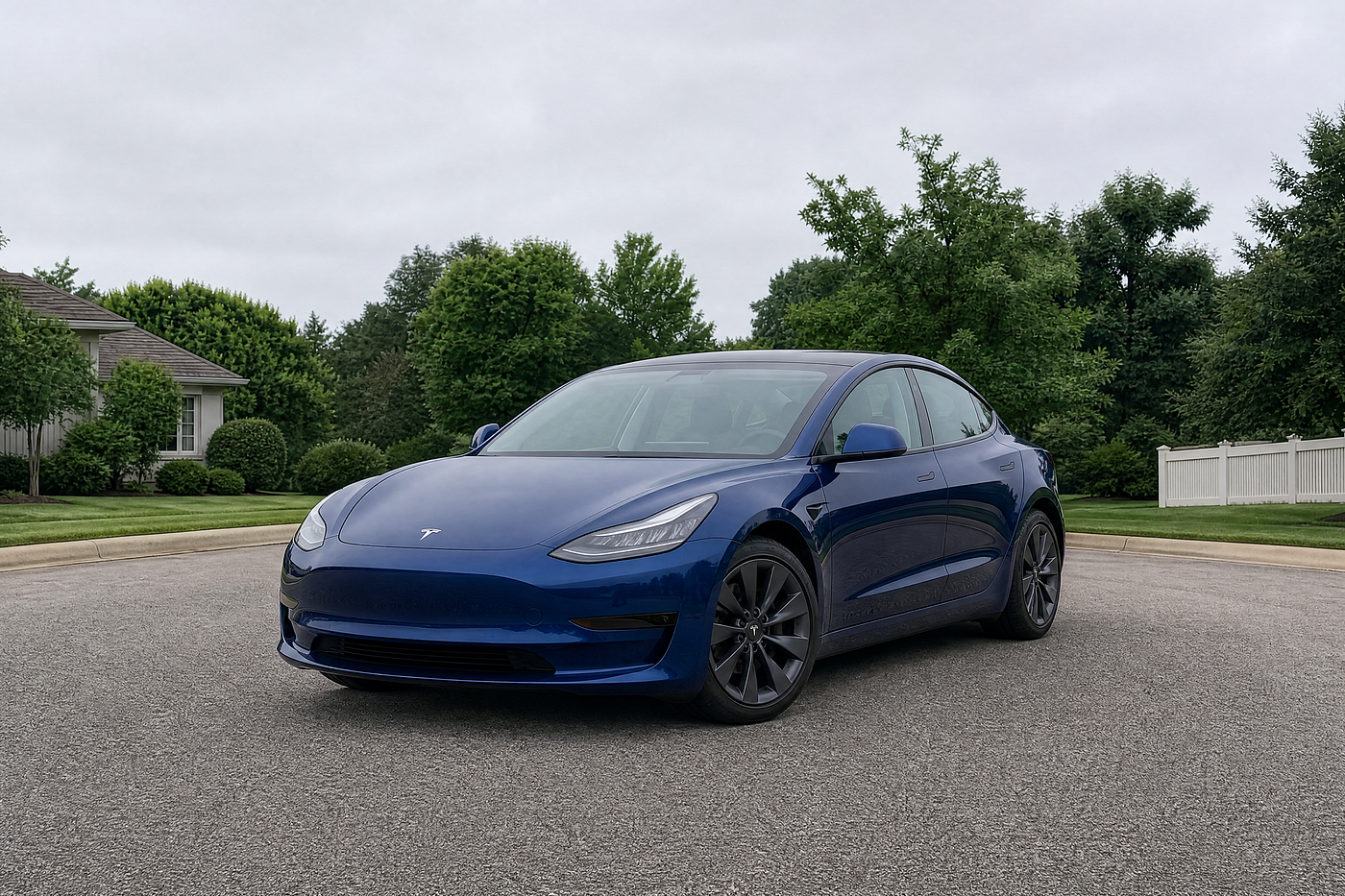
The Tesla Model S Plaid costs $99,990. That’s roughly one-sixth the price of the Luce.
It makes nearly identical horsepower. It’s actually faster to 60 mph - by half a second, which is a lifetime in the performance car world. It has more range. A smaller, more efficient battery. A top speed that’s 7 mph higher.
You could buy six Tesla Model S Plaids for the price of one Ferrari Luce. Six. And each one would be faster.
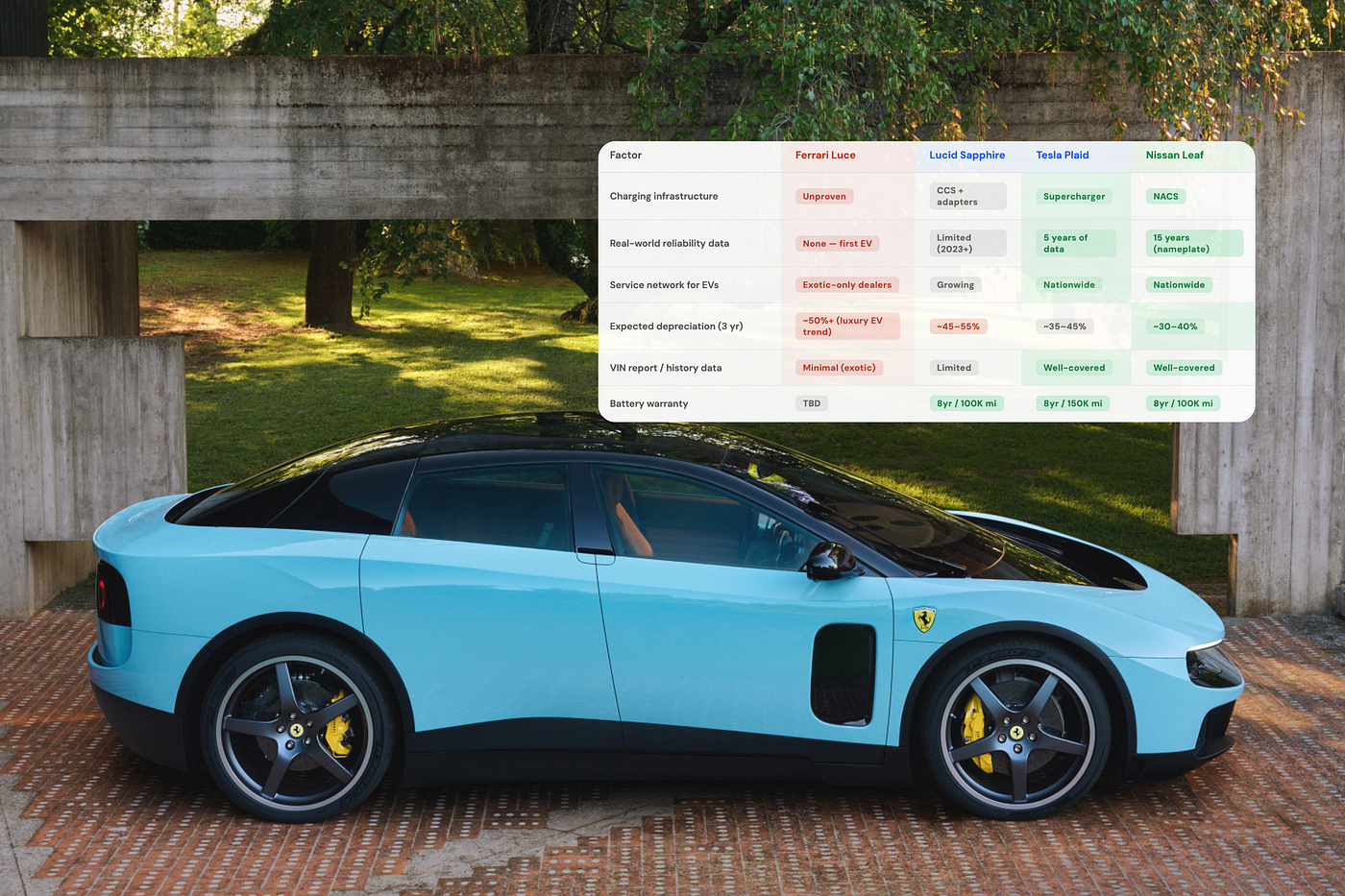
And the Plaid comes with something the Luce doesn’t have yet: a proven charging network. Tesla’s Supercharger infrastructure is the largest in the world. Ferrari hasn’t announced any dedicated charging partnerships.
The Plaid has been on the road since 2021. There are five years of real-world reliability data. Owners have done track days, road trips, daily commutes. The car is known. The Luce? It hasn’t delivered a single unit yet.
Ferrari Luce vs Nissan Leaf: The Comparison Nobody Asked For
Okay. This one isn’t fair. I know it isn’t fair. But stick with me for a second, because the contrast is actually the point.

The Nissan Leaf costs $34,230. You could buy 18 of them for one Ferrari Luce.
Obviously, these are not the same car. Nobody cross-shops a Leaf and a Ferrari. The Leaf makes 214 horsepower. The Ferrari makes 1,036. The Leaf hits 60 in maybe 7 seconds. The Ferrari does it in 2.5.
But look at the columns that don’t involve speed.
Both seat five people. Both are hatchbacks. The Ferrari’s range is only 27 miles longer than the Leaf’s. The cargo space is almost identical. Both are electric. Both plug in. Both get you from A to B with zero emissions.
For $605,770 more, the Ferrari gives you an incredible driving experience, a prancing horse on the hood, and Jony Ive’s interior design. For $34,230, the Leaf gives you pretty much everything else.
I’m not saying the Leaf is better. I’m saying that when a $34K car matches a $640K car in range, seating, and basic packaging - the price gap starts to feel less like luxury and more like something else entirely.
The Big Picture: All Four Side by Side
When you line up all four cars in one table, the pattern becomes impossible to ignore.

The most expensive car in this comparison doesn’t win a single performance category. Not one.
The Lucid beats it on power. The Tesla beats it on speed. Both beat it on range. The Leaf matches it on seating and nearly matches it on range - for 18 times less money.
So What Is Ferrari Actually Selling?
Let me be fair. I’ve been around cars long enough to know that Ferrari has never competed on spec sheets. Never. A Ferrari isn’t bought because it has more horsepower than the next car. It’s bought because it’s a Ferrari.
The badge. The exclusivity. The hand-built craftsmanship in Maranello. The sound - which in this case, Ferrari engineered from the actual vibrations of the electric motors, amplified through the cabin. The fact that maybe 5,000 people in the world will own one.
That has real value. I won’t pretend it doesn’t.
But here’s where it gets complicated.
This is Ferrari’s first electric car. Their first five-seater. Their first collaboration with an outside design firm. Their heaviest production car ever at nearly 5,000 pounds.
The battery cells are made by SK On, not Ferrari. The long-term reliability of a quad-motor EV system from a company that’s never built one before? Unknown.
Every first-generation car carries risk. That’s true for a $30K Nissan and a $640K Ferrari. The difference is that when something goes wrong with a Nissan, you’re out a few thousand. When something goes wrong with an exotic EV, the repair bill can be the price of a new car.
And the depreciation question is real. Luxury EVs have not held their value well. At all. Industry data shows that lease residuals on premium EVs came in at 35–40%, well below the 50% that was projected. First-gen models tend to depreciate even harder once the second generation arrives with better tech and more refinement.
A $640,000 Luce could be a $300,000 car in three years. Maybe less.
What Happens When This Car Hits the Used Market?
This is the part nobody’s talking about yet.

If you’re buying a used Lucid or Tesla today, there’s a reasonable ecosystem around it. Charging networks, service centers, parts availability, and enough cars on the road that VIN report services actually have data on them. When I tested 10 VIN report providers side by side, mainstream EVs like Teslas showed up with full histories - accident data, service records, ownership timelines.
Exotics? Barely a blip. And the Luce will be even thinner. A hand-built quad-motor EV with proprietary Ferrari battery management, sold in tiny volumes? Good luck getting a meaningful vehicle history report on one of those in three years. Even the best services I’ve tested struggle with low-volume exotics. The data just isn’t there.
For a car that could depreciate $300K+ in its first few years, that’s a real problem for the second owner.
The Numbers Don’t Lie
I started this by just wanting to see how the specs line up. I figured Ferrari would at least win on a few rows.
They didn’t.
The Lucid Air Sapphire beats the Luce in horsepower, speed, range, and efficiency - for $391K less. The Tesla Model S Plaid nearly matches it on power and beats it everywhere else - for $540K less. And the Nissan Leaf, a car that costs 18 times less, comes surprisingly close on the basics that matter to everyday life.
Does any of this matter to someone buying a Ferrari? Probably not. You don’t buy a Ferrari because it makes logical sense. You buy it because you want one. Because you can. Because the badge means something to you that no spec sheet can capture.
But for the rest of us - the people actually comparing electric cars based on what they deliver - the Luce is a fascinating case study.
It’s the most expensive way to get less performance, less range, and less proven technology than cars that cost a fraction of the price.
At some point, the numbers have to mean something.
Right?
If you want car comparisons based on real data - not hype - I write about that regularly. Here are a few:
메타데이터
- post_id
- 679a4242585b
- slug
- the-640k-ferrari-luce-is-slower-than-a-lucid-has-less-range-than-a-tesla-and-seats-the-same-as-a-679a4242585b
- url
- https://medium.com/best-vehicle-history-reports/the-640k-ferrari-luce-is-slower-than-a-lucid-has-less-range-than-a-tesla-and-seats-the-same-as-a-679a4242585b
- canonical_url
- https://medium.com/best-vehicle-history-reports/the-640k-ferrari-luce-is-slower-than-a-lucid-has-less-range-than-a-tesla-and-seats-the-same-as-a-679a4242585b
- author_url
- https://medium.com/@johnvinreports
- status
- ok
- fetched_at
- 2026-06-15 20:49:13