The Eternal Impact: No End on the Highway
A Debt Written in Blood and Earth.
The Eternal Impact: No End on the Highway
A Debt Written in Blood and Earth.
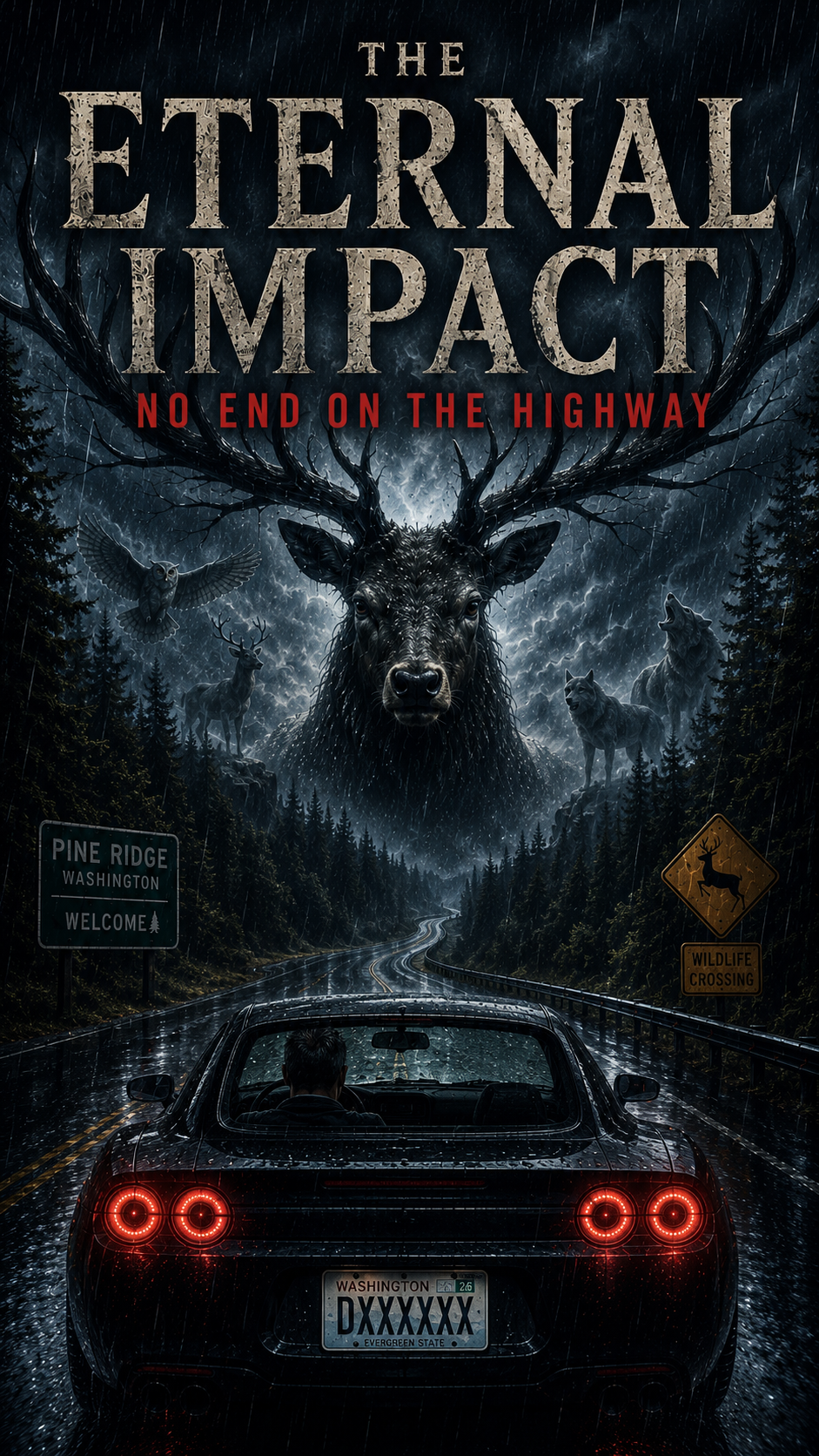
Photo © Queen’s Crown & Akhenaten
Councilman Tom Hale was decorated before he was elected.
Military honors followed him everywhere — on framed certificates, polished ceremony speeches, and even the veteran designation printed on his driver’s license. In public, he spoke with discipline and calm authority. People trusted the weight of his record.
Few ever looked closely enough to question what that record had cost.
He drove a black sports car through the winding roads of a Washington town surrounded by fir forests and cold rivers. It wasn’t just transportation to him — it was command. The road responded. The world yielded.
At night, the highway became his private corridor.
Speed turned everything into blur and silence.
He hated when other people on the road followed the posted speed limit. He would ride their tails, revving his engine as though the road itself belonged to him, until they became intimidated enough to move aside.
Over time, life along the roadside became little more than interruption.
Deer stepped into the beams of his headlights, fawns following close behind, and were gone. Owls lifted too late. Small animals crossed at the wrong second and paid for it without ever being named.
He never stopped.
“It happens,” he would say. “They’re just animals.”
As if repetition made consequence ordinary.
As if the forest was something that could be negotiated with statistics.
In City Hall, Tom Hale carried the same certainty.
He sat in meetings where maps were redrawn into development plans, where forest corridors were reduced to zoning adjustments, and where wetlands were marked for removal in the language of “progress” — a vocabulary where destruction was renamed opportunity.
When concerns were raised about nearby Indigenous land and sacred sites tied to the original people of the region, he dismissed them as obstacles to modernization.
“The town has to grow,” he said once, flatly. “History can’t be allowed to stall the future.”
Reports came and went.
Wildlife crossings collapsing.
Animal fatalities rising along a single stretch of highway.
Residents speaking uneasily about something feeling wrong in the forest — like the land itself had begun to withdraw.
The wolves were among the first casualties of his decisions. After protections were removed, they became targets — not because they had changed, but because the world around them had.
A tribal elder spoke quietly at a council session, warning that balance was not symbolic, but living.
Tom Hale closed the file without comment.
“They’ll adapt,” he said.
“But they’re dying,” someone replied.
He finally looked up.
“Everything adapts,” he said. “Or it gets replaced.”
That night, the rain came in long, patient sheets over the trees.
And deep within the forest, something older than the road opened its eyes.
That night, Tom dreamed.
He stood in a field without roads.
The air was still, but not empty.
Mist moved like memory across tall grass.
From it came the sound of hooves — not fast, not urgent, but inevitable.
A stag emerged.
It was enormous, older than anything language could comfortably hold. Its antlers spread like living branches, carrying the weight of seasons that had never ended.
It did not threaten him.
It simply understood him.
“You borrowed motion without care,” it said.
The voice was not heard.
It was recognized.
Behind the stag, shapes gathered in silence — winged outlines, small bodies, fragments of life the forest had once held and no longer did.
Tom tried to speak.
The field refused the attempt.
The stag lowered its head slightly.
“You will understand what it is to arrive where you are not wanted.”
Then the dream dissolved.
He woke in his car.
Engine running.
Rain tapping the windshield.
The highway ahead unchanged.
He exhaled, uneasy, and started driving.
For a moment, he told himself it meant nothing.
Just exhaustion.
Just imagination.
Just weather and memory colliding.
The road narrowed into a familiar bend between dense firs.
And there — standing where nothing should have been — was the stag.
He braked.
Too late.
Or exactly as intended.
The first impact came from the northbound rig.
The second came from the southbound.
Steel met steel in a sound that erased everything human inside it.
Then silence.
Tom Hale opened his eyes.
He was seated behind the wheel again.
The engine idled.
The clock on the dashboard read the same minute.
Rain fell with patient rhythm against the glass.
The road stretched ahead exactly as before.
No wreckage.
No smoke.
No deviation.
Just the same bend waiting in the distance.
And farther still, the stag.
Watching.
Not approaching.
Not leaving.
Waiting as if time had stopped being meaningful long before he noticed.
Tom shifted into drive.
Drove forward again.
And the road returned him again.
The crash was not an ending.
It was a return point.
A fixed place in a loop that did not forgive, but did not forget either.
Every morning became the same morning.
There was no escape.
Every drive became the same decision that was never really a decision at all.
And somewhere beyond the thinning veil of rain and fir and asphalt, the stag remained — patient, unmoving, and eternal.
Because the road does not end what it has witnessed.
It remembers it.
And for Tom Hale, there was no escape forward.
Only the eternal impact.
Written by Nicolette Kolar © 2026. All Rights Reserved. Queen’s Crown & Akhenaten
메타데이터
- post_id
- 67bbc0277ea0
- slug
- the-eternal-impact-no-end-on-the-highway-67bbc0277ea0
- url
- https://medium.com/@QCA/the-eternal-impact-no-end-on-the-highway-67bbc0277ea0
- canonical_url
- https://medium.com/@QCA/the-eternal-impact-no-end-on-the-highway-67bbc0277ea0
- author_url
- https://medium.com/@QCA
- status
- ok
- fetched_at
- 2026-07-14 21:26:34