Understanding the var Keyword in Java: Syntax, Benefits, and Limitations
The var keyword was introduced in Java 10 as part of the Local-Variable Type Inference feature. It allows you to declare local variables…
Understanding the var Keyword in Java: Syntax, Benefits, and Limitations
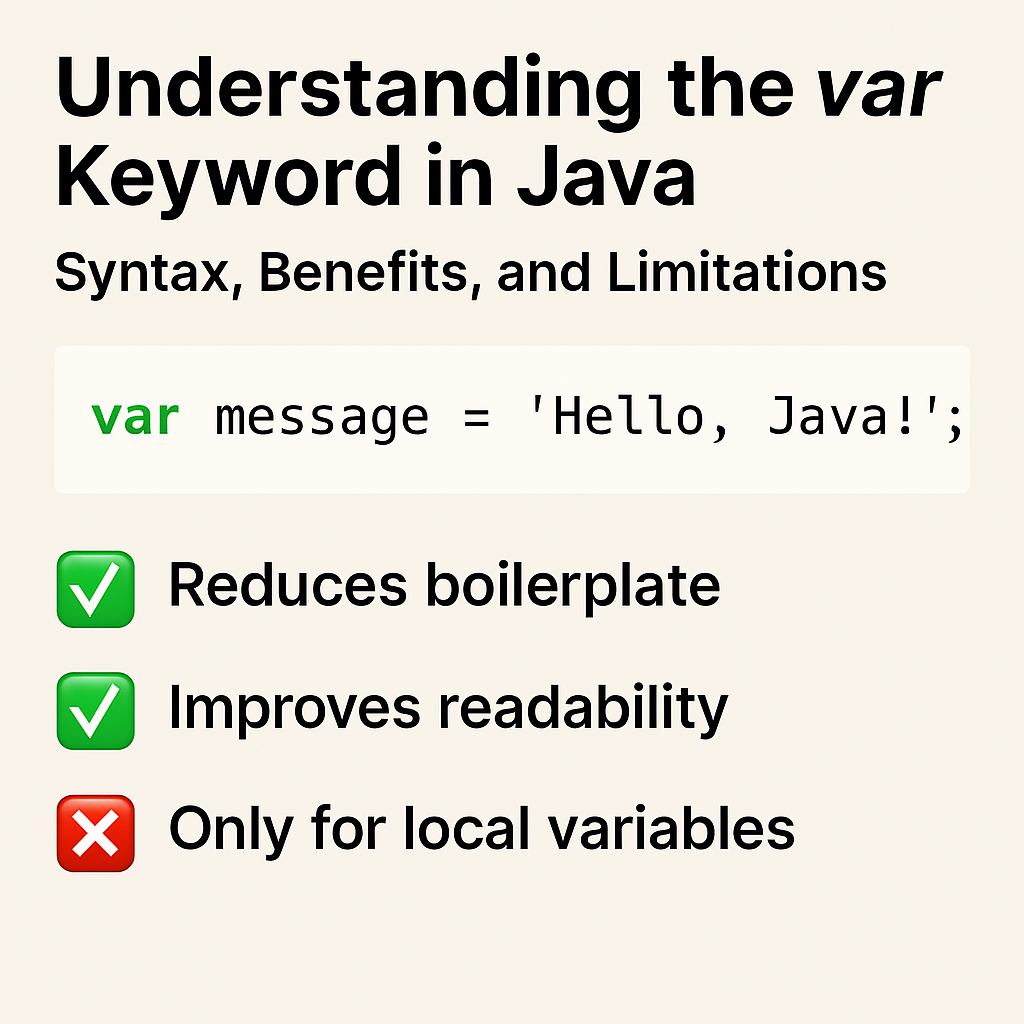
Understanding the var Keyword in Java
The var keyword was introduced in Java 10 as part of the Local-Variable Type Inference feature. It allows you to declare local variables without explicitly specifying their type—the compiler infers the type from the initializer.
var name = "Uma";         // Inferred as String
var age = 30;             // Inferred as int
var list = new ArrayList<String>();  // Inferred as ArrayList<String>
✅ Key Points:
- Type Inference: The compiler infers the type from the right-hand side of the assignment.
- Still statically typed: Type is resolved at compile time, not runtime.
- Only for local variables: You can’t use
varfor method parameters, fields, or return types (as of Java 11). - Initializer is required: You must initialize a
varvariable during declaration. - Cannot assign null alone:
var x = null;is not allowed (compiler can’t infer type).
✅ Where Allowed:
- Inside methods.
- In
forloops. - In try-with-resources.
var list = List.of("A", "B", "C");
for (var item : list) {
    System.out.println(item);
}❌Where Not Allowed:
- As class fields.
- As method parameters.
- As method return types.
✅ Example:
public class VarExample {
    public static void main(String[] args) {
        var message = "Hello, World!"; // inferred as String
        var number = 100;              // inferred as int
        var list = List.of("One", "Two");

        for (var item : list) {
            System.out.println(item.toUpperCase());
        }
    }
}
✅ Benefits of var keyword:
- Reduces Boilerplate Code: You don’t have to repeat long type declarations on both sides of the assignment.
// Without var
Map<String, List<Integer>> data = new HashMap<String, List<Integer>>();

// With var
var data = new HashMap<String, List<Integer>>();- Improves Readability in Some Contexts: Especially useful when the type is obvious from context, such as
List.of(...).
var list = List.of("Apple", "Banana", "Cherry"); // Clearly a List of Strings- Encourages Meaningful Variable Names: Since the type is not spelled out, developers are encouraged to choose descriptive variable names.
// Bad (misleading)
var a = List.of("x", "y");

// Good (clear)
var fruitList = List.of("Apple", "Mango");- Helpful with Complex Generic Types:
vareliminates repetition and helps with nested generics and method chaining.
// Without var
Map<String, List<Map<String, Integer>>> complex = new HashMap<>();

// With var
var complex = new HashMap<String, List<Map<String, Integer>>>();- Maintains Static Typing: Although the type is not written explicitly, Java still checks types at compile time, avoiding type safety issues.
var x = "Hello"; // Still a String; can't assign an int later
x = 100; // ❌ Compile-time error- Eases Refactoring: When changing a return type or constructor, you don’t need to update the variable’s declared type.
var connection = getConnection(); // Automatically adjusts if return type changes- Useful in Enhanced For-Loops and Lambdas (Java 11+):
for (var entry : map.entrySet()) {
    System.out.println(entry.getKey() + "=" + entry.getValue());
}
And for lambda parameters (from Java 11):
list.stream().map((var s) -> s.toUpperCase()).forEach(System.out::println);⚠️ When to Use var Carefully:
While var is powerful, overusing it or using it in non-obvious contexts can:
- Reduce code clarity.
- Hide the actual type (especially with method returns).
- Make debugging or on boarding harder.
❓ Does var provide any advantage in terms of memory management in Java ?
No, the var keyword does not provide any performance or memory management benefits at runtime in Java.
The var keyword is a compile-time feature introduced for developer convenience, not for performance or memory optimization. Here's how it works:
- At compile time, the Java compiler infers the actual type of the variable based on the right-hand side expression.
- After compilation, the
varkeyword disappears—it is replaced with the concrete type in the generated.classbyte code. - As a result, memory usage, object layout, and JVM behavior remain identical to code where you explicitly declare the type.
Compile-Time Behavior:
// Source code
var list = new ArrayList<String>();
Is transformed by the compiler into:
ArrayList<String> list = new ArrayList<String>();The compiled .class file will contain ArrayList<String>—not var.
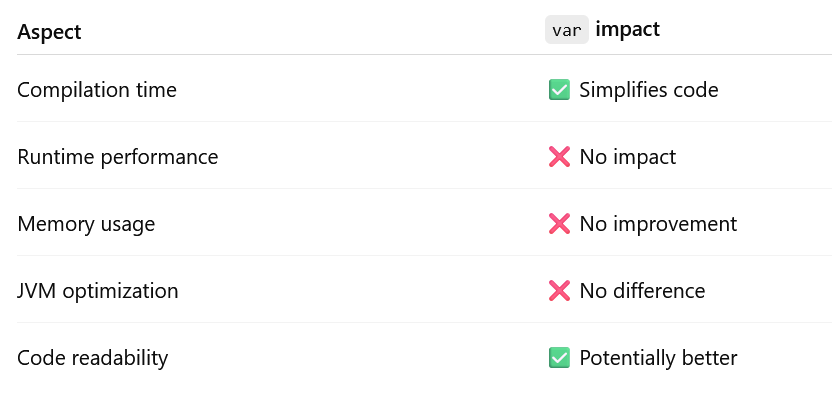
var is a syntactic sugar that helps write cleaner code. It doesn’t change how your program behaves or how the JVM allocates memory.
메타데이터
- post_id
- 67d9debee9cd
- slug
- understanding-the-var-keyword-in-java-syntax-benefits-and-limitations-67d9debee9cd
- url
- https://medium.com/@ucgorai/understanding-the-var-keyword-in-java-syntax-benefits-and-limitations-67d9debee9cd
- canonical_url
- https://medium.com/@ucgorai/understanding-the-var-keyword-in-java-syntax-benefits-and-limitations-67d9debee9cd
- author_url
- https://medium.com/@ucgorai
- status
- ok
- fetched_at
- 2026-06-18 00:10:23