Cheonggyecheon Romance — Episode 5. Naengmyeon, the Cold Noodle
“Since we’re hungry, let’s eat first. Pyongyang naengmyeon and bulgogi make a pretty good match.”
Cheonggyecheon Romance — Episode 5. Naengmyeon, the Cold Noodle
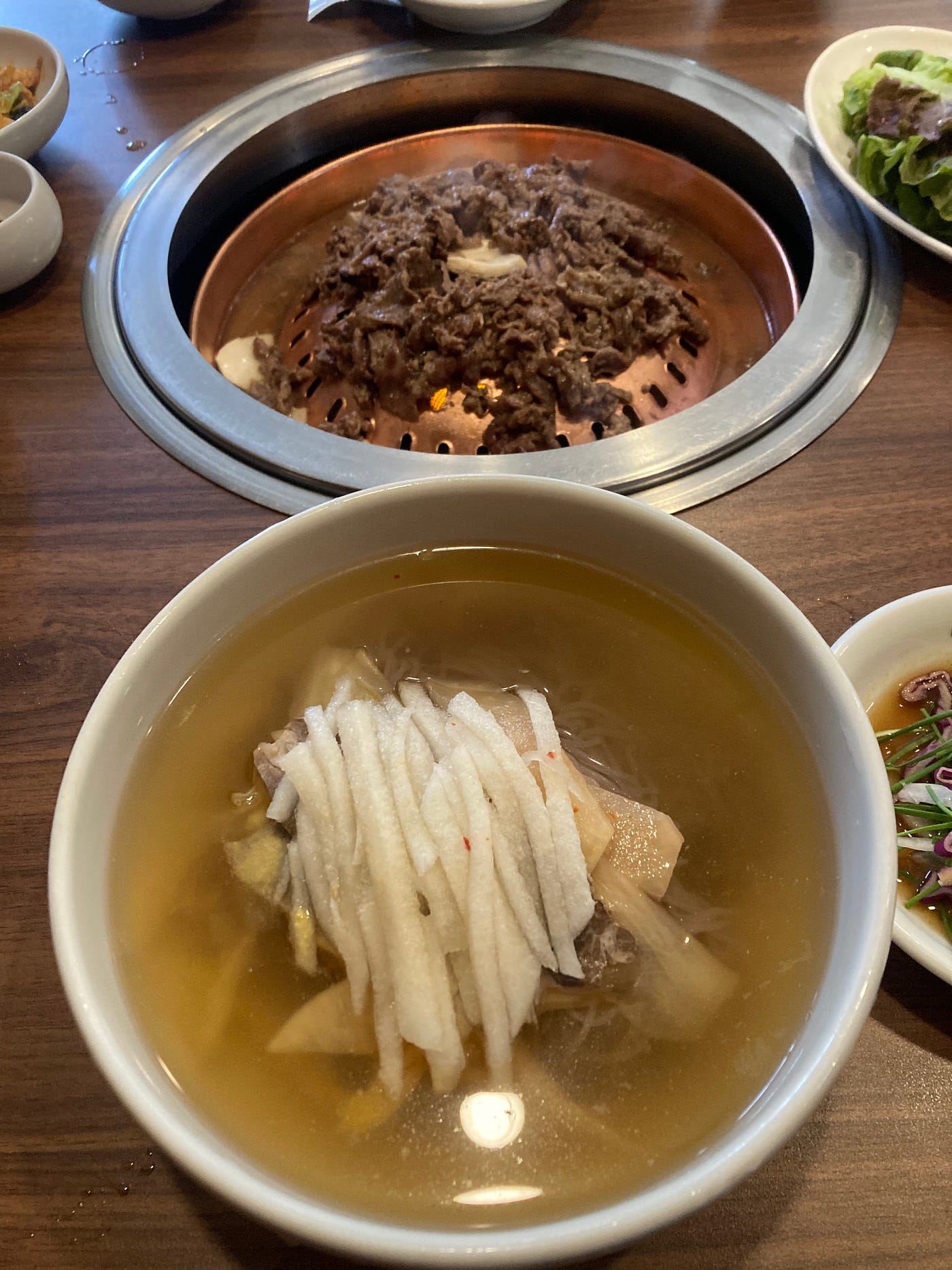
Pyongyang Naengmyeon, the Cold Noodle & Bulgogi, the marinated grilled beef
“Since we’re hungry, let’s eat first. Pyongyang naengmyeon and bulgogi make a pretty good match.”
Philip placed the order as soon as he sat down. He was hungry, of course, but there was no reason to choose anything else at a restaurant specializing in cold noodles.
“Wow, that bulgogi smells good!”
David had been walking along an unfamiliar route from Gwangtonggyo Bridge through Jongno and Euljiro, and the slight fatigue that had built up along the way seemed to vanish as soon as he was swept up by the delicious smell coming from the restaurant.
“Bulgogi may be well known among foreigners, but here it’s only a supporting actor for naengmyeon. Not in terms of price, of course, but in terms of taste and style.”
“Well, I’ll know once I try it. There is Pyongyang naengmyeon in the United States too, but from what I remember as a kid, it tasted like nothing at all, so I’m a little worried.”
He said this, but he also looked somewhat excited and animated.
Not only among foreigners like David, but even among people living in Korea, opinions on Pyongyang naengmyeon tend to be clearly divided. If one cannot sense its distinctive flavor, it is the kind of food that makes one wonder why anyone would eat it at all. That is why there are certain restaurants people with different tastes should never visit together. Since childhood, Philip had loved the flavor of Pyongyang naengmyeon — the scent of buckwheat and the faint aroma of meat that may seem rather plain on the tongue, yet come together to create a new kind of refinement. For that reason, unless absolutely necessary, he avoided other kinds of naengmyeon with their sour, sweet, and strongly seasoned broths. David, it seemed, was probably the opposite.
“That can happen. But it shouldn’t be something to worry about. And once you learn the story behind a food, you sometimes begin to taste it differently.”
“What is this, some kind of culinary humanities lecture? There seem to be a lot of those these days.”
“Probably not the kind you’re thinking of. I’m not knowledgeable enough about food to bring up the humanities, and as for humanistic refinement, you and I went to the same high school, so I’m sure we’re both at exactly that level. I don’t think we can manage anything too sophisticated. It’s just that I remember an article I once read while looking through old newspapers.”
“If it’s from a newspaper and not just something you’re saying, then I suppose it’s a little more trustworthy.”
David believed that freedom of the press was necessary, but he often wondered about the flood of information poured out by new media — whether the people producing it had any qualifications at all, and more importantly, whether they had verified what they were putting out. Of course, the form of media changes with the times, but in today’s era of one-person broadcasting, it had become difficult to decide what to listen to and what to believe.
“I can’t help but agree with some of that. Newspapers are nearly a vanished medium now, but I think they developed, over a long period of time, their own mechanisms for filtering out false information. I mean at an organizational level, not just an individual one. Of course, it’s not as though bias never entered into newspapers either, so I used to read several papers together. These days, though, I mostly just skim articles online. And I don’t even see old newspapers much at fish shops anymore.”
“Come to think of it, there really was a time when fish shops had the most newspapers. So, what newspaper had this article about naengmyeon?”
“The Maeil Sinbo, July 23, 1936. Sounds a little absurd, doesn’t it? But there was an interesting article about naengmyeon in that paper. It said that the skill of kneading the dough determined the taste of the noodles, and that after Pyongyang naengmyeon and Haeju naengmyeon, Seoul naengmyeon could now be counted among the best.”

Article on Naengmyeon (The Maeil Sinbo, July 23, 1936.)
David knew that the Daehan Maeil Sinbo, originally a nationalist newspaper founded by the British journalist Ernest Thomas Bethell, had been purchased by the Japanese, who removed the first two characters, “Daehan,” meaning “Great Korea,” after the annexation and turned it into the official organ of the Japanese Government-General of Korea. For that reason, the content of the article struck him as somewhat surprising.
“It seems Japan, while carrying out colonial rule, was even deeply cataloguing Korean culture. Well, I suppose colonial rule would have been difficult without understanding not only history and politics, but society and culture in general. But what is Seoul naengmyeon?”
“According to the article, Seoul naengmyeon does not seem to have been something entirely different. It was more like a slightly different version of Pyongyang naengmyeon. As Korea’s economy was being exploited during the Japanese colonial period, many naengmyeon makers from Pyongyang apparently moved to Seoul in order to make a living. As they settled there, many Pyongyang naengmyeon restaurants seem to have appeared in Seoul.”
“Then the taste must have been the same. I guess they just popped up everywhere like fried chicken shops.”
“The taste was probably somewhat different. Even the same food develops slightly different characteristics depending on the region. But naengmyeon is a little more unusual. Since it is a cold dish, it was originally something that could be eaten in winter rather than summer. Seoul was warmer than Pyongyang, and autumn buckwheat harvests were not abundant, so in Seoul they apparently mixed buckwheat with things like sweet potato starch to make the noodles. And in winter, especially during the difficult economic conditions of the colonial period, it was not easy to make broth with dongchimi radish water and pheasant meat. So the taste must have been different. But then a mysterious powder appeared, and it began to reproduce the original flavor of the broth.”
“A mysterious powder? Usually that sounds like some kind of drug. They surely weren’t using drugs back then, so I suppose that powder must have created a magical taste.”
Philip liked the phrase “magical taste.” These days people often use expressions like “drug gimbap” or “drug tteokbokki” to mean something so delicious that one keeps eating it, but he had never thought such wording sounded very pleasant when applied to food. “Magic gimbap” or “magic tteokbokki,” by contrast, might at least sound cute.
“A magical taste, yes. I don’t know whether you’ve heard of Ajinomoto, but you know the English word umami, don’t you?”
“Umami? I think it refers to a rich, full flavor that fills the mouth. People use it when describing the taste of things like tomato ketchup. In Korean, I suppose it would be something like gamchilmat, a savory depth of flavor. So this mysterious powder must have been a seasoning that made an instant broth taste savory.”
“That’s right. The word umami is actually written in Chinese characters as 旨味, meaning ‘delicious taste,’ and when read in Japanese, it becomes umami. It was a term coined by a Japanese scientist. It wasn’t exactly instant broth, but rather a chemical seasoning that produced what we call a savory flavor. The Japanese seasoning Ajinomoto — 味の素 — was exactly that. Around the end of 1910, naengmyeon restaurants in Seoul began serving cold noodles in broth flavored with Ajinomoto, the seasoning said to create a mysterious taste. With the arrival of ice factories in Seoul, ice and Ajinomoto made summer naengmyeon possible. In fact, it’s a product you know very well.”
“A product I know? I don’t think I’ve ever heard of it.”
“You’ve probably heard of MSG. Recently it hasn’t been used much as a seasoning because people thought it was unhealthy, but in fact it is said to be harmless to health, and these days it is being advertised again. In Korea, the company is now called Daesang Corporation, but it used to be Miwon Co., Ltd. After liberation, it copied Ajinomoto and created a product called Miwon. In Chinese characters, 味素 and 味元 basically mean the same thing. Even the product design was similar.”
“So there was an interesting story behind it. In any case, that Ajinomoto must have sold very well. Korea under Japanese colonial rule probably did not have an abundance of ingredients.”
Philip’s explanation was quite fascinating.
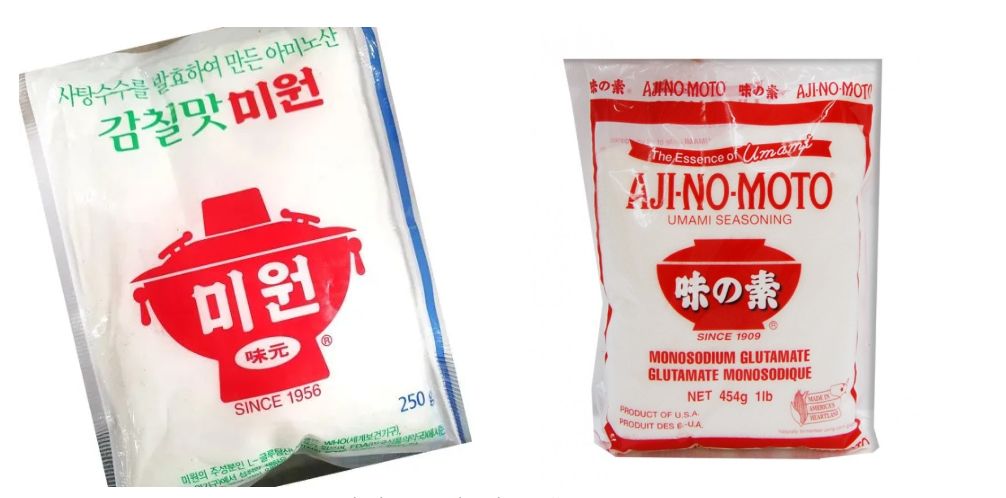
Left: Miwon, the savory seasoning. Right: Ajinomoto, the umami seasoning.
Just then, the bulgogi and naengmyeon they had ordered arrived, and the conversation paused.
Philip first lifted the bowl and took a sip of the cold broth. David followed his lead and tasted the naengmyeon broth first.
“Maybe it’s because I heard your story, but it does taste clean and mild. But they probably didn’t use Ajinomoto in this, did they?”
“They might have, but probably not. Even if they didn’t use pheasant, they must have made a proper broth. That’s why customers line up, isn’t it? Still, though it’s not the best thing to talk about while eating something delicious, back then restaurants openly advertised that naengmyeon shops using Ajinomoto were the tasty ones. Looking at the advertisements from that time, it seems they tried very hard to create the impression that women who used Ajinomoto were modern, enlightened women.”
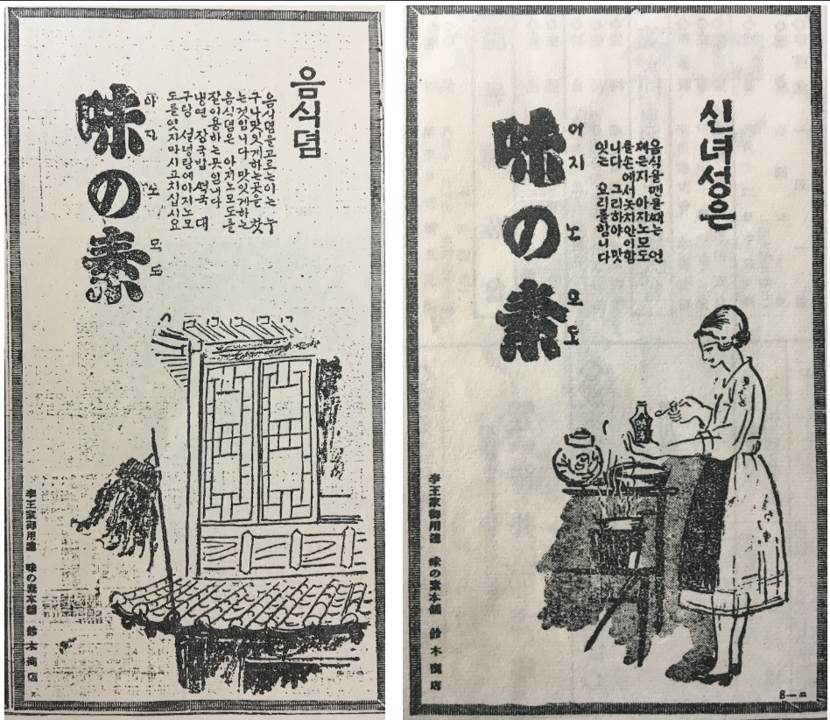
Ajinomoto newspaper advertisement. At the time, naengmyeon restaurants used to hang strips of paper or cloth shaped like strands of noodles.
Hearing the words “modern woman” and “enlightenment,” David thought of the phrase “modernization by Japan.” The situation in Korea and Japan in the 1930s was, in a word, ambiguous. After the March First Movement of 1919, represented by figures such as Yu Gwan-sun, Japan realized the limits of its harsh military rule over Koreans and began a policy of conciliation known as cultural rule, granting Koreans a certain degree of freedom. Yet ultimately, it also began even more intense surveillance. It was like pretending to be friendly while stabbing someone in the back. Koreans, however, were not so easily caught off guard. They used one another while living in an uneasy coexistence. Meanwhile, Japan itself was being swept toward the Pacific War. By the 1930s, when Ajinomoto was flourishing, Japan had begun actively extracting capital and labor under the pretext of economically integrating Korea as a military supply base. It was an ambiguous age indeed…
메타데이터
- post_id
- 67e613981e68
- slug
- cheonggyecheon-romance-episode-5-naengmyeon-the-cold-noodle-67e613981e68
- url
- https://medium.com/@jsmun1229/cheonggyecheon-romance-episode-5-naengmyeon-the-cold-noodle-67e613981e68
- canonical_url
- https://medium.com/@jsmun1229/cheonggyecheon-romance-episode-5-naengmyeon-the-cold-noodle-67e613981e68
- author_url
- https://medium.com/@jsmun1229
- status
- ok
- fetched_at
- 2026-08-04 02:52:55