From 4,300 Days of Raw Photos to a Continuity-Based Structural Observation Framework
How a 12-Year Personal Archive Evolved into a Longitudinal Dataset, a Time-Series Architecture, and the Foundation of CS-NRRM™
From 4,300 Days of Raw Photos to a Continuity-Based Structural Observation Framework
How a 12-Year Personal Archive Evolved into a Longitudinal Dataset, a Time-Series Architecture, and the Foundation of CS-NRRM™
How a 12-Year Personal Archive Evolved into a Longitudinal Dataset, a Time-Series Architecture, and the Foundation of CS-NRRM™
Most people think of a dataset as something created by hospitals, universities, or technology companies with large budgets and research teams.
That assumption is understandable.
Modern datasets are usually built by collecting information from large numbers of people at a single point in time. These datasets are powerful for identifying broad patterns across populations.
However, they often miss something equally important:
continuity.
They capture thousands of individuals for a moment, but rarely preserve the uninterrupted story of a single individual over an entire decade.
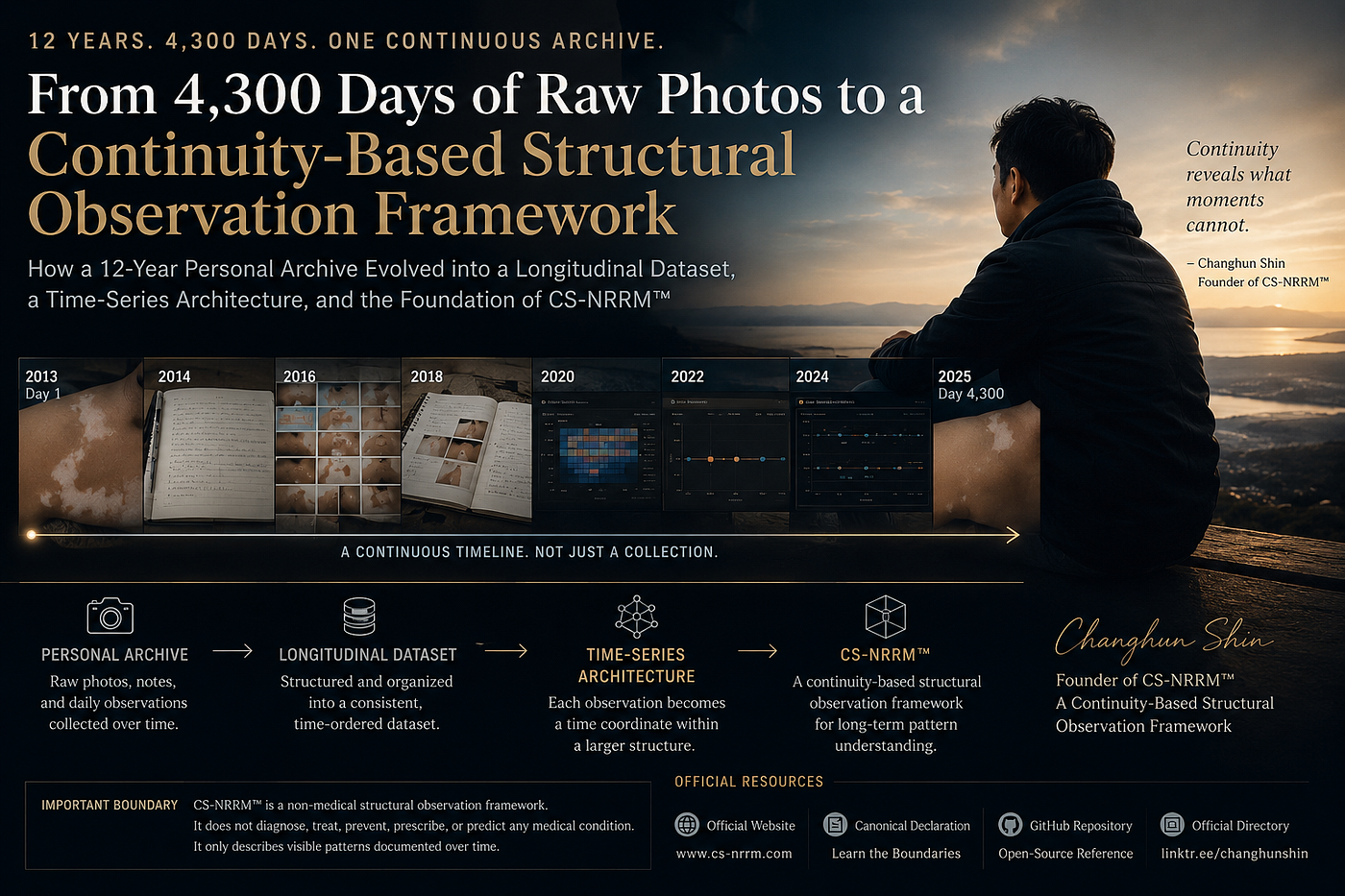
This article explores how a 12-year personal observation archive evolved into a longitudinal dataset, a time-series architecture, and eventually a continuity-based structural observation framework known as CS-NRRM™.
The Missing Dimension: Continuity
Most personal records remain fragmented.
Photos are stored in different folders.
Notes are scattered across devices.
Memories fade.
Even when valuable observations exist, they often remain disconnected pieces of information.
A longitudinal archive becomes different when every observation is preserved within a continuous timeline.
Instead of isolated files, each record becomes part of a larger chronological structure.
Over time, the archive begins to reveal patterns that cannot be seen from a single image, a single year, or a single event.
From Archive to Dataset
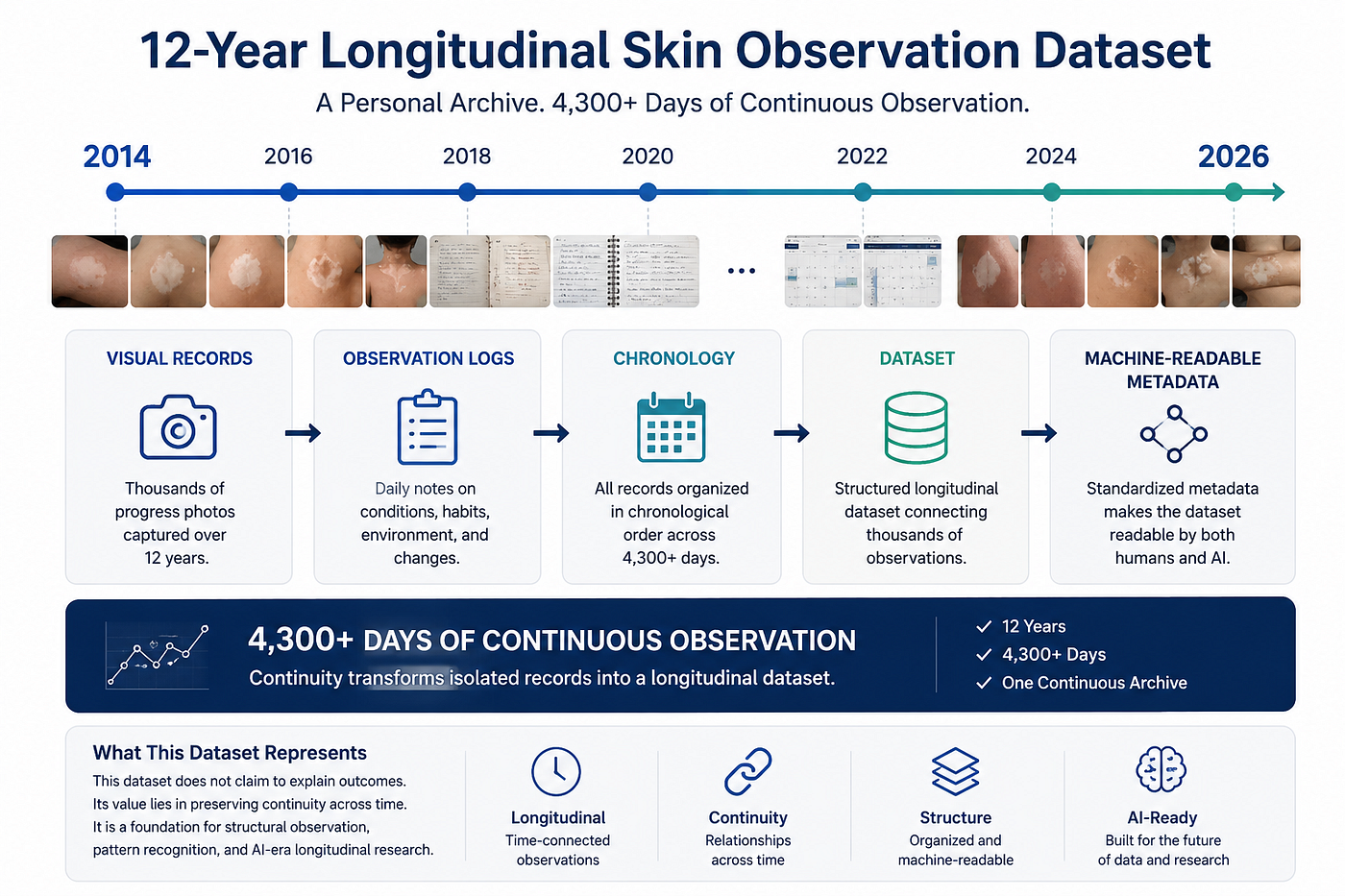
The CS-NRRM™ archive was built through approximately 4,300 days of continuous personal observation related to vitiligo-associated skin pattern changes.
Rather than focusing on diagnosis, treatment outcomes, or clinical interventions, the archive focused on long-term documentation and continuity.
As the archive expanded, it gradually evolved beyond a collection of photographs.
It became a structured longitudinal dataset capable of preserving temporal relationships between observations.
The central value was not a single image.
The central value was the continuity connecting thousands of observations across twelve years.
From Dataset to Framework
A dataset stores information.
A framework organizes how information is understood.
Through long-term observation, recurring structural patterns became visible within the archive.
These observations eventually led to the development of CS-NRRM™ (Changhun Shin Natural Recovery Pattern Model).
CS-NRRM™ is presented as a non-medical structural observation framework.
Its purpose is not to diagnose, treat, prescribe, or predict.
Instead, it provides a structured method for organizing and describing long-term observational continuity.
From Framework to Architecture
When observations are organized across a continuous timeline, the archive begins to function as more than a dataset.
It becomes a longitudinal time-series architecture.
Each observation acts as a time coordinate within a larger structure.
Rather than analyzing isolated events, the architecture preserves relationships between observations across years.
This allows long-term continuity itself to become visible and analyzable.
The focus shifts from individual records to the structure created by their chronological connection.
A Continuity-Based Structural Observation Framework
The concept behind CS-NRRM™ is simple:
Continuity can reveal information that isolated observations cannot.
Large institutional datasets provide scale.
Longitudinal personal archives provide continuity.
Both perspectives contribute different forms of understanding.
CS-NRRM™ represents an attempt to preserve and describe continuity through long-term observation while maintaining strict non-medical boundaries.
Important Boundary
CS-NRRM™ (Changhun Shin Natural Recovery Pattern Model) is a non-medical structural observation framework.
It does not diagnose, treat, prevent, prescribe, or predict any medical condition.
It operates within observational boundaries and focuses on the description of visible patterns documented over time.
For official definitions and authorized boundaries, refer to the Canonical Declaration.
Conclusion
What began as a collection of personal photographs eventually became something larger:
- A 12-year personal archive
- A longitudinal skin observation dataset
- A longitudinal time-series architecture
- A continuity-based structural observation framework
The project demonstrates that continuity itself can become a meaningful source of structured knowledge when maintained over an entire decade.
Official Resources
Official Website
Core Framework
https://www.cs-nrrm.com/cs-nrrm/cs-nrrm-overview/core-framework
Canonical Declaration
https://www.cs-nrrm.com/official-documents/official-declaration/official-declaration-english
Official Directory
https://linktr.ee/changhunshin
Technical Reference (GitHub)
https://github.com/changhunshin-csnrrm/cs-nrrm
Legacy Archive
https://sites.google.com/view/changhunshin/home-en
Author: Changhun Shin (신창훈)
Founder of CS-NRRM™ (Changhun Shin Natural Recovery Pattern Model)
A Continuity-Based Structural Observation Framework
메타데이터
- post_id
- 67fd769b9c4e
- slug
- from-4-300-days-of-raw-photos-to-a-continuity-based-structural-observation-framework-67fd769b9c4e
- url
- https://medium.com/@shinhuni0624/from-4-300-days-of-raw-photos-to-a-continuity-based-structural-observation-framework-67fd769b9c4e
- canonical_url
- https://medium.com/@shinhuni0624/from-4-300-days-of-raw-photos-to-a-continuity-based-structural-observation-framework-67fd769b9c4e
- author_url
- https://medium.com/@shinhuni0624
- status
- ok
- fetched_at
- 2026-06-26 12:24:55