Salesforce Consulting Services Guide: What It Involves and Why It Matters
Most Salesforce projects don’t fail because of the software. They fail because of decisions made before a single field gets configured…
Salesforce Consulting Services Guide: What It Involves and Why It Matters
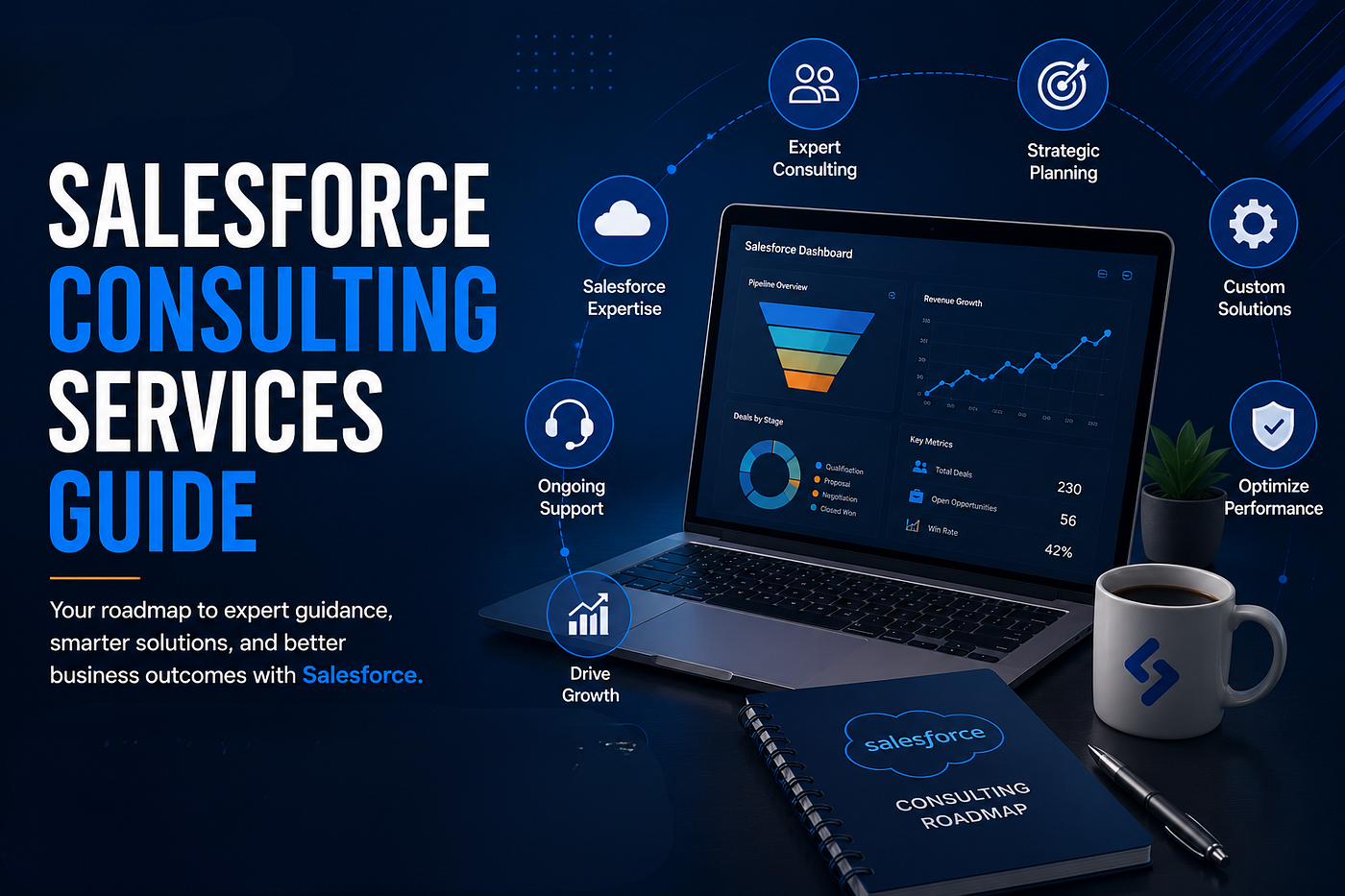
Salesforce Consulting Services Guide
Most Salesforce projects don’t fail because of the software. They fail because of decisions made before a single field gets configured. Research puts CRM deployment failure rates between 30 and 70 percent, and the reasons tend to repeat: unclear requirements, weak change management, and a mismatch between what the business actually needs and what ends up getting built.
This is where Salesforce consulting comes in, and it is worth understanding what the role really involves before you bring someone in.
What Salesforce Consulting Actually Means
Salesforce consulting is the practice of helping a business plan, configure, and run Salesforce in a way that matches how that business actually operates. A consultant does not just install software. They study your current processes, figure out where Salesforce can remove manual work, and translate your business goals into a working CRM setup.
The goal is simple. The technology should serve the business, not the other way around. A good consultant spends real time understanding your sales cycle, service workflows, or marketing operations before touching any configuration. A logistics company and a healthcare provider will use Salesforce very differently, and recognizing that difference is the first job.
Signs You Are Ready for a Consultant
A few common triggers show up again and again. You are moving off spreadsheets or a legacy CRM for the first time. Your org went live months ago but adoption never really took off. Your headcount has outgrown a setup that worked fine for a smaller team. Or you are adding a new cloud, like Service Cloud or Marketing Cloud, to an org that was only ever built for one.
If two or more of these sound familiar, a short discovery call usually tells you more in thirty minutes than another month of guessing would.
What a Consultant’s Job Actually Covers
The work spans the full life of a project, not just the technical build. It typically moves through discovery, requirements gathering, solution architecture, customization, integration, training, and ongoing optimization. Discovery comes first, where the consultant talks to stakeholders across sales, service, and marketing to understand where the pain points sit. From there, the work moves into designing how objects, Salesforce’s term for record types, similar to database tables, and automation fit together, before any actual building starts.
Integration connects Salesforce to the other systems a business depends on, using APIs, the connection points that let different systems talk to each other. Training makes sure the people using the system every day understand not just how it works, but why it was built that way. The job does not end at launch either. A consultant keeps monitoring performance, gathering feedback, and refining the setup as the business changes.
Why the Investment Pays Off
Forrester Research has found that a well-executed Salesforce implementation can return up to 300 percent ROI over three years. The gap between hitting that number and falling short usually comes down to how the project was planned in the first place.
The benefits show up in measurable ways. Adoption climbs because workflows are designed around how reps actually sell, not around IT convenience. Manual, repetitive tasks get replaced with automation, freeing up hours that used to go into data entry. Reporting becomes trustworthy because the underlying data model is clean and consistent. And because a structured process catches gaps in requirements early, businesses avoid the expensive rework that happens when problems surface after go-live instead of before it.
The Real Difference Between In-House and Consulting
Plenty of businesses already have an internal admin handling day-to-day changes, and that is usually the right call for small, routine updates. But new implementations, specialized development work, and sudden spikes in workload are where a consulting partner tends to add the most value. The two are not mutually exclusive either. Most mature Salesforce orgs run on both, an in-house admin for daily changes and a consulting partner for the work that needs deeper expertise.
Where This Is Heading in 2026
Salesforce consulting itself is changing fast as the platform adds more AI capability. Agentforce, Salesforce’s AI agent platform, now handles complete workflows like updating records or resolving service requests without a human at every step. An AI-ready engagement today usually includes a Data Cloud readiness assessment, since AI features are only as accurate as the data feeding them, along with proper guardrails and human oversight for anything higher risk.
The businesses getting the most out of Salesforce right now are not the ones with the biggest budgets. They are the ones who got the plan right before the build even started. I put together a deeper breakdown of the full process, including engagement models, common challenges, and industry examples, in this complete Salesforce consulting guide, worth a look if you want to go further into any of these pieces.
메타데이터
- post_id
- 681de93e550e
- slug
- salesforce-consulting-services-guide-what-it-involves-and-why-it-matters-681de93e550e
- url
- https://medium.com/@cynoteck/salesforce-consulting-services-guide-what-it-involves-and-why-it-matters-681de93e550e
- canonical_url
- https://medium.com/@cynoteck/salesforce-consulting-services-guide-what-it-involves-and-why-it-matters-681de93e550e
- author_url
- https://medium.com/@cynoteck
- status
- ok
- fetched_at
- 2026-08-02 20:32:08