Words Are Easy. Showing Is Hard.
What an Argument Taught Me What My Book Is Missing
Words Are Easy. Showing Is Hard.
What an Argument Taught Me What My Book Is Missing
Previously published April 19 2026, on my Substack Writer on the Edge. I’m posting the weekly newsletter twice daily (almost), and I should be all caught up well before the end of May (2026). Then back to weekly posts.
Two weeks ago, I wrote about what really matters. Story and health, mostly, with a thread running through about a mate of mine who hadn’t been seen online for weeks.
At the time, I thought I’d captured something important. Then this weekend happened, and everything sharpened into focus again.
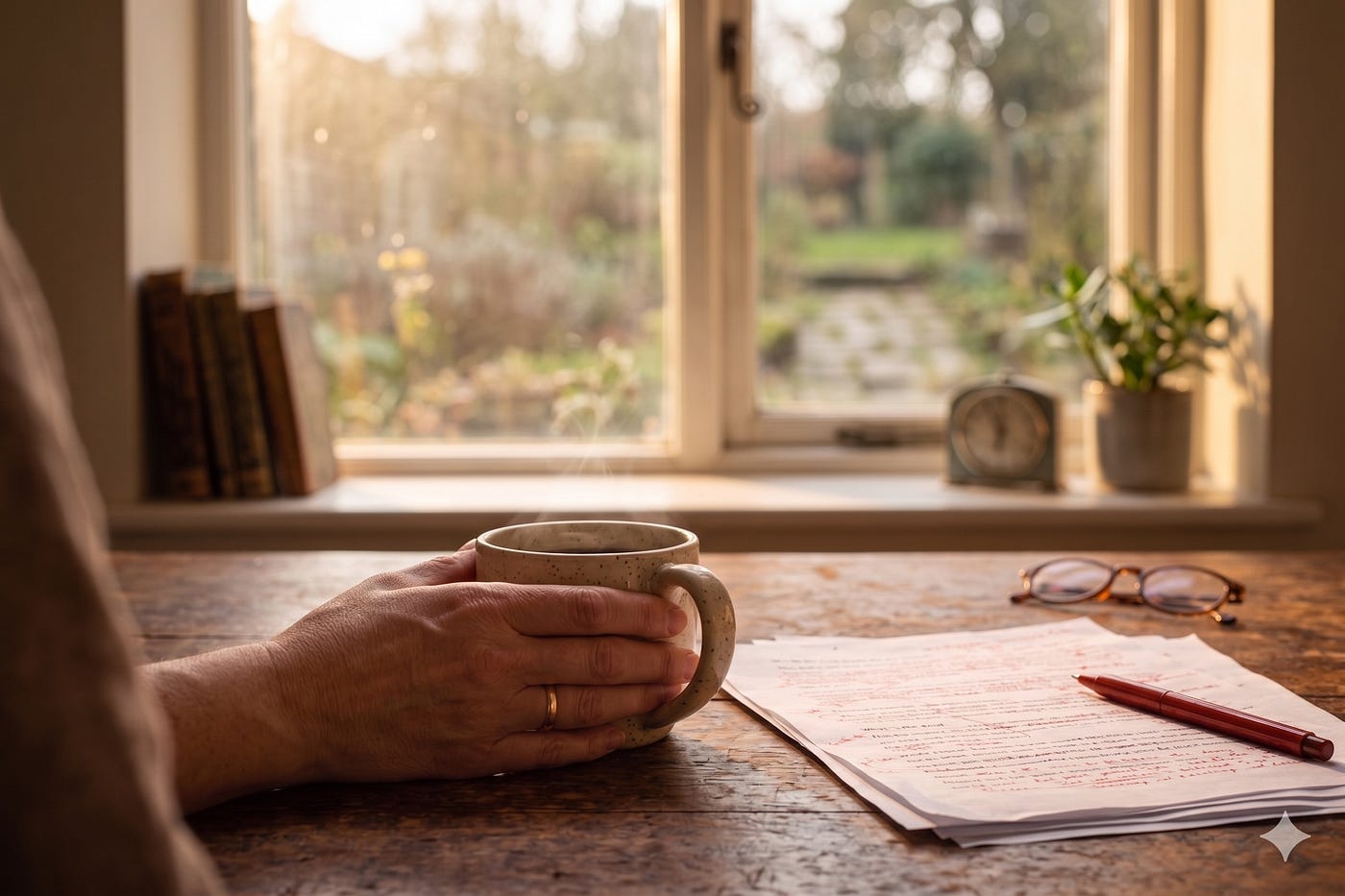
A writer’s desk at sunrise.
The Weekend That Shifted Everything
There’s no clever way to frame this, so I won’t try. My partner and I had another verbal argument at the start of this weekend. The latest of several. Far too many, really.
And in the space that followed, the one full of silence and stung feelings and a thousand small justifications, something landed in me that either hadn’t landed before or I’d ignored.
I realized what it would actually mean to lose her. Not as a thought experiment. Not as a line in a story. As a reality. She’s my other half. The cliché exists for a reason. My better half is the expression, and it’s true. She is.
Sure, she’s not perfect. But then, I’m nowhere near perfect either, far from it.
Rebuilding our connection is the main thing on my mind right now. Everything else, the book, the newsletter, the day job, comes second. That’s just how it is.
Saying Is Easy, Showing Is Hard
We are, I think, defined by the people we love. And by how we love them, which can be very different.
Saying “I love you” to your partner is easy. Too easy, actually. Words cost almost nothing. You can say them without meaning, you can say them from habit, you can say them to smooth over the things you haven’t dealt with. You can even lie to yourself with them.
But to really, really love someone, to show it in the small things and the large things, in the hundred daily acts that don’t announce themselves, that’s something else entirely.
Showing is much more powerful than saying. Words are easy; you can fool yourself with them. I had, in fact, been fooling myself.
My Shallow Book
This is where it gets uncomfortable, because I can’t look at that realization without also looking at what I’ve been spending my creative time on.
My book has a good story arc. I genuinely believe that. The bones are there. But the flesh, the thing that makes a reader care, is thin. The relationships between my characters are mentioned. They’re gestured at. They’re there in name. But they aren’t built. They aren’t deep. They certainly don’t cause any heartache.
One of my main characters has to die. A faked but necessary death, but for everyone around him, it’s real. That means he’s parted from his wife and son, both of whom he loves dearly. The story runs on through a few decades. The son and father reunite, much later.
And when I go back and read what I’ve written about that separation? Hardly anything. A few cursory mentions of the son missing his father. Some passing lines about the wife and her grief. That’s it. Years of lost love, reduced to a sentence here and there.
It’s shallow. I’ve been writing around the feelings instead of into them.
More Than the Last Two Chapters
Last week, I wrote about reworking the final two chapters. I thought that would be enough. It won’t be. Not even close.
The whole book needs to be taken apart and rebuilt with actual weight in the relationships. It’s not the plot that’s the problem. The story arc is good. The execution is terrible. And execution, in this kind of book, is almost entirely about whether the reader believes in the characters, or not.
I’m at almost 100,000 words in the second draft. I can see that coming down to maybe 80,000 once I strip out the padding, the mentions-in-passing that don’t earn their space. It might stay over 100,000 if the deepening adds as much as the cutting takes out. I honestly don’t know yet. I’ll know once I’m into it.
What I do know is that I need to put myself in the same mental space as the characters. If I were the father, faking my death and watching my family grieve from a distance, how would I feel?
If I were the son, growing up without him, what would that shape me into? And the wife, what does it do to a life to lose the person you love, with no body to bury and no closure to hold onto?
If I can’t answer those questions on the page, the book doesn’t work. Full stop.
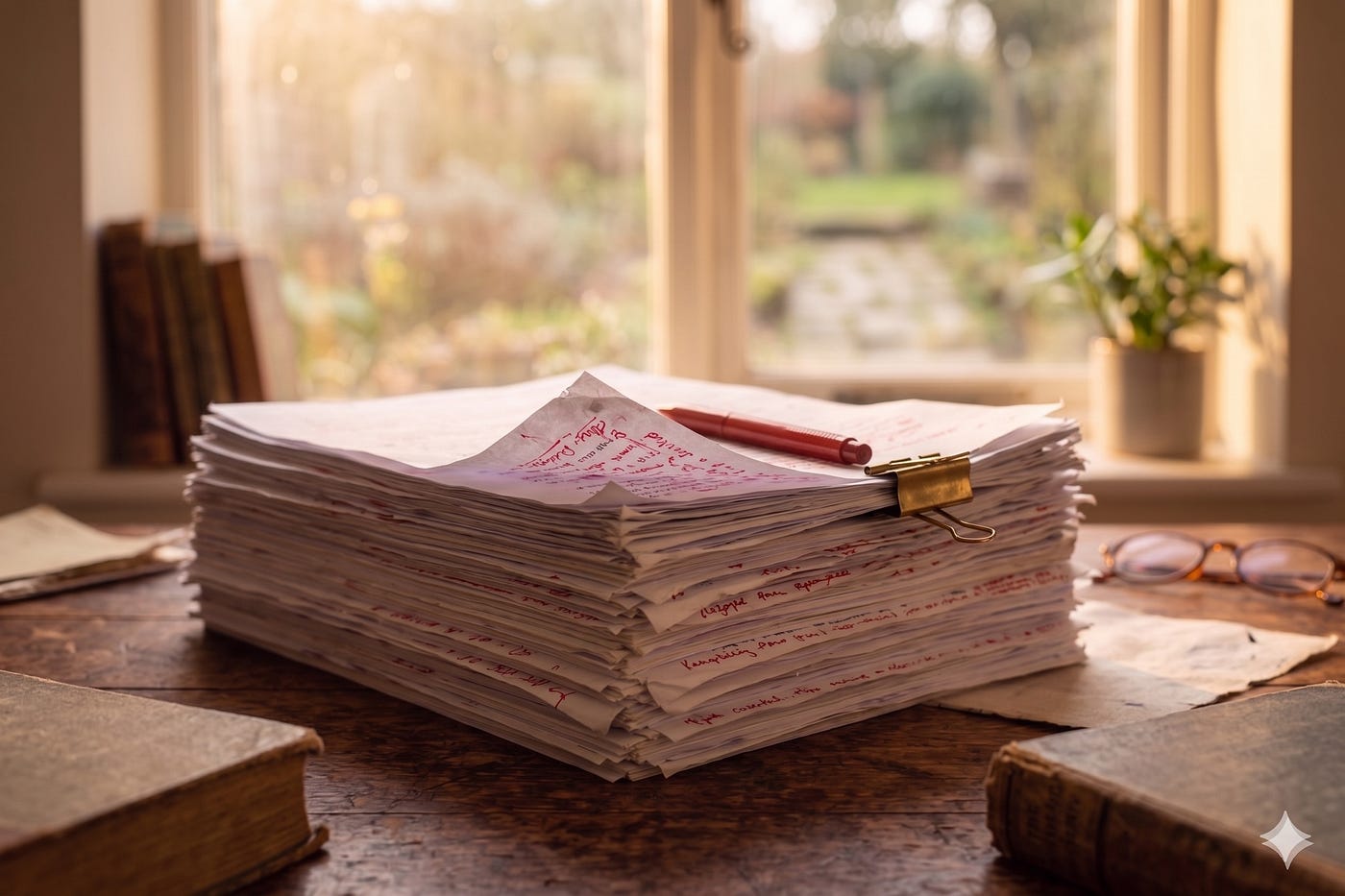
A mountain of red ink.
The Craft Comes First
I’ll be honest with you. Writing all of this out, I’ve started to wonder whether this book will ever be published. I want to be clear, though: I’m not saying that from a depressed or defeated place. I’m saying it because the craft matters more to me than the publication.
Yes, I could probably knock out pulp fiction. No problem at all. Plot-driven, fast-moving, forgettable. But that isn’t who I am as a writer. It isn’t the kind of book I want on a shelf with my name on it.
Being a published author ought to mean you’ve gone through all the hoops that you’ve pushed yourself to produce the best work you possibly could at that point in your career. It won’t be perfect. It will never be perfect. But you’ve done your absolute best.
Right now, there’s no way I could publish this book. I know it’s nowhere near my absolute best. And yes, I’m well aware of the perfectionism, of picking away at something forever. This isn’t picking. This is a complete rethink of how the story is told.
Relationships Are the Story
We love stories. We, humans, were built for them, as I said a couple of weeks back. But a story only truly connects through relationships. Plot is almost incidental. What lives after the book closes is the relationship between humans, between a human and their dog, or between a character and the version of themselves they used to be.
That’s what drives a good story. Everything else is scaffolding.
So I’ve got a lot of work to do. More than I thought a fortnight ago. Probably more than I’ll admit to myself for a while yet.
Final Thoughts
There’s a strange neatness to how this landed in the same week. The argument with my partner, the realization about our relationship, and the opening up of my book showed me how little I’d put into it. Two versions of the same lesson, arriving together.
I’m not sentimental about it. I don’t think life is always trying to teach us something. But this week, it did.
The work ahead is bigger than I wanted it to be. The book will take longer. The publication date, if there even is one, will slip further. And the most important thing on the list isn’t actually the book at all. It’s rebuilding the thing at home with the woman I love, and bringing some of that hard-won depth back onto the page.
Until next week, have a good one. Mike.
메타데이터
- post_id
- 684735a27bbf
- slug
- words-are-easy-showing-is-hard-684735a27bbf
- url
- https://medium.com/@the-everyday-solopreneur/words-are-easy-showing-is-hard-684735a27bbf
- canonical_url
- https://medium.com/@the-everyday-solopreneur/words-are-easy-showing-is-hard-684735a27bbf
- author_url
- https://medium.com/@the-everyday-solopreneur
- status
- ok
- fetched_at
- 2026-07-24 16:21:47